eBook - PDF
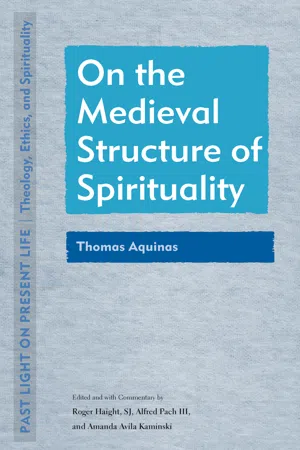
On the Medieval Structure of Spirituality
Thomas Aquinas
- 125 pages
- English
- PDF
- Available on iOS & Android
eBook - PDF
On the Medieval Structure of Spirituality
Thomas Aquinas
About this book
If Thomas Aquinas was born in 1225, as is commonly thought, then he died before reaching the age of fifty after producing the single most influential systematic theology of the Western Christian tradition. He did this with a formula: He internalized the thought of Aristotle as it was being introduced into western Europe and translated into Latin, and he in turn "translated" Christianity into this Aristotelian language. One can use the principles of hermeneutics outlined in Retrieving the Spiritual Teaching of Jesus of this series to analyze what was going on as Aquinas went through some of the basic doctrines of the Church in his Summa Theologiae. He laid out their contents by answering an exhaustive series of questions and responding to each of them in intricate detail. The model for each question and answer was drawn directly from the pattern of learning at the University of Paris. Although systematic and abstract, it also enabled an extensive conversation with the tradition of classical theologians and his own contemporaries. This may seem quite distant from spiritual life on the ground, but the method produced a clear understanding of the structure of spiritual life in terms of its goal and the means of attaining it. Aquinas's analysis of grace—how it enabled genuine Christian spirituality, empowered the virtues, and led to eternal life—constitutes a classic substructure of Western Christian spirituality that became all the more distinctive when Reformation spiritualities offered alternatives to it.
Information
Table of contents
- Cover
- Series Editor
- Title Page
- Copyright
- Contents
- I – Introduction to Thomas Aquinas and the Texts
- II – The Texts
- III – Retrieving Aquinas for Christian Life Today
- Further Reading
- About the Series
- About the Editors
- Series
Trusted by 375,005 students
Access to over 1.5 million titles for a fair monthly price.
Study more efficiently using our study tools.
Frequently asked questions
Yes, you can cancel anytime from the Subscription tab in your account settings on the Perlego website. Your subscription will stay active until the end of your current billing period. Learn how to cancel your subscription
No, books cannot be downloaded as external files, such as PDFs, for use outside of Perlego. However, you can download books within the Perlego app for offline reading on mobile or tablet. Learn how to download books offline
Perlego offers two plans: Essential and Complete
- Essential is ideal for learners and professionals who enjoy exploring a wide range of subjects. Access the Essential Library with 800,000+ trusted titles and best-sellers across business, personal growth, and the humanities. Includes unlimited reading time and Standard Read Aloud voice.
- Complete: Perfect for advanced learners and researchers needing full, unrestricted access. Unlock 1.5M+ books across hundreds of subjects, including academic and specialized titles. The Complete Plan also includes advanced features like Premium Read Aloud and Research Assistant.
We are an online textbook subscription service, where you can get access to an entire online library for less than the price of a single book per month. With over 1.5 million books across 990+ topics, we’ve got you covered! Learn about our mission
Look out for the read-aloud symbol on your next book to see if you can listen to it. The read-aloud tool reads text aloud for you, highlighting the text as it is being read. You can pause it, speed it up and slow it down. Learn more about Read Aloud
Yes! You can use the Perlego app on both iOS and Android devices to read anytime, anywhere — even offline. Perfect for commutes or when you’re on the go.
Please note we cannot support devices running on iOS 13 and Android 7 or earlier. Learn more about using the app
Please note we cannot support devices running on iOS 13 and Android 7 or earlier. Learn more about using the app
Yes, you can access On the Medieval Structure of Spirituality by Roger Haight, Alfred Pach, Amanda Avila Kaminski, Roger Haight,Alfred Pach,Amanda Avila Kaminski in PDF and/or ePUB format, as well as other popular books in Theology & Religion & Christian Theology. We have over 1.5 million books available in our catalogue for you to explore.