- 291 pages
- English
- PDF
- Available on iOS & Android
eBook - PDF
About this book
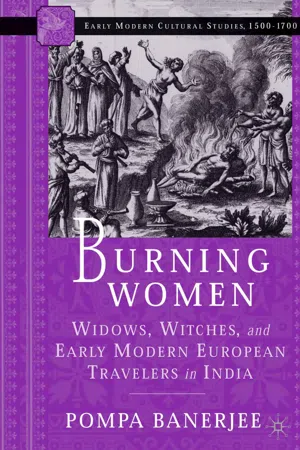
In early modern Europe, the circulation of visual and verbal transmissions of sati, or Hindu widow burning, not only informed responses to the ritualized violence of Hindu culture, but also intersected in fascinating ways with specifically European forms of ritualized violence and European constructions of gender ideology. European accounts of women being burned in India uncannily commented on the burnings of women as witches and criminal wives in Europe. When Europeans narrated their accounts of sati, perhaps the most striking illustration of Hindu patriarchal violence, they did not specifically connect the act of widow burning to a corresponding European signifier: the gruesome ceremonial burnings of women as witches. In examining early modern representations of sati, the book focuses specifically on those strategies that enabled European travellers to protect their own identity as uniquely civilized amidst spectacular displays of 'Eastern barbarity'.
Information
Topic
LetteraturaSubtopic
Critica letterariaTable of contents
- Cover
- Half-Title
- Title
- Copyright
- Dedication
- Contents
- Acknowledgments
- Series Editor’s Foreword
- List of Illustrations
- Introduction
- 1. Overlapping Discourses:Widows,Witches, and Forms of Literary Haunting
- 2. Under Western Eyes: Sati and Witches in European Representations
- 3. Instructions for Christian Women:The Sati and European Widows
- 4. Disorderly Wives, Poison, and the Iconography of Female Murderers
- 5. Civility and “Dying” to Speak: Sati, the Fetish, and History
- Chronological Chart of Indian Voyages of Early Modern European Travelers (cited in this book) who wrote about Sati
- Notes
- Bibliography of Indian Travel Narratives cited in this book
- Bibliography
- Index
Trusted by 375,005 students
Access to over 1.5 million titles for a fair monthly price.
Study more efficiently using our study tools.
Frequently asked questions
Yes, you can cancel anytime from the Subscription tab in your account settings on the Perlego website. Your subscription will stay active until the end of your current billing period. Learn how to cancel your subscription
No, books cannot be downloaded as external files, such as PDFs, for use outside of Perlego. However, you can download books within the Perlego app for offline reading on mobile or tablet. Learn how to download books offline
Perlego offers two plans: Essential and Complete
- Essential is ideal for learners and professionals who enjoy exploring a wide range of subjects. Access the Essential Library with 800,000+ trusted titles and best-sellers across business, personal growth, and the humanities. Includes unlimited reading time and Standard Read Aloud voice.
- Complete: Perfect for advanced learners and researchers needing full, unrestricted access. Unlock 1.5M+ books across hundreds of subjects, including academic and specialized titles. The Complete Plan also includes advanced features like Premium Read Aloud and Research Assistant.
We are an online textbook subscription service, where you can get access to an entire online library for less than the price of a single book per month. With over 1.5 million books across 990+ topics, we’ve got you covered! Learn about our mission
Look out for the read-aloud symbol on your next book to see if you can listen to it. The read-aloud tool reads text aloud for you, highlighting the text as it is being read. You can pause it, speed it up and slow it down. Learn more about Read Aloud
Yes! You can use the Perlego app on both iOS and Android devices to read anytime, anywhere — even offline. Perfect for commutes or when you’re on the go.
Please note we cannot support devices running on iOS 13 and Android 7 or earlier. Learn more about using the app
Please note we cannot support devices running on iOS 13 and Android 7 or earlier. Learn more about using the app
Yes, you can access Burning Women by P. Banerjee in PDF and/or ePUB format, as well as other popular books in Letteratura & Critica letteraria. We have over 1.5 million books available in our catalogue for you to explore.