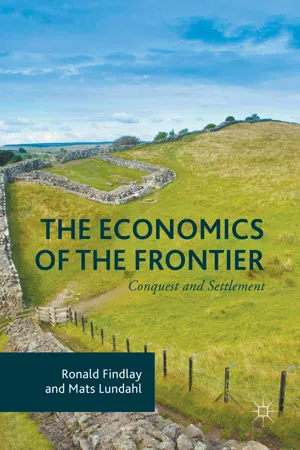
This book deals with the economics of establishing a frontier by conquest or by peaceful settlement, the costs involved, and the optimum extension of the territory. The opening chapters discuss the most relevant literature about frontiers – conceptual, theoretical and empirical – and introduce the fundamental theoretical model for extending frontiers which is drawn on throughout the book. The authors use this theoretical apparatus by applying it to a number of historical cases. These include the division of the European territory between the Byzantine Empire, Islam and Western Europe, the creation and expansion of the Mongol Empire, the impact of the Black Death, the European discovery of the New World, the staples trade from 1870–1914, and the rise and fall of banditry in Brazil. The Economics of the Frontier brings together a collection of essays which explore how economically optimal frontiers were founded from sixth-century Europe through to twentieth-century Brazil.
- 457 pages
- English
- PDF
- Available on iOS & Android
eBook - PDF
About this book
Information
Topic
EconomiaSubtopic
Business generaleTable of contents
- Dedication
- Preface
- Contents
- List of Sources
- List of Figures
- 1: Introduction: Frontiers and Empires
- 2: Frontiers and Empires in Historical Perspective
- 3: Modeling Global Interdependence: Centers, Peripheries and Frontiers
- 4: Towards a Model of Territorial Expansion and the Limits of Empire
- 5: Demographic Shocks and the Factor Proportions Model: From the Plague of Justinian to the Black Death
- 6: The First Globalization Episode: The Creation of the Mongol Empire, or the Economics of Chinggis Khan
- 7: Towards a Factor Proportions Approach to Economic History: Population, Precious Metals and Prices from the Black Death to the Price Revolution
- 8: International Trade and Factor Mobility with an Endogenous Land Frontier: Some General Equilibrium Implications of Christopher Columbus
- 9: Natural Resources, ‘Vent-for-Surplus’ and the Staples Theory
- 10: Resource-Led Growth—A Long-Term Perspective: The Relevance of the 1870–1914 Experience for Today’s Developing Economies
- 11: Lampião and the Colonels: On the Political Economy of Banditry
- Epilogue: Frontiers—Theory and History
- Index
Trusted by 375,005 students
Access to over 1.5 million titles for a fair monthly price.
Study more efficiently using our study tools.
Frequently asked questions
Yes, you can cancel anytime from the Subscription tab in your account settings on the Perlego website. Your subscription will stay active until the end of your current billing period. Learn how to cancel your subscription
No, books cannot be downloaded as external files, such as PDFs, for use outside of Perlego. However, you can download books within the Perlego app for offline reading on mobile or tablet. Learn how to download books offline
Perlego offers two plans: Essential and Complete
- Essential is ideal for learners and professionals who enjoy exploring a wide range of subjects. Access the Essential Library with 800,000+ trusted titles and best-sellers across business, personal growth, and the humanities. Includes unlimited reading time and Standard Read Aloud voice.
- Complete: Perfect for advanced learners and researchers needing full, unrestricted access. Unlock 1.5M+ books across hundreds of subjects, including academic and specialized titles. The Complete Plan also includes advanced features like Premium Read Aloud and Research Assistant.
We are an online textbook subscription service, where you can get access to an entire online library for less than the price of a single book per month. With over 1.5 million books across 990+ topics, we’ve got you covered! Learn about our mission
Look out for the read-aloud symbol on your next book to see if you can listen to it. The read-aloud tool reads text aloud for you, highlighting the text as it is being read. You can pause it, speed it up and slow it down. Learn more about Read Aloud
Yes! You can use the Perlego app on both iOS and Android devices to read anytime, anywhere — even offline. Perfect for commutes or when you’re on the go.
Please note we cannot support devices running on iOS 13 and Android 7 or earlier. Learn more about using the app
Please note we cannot support devices running on iOS 13 and Android 7 or earlier. Learn more about using the app
Yes, you can access The Economics of the Frontier by Ronald Findlay,Mats Lundahl in PDF and/or ePUB format, as well as other popular books in Economia & Business generale. We have over 1.5 million books available in our catalogue for you to explore.