- 263 pages
- English
- PDF
- Available on iOS & Android
eBook - PDF
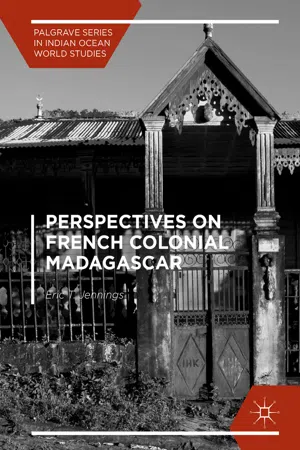
Perspectives on French Colonial Madagascar
About this book
This book provides new insight into French colonial Madagascar. The work is structured along three main lines: health and domination, the two world wars, and the mystery of Malagasy origins. The three parts are preceded by short introductions. The book showcases some of Madagascar's defining yet often neglected features within the French colonial realm. Its conquest at the end of the nineteenth century's scramble for Africa was notable for the way it shattered the island's reputation for healthfulness. Its colonization coincided with a growing French need for troops in the buildup to military conflict in Europe. Lastly, the origin of the island's people continued to both baffle and fascinate French colonial experts, be they ethnographers, linguists or historians, from the beginning to the end of the colonial period (1896-1960). Together, then, this book probes the relationship between domination and health fears, the island's role during the two world wars, and its enduring fascination as a site that could never be neatly categorized as either African or Asian. The net result will be to underscore both the scope of the colonial project in Madagascar, and the obstacles and limits that it encountered.
Information
Subtopic
African HistoryIndex
HistoryTable of contents
- Acknowledgements
- Note on Place Names
- Contents
- List of Figures
- Chapter 1 Introduction
- Part I Health, Power and Vulnerability
- Chapter 2 Disease and Conquest
- Chapter 3 Rabies and Resistance
- Part II The Great Island in Global Conflict, 1914–1945
- Chapter 4 The Black Angel of Antananarivo
- Chapter 5 Tyranny in the Wartime Central Highlands
- Part III The Mystery of Malagasy Origins
- Chapter 6 Writing Madagascar Back into the Madagascar Plan
- Chapter 7 Recasting Madagascar: Village Structures, Racial Anthropology, and the Meanings of Cliff Markings
- Conclusion
- Appendix
- Bibliography
- Index
Trusted by 375,005 students
Access to over 1.5 million titles for a fair monthly price.
Study more efficiently using our study tools.
Frequently asked questions
Yes, you can cancel anytime from the Subscription tab in your account settings on the Perlego website. Your subscription will stay active until the end of your current billing period. Learn how to cancel your subscription
No, books cannot be downloaded as external files, such as PDFs, for use outside of Perlego. However, you can download books within the Perlego app for offline reading on mobile or tablet. Learn how to download books offline
Perlego offers two plans: Essential and Complete
- Essential is ideal for learners and professionals who enjoy exploring a wide range of subjects. Access the Essential Library with 800,000+ trusted titles and best-sellers across business, personal growth, and the humanities. Includes unlimited reading time and Standard Read Aloud voice.
- Complete: Perfect for advanced learners and researchers needing full, unrestricted access. Unlock 1.5M+ books across hundreds of subjects, including academic and specialized titles. The Complete Plan also includes advanced features like Premium Read Aloud and Research Assistant.
We are an online textbook subscription service, where you can get access to an entire online library for less than the price of a single book per month. With over 1.5 million books across 990+ topics, we’ve got you covered! Learn about our mission
Look out for the read-aloud symbol on your next book to see if you can listen to it. The read-aloud tool reads text aloud for you, highlighting the text as it is being read. You can pause it, speed it up and slow it down. Learn more about Read Aloud
Yes! You can use the Perlego app on both iOS and Android devices to read anytime, anywhere — even offline. Perfect for commutes or when you’re on the go.
Please note we cannot support devices running on iOS 13 and Android 7 or earlier. Learn more about using the app
Please note we cannot support devices running on iOS 13 and Android 7 or earlier. Learn more about using the app
Yes, you can access Perspectives on French Colonial Madagascar by Eric T. Jennings in PDF and/or ePUB format, as well as other popular books in History & African History. We have over 1.5 million books available in our catalogue for you to explore.