- 291 pages
- English
- PDF
- Available on iOS & Android
eBook - PDF
About this book
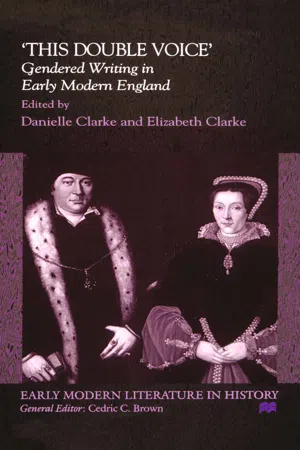
The Double Voice reassesses the notions of gender which have been used to analyze Renaissance literature. Rather than assuming that men and women write differently because of background, education, and culture, it tries to unsettle the connections between the sex of the author and the constructions of gender in texts, and to reconsider the prevalent determinist model of reading which tends to consign women writers to the private, domestic sphere and to render male negotiations of gender invisible and transparent.
Information
Print ISBN
9780312232207
Table of contents
- Cover
- Title
- Copyright
- Contents
- Notes on the Contributors
- Acknowledgements
- Introduction
- 1 Female Authority and Authorization Strategies in Early Modern Europe
- 2 'In a mirrour clere': Protestantism and Politics in Anne Lok's Miserere mei Deus
- 3 'Formd into words by your divided lips': Women, Rhetoric and the Ovidian Tradition
- 4 The Voices of Anne Cooke, Lady Anne and Lady Bacon
- 5 Old Wives' Tales Retold: the Mutations of the Fairy Queen
- 6 Giving Time to Women: the Eternizing Project in Early Modern England
- 7 The 'Double Voice' of Renaissance Equity and the Literary Voices of Women
- 8 'For Worth, Not Weakness, Makes in Use but One': Literary Dialogues in an English Renaissance Family
- 9 'Whom the Lord with love affecteth': Gender and the Religious Poet, 1590-1633
- 10 Ejaculation or Virgin Birth? The Gendering of the Religious Lyric in the Interregnum
- 11 Unfettered Organs: the Polemical Voices of Katherine Philips
- 12 A Voice for Hermaphroditical Education
- Index
Trusted by 375,005 students
Access to over 1.5 million titles for a fair monthly price.
Study more efficiently using our study tools.