- 298 pages
- English
- PDF
- Available on iOS & Android
eBook - PDF
About this book
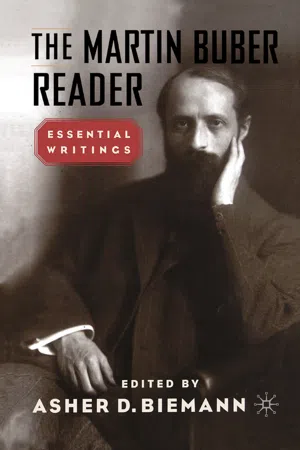
Martin Buber was professor of the history of religions and Jewish religion & ethics from 1923 to 1933 at the University of Frankfurt. He resigned in 1933, after Hitler came to power, and immigrated to Israel where he taught at the Hebrew University in Jerusalem. Buber wrote numerous books during his lifetime (1878-1965) and is best known for I and Thou and Good and Evil. His philosophy of dialogue-that is, the 'I-Thou' relationship which affirms each individual as being of unique value-is extremely well-known and has influenced important Protestant theologians like Karl Barth, Emil Brunner, Paul Tillich, and Reinhold Niebuhr. There is truly no genuine understanding of contemporary Jewish and Christian theology without reference to Martin Buber. His appeal is vast - not only is he renowned for his translations of the Old Testament but also for his interpretation of Hasidism, his role in Zionism, and his writings in both psychotherapy and political philosophy.
Information
Topic
FilosofíaSubtopic
Historia y teoría filosóficasTable of contents
- Cover
- Half-Title
- Title
- Copyright
- Contents
- Introduction
- Part I Bible
- Part II Hasidism
- Part III Judaism and Jewish Religiosity
- Part IV Dialogue and Anthropology
- Part V Philosophy and Religion
- Part VI Community
- Part VII Zionism and Nationalism
- Bibliographical Guide
- Index
Trusted by 375,005 students
Access to over 1.5 million titles for a fair monthly price.
Study more efficiently using our study tools.
Frequently asked questions
Yes, you can cancel anytime from the Subscription tab in your account settings on the Perlego website. Your subscription will stay active until the end of your current billing period. Learn how to cancel your subscription
No, books cannot be downloaded as external files, such as PDFs, for use outside of Perlego. However, you can download books within the Perlego app for offline reading on mobile or tablet. Learn how to download books offline
Perlego offers two plans: Essential and Complete
- Essential is ideal for learners and professionals who enjoy exploring a wide range of subjects. Access the Essential Library with 800,000+ trusted titles and best-sellers across business, personal growth, and the humanities. Includes unlimited reading time and Standard Read Aloud voice.
- Complete: Perfect for advanced learners and researchers needing full, unrestricted access. Unlock 1.5M+ books across hundreds of subjects, including academic and specialized titles. The Complete Plan also includes advanced features like Premium Read Aloud and Research Assistant.
We are an online textbook subscription service, where you can get access to an entire online library for less than the price of a single book per month. With over 1.5 million books across 990+ topics, we’ve got you covered! Learn about our mission
Look out for the read-aloud symbol on your next book to see if you can listen to it. The read-aloud tool reads text aloud for you, highlighting the text as it is being read. You can pause it, speed it up and slow it down. Learn more about Read Aloud
Yes! You can use the Perlego app on both iOS and Android devices to read anytime, anywhere — even offline. Perfect for commutes or when you’re on the go.
Please note we cannot support devices running on iOS 13 and Android 7 or earlier. Learn more about using the app
Please note we cannot support devices running on iOS 13 and Android 7 or earlier. Learn more about using the app
Yes, you can access The Martin Buber Reader by A. Biemann in PDF and/or ePUB format, as well as other popular books in Filosofía & Historia y teoría filosóficas. We have over 1.5 million books available in our catalogue for you to explore.