Nitric Oxide in Plants
eBook - ePub

Nitric Oxide in Plants

A Molecule with Dual Roles

  1. English
  2. ePUB (mobile friendly)
  3. Available on iOS & Android
eBook - ePub

Nitric Oxide in Plants

A Molecule with Dual Roles

About this book

ORGANIC REACTIONS

Examines the beneficial roles of nitric oxide in growth and stress tolerance regulation through its involvement in tolerance mechanisms

Studies have identified the central role of nitric oxide in stress mitigation through the modulation of physiological and biochemical pathways including germination, photosynthesis regulation, and programmed cell death. Nitric Oxide in Plants: A Molecule with Dual Roles provides a detailed account of the physio-biochemical, molecular, and omic basis of NO-mediated responses in crop plants under different stresses.

Summarizing recent work from leading researchers in the field, this up-to-date volume presents the current understanding of the modulation of the endogenous nitric oxide concentration following exogenous treatments and nitric oxide scavengers or inhibitors. The contributors discuss topics such as NO-mediated regulation of growth, photosynthesis, and tolerance mechanisms, the reductive and oxidative pathways of NO synthesis, molecular interventions for enhancing NO synthesis, the role of nitrogen in production of NO, beneficial microbes in NO production under normal and changing environmental conditions, and more.

  • Includes an overview of the biosynthesis and regulation of NO synthesis in plants
  • Describes the enzymatic and non-enzymatic biosynthesis of NO and the influence of different stress factors on NO synthesis
  • Explores the role of reactive oxygen, sulphur, and nitrogen species in stress signaling
  • Discusses endogenous and exogenous NO in modifying the ascorbate-glutathione cycle
  • Explains the crosstalk mechanisms underlying NO and phytohormones, including auxins, cytokinins, abscisic acid, and ethylene

Nitric Oxide in Plants: A Molecule with Dual Roles is an essential resource for academics, students, and industry professionals studying the role of nitric oxide in environmental stress tolerance and its interaction with key signaling molecules.

Information

Publisher
Wiley
Year
2022
Print ISBN
9781119800125
Edition
1
eBook ISBN
9781119800149

1
Nitric Oxide: A Dynamic Signaling Molecule Under Plant Stress

Asha Kumari1, Binny Sharma2, Bansh Narayan Singh2, and Padmanabh Dwivedi2
1ICAR-Vivekananda Parvatiya Krishi Anusandhan Sansthan, Almora, Uttarakhand, India
2Department of Plant Physiology, Institute of Agricultural Sciences, Banaras Hindu University, Varanasi, Uttar Pradesh, India

1.1 Introduction

Nitrogen monoxide, often known as nitric oxide, is a physiologically active chemical that is widely used in animal and plant signaling mechanisms. In plants and animals, it is an intracellular and intercellular signaling molecule with a variety of regulatory roles. Its functions in the central nervous, cardiovascular, and immunological systems, platelet inhibition, programmed cell death, and host responses to infection, among other things, have been widely studied in animals.
Because of the presence of an unpaired electron, it is a highly reactive gaseous molecule that occurs with oxygen in a variety of reduced states such as nitroxyl ion (NOāˆ’), nitric oxide free radical (NO•), and nitrosonium (NO+). These NO-derived molecules are referred to as reactive nitrogen species (RNS). NO influences signaling in biological systems through a variety of mechanisms. The interaction of NO• with O2 results in the formation of several redox compounds (including NO2•, N2O3, and N2O4), which may react with cellular amines and thiols or simply change to form the metabolites nitrogen dioxide radical (NO2āˆ’) and nitrate (NO3āˆ’) (Wendehenne et al. 2001). NO combines with dioxygen to form NO2 or with reactive oxygen species (ROS) to form peroxynitrite (ONOOāˆ’), which triggers cellular damage. NO• facilitates electrophilic assault on reactive sulfur, oxygen, nitrogen, and aromatic carbon centers, with thiols being the most reactive of the reactive teams. Nitrosation is the name given to this natural process. Nitrosation of numerous enzymes or proteins results in chemical change, which may affect the function of those entities. These alterations are reversible, and supermolecule nitrosation–denitrosation might be a crucial mechanism for controlling signal transduction (Hayat et al. 2010).
In contrast to the mammalian system, the cellular/subcellular localization of NO production in plants is exceedingly diverse and contentious. The production of NO in plants is determined by the plant’s physiological condition. This includes NO production during root development, stomatal movement control, blooming, plant component expansion, and leaf senescence (Neill et al. 2002; Mishina et al. 2007). NO is produced in plants through nonenzymatic and accelerator systems, depending on the plant species, organ, or tissue, as well as the plant’s state and ever-changing environmental circumstances. The most effective recognized NO sources in plants are as a substrate by cytosolic (cNR) and membrane-specific nitrate enzyme (PM-NR), and NO synthesis by many arginine-dependent gas synthase-like activities (NOS).
According to studies, mitochondria are a major source of arginine- and nitrite-dependent NO synthesis in plants. Tischner et al. acquired the first evidence for mitochondrial NO synthesis in plants when they assessed NO production under anoxic conditions from the unicellular blue green alga Chlorella sorokiniana (Tischner et al. 2004). This green alga does not create NO when exposed to nitrate (NO3), but it does create NO when exposed to nitrite (NO2). NO generation was also inhibited by mitochondrial electron transport inhibitors. Shortly after, mitochondrial NO synthesis in higher plants was discovered. Gupta et al. discovered mitochondrial NO production in barley plants grown in anoxic conditions (Gupta and Kaiser 2010). Under anoxic circumstances, a tobacco Nia 1, 2 (nitrate reductase-deficient) cell suspension was able to manufacture NO from exogenous nitrite, despite the absence of nitrate reductase (which can also manufacture NO from nitrite) (Gupta et al. 2011). Other putative NO producers in plants include xanthine oxido-reductase, peroxidase, and cytochrome P450. NO is a ubiquitous chemical that is found in all eukaryotes. The NR system is by far the most effective and well-characterized mechanism for NO generation in plants. In this case, the cytosolic NR mostly catalyzes the reduction of nitrate to NADH as the predominant negatron donor. NR’s NAD(P)H-dependent NO production has been demonstrated in vitro and in vivo (Rockel et al. 2002). The biological significance of NR activity as a source of NO was first shown in Arabidopsis guard cells by Desikan et al. (2002). The peroxisomal catalyst organic compound enzyme can also catalyze group reduction to NO (XOR). XOR activity in pea (Pisum sativum) leaves is linked to peroxisomes, and as a result, the possibility of interaction between the construction of reactive chemical elements and reactive gas species (ROS and RNS, respectively) has been suggested (del RĆ­o et al. 2004). NO production in animals was demonstrated by a chemical reaction of arginine transforming into citrulline mediated by the enzyme NO synthase (Palmer et al. 1987). Following the discovery of a purpose for NO in plants in 1998 (Delledonne et al. 1998; Durner et al. 1998), several researchers began to look for NOS activity in plants, despite the fact that the Arabidopsis thaliana ordering failed to reveal any factor with significant similarity to animal NOS (Moreau et al. 2010).

1.1.1 Historical Evidence and Biosynthesis of Nitric Oxide

Several studies have been conducted over the past several decades to investigate the presence and characteristics of NO gas in living beings. Gas, as a versatile molecule, has piqued curiosity and opened up new opportunities for research. NO gas is an atom gas with well-defined communication roles in mammalian systems, serving as a second messenger during vasorelaxation, neurotransmission, immunity, and toxicity. It is now clear that NO performs a critical role in animal physiology. Because of its extensive biological relevance, NO was designated ā€œMolecule of the Yearā€ in 1992 by Science, and Furchgott, Murad, and Ignarro were given the Nobel Prize in Physiology and Medicine in 1998. Furchgott discovered in 1980 that an unknown molecule found in animal tissue could relax smooth muscle cells, and he dubbed it EDRF (endothelium-derived reposeful factor). Murad discovered years ago that vasodilators activate guanylate cyclase (GC), which creates cyclic guanosine monophosphate and relaxes muscle fibers. This discovery begged the question of how a vasodilator outside the ce...
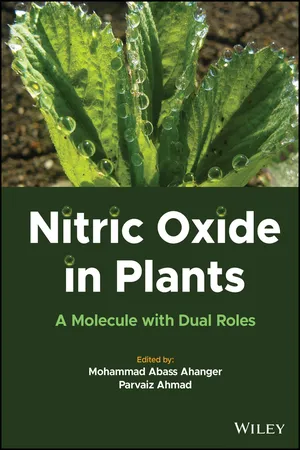
Table of contents

  1. Cover
  2. Title page
  3. Copyright
  4. Table of Contents
  5. Preface
  6. List of Contributors
  7. 1 Nitric Oxide: A Dynamic Signaling Molecule Under Plant Stress
  8. 2 Regulation of Nitric Oxide Biosynthesis Under Abiotic Stresses and Modulation Due to Osmolytes
  9. 3 Role of Nitric Oxide in Abiotic Stress
  10. 4 Molecular Approaches for Designing NO-Mediated Stress Tolerance Pathways
  11. 5 Nitrogen Uptake and Utilization Toward Sustainable Agriculture Development Role of Nitric Oxide
  12. 6 Regulation of Plant Growth by Microbe-Assisted Nitric Oxide Production
  13. 7 Nitric Oxide and Reactive Oxygen Species Interaction for Stress Signaling
  14. 8 AscorbateĀ–Glutathione Cycle: Nitric Oxide and Phytohormone Interactions for Plant Stress Tolerance
  15. 9 Phytohormones and Nitric Oxide Cross-talk in Regulation of Stress Tolerance in Plants
  16. 10 Nitric Oxide Cross-talk with Phytohormones Vis-Ć -Vis Photosynthetic Regulation Under Extreme Environments
  17. 11 Polyamines and Nitric Oxide Interaction in Abiotic Stress Regulation in Plants
  18. 12 Nitric Oxide: Interaction with Auxins, Brassinosteroids, and Abscisic Acid
  19. 13 Nitric Oxide: Interaction with Salicylic Acid, Jasmonic Acid, and Ethylene
  20. Index
  21. End User License Agreement

Trusted byĀ 375,005 students

Access to over 1.5 million titles for a fair monthly price.

Study more efficiently using our study tools.

Frequently asked questions

Yes, you can cancel anytime from the Subscription tab in your account settings on the Perlego website. Your subscription will stay active until the end of your current billing period. Learn how to cancel your subscription
No, books cannot be downloaded as external files, such as PDFs, for use outside of Perlego. However, you can download books within the Perlego app for offline reading on mobile or tablet. Learn how to download books offline
Perlego offers two plans: Essential and Complete
  • Essential is ideal for learners and professionals who enjoy exploring a wide range of subjects. Access the Essential Library with 800,000+ trusted titles and best-sellers across business, personal growth, and the humanities. Includes unlimited reading time and Standard Read Aloud voice.
  • Complete: Perfect for advanced learners and researchers needing full, unrestricted access. Unlock 1.5M+ books across hundreds of subjects, including academic and specialized titles. The Complete Plan also includes advanced features like Premium Read Aloud and Research Assistant.
Both plans are available with monthly, semester, or annual billing cycles.
We are an online textbook subscription service, where you can get access to an entire online library for less than the price of a single book per month. With over 1.5 million books across 990+ topics, we’ve got you covered! Learn about our mission
Look out for the read-aloud symbol on your next book to see if you can listen to it. The read-aloud tool reads text aloud for you, highlighting the text as it is being read. You can pause it, speed it up and slow it down. Learn more about Read Aloud
Yes! You can use the Perlego app on both iOS and Android devices to read anytime, anywhere — even offline. Perfect for commutes or when you’re on the go.
Please note we cannot support devices running on iOS 13 and Android 7 or earlier. Learn more about using the app
Yes, you can access Nitric Oxide in Plants by Mohammad Abass Ahanger,Parvaiz Ahmad in PDF and/or ePUB format, as well as other popular books in Biological Sciences & Biology. We have over 1.5 million books available in our catalogue for you to explore.