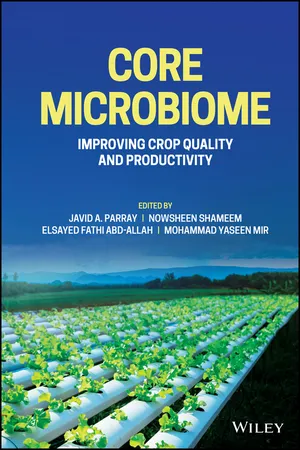
Core Microbiome
eBook - ePub

Core Microbiome

Improving Crop Quality and Productivity

  1. English
  2. ePUB (mobile friendly)
  3. Available on iOS & Android
eBook - ePub

Core Microbiome

Improving Crop Quality and Productivity

About this book

Improve the quality and productivity of your crops through selecting positive and effective interactive core-microbiomes

As microbial cells are present in overwhelming numbers in our soil, it is perhaps inevitable that microbes are found extensively in plant and animal tissue. The role of microbiomes on the regulation of physiological processes in animals has been extensively researched in recent years, but the overarching role of the plant microbiome has yet to be discovered.

Core Microbiome: Improving Crop Quality and Productivity is an attempt to remediate some of that deficit, as the first book to summarize feature of microbial communities that make up the plant microbiome. There is substantial evidence that these communities are crucial in disease control, enhanced nutrient acquisition, and stress tolerance—a feature more important than ever due to climate change. A further focus on improving how core microbiomes interact so that they are both phenotypically and genotypically very adaptive and sustainable will allow the reader to improve the quality and productivity of crops so that they may be considered sustainable agriculture.

Core Microbiome readers will also find:

  • Descriptions of the basic structure of core microbiomes and their functions across various habitats
  • New and cutting-edge trends and technological innovations highlighted that use core microbiomes to harness plant microbiome interaction
  • The structure, classification, and biotechnological applications of aquatic core microbiomes, in addition to the material on plant microbiomes

As a broad introduction to the interaction of core microbiome and plant productivity, Core Microbiome is ideal for researchers and scientists working in the field of environmental science, environmental microbiology, and waste management. Similarly, undergraduate and graduate students in these fields, as well as in agriculture, biotechnology, biosciences, and life and environmental sciences will also benefit from this work.

Information

Publisher
Wiley
Year
2022
Print ISBN
9781119830764
Edition
1
eBook ISBN
9781119830771

1
A Review of Endophytic Microbiota of Medicinal Plants and Their Antimicrobial Properties

Robeena Sarah, Nida Idrees, and Baby Tabassum
Toxicology Laboratory, Department of Zoology, Govt. Raza P.G. College, Rampur 244901, India

1.1 Introduction

Medicinal plants have been used in many parts of the world for thousands of years in traditional treatments for numerous diseases. In rural areas of developing countries, they are still used as a primary source of drugs [1]. About 80% of developing countries use conventional medicines for general health care [2]. Natural products can be obtained from medicinal plants that have proven to be a rich source of biologically active compounds; many of them are used to develop novel chemicals for the pharmaceutical industry. With regard to disease-causing microorganisms, the increasing resistance to therapeutic agents currently in use, such as antibiotics and antiviral agents, has led to renewed interest in exploring novel anti-infective compounds. As approximately 450,000 plant species are available worldwide, of which only one per cent has been phytochemically analyzed, the prospects of locating new bioactive compounds are tremendously positive.
Medicinal plants are essentially considered complex and dynamic when used in systems for remedial therapy. Hence, their chemical composition depends upon several factors, such as botanical species, genetically determined chemotypes, anatomically a part of the plant (e.g., seed, flower, root, and leaf), storage, sun exposure, humidity, kind of ground, time of harvesting, and ecological area. Moreover, biogenic factors, such as the fungal and bacterial endophytes related to diverse parts of the plant, can influence their chemical composition. In recent years, the research and study of the multiple interactions occurring between endophytes and medicinal plants have modernized our knowledge of plant biology, with entirely unexpected and remarkable application perspectives: the probability of modulating, amplifying, or interfering within the biosynthesis of phytoconstituents (e.g., terpenes, polyphenols, and alkamides), but also to engineer the synthesis of latest molecules directly, for instance with antibiotic activity.

1.2 Antimicrobial Properties of Medicinal Plants with Particular Reference to Neem (Azadirachtaindica)

There are many reports on conventional medicinal plants and natural products to treat several diseases. Many plant-based medicines utilized in traditional therapeutic systems as agents in the treatment of infectious diseases are recorded in pharmacopoeia, a variety of which have been investigated recently for their efficiency against disease-causing microorganisms. The general antimicrobial activities of medicinal plants and their products, such as essential oils, were analyzed earlier [3,4].
Moreover, medicinal plants also can play an elementary function against rising antibiotic resistance both directly for their antimicrobial activities (e.g., antibacterial, antiviral, antifungal, and antiparasitic ones) and indirectly by reducing resistance against antibiotics.
There are numerous medicinal plants with well-known antimicrobial activity, including traditional Chinese or Ayurvedic medicine. Among medicinal plants adopted in experimental studies, a classic example is the Azadirachta indica (Figure 1.1) commonly known as neem, an evergreen tree of the sub-tropics and tropics, indigenous to the Indian subcontinent, with a recognized ethnomedicinal value and significance in agriculture and also in the pharmaceutical industry [5]. Every part of the neem plant, such as leaves, fruits, seeds, bark, and roots, contains compounds with proven antioxidant, anti-inflammatory [6], antidiabetic, antibacterial, antigingivitic, antifungal, anticancer, antiviral, antiulcer, neuroprotective, antipyretic, hepatoprotective, nephroprotective, and wound-healing properties. It possesses incredible potential within the field of medicine, pest management, and environmental protection. Neem may be a natural source of eco-friendly herbal pesticides, insecticides, and agro-based chemicals [7]. The impact of mouthwash containing neem on plaque and gingivitis was analyzed in a clinical study, indicating that it may help maintain mouth hygiene and suggest an enhanced effect on preventing oral diseases since it is both cost-effective and easily accessible [8]. Approximately 400 compounds are isolated from va...

Table of contents

  1. Cover
  2. Title page
  3. Copyright
  4. Table of Contents
  5. List of Contributors
  6. Preface
  7. 1 A Review of Endophytic Microbiota of Medicinal Plants and Their Antimicrobial Properties: Robeena Sarah, Nida Idrees, and Baby Tabassum
  8. 2 Plant Microbiome: A Key to Managing Plant Diseases: Dipal B. Minipara, Khushboo Pachhigar, and Himanshu R. Barot
  9. 3 Impact of Microbiomes to Counter Abiotic Stresses in Medicinal Plants- A Review: Abeer Hashem, Khaloud Mohammed Alarjani, Khalid F. Almutariri, Javid A. Parray, Sushil K. Sharma, Ashwani Kumar, Turki M. Dawoud, Khalid S. Almaary, Nosheen Shameem, and Elsayed Fathi Abd-Allah
  10. 4 Uses of Compost in Agriculture and Bioremediation – A Review: Aparna Gunjal
  11. 5 Metagenomics and Microbiome Engineering: Identification of Core Microbiome and Improvement of Rhizosphere: Bahman Fazeli-Nasab, Nafiseh Mahdinezhad, and Javid A. Parray
  12. 6 Core Microbiome: Plant Growth and Development: Thirunarayanan P, Uday Kumar Thera, Tulasi Korra, and Manoj Kumar V
  13. 7 Microbiome Engineering and Biotechnology: The Real Finenesses of a Robust Rhizosphere: Barkha Sharma, Shalini Tiwari, and Kailash Chand Kumawat
  14. 8 Role of Rhizospheric Microbiome in Enhancing Plant Attributes and Soil Health for Sustainable Agriculture: Sandeep Sharma and Kailash Chand Kumawat
  15. 9 Toxic Effects of Some Herbicides on the Fatty Acid Profile of Wheat Varieties: A Phytomicrobiome Study: Fadime Karabulut and Songul çanakcι-Gulengul
  16. 10 Microbial Prospects in Sediment Denitrification of Eutrophic Wetland Ecosystems: Rupak Kumar Sarma and Kamal Choudhury
  17. 11 Role of Plant Microbiome in Carbon Sequestration for Sustainable Agriculture: Ranjith Sellappan, Aswini Krishnan, and Kalaiselvi Thangavel
  18. 12 Functions and Emerging Trends of the Microbial Community in Heavy Metals Bioremediation: A Review: Nida Idrees, Robeena Sarah, and Baby Tabassum
  19. 13 Microbiomics and Sustainable Agriculture: New Frontiers: Shabeer Ahmad Dar, Mohammad Yaseen Mir, Azra N. Kamili, Irshad Ahmad Nawchoo, and Shabir Ahmad Bhat
  20. 14 Role of Nanotechnology in Soil Microbiome and Agricultural Development: Bisma Farooq, Shahnaz Anjum, Madiha Farooq, Gulzar Ahmed Rather, Asma Nazir, Bijaya Kumar Nayak, and Anima Nanda
  21. 15 Microbial Biofilms: Optimal Genetic Material Exchange in a Microbiome Environment: Niraj Singh and Pranjal Pratim Das
  22. 16 Rhizosphere Improvement: Role of Biotechnology and Microbioengineering: Afrozah Hassan and Irshad Ahmad Nawchoo
  23. 17 Exploring Biological Agents and Core Microbiomes as a Tool for Reclamation of Abandoned Mines: Seema B. Sharma and Rupak Dey
  24. 18 Mycorrhizal Strategy for the Management of Hazardous Chromium Contaminants: Abeer Hashem, Nowsheen Shameem, Javid A. Parray, and Elsayed Fathi Abd-Allah
  25. Index
  26. End User License Agreement

Trusted by 375,005 students

Access to over 1.5 million titles for a fair monthly price.

Study more efficiently using our study tools.

Frequently asked questions

Yes, you can cancel anytime from the Subscription tab in your account settings on the Perlego website. Your subscription will stay active until the end of your current billing period. Learn how to cancel your subscription
No, books cannot be downloaded as external files, such as PDFs, for use outside of Perlego. However, you can download books within the Perlego app for offline reading on mobile or tablet. Learn how to download books offline
Perlego offers two plans: Essential and Complete
  • Essential is ideal for learners and professionals who enjoy exploring a wide range of subjects. Access the Essential Library with 800,000+ trusted titles and best-sellers across business, personal growth, and the humanities. Includes unlimited reading time and Standard Read Aloud voice.
  • Complete: Perfect for advanced learners and researchers needing full, unrestricted access. Unlock 1.5M+ books across hundreds of subjects, including academic and specialized titles. The Complete Plan also includes advanced features like Premium Read Aloud and Research Assistant.
Both plans are available with monthly, semester, or annual billing cycles.
We are an online textbook subscription service, where you can get access to an entire online library for less than the price of a single book per month. With over 1.5 million books across 990+ topics, we’ve got you covered! Learn about our mission
Look out for the read-aloud symbol on your next book to see if you can listen to it. The read-aloud tool reads text aloud for you, highlighting the text as it is being read. You can pause it, speed it up and slow it down. Learn more about Read Aloud
Yes! You can use the Perlego app on both iOS and Android devices to read anytime, anywhere — even offline. Perfect for commutes or when you’re on the go.
Please note we cannot support devices running on iOS 13 and Android 7 or earlier. Learn more about using the app
Yes, you can access Core Microbiome by Javid A. Parray,Elsayed F. Abd-Allah,Nowsheen Shameem,Mohammad Yaseen Mir,Mohammad Y. Mir in PDF and/or ePUB format, as well as other popular books in Technology & Engineering & Sustainable Agriculture. We have over 1.5 million books available in our catalogue for you to explore.