"… a highly valuable contribution to the legal literature. It adopts a useful, modern approach to teaching the young generation of lawyers how to deal with the increasing internationalisation of law. It is also helpful to the practising lawyer and to legislators." (Uniform Law Review/Revue de Droit Uniforme)
Volume 4 of this new edition deals with movable and intangible property law. The book addresses the transformation of the models of movable property in commercial and financial transactions between professionals in the international flow of goods, services, money, information, and technology. In this transnational legal order, the emphasis in the new law merchant or modern lex mercatoria of movable property turns to risk management, asset liquidity, and transactional and payment finality.
Particular attention is given to the notion of assets and asset classes, the inclusion of monetary claims, the transformation of assets in production and distribution chains, and the type of user, income and enjoyment rights that can be established in them, when they become proprietary, what that means, the role of party autonomy in the creation and operation of these rights, and how they are handled between professional participants and upon a sale to consumers.
The volume compares common law and civil law concepts - the one being geared to improving value, the other to consumption; it then identifies their relevance especially in modern finance, and concludes by indicating future directions.
The complete set in this magisterial work is made up of 6 volumes. Used independently, each volume allows the reader to delve into a particular topic. Alternatively, all volumes can be read together for a comprehensive overview of transnational comparative commercial, financial and trade law.
eBook - ePub
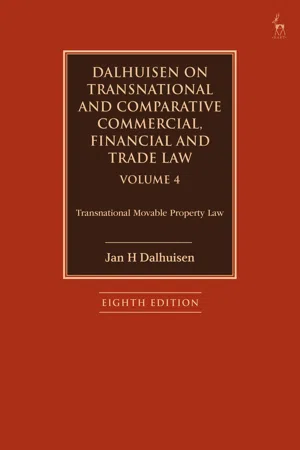
Dalhuisen on Transnational and Comparative Commercial, Financial and Trade Law Volume 4
Transnational Movable Property Law
- 488 pages
- English
- ePUB (mobile friendly)
- Available on iOS & Android
eBook - ePub
Dalhuisen on Transnational and Comparative Commercial, Financial and Trade Law Volume 4
Transnational Movable Property Law
About this book
Trusted by 375,005 students
Access to over 1.5 million titles for a fair monthly price.
Study more efficiently using our study tools.
Information
Part I
Ownership, Possession and Limited, Future, Conditional or Temporary and Beneficial Proprietary Rights in Chattels and Intangible Assets
1.1.Introduction
1.1.1.The Notion of Property Law
Property law is best understood in terms of the various legal structures under which assets are held, used and protected, more specifically from the perspective of the user, income and enjoyment rights that may operate in these assets against, or must be respected by, third parties who were not involved in their creation or transfer, often considered the essential feature, which distinguishes these rights from mere contractual arrangements. What rights do we mean more precisely, and in respect of which assets can such rights be given or claimed, particularly when split-off and transferred by the original owner (who has them all in principle) as rights more limited than full ownership, like usufructs or life interests and security interests? When and how do they become proprietary affecting third parties, why, or when do they remain merely contractual and what does that mean? Can they be further split-up by transferees and then redistributed to others in a similar proprietary fashion, how and when? When are these splits and transfers final, and what does that mean?
This requires first some idea of what assets are and how they may become the object of user, income and enjoyment rights in this sense. Land and chattels or physical movable assets are the most obvious examples but assets may also be monetary or could be claims, in fact all that has economic value may then be considered an asset, see further section 1.1.5 below, although, in some legal systems as we shall see, the asset status of intangible assets, even monetary claims like receivables, is sometimes still questioned. This suggests a physical aspect which legally confuses and raises also the question why rights of this nature might only attach to specific, identified and individualised existing assets for them to become proprietary. Or can proprietary rights, in a more modern environment, also attach to classes of assets, physical or intangible, now often commingled with services, information, technology and software, upon mere description of the asset or asset class in the relevant documentation, while within such a class legally there may then also be asset substitution, for example when these goods are in transformation as part of a production process or distribution chain whilst they are physically succeeded or replaced by others e.g when moving from commodities to final products, and, upon a sale, to receivables and, upon payment, to proceeds.
This is relevant especially when user, income and enjoyment rights are given or split off as security for debt when the issue is whether upon transformation or a sale of the underlying assets these security interests may shift into replacement assets in the production process, or, upon a sale, into receivables or proceeds, hopefully with preservation of the original rank. Rights in regard of assets in transformation or in future assets might thus be included and transferred prospectively and there may be assets and transfers in bulk or as a class in transformation. This is at the heart of floating charges as a form of asset-backed funding to obtain working capital for the manufacturing and distribution process as we shall see.
The changing nature of the underlying assets presents in many legal systems a serious problem in respect of the continuing validity and effectiveness of these security interests or charges and the maintenance of their rank, see further Volume 5, section 2.2. In fact, it is in modern times this issue of identification, individualisation, and (physical) existence of the underlying assets that has become an important issue concerning property rights, their existence and creation or transfer and continuation, including the creation of security interests in them, at least in respect of movable assets, including claims, used or produced in the professional sphere. The nature of assets is therefore closely connected with the kind of proprietary legal framework we have or must move to and both may be in need of fundamental rethinking as the basic cornerstones of property rights. These rights and the way they are manifested and protected may then have to be reconsidered in their meaning and expanded in their operation, especially in international commerce and finance as we shall see all through.
This might seem a merely technical issue or concern but proves to be essential and arises in particular in respect of the modern flows of goods, services, software, technology and other information, and of receivables, money or proceeds, and proves to present a major intellectual challenge in legal thinking as to how these flows can or should now be captured in any proprietary sense, not in the least also in their transformation, see the discussion in section 1.1.5 below, more urgent upon the globalisation of these flows in international production, and distribution chains. It raises the further question of the applicable law in the various stages and aspects of these chains.
An example may help. Assume a car manufacturer buys iron plates in Sweden, produces car frames in Spain, adds tyres in France, electronic equipment from Germany, and software from the US before assembling the final product in Italy, subsequently distributed in 25 countries, sold whilst giving credit to buyers against a receivable, ultimately collected upon payment in banks in any of these countries. How is in this example, a reservation of title by the Swedish supplier of steel plates to be treated and maintained in the production, first in Spain into car bodies, then in France after the supply of tires potentially with a further reservation of title in them, and then in Germany after the addition of electronic equipment, again assuming a further reservation of title. How do they all figure in Italy after the completion of production and in the subsequent distribution of these cars in various countries, followed by a receivable upon the sale and ultimately by a payment into a bank in yet another country? Who has got what?
If the local lex situs prevails at each moment of creation of such rights—which is the traditional proprietary principle—we get an amalgam of local rights in their proprietary aspects vying for recognition elsewhere, relevant especially in a bankruptcy of anyone in the chain wherever that may be. It raises issues of shifting rights in (future) replacement assets that are in transformation, with or without the preservation of rank or their loss altogether, complicated further by the possibility and impact of bulk transfers of these assets and rights therein in the manufacturing and distribution process, all potentially under some local laws. Does it provide for any sensible regime in respect of the whole operation with sufficient certainty and predictability? Can this still make sense in the international flows or must transnationalisation and transnational custom and practice or general principle or even party autonomy as an independent source of transnational law come to the rescue, which is the thesis of this book.
If, as will be submitted shortly, the issues of liquidity and finality, and ultimately of risk management, are at the heart of the meaning and significance of modern proprietary rights in professional dealings in the international flows and the focus of transnationalisation of the proprietary laws therein, any formal or intrinsic requirement of the asset in terms of identification, individualisation, and existence is likely to prove a major hindrance to the further development of property law into a more dynamic force in international business as is also the formal limitation of the proprietary rights therein, in civil law terms the numerus clausus. The essence is here how the whole production and distribution process can be given as security for working capital, necessary to pay the workers and buy more commodities and semi-finished materials in the continuation of this process before payment of finished products is received. How can this be legally achieved if we still mean to cut this process up along domestic lines, further complicated by the lack of a consensus what assets are or whether there could be legal unity in the production and distribution process. If it cannot or not effectively and efficiently be achieved, the financing of this process may be more expensive as it is likely to be ineffectively or insufficiently secured. That would be the unavoidable consequence of nationalistic and traditional legal thinking in terms of assets and rights thereto which still prevail and assume that these flows must be broken up in individualised assets and along national lines assuming that all these domestic legal pieces together (derived from and identified under the traditional rules of private international law) can still produce an efficient legal system of operation and protection for the international flows. This discussion was started in Volume 1, section 1.1.6 and will now be resumed.
Once we know what assets legally are, either in individualised form or in more modern perceptions of their flows as classes of present or future assets in movement and transformation, constantly transported between countries, commingled when necessary with services, technology, information or software, captured foremost in the contractual description that is likely to be at the origin of each proprietary right when conceded or transferred to others, we should obtain some better idea or clearer view of what legal structures we are speaking of in terms of their movement towards proprietary status, therefore of the types of user, enjoyment and income rights, including security interests or charges, that may be exerted in respect of these assets and legally claimed by the beneficiaries or interest holders as proprietary, and what that truly means and does for us.
It was already said that the essence of rights being proprietary is that they are maintainable against everyone, therefore also against those not involved in their creation, transfer, or transformation. Indeed, it is the facility to enforce these rights, even if originally created or split-off by contract, against all the world that is traditionally considered the essence of proprietary rights, or in more modern approaches as we shall see, at least against professional classes of third parties. Without any form of privity, third parties must thus respect these interests, their creation and transfer, and leave them alone. But even then, it still remains to be determined which these rights are and what third party effect truly means or implies in this connection. It is particularly relevant in a bankruptcy when the proprietary right holders may be able to maintain their claims, if proprietary, against a bankrupt debtor and its bankruptcy trustee, thus potentially ignoring the bankruptcy and its liquidation, reorganisation and distribution process in respect of assets so encumbered. On the other hand, it is also important that these rights are extinguished at the level of the ordinary buyer to preserve their liquidity: nobody would dare to buy anything without it. It must then be determined when in truth they have reached the public to be so protected. That is the world of the bona fide purchaser.
In first instance, the right of ownership as the most complete (in civil law terminology) user, enjoyment and income right to exploit and dispose of one’s asset springs to mind. It means that we can defend the ownership right in our car against all comers. If it is in the garage of our bankrupt friend, we just reclaim it and it is not part of our friend’s bankrupt estate. There are also more limited and therefore less complete user, enjoyment or income rights that the owner may subsequently create in assets, which may also become proprietary and therefore maintainable against all others, such as life interests or usufructs, forms of leases (in real estate), rights of way or servitudes (notably in real estate), and especially security interests of which mortgages are prime examples in land, pledges in chattels, and in equity in common law countries, floating charges in classes of assets in transformation as already mentioned. These involve then more limited interests of other people in an owner’s assets and if becoming proprietary in civil law terminology are rights in other people’s property or iura in re aliena and must then be no less respected by all, therefore not only by the owner who granted or transferred these rights or his successor. It means that even if the owner sells the property, these rights in the asset remain intact, with the important side benefit that the erstwhile owner is discharged of any duties under such a proprietary right transferred to others. In our above example, if I have given my friend a loan, and he has given me his car as security, I now retrieve his car from his garage, not as owner but as a security interest holder and separate the car from the rest of his estate and sell it in a separate execution, thus retrieving my loan plus interest and cost out of the proceeds quite apart from the liquidation of the estate. The security interest was my proprietary right, which I may defend against everyone, even against the owner’s bankruptcy trustee or any new owner should my friend have sold the property in the meantime, which as owner he may be able to do but it would not interfere with my right or risk management arrangements. It being proprietary I can maintain against all the world including the new owner, as mine is older.
The importance for the erstwhile owner is that s/he can still sell the property regardless of the charge s/he allowed to arise in it. That is liquidity.1 It discharges him/her at the same time from any duties under this proprietary right, for example, to look after the property pending the mortgage. Another example: there may be rights of way created for me over my neighbour’s land to provide ready access to my own property. If proprietary, these rights are easements or, in civil law, servitudes maintainable against everybody. That means that, even if the property of my neighbour is sold, my rights over his land are not affected. My former neighbour is discharged at the same time and the duty to give access passes to his successor in the property. Again, proprietary rights so passing to purchasers mean that the obligation passes with the underlying assets so that their liquidity remains ensured. My neighbour can sell the property regardless of the charge he created in it for me, without which he would face difficulties as he would still be liable to provide the right of way after having lost control.
This can be demonstrated and would be the case if my right of way had remained merely contractual. Practically, that would require the underlying asset to remain in the control of the party having granted any contractual user or enjoyment right in the asset (here the right of way by my erstwhile neighbour to me) as without control of the asset, especially upon a sale of the property, performance of the contractual duties to let me pass could not remain assured. The new neighbour has no duty to me because he is not a party to the contract and it does not concern a proprietary right that passes with the property. The contractual duty to provide access to me cannot be unilaterally transferred by the former owner without my consent and acceptance by the new owner, who might not even know of my right and may in any event not be willing to continue it. Again, unless I agree (which will depend on the new owner’s willingness to afford similar access or on me being paid off by the seller), the property cannot be sold because the seller could no longer perform under the original contract and provide me with my right of way. Hence the resulting illiquidity in the underlying asset and that is in a market economy highly undesirable. The ultimate question then is how modern law reacts against this conundrum.
In civil law, the main example of this problem is presented in the lease of apartments, which lease in most civil law countries is contractual, not proprietary as it is likely to be in common law. As we shall see, that has required a statutory exception to be made, for example, section 566 Civil Code (BGB) in Germany, under which any new owner must respect the lease contract and the old owner is discharged. This means that the rental agreement exceptionally acquires proprietary features. It has a long history and was earlier identified as an important inroad into the concept of privity of contract: see Volume 3, section 1.5.1. It is not a question of rental protection (as is often thought by students) but is motivated by the need for liqui...
Table of contents
- Cover
- Dedication
- Title Page
- Preface
- Contents
- Table of Cases
- Table of Legislation and Related Documents
- Part I Ownership, Possession and Limited, Future, Conditional or Temporary and Beneficial Proprietary Rights in Chattels and Intangible Assets
- Part II Negotiable Documents of Title and Negotiable Instruments
- Part III Investment Securities
- Index
- Copyright Page
Frequently asked questions
Yes, you can cancel anytime from the Subscription tab in your account settings on the Perlego website. Your subscription will stay active until the end of your current billing period. Learn how to cancel your subscription
No, books cannot be downloaded as external files, such as PDFs, for use outside of Perlego. However, you can download books within the Perlego app for offline reading on mobile or tablet. Learn how to download books offline
Perlego offers two plans: Essential and Complete
- Essential is ideal for learners and professionals who enjoy exploring a wide range of subjects. Access the Essential Library with 800,000+ trusted titles and best-sellers across business, personal growth, and the humanities. Includes unlimited reading time and Standard Read Aloud voice.
- Complete: Perfect for advanced learners and researchers needing full, unrestricted access. Unlock 1.5M+ books across hundreds of subjects, including academic and specialized titles. The Complete Plan also includes advanced features like Premium Read Aloud and Research Assistant.
We are an online textbook subscription service, where you can get access to an entire online library for less than the price of a single book per month. With over 1.5 million books across 990+ topics, we’ve got you covered! Learn about our mission
Look out for the read-aloud symbol on your next book to see if you can listen to it. The read-aloud tool reads text aloud for you, highlighting the text as it is being read. You can pause it, speed it up and slow it down. Learn more about Read Aloud
Yes! You can use the Perlego app on both iOS and Android devices to read anytime, anywhere — even offline. Perfect for commutes or when you’re on the go.
Please note we cannot support devices running on iOS 13 and Android 7 or earlier. Learn more about using the app
Please note we cannot support devices running on iOS 13 and Android 7 or earlier. Learn more about using the app
Yes, you can access Dalhuisen on Transnational and Comparative Commercial, Financial and Trade Law Volume 4 by Jan H Dalhuisen in PDF and/or ePUB format, as well as other popular books in Law & Comparative Law. We have over 1.5 million books available in our catalogue for you to explore.