This study explores the organization, history and uniforms of the Soviet Red Army during the 20 years between its victory in the Civil War and the invasion of the USSR by Germany in 1941.
The two decades following the Bolshevik victory over the 'Whites' in the Russian Civil War saw widespread and fundamental developments for the Red Army. Nevertheless, these still left it largely unready to face Germany's Operation Barbarossa in June 1941, having been reduced in size and planning for modernization.
Despite Stalin's murderous purges of the officer class in the 1930s, the Red Army was victorious in clashes against Imperial Japan in 1938–39 and fighting for the Republicans in the Spanish Civil War (1936–39). Yet, shortly after taking over half of Poland in 1939, Stalin's 'Winter War' against Finland demonstrated serious inadequacies in the Red Army's readiness for modern warfare. This would be shockingly confirmed in the first days of Operation Barbarossa.
Using rare photos and detailed colour artwork, this study explores the interwar history of the Red Army, describing its campaigns, organization and uniforms, and focusing on the 20 years between its victory in the Civil War and the invasion of the USSR by Germany in 1941.
eBook - ePub
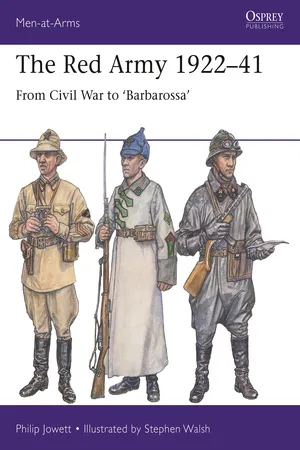
The Red Army 1922–41
From Civil War to 'Barbarossa'
- 48 pages
- English
- ePUB (mobile friendly)
- Available on iOS & Android
eBook - ePub
About this book
Information
UNIFORMS, 1922–41
The Tsarist army had fought World War I uniformed mainly in shades of khaki, with grey greatcoats. Due to its inevitably very uneven and patchy logistics, the Red Army emerged from the Civil War in 1922 wearing a wide variety of whatever clothing was regionally available. The majority of soldiers had khaki uniforms (in the British usage of the term – drab brown/olive) from pre-1917 Imperial Army stocks, or various others supplied to the Tsarist and White armies by the Entente powers during World War I and the Civil War. Over the next 19 years Red Army uniforms would be gradually standardized and developed, culminating in a range of modern orders-of-dress in the mid-1930s. This was again an inconsistent process, due to widely dispersed manufacture, and to the inevitably long delays in compliance with any given set of regulations over the whole area of the USSR.5

Seen at a Party sports meeting in October 1923, about a year before they both lost their posts in the power-struggle following Lenin’s death, are the Moscow Military District commander N.I. Muralov (left) and the Commissar for Military and Naval Affairs, Leon Trotsky. Their budenovka caps are of winter weight, but have the front peak and rear neck flap cut as on the 1922 summer-weight version. Both are wearing the new kaftan greatcoat with coloured collar patches and the chest tabs introduced in 1919 (Trotsky’s coat seems to be made of civilian material with a noticeable ‘pile’.). As a Trotsky loyalist, Muralov would be executed in January 1937 during Stalin’s purges, and Trotsky would be assassinated in exile in Mexico in August 1940. (Author’s collection)
Headgear
The best-known type of field headgear worn in 1922 was a cloth shlem (‘helmet’) type. Actually designed in 1913, reportedly by Viktor Vasnatsov, but not issued to the Imperial Army, this was adopted in January 1919 by the Bolshevik RMSR (Revolutionary Military Council). In widespread use from early 1920, it had several names, including bogatirka – recalling the ‘spired’ helmets worn by some medieval Russian warriors – but it became universally known as the budenovka, after the Red Cavalry commander Semyon Budenny (see Plates A1 & A2). Cheap to produce from available materials, it was locally made in slightly differing versions, but it was characterized by the crown rising to a point, which made Bolshevik troops easier to identify in Civil War battles when both sides wore very similar clothing. Regulation winter and summer patterns appeared in January 1922. The former, of dark grey woollen cloth, had a cloth peak (visor) and a button-up ear-and-neck flap; the latter, in khaki cotton, had the peak and a smaller permanent rear neck flap made in one piece. Slightly modified in 1927, it remained in field use right up until 1941; the M1927 was dark grey for officers, mid-grey for enlisted ranks. On all versions the universal M1922 red-enamelled or painted star badge, with the hammer-&-sickle motif, was pinned to a 95mm branch-colour cloth star backing. A floppy-brimmed khaki ‘panama’ sunhat was also used in Central Asia in the 1920–30s (see F1), and became general issue for hot-region service in 1938.
Versions of the Imperial Army’s stiff-peaked (visored) M1910 service cap (furashka) were widely worn throughout and after the Civil War, those in use in the 1920s usually being termed the M1919 or M1922. From 1924 they were authorized for officers in summer, beside the winter-weight budenovka worn in cold weather. Between 1924 and 1935 officially, and until 1939 in practice, enlisted ranks wore soft-crowned service caps (with card stiffeners only for the band and visor). These were usually plain khaki, and of a smarter model from 1928 (see D1).
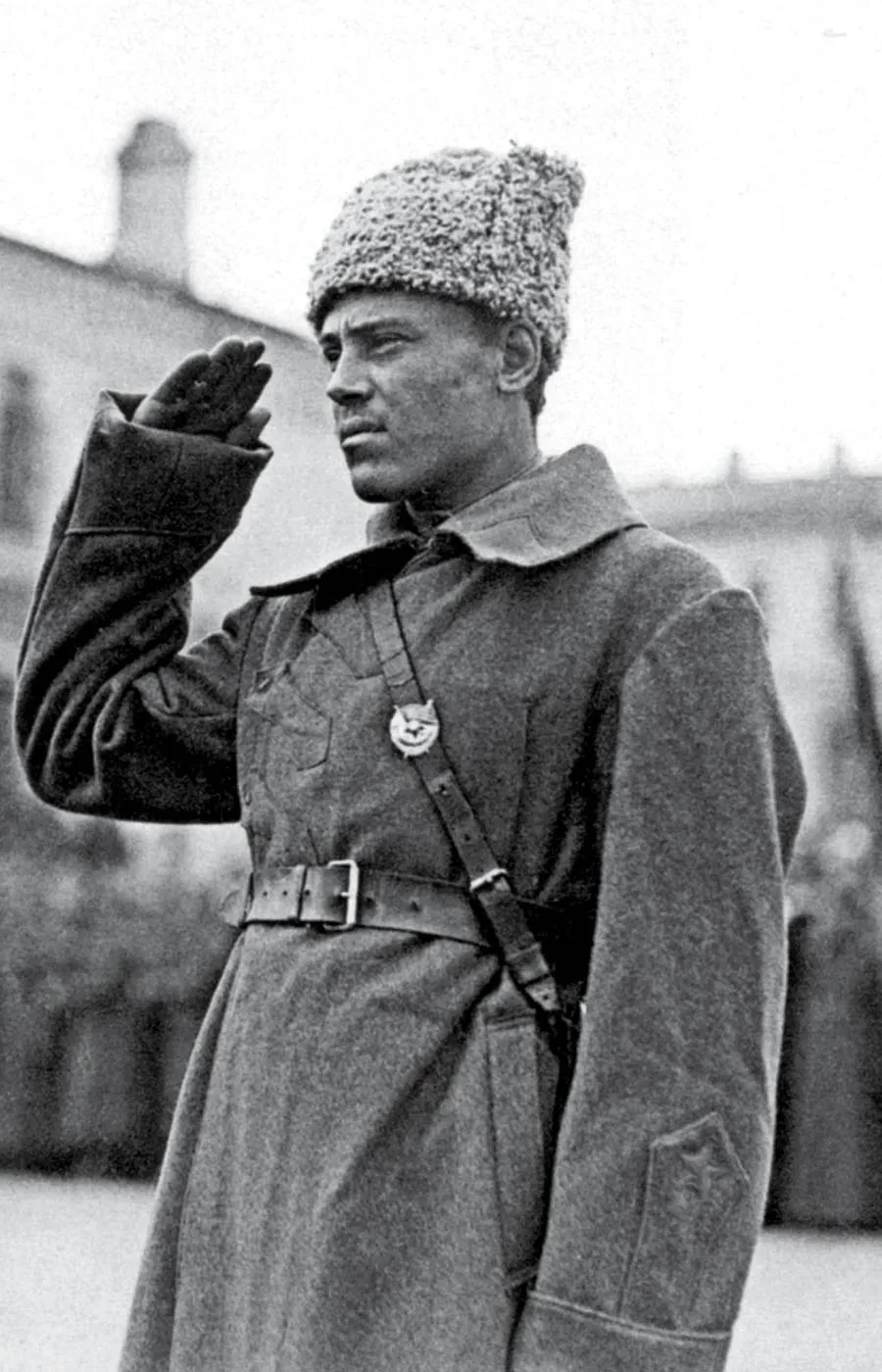
A Red Army unit commander on parade with his troops in winter 1922/23. As a common 1920s–30s alternative to the budenovka he wears a pre-Revolution style astrakhan papakha cap, here lacking the usual red star badge. This photograph shows the vertical ‘slash’ chest and waist pockets of the 1919 kaftan. Under magnification the collar patches, chest tabs, and left forearm rank tab of 1922 regulations can all be made out, but in plain coat-cloth for lack of coloured material. Note the metal RKKA badge worn on the cross-strap. (Author’s collection)
However, some categories of personnel had distinctive coloured crowns and bands – notably, OGPU/NKVD security forces (see B2), though not universally, and some photographs show them in khaki caps. Initially the RKKA’s cavalry enjoyed elite status, and from 1924 the cavalry divisions and their constituent regiments were distinguished in this way; see accompanying Table 1.

Desert troops of the Red Army somewhere in Soviet Central Asia in 1937, wearing the khaki service cap as field headgear; that of the officer (left) is more stiffened than those of his soldiers. The central man is a locally-recruited Turkic interpreter. (Author’s collection)
| Table 1: Cavalry service cap colours, 1924–29 |
| The 11th–3rd, 7th, and 9th–11th Cav Divs each had four cavalry regimen... |
Table of contents
- Cover
- Title Page
- Table of Contents
- Introduction
- The Red Army in the 1920s
- The Red Army in the 1930s
- Campaigns in the 1930s
- Uniforms, 1922–41
- Select Bibliography
- Plate Commentaries
- eCopyright
Trusted by 375,005 students
Access to over 1.5 million titles for a fair monthly price.
Study more efficiently using our study tools.
Frequently asked questions
Yes, you can cancel anytime from the Subscription tab in your account settings on the Perlego website. Your subscription will stay active until the end of your current billing period. Learn how to cancel your subscription
No, books cannot be downloaded as external files, such as PDFs, for use outside of Perlego. However, you can download books within the Perlego app for offline reading on mobile or tablet. Learn how to download books offline
Perlego offers two plans: Essential and Complete
- Essential is ideal for learners and professionals who enjoy exploring a wide range of subjects. Access the Essential Library with 800,000+ trusted titles and best-sellers across business, personal growth, and the humanities. Includes unlimited reading time and Standard Read Aloud voice.
- Complete: Perfect for advanced learners and researchers needing full, unrestricted access. Unlock 1.5M+ books across hundreds of subjects, including academic and specialized titles. The Complete Plan also includes advanced features like Premium Read Aloud and Research Assistant.
We are an online textbook subscription service, where you can get access to an entire online library for less than the price of a single book per month. With over 1.5 million books across 990+ topics, we’ve got you covered! Learn about our mission
Look out for the read-aloud symbol on your next book to see if you can listen to it. The read-aloud tool reads text aloud for you, highlighting the text as it is being read. You can pause it, speed it up and slow it down. Learn more about Read Aloud
Yes! You can use the Perlego app on both iOS and Android devices to read anytime, anywhere — even offline. Perfect for commutes or when you’re on the go.
Please note we cannot support devices running on iOS 13 and Android 7 or earlier. Learn more about using the app
Please note we cannot support devices running on iOS 13 and Android 7 or earlier. Learn more about using the app
Yes, you can access The Red Army 1922–41 by Philip Jowett,Stephen Walsh,Steve Walsh in PDF and/or ePUB format, as well as other popular books in Technology & Engineering & 20th Century History. We have over 1.5 million books available in our catalogue for you to explore.