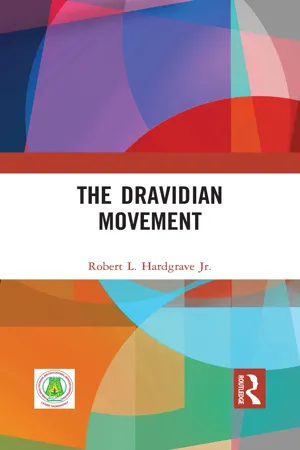
The foundations of politics in Tamil Nadu today are rooted in the rising consciousness and various organizations of what may be broadly termed "the Dravidian Movement" of the late nineteenth century and first decades of the twentieth century. This book focuses on the emergence of a new awareness of Tamil identity though a range of organizations for Dravidian uplift such as the Non-Brahmin Movement, the South Indian Liberal Federation (popularly known as the Justice Party), the Self-Respect Movement, the Dravida Kazhagam (DK), and its dynamic off-shoot, the Dravida Munnetra Kazhagam (DMK). The most prominent leaders of the Dravidian Movement were E. V. Ramaswamy Naicker, known as Periyar, "Great Sage," and C. N. Annadurai—Anna—who in 1967 was to become Chief Minister of Madras State. Today there are many books on Tamil politics, but until the 1960s no book had addressed the movement that was to become the dominant force in the political life of Tamil Nadu today. It was a young American, Robert L. Hardgrave, Jr., in 1960 who took up the project to portray the Dravidian Movement. With several months in Madras, he met leaders of the DMK and attended a number of conferences, and he collected all the pamphlets and papers he could find on the movement, many going back to the 1930s. As a graduate student at the University of Chicago, he brought this together for his Master's degree thesis, completed in 1962. It was published as a book, The Dravidian Movement, in Bombay in 1965. Long out-of-print, the pioneering volume is again available in this new reprint edition.
- 96 pages
- English
- ePUB (mobile friendly)
- Available on iOS & Android
eBook - ePub
The Dravidian Movement
1 Introduction
The Transformation of Primordial Sentiment
In 1947, as the time approached the transfer of power from the British Raj to an independent India, communal strife permeated the subcontinent. The decision for a separate Islamic State of Pakistan had spread bitterness and dissatisfaction among the elements of both Muslim and Hindu society, and within the Hindu society itself fissiparous tendencies of regional nationalism were asserting themselves to the detriment of Indian unity. On the eve of Independence, E. V. Ramaswami Naicker, leader of the newly formed Dravida Kazhagam in Madras, called upon the Dravidian peoples of South India “to guard against a transfer of power from the British to the Aryans.”1 Fearing Brahmin dominance under Aryan “imperialism,” Naicker called for the formation of a separate South Indian State, Dravidasthan, enjoining his followers to sign a pledge of support for complete separation from the Indian Union.
Less than eight years later, Naicker rallied his black-shirted followers to the support of a newly formed Congress Ministry under Kamaraj Nadar and declared opposition to the Dravida Munnetra Kazhagam, an offshoot of the DK which had captured the forefront of the movement for Dravidasthan. As the Congress Party of Madras became increasingly “Tamilized” in the years following 1954, the issue of Dravidasthan became a symbol of a growing specificity of regional demands on the part of the DMK and began to recede as a realistic aspiration in the minds of even the most nationalistic of Tamilians. In the General Elections of 1962, the DMK emerged as the strongest Opposition ever to challenge the entrenched Congress Party in Madras: it captured fifty seats in the Legislative Assembly and seven in the Lok Sabha (the Union Parliament). The DMK had campaigned on the issues of bread-and-butter politics, and its election manifesto reflected an immediate economic concern which all but forgot the aspiration for a separate and independent Dravidasthan. At the height of its power, the movement for Dravidasthan was virtually dead. It had been transformed, under the impact of social mobilization and accommodation by the government, from a secessionist movement, based on the glories of a resurrected past and a vague and impossible hope for the future, to a political party representing an increasing specificity of interests and a germinal acceptance of basic democratic, electoral and parliamentary values and practices.
Confronted by a continuing barrage of primordial demands, from the Muslim League to the Jan Sangh, the Jharkhand, and the DMK, Prime Minister Nehru long decried the “tribal mentality” of the Indian communities. Loyalties to the family, clan, caste, tribe, or village have remained seemingly fixed in time. India, however, is not unique. The newly emergent states of Africa and Asia are mosaics of a multitudinous variety of communities—racial, religious, ethnic, and linguistic. With what often seem no more than the formal trappings of modern statehood, each of these countries is confronted with the necessity of creating a nation, a single people, with a common identity and aspiration, out of the uncongealed plurality of its society. Indonesia comprises some two thousand islands, each clinging to its own “little tradition”, and stretching across an ocean area equal to the distance between New York and San Francisco. Malaya is confronted with a multi-racial population and a precariously even balance between the native Malay and the immigrant Chinese. In Burma, diverse tribal minorities forming more than one-third of the population live in the isolated hills above the Irrawaddi Valley. The people of East and West Pakistan, united by Islam, are separated by cultural tradition and one thousand miles of Indian territory. In Iraq, Islam is divided by the Sunni and Shi’i sects, while Lebanon is confessionally fragmented into seven major Muslim and Christian sects. Nigeria, Tanganyika, and most of the African states south of the Sahara are divided regionally by tribal kingdoms which pay little regard to the political boundaries of the modern state.
India, perhaps the supreme example, evidences the fissures of virtually every known societal division: six major religions— Hinduism, Islam, Sikhism, Christianity, Buddhism, and the faith of the Parsis; two major language families—Aryan and Dravidian, of which there are fourteen major languages and innumerable dialects and tribal tongues; racial varieties of the Aryan, the Dravidian, and the proto-Australoid; and two thousand castes, endogamous, occupational, and hierarchically ranked. Complex India, in its rich tradition, diversity, experience under the colonial rule and subsequent independence, reflects many of the problems and processes of political change which are being experienced throughout the non-Western world. India poses, perhaps all too clearly, the question of whether a multinational society can sustain a viable democracy.
The diversity in the national composition of the New States has posed a fundamental threat to the process of political development and nation-building, but it is a threat which is not unique to the areas of Africa and Asia. Every plural society has had in some way to accommodate its minorities. The state must, as Clifford Geertz has suggested, “reconcile them with the unfolding civil order by divesting them of their legitimizing force with respect to governmental authority, by neutralizing the apparatus of the State in relation to them, and by channelling discontent arising out of their dislocation into properly political rather than para-political forms of expression.”2 The process of integration has perhaps never been wholly successful even in the highly developed modern states of Europe and North America, but the integrative achievement of bilingual Canada and Switzerland, if only partial, has led to the creation and operation of viable democracies. The United States has, through the “ethnic ladder” and “balanced ticket,” been able to draw its substantial minorities into the political life of the nation through the structure of its party system.
A minority may, on the other hand, be represented by a political party of its own creation. Such a party may, as pointed out by Duverger, assumes the role of an arbiter and acquire considerable influence, either electorally or in parliament. Holding the crucial balance, the party may be able to shift its position in such a way as to make or break governments. Duverger indicates, however, that “if a party is clearly in a minority in the country as a whole but in a majority in certain districts its attitude becomes autonomist or even secessionist, which may imperil the unity of the country.”3 As examples, he points out the Alsatian party in Germany and the Sudeten German party in Czechoslovakia. He could have also added the Dravidian Movement.
The New States, with their minorities representing regional areas of racial, ethnic, or linguistic dominance, fall within Duverger’s second category. Religious minorities also tend toward regional concentration, although they may be dispersed over the country, as in Lebanon. The sizable and multitudinous minorities of the non-Western world represent an insular separateness in which the community becomes codeterminous with the world, reinforcing the fissiparous tendencies of autonomy and secession.
These states, determined to modernize and to take an equal place in the world of nations, are primarily traditional peasant societies. The universe for 80 to 90 per cent of these people is virtually limited to a 30-mile radius of the village community. The identity horizon of the individual is circumscribed by the personal contact of face-to-face relations, and loyalties are expressed in terms of the basic primary ascriptive affiliations of family, clan, lineage, caste, tribe, or village. Political activity, fundamentally limited to the issues of village life, is expressed largely in factionalism or clan groups, reflecting the divisions of the village in terms of primary identifications. Political behaviour is largely determined by the social stains of the individual and his personal ties. This condition, according to Lucian Pye,
places severe limits on the effectiveness of any who come from the outside to perform a political role, be it that of an administrative agent of the national government or of a representative of a national party. Indeed, the success of such agents generally depends more on the manner in which they relate themselves to the social structure of the community than on the substance of their political views.Thus, the fundamental framework of non-Western politics is a communal one, and all political behaviour is strongly colored by considerations of communal identification.44 Lucian Pye, Politics, Personality, and Nation Building: Burma’s Search for Identity (New Haven: Yale University Press, 1962), pp. 16–17.
Beyond the village, however, the urban areas of the New States are islands of change, centres of technical and intellectual innovation, from which political leaders seek to mobilize the population. Social mobilization denotes, in the words of Karl Deutsch “a concept which brackets together a number of more specific processes of change, such as changes of residence, of occupation, of social setting, of face-to-face associates, of institutions, roles, and ways of acting, of experiences and expectations, and finally of personal memories, habits, and needs, including the need for new patterns of group affiliation and new images of personal identity.”5 Defined more succinctly, it is “the process in which major clusters of old social, economic and psychological commitments are eroded or broken and people become available for new patterns of socialization and behaviour.”6
Through social mobilization, under the impact of the interacting variables of industrialization, urbanization, communication, and literacy, which acts both as agents and as an index of change, the individual is drawn from the traditional into the participant society of the modern state. It is within the “heterogenetic” city,7 where the traditional culture gradually disintegrates with the formation of new economic and cultural values and the acquisition of new social roles and action patterns, that the identity horizon of the migrant from the traditional village is expanded from the kin group and village to a sense of identity with religion, language, or nationality, and ultimately with class and state. Daniel Lerner, in The Passing of Traditional Society, sees this identity expansion as basic to modern society, which he characterizes as industrial, urban, literate, and participant. “Empathy,” the combination of projection and introjection, is the inner mechanism by which the individual’s identity horizon is enlarged and which enables the newly mobile person to operate efficiently in a changing world.8
This process may be considered as a transformation of primordial sentiment. Primordial sentiment refers to the terminal identification of an individual or group to a communal structure. The primordial bond, as Clifford Geertz states, stems from the assumed “givens” of social existence.9 This ascriptive and particularistic tie of the traditional village is expressed in terms of the primary affiliations of kin, caste, and tribe. But under the impact of social mobilization and its accompanying psychic mechanism, empathy, primordial identity is expanded and transformed to include the “givens” of language, race, religion, culture, or nationality.
This new self-image of membership in a larger community gives rise to an articulation of primordial sentiment and the formulation of particularistic political demands. The accommodation of primordial demands by the government provides the foundation for a second transformation of the identity horizon, from identity with nationality and language to an identity expressed in terms of class and associational interests. Whether the individual will make the final transition will depend upon the access afforded the primordial sentiment by the political system and the governmental response to the primordial demand. As access is widened in the accommodation of primordial sentiment, however, the political process will be “traditionalized” to a corresponding degree. In the removal of the felt-threat to its existence, the primordial party, in identifying with increasingly larger communities, thus undergoes a dynamic transformation through a dialectical process.
The expanding base of primordial sentiment in formulating a cultural nationalism, while regarded with honor by many who see it as the seed of separation and destruction, may be in fact the most effective vehicle in the transference of loyalty from the primary village and kinship groups to that of the larger community. Primordial sentiment thus acts, as in Lloyd Rudolph’s description of India’s caste associations, as a link between the mass electorate and “the new democratic political processes and makes them comprehensible in traditional terms to a population still largely politically illiterate.10 Its expanding base is the vehicle of political socialization and recruitment into the political culture. It is at the same time the agent of “traditionalization,” which has given rise to a growth of cultural nationalism throughout the New States of Asia and Africa. It is reflected in the “Arabization” of the Egyptian government, the “Sinhalesation” of the Ceylonese government, and the “Tamilization” of Madras State in India. It is the means by which the forms and processes of modern government become culturally acceptable, psychologically satisfactory, and politically meaningful to the people.
While the concept of the transformation of primordial sentiment is only an initial step—hopefully in the right direction—toward the formation of a theory of national political integration, it does suggest, in barest outline, a process in operation throughout the New Nations. This process is revealed in the growth and development of the Dravidian Movement from its inception to the present day. An analysis of the primordial dynamics of Tamil politics provides empirical flesh to the skeletal concept.
2 Foundations of the Dravidian Movement
The vast Indian subcontinent, in five thousand years of history, has nourished the growth of a great civil...
Table of contents
- Cover Page
- Half-Title Page
- Title Page
- Copyright Page
- Table of Contents
- Foreword
- Preface
- 1. Introduction
- 2. Foundations of the Dravidian Movement
- 3. The Justice Party
- 4. The Dravida Kazhagam
- 5. The Dravida Munnetra Kazhagam
- 6. Dravidian Politics and the First General Elections
- 7. The Second General Elections
- 8. Crisis and Victory
- Afterword to the reprint edition
- Bibliography
Trusted by 375,005 students
Access to over 1.5 million titles for a fair monthly price.
Study more efficiently using our study tools.
Frequently asked questions
Yes, you can cancel anytime from the Subscription tab in your account settings on the Perlego website. Your subscription will stay active until the end of your current billing period. Learn how to cancel your subscription
No, books cannot be downloaded as external files, such as PDFs, for use outside of Perlego. However, you can download books within the Perlego app for offline reading on mobile or tablet. Learn how to download books offline
Perlego offers two plans: Essential and Complete
- Essential is ideal for learners and professionals who enjoy exploring a wide range of subjects. Access the Essential Library with 800,000+ trusted titles and best-sellers across business, personal growth, and the humanities. Includes unlimited reading time and Standard Read Aloud voice.
- Complete: Perfect for advanced learners and researchers needing full, unrestricted access. Unlock 1.5M+ books across hundreds of subjects, including academic and specialized titles. The Complete Plan also includes advanced features like Premium Read Aloud and Research Assistant.
We are an online textbook subscription service, where you can get access to an entire online library for less than the price of a single book per month. With over 1.5 million books across 990+ topics, we’ve got you covered! Learn about our mission
Look out for the read-aloud symbol on your next book to see if you can listen to it. The read-aloud tool reads text aloud for you, highlighting the text as it is being read. You can pause it, speed it up and slow it down. Learn more about Read Aloud
Yes! You can use the Perlego app on both iOS and Android devices to read anytime, anywhere — even offline. Perfect for commutes or when you’re on the go.
Please note we cannot support devices running on iOS 13 and Android 7 or earlier. Learn more about using the app
Please note we cannot support devices running on iOS 13 and Android 7 or earlier. Learn more about using the app
Yes, you can access The Dravidian Movement by Robert L. Hardgrave, Jr. in PDF and/or ePUB format, as well as other popular books in History & Indian & South Asian History. We have over 1.5 million books available in our catalogue for you to explore.