Offering voices from the field – the first of its kind outside of Japan – this guide to teaching and learning elementary mathematics highlights real case examples from teachers and educators who share what they have learned through Lesson Study.
The teachers' reports provide vivid examples of new insights and ideas about mathematics, about pedagogy and lesson design, about student learning, and about professional collaboration gained through Lesson Study. Each report includes an abbreviated plan of the specific research lesson that led to the new insights, which readers can draw from to replicate the powerful learning in their own community. The case examples of this book are from Lesson Study in mathematics, elementary to lower secondary grade levels, focused on what teachers and educators have learned about improving mathematics teaching and learning; but many ideas from each report can be applied to other subjects and different grade levels.
This unique book will be an excellent resource for mathematics teachers in training and practice who seek to improve mathematics teaching and learning in their own and others' classrooms, including researchers and school administrators who lead professional development.
Word problems in the primary grades — solve "take-from with change unknown" story problems with grade 1 (6- and 7-year-old) students
BrigidBrown
DOI: 10.4324/9781003230915-6
One might think it would be hard to find a topic of common interest for a Lesson Study group spanning three grade levels, two languages of instruction, brand new teachers and veterans, and both a general- and a special-education-inclusion context. That was not the case for this team of primary grade teachers at Acorn Woodland Elementary School, for which I was a facilitator. With resounding conviction, they agreed: our students struggle with subtraction word problems. What causes this struggle? And what learning experiences and tools can we provide to help them make sense of this work? In our research, we would come to discover that a powerful way to answer these questions was to explore subtraction word problems from our students’ perspectives, attempting to solve as we imagined they might.
Across these different contexts and among students aged 5 to 8 years old, the teachers had noticed that when our students encounter a word problem, they often rush into calculations without taking time to comprehend the situation in the problem. Often this meant that students would scan the problem, take the two numerals they saw, add them, and name the total as the answer. The team wondered how they could slow students down enough for them to make sense of a problem first and then choose an operation that matched the context of the problem. To do so, students would need to attend to the meanings of the numbers in the problem, especially to the unknown. More broadly speaking, team members wanted to better understand their students’ mathematical thinking and to teach their classes in a way that would allow students to experience agency in their learning.
To ground our research in our students’ own experience of solving word problems, I led the team in a hands-on activity for exploring word problem types and structures, an activity that the team called “doing the math.” Using Elementary and Middle School Mathematics: Teaching Developmentally (Van de Walle, Karp, & Bay-Williams, 2016) as our guide, we first read about the different types of addition and subtraction problem types and structures. Then we went through each one and attempted to solve the way we thought our students might, using counters, diagrams, and equations. For reference, a chart similar to the one our team used is available in the Mathematics Glossary, Table 1, of the Common Core State Standards, available online at www.corestandards.org/Math/Content/mathematics-glossary/Table-1/.
Very quickly in the process of “doing the math” ourselves, the team noticed differences in the degrees of difficulty in the problem types and structures. Problems in which the result was unknown were easy to model with counters, and the equations looked familiar. But in problems where the unknown quantity represented the change or the start, we found it was difficult to use the counters to show our work. We were surprised to see that we came up with different equations to represent certain problems as well. For example, in a “take-from” subtraction situation where the change was the unknown, some team members were certain that an equation showing the total minus the known result was the proper representation (T − R =?), whereas others were convinced that the known result should fall to the right of the equal sign, with the total minus the unknown change to the left (T −? = R).
Team members reflected on how they’d never have guessed that discussing solution methods for addition and subtraction word problems would have led to such rigorous debate (and frankly, confusion) among a group of adults – these are kindergarten and first grade standards after all! The exercise left team members with a deeper appreciation for the complexities of these problems, and how significantly that complexity can vary among problem types and structures.
The team began to think of word problems as complex texts. Drawing on their literacy work, the team decided to try explicitly teaching students to use visualization with their word problems, just as they did in their reading. As a bridge to this strategy, the team would dedicate a series of lessons to unpacking one word problem at a time, treating the word problem like a storybook. The teachers designed four illustrations to align with the three quantities in their problem plus the question at the end, hypothesizing that this might serve as a productive support for relating the context to the corresponding equation.
Finally, the team considered what discussion questions could guide students to think carefully about the story context and the missing information: “What do we already know? What are we trying to figure out?” These questions could be applied in many lessons throughout the year in order to reinforce the concept of the “unknown” (or “mystery number”) in a word problem as a more precise way to think of the “answer.”
This process of study left a strong impression on our team of how mathematics teaching in the primary grades can be deceptive in its apparent simplicity. Working through specific word problems as we thought our students might allowed us to experience the “sense-making” required of our students, which was often in contrast to the “answer-getting” we remembered being emphasized in our own early schooling. We saw that even for what seems like a simple problem, “doing the math” could take us a long way towards teaching our students more effectively.
Lesson plan
Title of the lesson: Solve Take-From with Change Unknown Story Problems
Students’ school: Acorn Woodland Elementary School, Oakland, CA
Student ages: Grade 1
Instructor: Malia Vitousek
Co-authors: Kristen Brett, Brigid Brown, Shelley Friedkin, Jayme Kritzler, Francisco Llaguno, Maira Lopez, Natalia Ruiz, Tala Sullivan, Malia Vitousek
Date: October 24, 2018
Goal of the lesson: Students will be able to use their chosen strategy effectively to solve the problem on their own. Students will be able to articulate what each number represents.
Learning standards
Use addition and subtraction within 20 to solve word problems involving situations of adding to, taking from, putting together, taking apart, and comparing, with unknowns in all positions, e.g., by using objects, drawings, and equations with a symbol for the unknown number to represent the problem (CCSS Math 1.OA.A.1) ( Common Core State Standards Initiative, 2010).
Understand subtraction as an unknown-addend problem. For example, subtract 10 – 8 by finding the number that makes 10 when added to 8 (CCSS Math 1.OA.B.4) (Common Core State Standards Initiative, 2010).
Flow of the lesson
Introduction
TEACHER: “We have been working on math story problems and today I have a real math storybook to read with you!”
Posing the problem
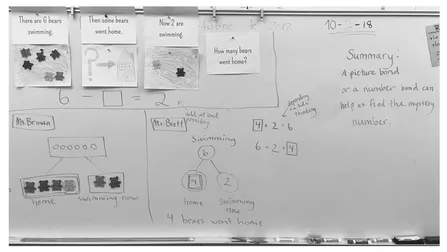
Teacher reads aloud the story problem: “There are 6 bears swimming. Then some bears went home. Now 2 bears are swimming. How many bears went home?”
Teacher then rereads the story, posting pictures on the board as she goes.
Anticipated responses
Note: Students may use any combination of the following strategies to reach their answer.
manipulatives
drawings
picture bond
number bond
equations
R1: Students combine 6 and 2 and name 8 as their answer.
R2: Students use manipulatives or diagrams to separate 6 into 4 and 2, but choose 6 as the answer or are unsure of which number is the answer.
R3: Students use manipulatives or diagrams to separate 6 into 4 and 2 and correctly identify 4 as the answer.
R4: Students use either an addition or subtraction equation but choose 6 or 2 as their answer.
R5: Students use an addition equation to identify 4 as the missing addend. 2 + _ = 6
R6: Students use subtraction to identify 4 as the difference. 6 – 2 = _
R7: Students use subtraction to identify 4 as the missing subtrahend. 6 − _ = 2
Comparing and discussing
Teacher presents two to three strategies that correctly depict the story, so the emphasis in discussion is on understanding how students’ strategies connect to the story, not on choosing the correct answer. Ideally one strategy uses manipulatives and one involves an equation, so as to have both concrete and abstract strategies represented in the discussion.
Teacher will ask questions such as:
What does the (name specific part of diagram or equation) represent? Where’s this in the story?
Six whats? (Six bears swimming at first)
Which numbers did we know? What was the “mystery number”?
How are these two strategies similar? Different? Where’s the (name specific part of diagram or equation) in this strategy . .. and in this one?”
Teacher may push students’ thinking by
adding labels according to students’ responses
prompting students to add equations to match their models
“playing the fool,” asking “Ok, so 2 went home?” in order to push students to explain, no, we don’t know how many went home.
Teacher may offer the equation 6 − _ = 2 under the story book as a way to represent the problem.
Summing up
Planned summary: A picture bond [or number bond] can help us find the mystery number.
Extension problem: There are 9 birds in a tree. Some birds flew away. Now there are 3 birds in the tree. How many birds flew away?
Board plan
Figure 2.1 Board plan for the lesson
Observations from the lesson
During the lesson, I immediately noticed the routines and norms Malia had been building in her classroom. Malia invited the students into the work of the lesson, asking them “are you up for the challenge?” to which they chorally responded in the affirmative. Students ea...
Table of contents
Cover
Half Title
Series
Title
Copyright
Dedication
Table of Contents
List of figures
List of tables
Foreword
Preface
Acknowledgements
List of contributors
I How we expect Lesson Study to contribute to the quality of teaching and learning
II What we learned about the contents we teach
III What we learned about lesson design and pedagogy
IV What we learned about student
V What we learned about teacher collaboration and leadership
VI Ideas for establishing sustainable Lesson Study - what we learned from US schools
Index
Trusted by 375,005 students
Access to over 1.5 million titles for a fair monthly price.
Study more efficiently using our study tools.
Frequently asked questions
Yes, you can cancel anytime from the Subscription tab in your account settings on the Perlego website. Your subscription will stay active until the end of your current billing period. Learn how to cancel your subscription
No, books cannot be downloaded as external files, such as PDFs, for use outside of Perlego. However, you can download books within the Perlego app for offline reading on mobile or tablet. Learn how to download books offline
Perlego offers two plans: Essential and Complete
Essential is ideal for learners and professionals who enjoy exploring a wide range of subjects. Access the Essential Library with 800,000+ trusted titles and best-sellers across business, personal growth, and the humanities. Includes unlimited reading time and Standard Read Aloud voice.
Complete: Perfect for advanced learners and researchers needing full, unrestricted access. Unlock 1.5M+ books across hundreds of subjects, including academic and specialized titles. The Complete Plan also includes advanced features like Premium Read Aloud and Research Assistant.
Both plans are available with monthly, semester, or annual billing cycles.
We are an online textbook subscription service, where you can get access to an entire online library for less than the price of a single book per month. With over 1.5 million books across 990+ topics, we’ve got you covered! Learn about our mission
Look out for the read-aloud symbol on your next book to see if you can listen to it. The read-aloud tool reads text aloud for you, highlighting the text as it is being read. You can pause it, speed it up and slow it down. Learn more about Read Aloud
Yes! You can use the Perlego app on both iOS and Android devices to read anytime, anywhere — even offline. Perfect for commutes or when you’re on the go. Please note we cannot support devices running on iOS 13 and Android 7 or earlier. Learn more about using the app
Yes, you can access Educators' Learning from Lesson Study by Akihiko Takahashi, Thomas McDougal, Shelley Friedkin, Tad Watanabe, Akihiko Takahashi,Thomas McDougal,Shelley Friedkin,Tad Watanabe in PDF and/or ePUB format, as well as other popular books in Education & Education General. We have over 1.5 million books available in our catalogue for you to explore.