This second edition of Making an Entrance is a practical and thought-provoking introduction to teaching dance with disabled and non-disabled students, updated with expanded coverage, new and revised exercises, and chapters that cover post-pandemic and online practice, diversity and inclusivity.
With improvisation as his central concern Benjamin covers an extensive range of topics, including new autoethnographic writing, mental health, performance, feedback, and The Dancers' Forest, and interrogates what we mean when we talk about 'inclusive' and 'integrated dance.' There are over 50 stimulating and challenging exercises purposefully designed for dance students of all levels accompanied by teaching notes, and examples drawn from the author's experience as a teacher, performer, and dance maker. Useful hints are provided on the practicalities of setting up workshops covering issues such as class sizes, the safety aspects of wheelchairs and accessibility.
An essential read for both students and teachers of improvisation who are seeking ways to engage with issues of diversity, written to be accessible whilst offering areas of increasing complexity and challenge for more experienced practitioners.
Finding it when you get there was the title of an inclusive dance workshop I led in Berlin at Tanzfabrik in 2014. Despite the access difficulties associated with the school, the directors2 wanted to open the programme to disabled students. The title was reference both to the uncertainties that awaited me in Germany and also to my own practice of improvisation, a commitment to un-scored work, and a willingness to leave space for the unknown and the unexpected. In 10 Rules for students and teachers (often misattributed to John Cage), Sister Mary Corita3 refers to this as leaving plenty of room for ‘x.’ Her point being that there are always going to be elements in creative processes that come into play only if we allow time and space for them to emerge. The implication being that those of us in the arts should therefore avoid being overly prescriptive about what our outcomes might be or, in the case of dance, too ‘conscriptive’ about what kind of body might qualify for training.
In conversation with Steve Paxton in the mid-1990s, I suggested that integrated dance would only be assured a sustainable future when we were able to see courses in universities open to disabled students and that those students be given the opportunity to train alongside their non-disabled peers. Paxton, the founder of Contact Improvisation and one of the first postmodern dancers to explore integrated dance, replied that he ‘100% agreed … and 100% disagreed.’ In 2008, I took a post at Plymouth University and pushed ahead with the issue of access. Six years later, the same year4 as the Berlin workshop, we were able to celebrate the opening of a fully accessible theatre (The House) and a performing arts programme that positively encouraged disabled students to apply. What, though, of the other 100% that part of the argument with which Paxton disagreed? Perhaps it was because he was able to see that higher education is conservative by nature, and that radical movements (and I would include inclusive dance in this category with its historical links to Contact Improvisation) are more likely to thrive outside of the academy, where exploration and ‘unforced’ research progress at their own pace. Paxton’s concerns might be summarized by educational reformer and Dean of the School of Education at the University of San Francisco, Kevin Kumashiro.
(P)edagogy often does what is harmful to itself, such as by privileging rationalism and repressing other ways of knowing and relating, such as “touching” (which is what Britzman suggests can lead the ego to desire to know, change, and make reparation).
Kumashiro, 2010:46
In this chapter I reflect on my Berlin workshop experience and my position as a non-disabled, Jewish artist traversing the fields of dance and disability with reference to the notion of reparation that Kumashiro refers to in the above quote. By including the voices of workshop participants, I hope to reveal how an embodied approach to learning prepares us for our lives in the world and indeed has the capacity to repair and renew our connection to the world we live in. It is both educative and regenerative, a model of the arts that seems increasingly usurped by an economic paradigm in which entrepreneurship and industry-driven curriculum design leaves precious few openings for ‘x.’
Berlin – July 2014
I was, truth be told, feeling the strain of a very full summer schedule on the back of a hectic year’s teaching at Plymouth University. Fortunately, I was staying in Kreuzberg, a stone’s throw from Viktoriapark, and the light summer mornings allowed me solitary re-adjustment time amidst the capital’s early morning dog walkers, a welcome space for tai chi and to contemplate each day ahead.
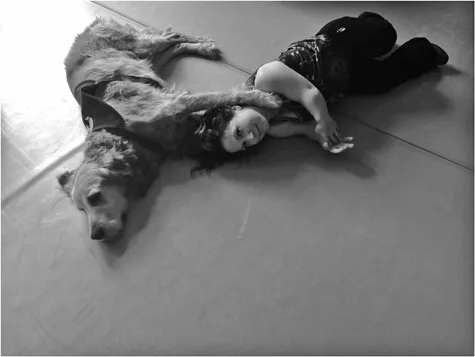
First morning, and dancers began to arrive, amongst them lawyer (and dancer) Silke Schöenfleisch accompanied by her helper dog, Jack. Between snoozes, Jack watched our activities with mild curiosity, occasionally meandering amongst the moving bodies before flopping down in his favoured spot by the piano.
I became increasingly fascinated by the immediacy of his sensing. As the workshop un-folded, he began to serve as litmus test to my teaching and my sense of presence. It was under Jack’s gaze that I began to monitor and reflect on how forced or faithful my choices and responses felt. I wrote in my diary:
It is in relation to Jack’s responses that I measure my steps, my tone, my playfulness, my resting; not all the time, sometimes I am oblivious to him, but his presence in the space is part of my sensorial world, a part I find myself taking more and more notice of. His senses outreach mine, his ears prick to sounds beyond my range, his nose tastes the air, his body gives way to resting with ease, while mine, full of a teacher’s thoughts, resists the floor; Jack, an uncanny, canine referee, seems able to sniff out a lie at forty paces.
FIGURE1.1Silke Schöenfleisch and helper dog Jack. Photo by author.
Joint Action5
On the second day, we play with Crossing the Line (Chapter 18), dancers entering the performance space,6 improvising for an agreed period, and then seeking their most opportune/satisfying/meaningful moment to leave, departing the space across the same line by which they entered. Jack watched the proceedings. Toward the end of one improvisation, a dancer becomes stranded alone in the space, temporarily unable to find the moment to leave. As we all watch, attending to her choices, gauging our need to offer assistance against her need to explore this moment of uncertainty, Jack emerges from behind the piano, crosses to where she stands, gently takes her by the wrist and tenderly (her wrist in his mouth) guides her across the (imaginary) line to join the rest of the group. It is such a remarkable moment that no one can think of anything very much to say. Silke, Jack’s owner, seemed fairly un-phased by it and explained that Jack saw what needed doing and was just trying to help; ‘He is a helper dog, Adam, a retriever, that’s his job.’ And Jack just looked at me, with his doleful eyes as if to say, ‘That wasn’t too difficult, was it … Adam?’
It is part and parcel of my teaching methodology to encourage students to be aware of everything that is in the space and be cognizant of how the space, and all that is in it, offers itself to the improvisation. Here is Gearóid McCann, one of the workshop participants describing the early work in the studio:
For the first two days, the groundwork of the practice, an attention to breath and senses was gently introduced and bedded in. This awareness of what is seen, heard, felt, sensed, touched connects us not only to each other but to physical space we move within, our breath connects us to the air that breezes in from the open windows, to the sounds of the city, police sirens sounding, birds singing, a dog barking somewhere down on the street below, our practice brings us into ‘being’ rather than ‘acting’ or the dance equivalent, ‘throwing shapes.’
Gearóid’s reference to the ‘groundwork’ brings to mind the work of social anthropologist Tim Ingold who talks of the ground comprising ‘a domain in which the lives and minds of its human and non-human inhabitants are comprehensively knotted with one another’ (Ingold, 2015:49). For many years the cognitive sciences laboured under the misapprehension that studying isolated individuals in laboratory conditions through psychological and neurological testing could give definitive answers about human behaviour and the nature of consciousness. It is an approach that has been referred to as the ‘experimental quarantine’ approach (Richardson et al., 2008), one that aligns itself to a medical model of the human psyche and neurologically centred explanations of consciousness. The unexpected contribution of Jack, clearly no respecter of ‘quarantines,’ raises myriad questions about social interaction and in particular about joint action; that field of enquiry that explores events where two or more individuals coordinate their actions in space and time to bring about a change in the environment (Sebanz et al., 2006). Whatever ‘motive’ we might apply to Jack’s action, his intervention in our score was a beautiful and unexpected example of Corita’s ‘x,’ a moment when something ‘other,’ something outside of our field or frame of enquiry, actively intervened in our research. It was a reminder that we are connected to the world and interact with it in multiple ways, some of which transcend individuated action or language. It was also a reminder that the purpose of research and education is to open us to possibilities that we might not have previously considered and to raise questions that we might not previously have imagined.
It can hardly be expected that students will emerge from higher education imbued with personal flexibility, able to respond deftly to the unexpected, unless they have encountered something of the kind in their educational experience (Barnett, 2014).
Breathing Space
I was somehow very aware that each morning the workshop participants made their way across the city to the studio, and each evening carried something of the studio research with them back out through the Berlin streets: that each day the studio seemed to breath us in, and each evening breath us out again, the boundaries of our activity, increasingly porous and difficult to define. Below, two of the participants record their experiences on different sets of wheels, the first provides an alternative perspective to the issue of ‘assistance’ raised by Jack’s actions and the second touches the idea of ‘grounds for play.’
In everyday life, it is very seldom that if I approach someone, he or she will respond to me, in the way they did in the workshop. Usually, people are scared and back away from me or they worry that I will run them over and hurry their children out of my way. If I look at someone in everyday life, usually they ask me “Do you need help?” so I avoid making eye contact. In the workshop this changed. When I travelled by train after the week and wanted to relocate from my wheelchair to a train seat, and to do so I need to sit on the floor, and this time when someone offered me help there was no accompanying feeling of stress or shame, just a simple understanding between us of what help was needed. I would say that I now move more and in different ways. I don’t sit so long in the same position in my chair, I put my legs on a bench or my back on a wall. And I allow myself to move more slowly. I notice impulses more often, and follow them, I am less the object of others’ gaze, more the director of my own.
Denise Kastler
Today a hitherto unpleasant cycle along a route where cyclists, pedestrians and motorists share limited space became a chance to dance attentively through the crowd. The necessity I often feel to defend my space gave way to playfulness. Tempo, balance, all round vision and especially, consideration for the others sharing the space with me became the elements of an improvisation that I joined in.
Gearóid McCann
Denise reminds us that integrated work is educative in the most profound sense, that it leads the individual out into new understandings, it widens the field of knowledge that we all share, and along with Gearóid, that this new shared knowledge shapes how we perceive and interact with the world around us. The world is no longer ‘other’ but a field of play that is mutual – a rather wonderful word ‘mutual,’ which denotes not only ‘shared,’ but has its roots in the Latin mutare – to change. Perhaps then, change need not always solely be presaged with disruption and dissatisfaction (Kumashiro, 2013). Perhaps change might also arise through play, which would therefore require the provision of ‘playground’ and ‘play time’ within our pedagogic offer.
Watching
On the Wednesday afternoon of the workshop, I was scheduled, as part of the summer programme, to perform with Gabi Reuter and Sharon Hilleli-Assa, a visiting artist from Israel. That day my workshop session overruns, and I find myself hurrying along the corridor to the performance space. Gabi and Sharon greet me and recognize my flustered, less than prepared state of body/mind. They weigh me down with knowing hands that guide me into my muscles and bones. My breathing shifts, my eyes meet theirs, they seem to trust me – I don’t know why, as I have not an idea in my head, but I, in return, empty, trust them. I am temporarily tethered and held, and for a moment, I stand willing and expectant but also, a little vacant, waiting to be led. This very uncertain, nascent, one might say ‘dog-like’ interlude, served as a reminder that some of our most basic emotive states might well be shared by species other than Homo Sapiens. Perhaps it is the ‘sapient’ nature of our species, and the enforced sapience of higher education that at times leads us away from this place of w...
Table of contents
Cover Page
Half-Title Page
Title Page
Copyright Page
Dedication Page
Contents
List of Figures
Foreword
Acknowledgements
Preface
PART I THOUGHTS
PART II PRACTICE
PART III OUTSIDE (THE BOX)
Bibliography
Index
Trusted by 375,005 students
Access to over 1.5 million titles for a fair monthly price.
Study more efficiently using our study tools.
Frequently asked questions
Yes, you can cancel anytime from the Subscription tab in your account settings on the Perlego website. Your subscription will stay active until the end of your current billing period. Learn how to cancel your subscription
No, books cannot be downloaded as external files, such as PDFs, for use outside of Perlego. However, you can download books within the Perlego app for offline reading on mobile or tablet. Learn how to download books offline
We are an online textbook subscription service, where you can get access to an entire online library for less than the price of a single book per month. With over 1.5 million books across 990+ topics, we’ve got you covered! Learn about our mission
Look out for the read-aloud symbol on your next book to see if you can listen to it. The read-aloud tool reads text aloud for you, highlighting the text as it is being read. You can pause it, speed it up and slow it down. Learn more about Read Aloud
Yes! You can use the Perlego app on both iOS and Android devices to read anytime, anywhere — even offline. Perfect for commutes or when you’re on the go. Please note we cannot support devices running on iOS 13 and Android 7 or earlier. Learn more about using the app
Yes, you can access Making an Entrance by Adam Benjamin in PDF and/or ePUB format, as well as other popular books in Media & Performing Arts & Inclusive Education. We have over 1.5 million books available in our catalogue for you to explore.