The Archaeology of the Prussian Crusade explores the archaeology and material culture of the crusades against the Prussian tribes in the 13th century, and the resulting society created by the Teutonic Order which endured into the 16th century.
It provides an updated synthesis of the material culture of this unique, hybrid society in the south-eastern Baltic region, encompassing the full range of archaeological data, from standing buildings through to artefacts and ecofacts, integrated with written and artistic sources. The work is sub-divided into broadly chronological themes, beginning with a historical outline, then exploring the settlements, castles, towns and landscapes of the Teutonic Order's theocratic state, the character and tempo of religious transformation and concluding with the roles of the reconstructed and ruined monuments of medieval Prussia in the modern world, particularly within the context of Polish culture.
This remains the first work on the archaeology of medieval Prussia in any language, and is intended as a comprehensive introduction to a period and area of growing interest. This book represents an important contribution to promoting International awareness of the cultural heritage of the Baltic region, which has been rapidly increasing over the last few decades.
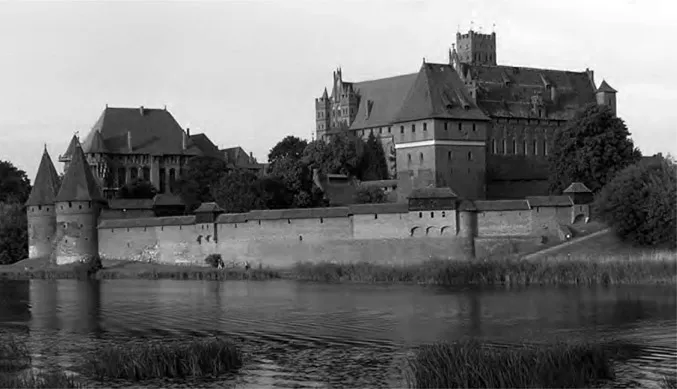
The castle at Malbork, a small town in the Pomeranian province of North Poland situated on the River Nogat, a distributary of the lower Vistula, is the largest fortified structure built from brick in the world, encompassing an area of around 20 hectares (Figure 1.1). Painstakingly restored to its fourteenth-century appearance following its partial destruction during the Second World War, the castle is the largest of the 218 fortified structures constructed between the mid-thirteenth and early-fifteenth centuries within the boundaries of modern North Poland, the Russian Kaliningrad Oblast and south-western Lithuania.1 These lands were known to medieval Europeans as Prussia, and in the thirteenth century they were inhabited by tribes who had rejected the message of Christianity and continued to venerate gods in woods, meadows and lakes.
FIGURE1.1 The castle at Malbork (Marienburg), view from the south-western bank of the Nogat
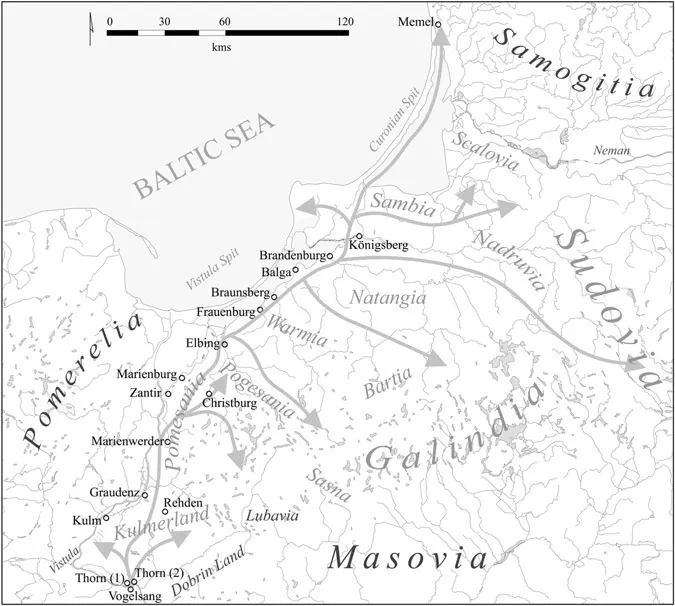
From 1230 a group of knights, members of the Order of the Hospital of St Mary of the Germans, more commonly referred to in the English-speaking world as the Teutonic Order, unleashed half a century of sustained warfare on the Prussian tribes framed in the language of Christian holy war: crusade. This was a war sanctioned by the pope in defence of Christianity (or its representative, the Church), conceptualised as an act of penance. Participants in a crusade received a plenary indulgence; a full remission of the penalties that were the consequence of sin. This custom had fully developed by the early-thirteenth century (Fonnesberg-Schmidt, 2007, p. 7; see also Trupinda, 1999, pp. 17–64). Crusaders, their families and properties also came under papal protection (Riley-Smith, 2002). The motivation for launching crusades against the Prussian tribes may be popularly associated with the territorial ambitions of the Masovian dukes, but Polish colonisation of neighbouring regions from the mid-tenth century had been accompanied by evangelisation and the establishment of ecclesiastical infrastructure (see also chapter 2). At the end of the eleventh century, the First Crusade had linked holy war with the protection of Christians. This sentiment was echoed in the early-thirteenth-century call for crusades against the Prussian tribes, considered an active threat to Christians living in the Polish-held Kulmerland (Ziemia Chełmińska; Figure 1.2). Although participating crusading armies were mixed, and in the fourteenth century knights from all corners of Christendom journeyed to Prussia to crusade against pagan Lithuanians, the Teutonic Order drove and dominated the transformation of Prussian tribal lands into a European, Christian polity. The Order created a state run by religious institutions: a theocracy. This was not so unusual in the case of the bishop’s territories which found their equivalents in the Holy Roman Empire, but more so in the case of the Order’s lands. The castle at Malbork, which became the headquarters of this state in 1309, was constructed in multiple phases over a period of almost 180 years. It was named Marienburg after the Order’s most important patron saint – the Virgin Mary.
FIGURE1.2 Prussian tribal territories and the path of the thirteenth-century crusades (redrawn aft. Biskup et al., 2009)
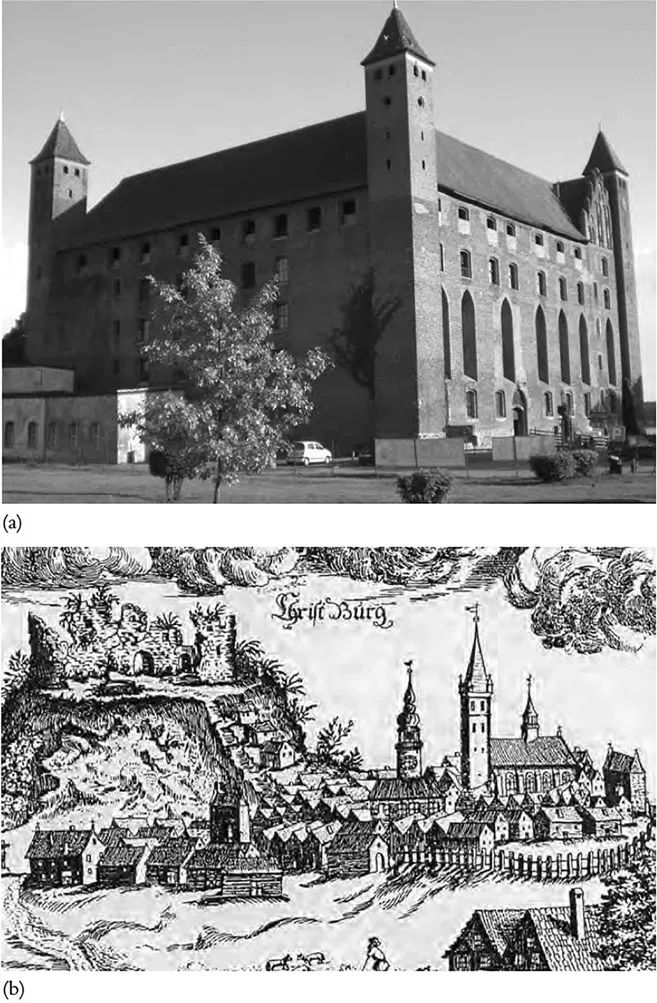
The origins of this institution of fighting monks lay in a hospital order established during the siege of Acre in 1190, to cater for German-speaking crusaders. Eight years later the brothers of the hospital were reincorporated as a military order by Pope Celestine, taking vows of poverty, chastity and obedience. Like their model the Templars, the Teutonic Knights developed a reputation as an effective, disciplined military force committed to the defence of Christendom. Initially petitioned to defend the eastern border of the Kingdom of Hungary against nomadic pagan Cumans in 1211, just over a decade later the Teutonic Order was invited by the Duke of Masovia to stabilise the northern frontier of his Polish domain. The Prussian Crusade that followed (in fact consisting of a series of crusades), resulted in the creation of a theocratic state in former Prussian tribal lands dominated by the Order, and secured with castles, several of which were built from red brick. This was accompanied by the introduction of Christianity and a protracted process of colonisation. The Order’s annexation of neighbouring Catholic Pomerelia (eastern Pomerania) in 1309 expanded its state but ultimately led to conflict with the Kingdom of Poland. This was finally resolved on the battlefield at Tannenberg (Polish Grunwald; Lithuanian Žalgiris) on 15 July 1410, where most of the Order’s leadership, including the Grand Master, were killed, after which its Prussian state slowly but assuredly declined. In 1525, the last Grand Master converted to Lutheranism and what remained of his territory in East Prussia became a duchy dependent on Poland. Although the region would experience further turmoil in later centuries, culminating in the years of the Second World War, several of its iconic red brick castles have survived and are now centres of burgeoning and increasingly international tourism (Figure 1.3). They remain the most vivid reminder in the south-eastern Baltic of a formative epoch in the shaping of European society.
FIGURE1.3 The castle at Gniew (Mewe) (a) and the ruins of the castle at Dzierzgoń (Christburg) as drawn by Hartknoch in 1684 (b)
In recent decades, the body of scholarly literature on the Baltic or Northern Crusades has steadily increased (see below). The Teutonic Order’s crusades and state in Prussia have been studied intensively by German and Polish scholars, primarily concerned with the Order’s military and political history, its bureaucracy and organisation. The number of scholarly papers and books in English has also begun to increase in the last two decades, building on the foundations of William Urban’s The Prussian Crusade (2000; originally published in 1980) and Eric Christiansen’s The Northern Crusades (1997; originally published in 1980). Moreover crusading in Prussia, and the rest of the eastern Baltic, is studied within the context of ‘Europeanisation’ – the expansion of medieval Christian Europe (Bartlett, 1994). In Prussia, the process has been frequently referred to as ‘Germanisation’, a continuation of Ostsiedlung or Drang nach Osten: the eastward expansion of German-speaking populations during the twelfth and thirteenth centuries (Labuda, 1964; see also chapter 3). The Order’s state certainly had a distinct ethnic dimension: the Teutonic Knights largely recruited from the German-speaking lands of the eastern Holy Roman Empire, and the majority of the peasant colonists invited to settle the Prussian interior was German. But nationalist sentiment in the early-twentieth century readily linked this multi-faceted process of medieval colonisation with a long-term agenda of territorial expansion, culminating in the Nazi invasion of Poland in 1939, an association that continues to colour popular perceptions of the crusading period in Prussia (see also chapter 8). In post-war Poland, the Teutonic Order became synonymous with German militarism and expansion (Von Güttner Sporzyński, 2008, p. 13). In fact, there is no evidence for a ‘German agenda’ of colonisation. Instead, the region is considered by modern historians as a frontier: a meeting point and crucible of contrasting social and economic systems, languages, religions and political agendas. Both hostility and collaboration defined the transformation of eastern Baltic societies into medieval states emulating in many ways the structures of the Holy Roman Empire (Jensen, 2001). Given this monumental corpus of scholarship, with its own fascinating historiography, it is not surprising that our understanding of medieval Prussia, and indeed the other crusading frontiers, remains dominated by studies of historical sources.
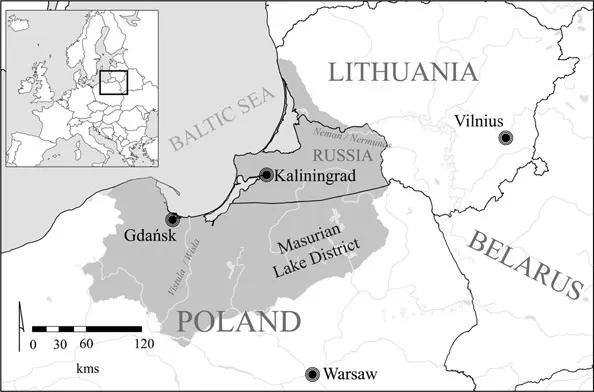
Archaeologists, in turn, have been excavating sites associated with both the Prussian tribes, the Teutonic Order and the migrant-fuelled populations of medieval Prussia for over a century. However, the discipline has been subdivided into the early and late Middle Ages, and it is unusual to see synthetic studies encompassing the centuries before and after the Prussian Crusade, although the relationship between castles and earlier strongholds has always attracted the attention of excavators. Indeed, the most visible representations of late-medieval archaeology in Prussia focus on the Order’s spectacular castles and towns (the former also accounts for the only synthetic work in English; Turnbull, 2003) whilst more detailed reports, syntheses and discussions remain scattered throughout specialist periodicals and regional journals. Moreover, the shifting political geography of the south-eastern Baltic has split the former territories of the Teutonic Order between three countries, representing a formidable obstacle to scholarly communication and collaboration (Figure 1.4). These difficulties are exaggerated even more for those seeking a broader understanding of the Baltic region, particularly when comparing Prussia, Livonia, Lithuania and the Russian principalities beyond. The most extensive work on the archaeology of medieval Prussia has been conducted in Poland, which encompasses a significant proportion of the Order’s former state. This time period is defined by Polish scholars as the transition from the early to late Middle Ages, although in Latvia and Estonia the same process is used to mark the end of the Iron Age and the start of the medieval period. The territories of the Teutonic Order extended to the northern tip of the Curonian Lagoon, although the castle at Memel (Klaipėda) and its commandery were administered by the Order’s Livonian branch until 1328 when the castle and much of its district became incorporated into Prussia.
FIGURE1.4 The south-eastern Baltic region today with the territory of medieval Prussia shown in grey
On ecclesiastical matters, the Memel region answered to the bishops of Cour-land and was the location of their residence until the start of the fourteenth century, although in the twentieth century it belonged briefly to the diocese of Ermland (Warmia) (Rowell, 1999, p. 195). From this point, the crusader states of Prussia and Livonia would be separated by Samogitia (Lithuanian Žemaitija). Today, western Lithuania (Klaipėda County or Lithuania Minor) encompasses parts of the former tribal territories of Courland, Scalovia and eastern Sudovia, which were replaced by the commanderies of Memel and the northern fragment of Ragnit. Lithuania minor has also seen over a century of archaeological research, particularly focused on the Late Iron Age culture, as well as the castle and part of the Old Town at Klaipėda. The distinction made in this book between the Order’s state in Prussia and Livonia is, on one level, somewhat artificial (see also chapter 9). Both regions were closely connected, although the Livonian branch of the Order acted interdependently and its relations with the indigenous population were different. The Memelland’s cultural sphere overlapped with Courland and Samogitia, whilst for merchants and crusaders alike it was easier to reach by sea than by land from Sambia. It is included here as the north-western frontier of the Order’s Prussian territories and provides an instructive case study for comparison with the heartland of western Prussia.
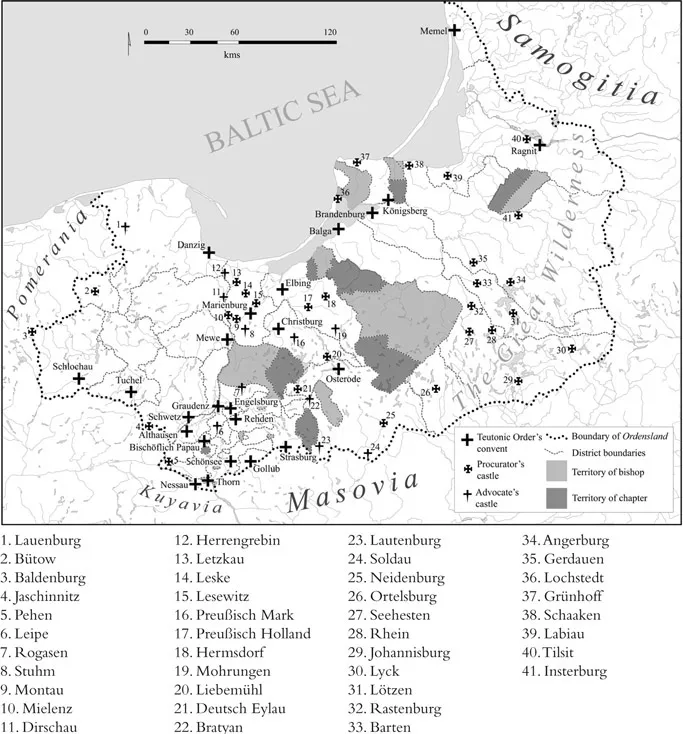
Sandwiched between north-east Poland and western Lithuania is the Kaliningrad Oblast, the geographically separated, western-most district of the Russian Federation. Ermland and the Duchy of Prussia had been amalgamated as the province of East Prussia or Ostpreußen in 1772–1773. Its borders remained more or less intact until 1919 when the Treaty of Versailles separated it from the Memelland, which four years later became an autonomous region within the Republic of Lithuania. In 1945, East Prussia was sub-divided between Poland and the Soviet Union, with Poland gaining around two-thirds of this territory. The Russian portion encompassed the tribal territories of Sambia, Nadruvia and part of Scalovia, which had been replaced by the Teutonic Order’s commanderies of Königsberg, Ragnit, Brandenburg and Balga, as well as the territories of the Sambian bishops (Figure 1.5). The incorporation of this region into the Soviet Union following the Second World War saw a programme of resettlement with a pronounced anti-German/pro-Slav policy, effectively rebranding the entire province. In 1945, the surviving German population was expelled and a year later the first wave of Russian, Ukrainian and Belarussian settlers arrived, followed later by Lithuanians, resulting in the reduction of the modern German population to less than 1 per cent (Krickus, 2002, pp. 40–41). Whilst Prussian and medieval sites have been excavated here, publications and especially grey literature are relatively difficult to access. This is beginning to change and there is in fact an extensive body of literature on the archaeology of early Sambia in Russian and German (for a good bibliography of the latter see Wendt, 2011). Vladimir Kulakov, Alexander Khokhlov and Anatoly Valuev have been leading various projects in recent years focusing on the former castle area in Kaliningrad, including the Prussia Museum, in the Old Town and across the region through to the coast.
FIGURE1.5 The commanderies and episcopal domains within the Teutonic Order’s state at the start of the fifteenth century (redrawn aft. Biskup et al., 2009). Engelsberg (Pokrzywno) was a commandery centre until 1416
The political and military significance of the Oblast had limited the possibilities of international collaboration in the second half of the twentieth century, although this situation has changed in the last two decades. In 2001, the German magazine Der Spiegel funded Russian-led excavations at the former castle in Kaliningrad. In 2003, a German–Russian team excavated a mid-first- to eleventh-century AD cemetery at Berezovka and also re-examined finds from earlier excavations at the site, whilst three years later a Viking Age settlement and cemetery at Wiskiauten (also referred to as Kaup and in the vicinity of Mokhovoye) on the northern Sambian coast was the focus of an excavation programme by a joint Russian and German team, deservedly hailed as a landmark in ‘building bridges’ (Streier, 2008). These excavations led by Vladimir Kulakov (2005) and Timo Ibsen (2005) have significantly contributed to our understanding of Prussian Sambia and its Baltic, particularly Scandinavian, contacts. New projects using innovative methodologies have also sought to re-define the chronologies of the region’s archaeological sites and monuments, particularly those of strongholds (Wemhoff et al., 2012; Ibsen et al., 2017; Ibsen, 2018) and cemeteries (Shiroukhov, 2019). Although much of the collection and archives of the Prussia Museum in Königsberg were destroyed during the Second World War, along with virtually the entire city, some material was recovered, and some had been dispersed to museums in Berlin, Olsztyn, Warsaw and Tallinn. From 2006, Polish, German and Russian archaeologists collaborated on conserving and studying the fragmentary archives (Bitner-Wróblewska, 2008). Artefacts from the old museum were also recovered in a nearby fort and discovered in the stores of the Museum für Vor- und Frühgeschichte in Berlin. Work continues on publishing restored archival data (Ibsen et al., 2013). The limited publications on the archaeology of medieval Sambia have restricted an integrated perspective of the Order’s state, whilst a commercial market for illicit antiquities such as coins has developed not only in the Kaliningrad region, but also in Poland (Paszkiewicz, 2009, pp. 130–131).
Similar problems of mutually negative perceptions arising from nationalist sentiment had plagued both German and Polish perceptions of the Teutonic Order’s state, especially in secondary education. The first German–Polish joint venture in heritage management was initiated from 1999, when the Museum of Western Prussia (Westpreußische Landesmuseum) in Drostenhof (Münster-Wolbeck) collaborated with the Regional Museum in Puck (Muzeum Ziemi Puckiej) alongside other institutions, most recently the National Museum in Gdańsk, to open the Regional Museum in Krokowa focusing on the Kashubian culture in Pomerelia. In 2008, the EU’s North Sea Region Programme (INTERREG IVb) facilitated the proposal of the construction of an open-air museum in the Kaliningrad Oblast based on the complex at Wiskiauten, building on an international living history festival begun two years earlier. From 2006, ‘The Lithuania, Poland and Kaliningrad Region of the Russian Federation Neighbourhood Programme’, co-financed by the European Regional Development Fund and the EU’s technical assistance programme, has sought to foster cross-border research collaborations and networks between Kalipėda County in Lithuania and the Kaliningrad region, with historical studies as one of its key priorities. Younger generations in Kaliningrad are certainly interested in the pre-Soviet heritage of the city, which has no place in the grand narrative of Russian history (Vendina, 2015), but plans to rebuild the Teutonic Order’s castle have been replaced by a desire to reimagine the ‘House of Soviets’, which had been constructed on top of the demolished ruins as a symbol of Russian supremacy. The region’s heritage remains inextricably connected with political identity. The future of international collaboration on research into historic and prehistoric Prussia looks bright, if only darkened by widespread reductions in public sources of funding.
The second edition of this book seeks to provide an updated synthesis of archaeological work on medieval Prussia, aimed at increasing public and...
Table of contents
Cover
Half Title
Title
Copyright
Dedication
Contents
List of figures
Preface and acknowledgements to the first edition
Preface to the second edition
Terminology and glossary
1 Introduction: historical framework and sources
2 Pre-Christian Prussia: early medieval Baltic society
3 The ravages of holy war: crusade and colonisation in the thirteenth century
4 A land of red castles: consolidating the Teutonic Order’s state in the fourteenth century
5 From colonisation to urbanisation: towns and international trade
6 Converting Prussia: the Christianisation of the Teutonic Order’s state
7 From forest to field: the changing environment of medieval Prussia
8 The end of holy war: from the decline of a crusader state in the fifteenth century to constructing memories of medieval Prussia in the twentieth century
9 Conclusion: holy war and colonisation
Further reading
Bibliography
Index
Trusted by 375,005 students
Access to over 1.5 million titles for a fair monthly price.
Study more efficiently using our study tools.
Frequently asked questions
Yes, you can cancel anytime from the Subscription tab in your account settings on the Perlego website. Your subscription will stay active until the end of your current billing period. Learn how to cancel your subscription
No, books cannot be downloaded as external files, such as PDFs, for use outside of Perlego. However, you can download books within the Perlego app for offline reading on mobile or tablet. Learn how to download books offline
Perlego offers two plans: Essential and Complete
Essential is ideal for learners and professionals who enjoy exploring a wide range of subjects. Access the Essential Library with 800,000+ trusted titles and best-sellers across business, personal growth, and the humanities. Includes unlimited reading time and Standard Read Aloud voice.
Complete: Perfect for advanced learners and researchers needing full, unrestricted access. Unlock 1.5M+ books across hundreds of subjects, including academic and specialized titles. The Complete Plan also includes advanced features like Premium Read Aloud and Research Assistant.
Both plans are available with monthly, semester, or annual billing cycles.
We are an online textbook subscription service, where you can get access to an entire online library for less than the price of a single book per month. With over 1.5 million books across 990+ topics, we’ve got you covered! Learn about our mission
Look out for the read-aloud symbol on your next book to see if you can listen to it. The read-aloud tool reads text aloud for you, highlighting the text as it is being read. You can pause it, speed it up and slow it down. Learn more about Read Aloud
Yes! You can use the Perlego app on both iOS and Android devices to read anytime, anywhere — even offline. Perfect for commutes or when you’re on the go. Please note we cannot support devices running on iOS 13 and Android 7 or earlier. Learn more about using the app
Yes, you can access The Archaeology of the Prussian Crusade by Aleksander Pluskowski in PDF and/or ePUB format, as well as other popular books in Social Sciences & European Medieval History. We have over 1.5 million books available in our catalogue for you to explore.