
Success in Social Marketing
100 Case Studies From Around the Globe
- 392 pages
- English
- ePUB (mobile friendly)
- Available on iOS & Android
About this book
Social marketing, a field first introduced by Philip Kotler and Gerald Zaltman in a pioneering article in the Journal of Marketing in 1971, uses marketing concepts to influence the behaviors of individuals and communities for the greater social good. Now, as the discipline celebrates its 50th anniversary, Success in Social Marketing provides an accessible and comprehensive guide to the field, introducing stories from around the world including public health, injury prevention, environmental protection, community engagement, financial well-being, and education. The 100 case examples contained in this book, each about two pages in length, follow an outline that includes key components of a campaign: Wicked Problem, Purpose & Focus, Priority Audience, Desired Behavior, Audience Insights, Marketing Intervention Mix, and Results. This common structure provides the reader with a clear sense of how success in social marketing may best be achieved in a wide variety of disciplinary and national contexts. Success in Social Marketing is intended to fill a gap in the market as well as inform and inspire students and practitioners through 100 easily digestible case studies. Issues addressed include public health (opioid use, mental health, COVID-19) , injury prevention (gun violence, youth suicide, texting while driving), environmental protection (wildfires, bicycle transportation in urban areas, food waste), community engagement (homelessness, racially motivated violence, voting) financial wellbeing (microfinance, savings, employment), and educational achievement (early childhood education, college applications, female participation in STEM programs), to name but a few.
This book is recommended reading for students enrolled in public administration, public health, environmental studies, as well as policymakers interested in ways social marketing may help influence their constituent behaviors for individual, as well as social, good.
Frequently asked questions
- Essential is ideal for learners and professionals who enjoy exploring a wide range of subjects. Access the Essential Library with 800,000+ trusted titles and best-sellers across business, personal growth, and the humanities. Includes unlimited reading time and Standard Read Aloud voice.
- Complete: Perfect for advanced learners and researchers needing full, unrestricted access. Unlock 1.4M+ books across hundreds of subjects, including academic and specialized titles. The Complete Plan also includes advanced features like Premium Read Aloud and Research Assistant.
Please note we cannot support devices running on iOS 13 and Android 7 or earlier. Learn more about using the app.
Information
1 Framework Used for Each Case Story
- Improving Public Health (30 cases)
- Preventing Injuries (15 cases)
- Protecting the Environment (30 cases)
- Engaging Communities (15 cases)
- Enhancing Financial Well-Being (5 cases)
- Supporting Educational Milestones (5 cases)
Framework Used to Summarize Each Case
- Wicked Problem: What was the social issue this campaign was intended to address?
- Purpose & Focus: What positive impact was this campaign intended to have on this social issue, and what was the strategic focus for its effort?
- Priority Audience: What homogeneous segment of a population was the campaign “custom-designed” to influence?
- Desired Behavior: What was the singular and clear desired behavior the plan intended to influence?
- Audience Insights: What did campaign managers know about audience perceived barriers, desired benefits, motivators, influential messengers, and the competition?
- Marketing Intervention Mix: What tools in the marketing intervention tool kit (Product, Price, Place, Promotion) were used to influence the behavior?
- Results: What results were measured and reported on (Inputs, Outputs, Outcomes, Impact, Return on Investment)?
The Wicked Problem
Campaign Purpose & Focus
Purpose
| Social Issue | Purpose Statement | Focus |
|---|---|---|
| COVID-19 | Reduce the spread of COVID-19 | Masks |
| Texting & driving | Decrease texting while driving | Apps disabling texting while driving |
| Water quality | Restore natural shoreline habitats | Soft shore armoring |
| Voter turnout | Increase voter turnout | Absentee ballots |
| Poverty | Increase self employment for women | Affordable financial services |
| Literacy | Decrease high school dropout rates | Unique curriculum components |
Focus
Priority Audience
Segmentation Variables
- Demographics: Age, Gender, Household Composition, Income, Occupation, Education, Ethnicity
- Geographics: World, Region, or Country; Urban, Suburban, or Rural
- Psychographics: Values, Lifestyle, Personality Characteristics
Selecting a Priority Audience
- Segment Size: Estimated number/percent of individuals/households in the segment
- Problem Severity: Estimated number/percent of those in this segment impacted by the social issue and/or engaged in the problem-related behavior
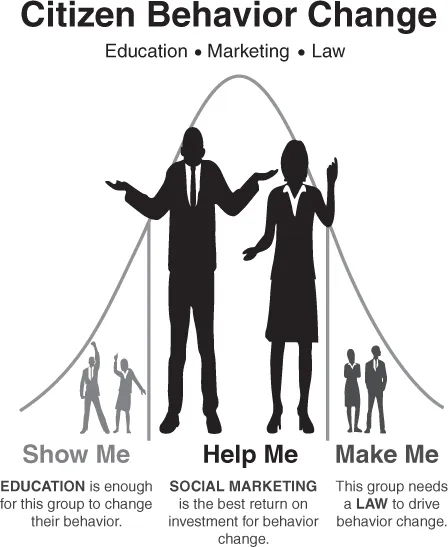
- Readiness to Change: Levels of concern and/or interest this segment has to behavior change related to the social issue this campaign is addressing (see Figure 1.1)
FIGURE 1.1 Segmentation Based on Readiness to Change.4This figure illustrates a simplified segmentation of a population based ...
Table of contents
- Cover
- Half Title
- Endorsement Page
- Title Page
- Copyright Page
- Dedication
- Table of Contents
- 1 Framework Used for Each Case Story
- 2 Improving Public Health: 30 Success Stories
- 3 Preventing Injuries: 15 Success Stories
- 4 Protecting the Environment: 30 Success Stories
- 5 Engaging Communities: 15 Success Stories
- 6 Enhancing Financial Well-Being: 5 Success Stories
- 7 Supporting Educational Milestones: 5 Success Stories
- Epilogue: The Past, Present, and Future of Social Marketing
- Index