eBook - ePub
Mobility and Transport for Elderly and Disabled Patients
- 1,198 pages
- English
- ePUB (mobile friendly)
- Available on iOS & Android
eBook - ePub
Mobility and Transport for Elderly and Disabled Patients
About this book
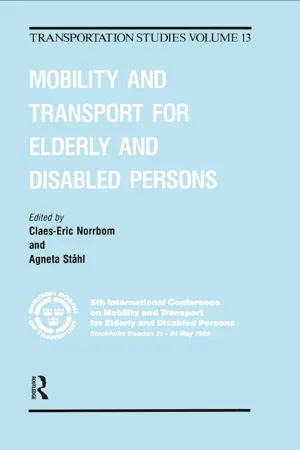
First Published in 1991. This is Volume 13 in a series of Transportation Studies. It contains 2 parts of the proceedings of a Conference held at Stockholmsmassan, Alvsjo, Sweden, 21-24 May 1989, organized by the Swedish Board of Transport in co-operation with the Department of Traffic Planning and Engineering, Lund Institute of Technology.
Information
SESSION F:
TRAVEL NEEDS AND TRAVEL PATTERNS
LONG-DISTANCE MOBILITY OF THE ELDERLY
Researchers/INRETS – FRANCE
1. INTRODUCTION
Some physical constraints which can hinder mobility become more frequent with age: in fact, elderly people make fewer longdistance journeys.
How important are the differences between younger and older people, and from what age does a significant reduction in these journeys become apparent? What part do handicaps caused by physical aging play in this reduced mobility? To what extent do other factors intervene – another type of handicap, financial for example, fewer opportunities for travelling or, more simply, persistance of a more sedentary way of life acquired at a time when travel was less accessible? Finally, are there different types of elderly people, characterized by varying degrees of mobility and favouring one type of travel or another?
The object of this paper is to provide some answers to these several questions. However, before doing so, it is necessary to supply some indications as to the data-base used.
The statistical source is the 1981-1982 survey on transport behaviour, carried out with reference to a sample of 7000 “ordinary” households :
– Persons living in a community, old-people’s homes or hospitals, for example, are not included in the study.
– The threshold distance has been set at 100 km from the place of residence. Each person’s journeys were noted over a period of three months; this time-scale is insufficient for fully understanding the behaviour patterns of a given individual. Therefore, comparisons between different categories only will be presented.
– The survey does not provide information on any physical handicaps the person may suffer from. Only the influence of socio-demographic factors on the number and nature of the journeys undertaken will be presented.
In the first part, the effect of age on the number and the nature of the journeys made is analysed. In the study of the elderly population, the age limit has been set at 65, corresponding to the moment when the majority has already retired.
2. AGE DETERMINED MOBILITY
Long-distance mobility peaks between the ages of 30 and 45. People of this age-group make on average four trips annually. Such mobility diminishes as of the age 45, but it is above all after 75 that a large decrease is to be observed : in effect, after that, the average number of journeys is limited to only one a year (figure 1).
Nevertheless, if these journeys are less frequent, each one is extended over a longer period : an average of five days before the age of 65, seven days between the ages of 65 and 75 and eight days after that. However, elderly people make proportionally more day-trips. All in all, the total time spent away from the place of residence is stable for adults until approximately the age of 70 or 75; it drops by half once that age has been reached.
The distance to the destination (a little less than 400 km on average) and the proportion of journeys made abroad (9Z) do not differentiate elderly people from the rest of the population. However, other characteristics define the differences in behaviour between younger and older people.
2.1 The types of journeys : maintaining a certain sociability and the pursuit of greater comfort (figures 2 and 3)
Contacts with close family – the prime motivation for travel at all ages – are closely maintained between the ages of 65 and 75, and particularly in terms of the time spent at the destination. These journeys are considerably reduced after the age of 75; but no less than the average for other types of travel. It is moreover quite probable that they are replaced by visits of relatives to the elderly. On the other hand, elderly people maintain many fewer links with more distant relations or friends.
The types of journeys preferred by the elderly cannot be dissociated from the pursuit of a certain comfort. This is the case with tourist trips made during the day or those with hotel lodging provided. These types of journeys are all the more popular because they are organized: this is indeed the case for half of them. The organized nature of these journeys indeed meets the requirements of a certain number of travellers, particularly in cases where the household does not have a car. Organized tours are very popular with elderly people: they amount to 15% of the journeys made by the over-65s, and even 25% for the over-75s, compared with less than 4% for the rest of the population. A very large selection of organizers is available, mostly linked with the person’s, or his spouse’s former professional activity: plant production comittee, superannuation fund, or municipal services…
On the contrary, the proportion of tourist trips where lodging is more precarious, and where the person is less taken in charge (camping, rural hostels, r...
Table of contents
- Cover
- Half Title
- Series
- Title Page
- Copyright Page
- Table of Contents
- Introduction to the Series
- Preface
- Acknowledgements
- Opening Speech
- Plenary Session I: Expected Changes: Society, Individual. Industrialized and Developing Nations
- Plenary Session II: Approaches – A State of the Art
- Plenary Session III: A Conference Summary of Workshop Sessions
- Plenary Session IV: Where to go for the Next Decade – Panel Discussion
- Session A: Political Perspectives and Policies
- Session B: Enhanced Mobility
- Session C: Private Transportation C1: Adaptation of Private Vehicles
- Session D: Public Transportation
- Session E: Special Transportation Systems
- Session F: Travel Needs and Travel Patterns
Trusted by 375,005 students
Access to over 1.5 million titles for a fair monthly price.
Study more efficiently using our study tools.
Frequently asked questions
Yes, you can cancel anytime from the Subscription tab in your account settings on the Perlego website. Your subscription will stay active until the end of your current billing period. Learn how to cancel your subscription
No, books cannot be downloaded as external files, such as PDFs, for use outside of Perlego. However, you can download books within the Perlego app for offline reading on mobile or tablet. Learn how to download books offline
We are an online textbook subscription service, where you can get access to an entire online library for less than the price of a single book per month. With over 1.5 million books across 990+ topics, we’ve got you covered! Learn about our mission
Look out for the read-aloud symbol on your next book to see if you can listen to it. The read-aloud tool reads text aloud for you, highlighting the text as it is being read. You can pause it, speed it up and slow it down. Learn more about Read Aloud
Yes! You can use the Perlego app on both iOS and Android devices to read anytime, anywhere — even offline. Perfect for commutes or when you’re on the go.
Please note we cannot support devices running on iOS 13 and Android 7 or earlier. Learn more about using the app
Please note we cannot support devices running on iOS 13 and Android 7 or earlier. Learn more about using the app
Yes, you can access Mobility and Transport for Elderly and Disabled Patients by Claes-Eric Norrbom,Agneta Stahl in PDF and/or ePUB format, as well as other popular books in Medicine & Health Care Delivery. We have over 1.5 million books available in our catalogue for you to explore.