![]()
1
NAPA 1974
In 1974, Napa was a bucolic blue-collar town, where many locals worked in the agricultural industry. Almost everyone who lived in Napa worked in town, so there were few commuters other than to nearby Vallejo, a larger city about thirteen miles south that drew many Napans for work at Mare Island Naval Shipyard. Many of the nonagricultural workers were employed by Napa State Hospital or Kaiser Steel Fabrication Plant in Napa. There was very little tourism.
The population was predominantly Caucasian. African American, Asian and Hispanic residents represented a small portion of the total. Most migrant agricultural workers came for the grape harvest and then returned to Mexico or moved on to work the crops in other locales. There were very few good restaurants, and you had to travel out of town to see a play or hear a concert. Kids and teenagers complained there was nothing to do.
At the same time, the community was experiencing significant growth. Redevelopment was underway, and many older buildings were being razed and replaced with modern structures complemented by artwork, clock towers, attractive benches and brick walkways. Concerted efforts were being made to modernize the town and make it more attractive for downtown businesses. City Councilman James V. Jones remembered it this way: “In many ways, things didn’t seem much changed from the forties; when the sun went down, they rolled up the sidewalks.”
Napa was considered a safe community. Many residents didn’t lock their homes or their cars, and most people knew their neighbors. You couldn’t walk anywhere in town without someone recognizing you and stopping to talk. Criminal activity was minimal, with few crimes other than alcohol-related offenses—usually bar fights or driving under the influence of alcohol. There were very few armed robberies, murders, narcotics offenses, gang activity or reported sexual assaults.
Law enforcement described Napa as a whiskey- and beer-drinking town; there were twenty-one bars in the city and several just outside city limits. In 1972, twenty deaths in the county were caused by DUI drivers. Drunks were responsible for most of the assaults, stabbings and bar fights, as well. Napa police officer Ronald Hess recalled many a busy graveyard shift, often leaving the station at 11:00 p.m. with lights and siren, driving from bar fight to bar fight. In those days, the police didn’t wear bulletproof vests, but they all wore blue-and-white riot helmets.
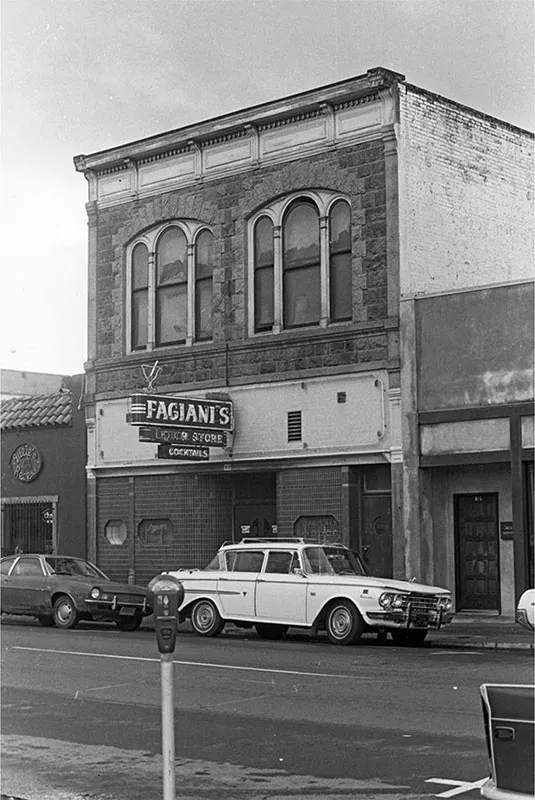
The intersection of Main and Third Streets marked the southwest corner of downtown Napa. The Conner Hotel stood on the east side of Main. Officer Hess succinctly described the Conner as a “flophouse.” On the ground floor of the Conner was the OK Corral bar, and across the street was Fagiani’s Cocktail Lounge, which the police regarded as a bar for old-timer drinkers. The Gilt Edge and the Oberon were located just up the block at Main and Second. One street over on Brown Street was the Plaza Hotel and Bar, which was a quieter lounge, though it, too, had its lively nights.
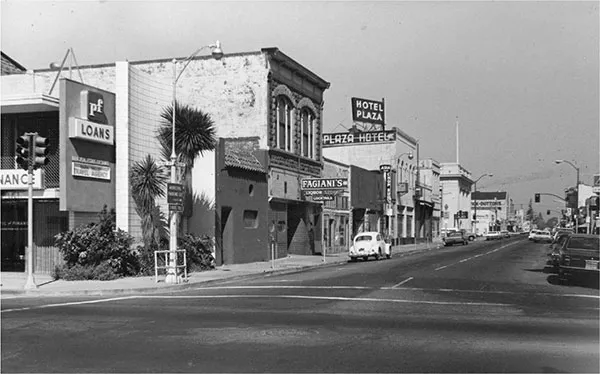
View of Main Street at Third Street, Napa, depicting Fagiani’s Cocktail Lounge, the Plaza Hotel and other local downtown businesses in the 1970s. Courtesy of the Napa County Historical Society.
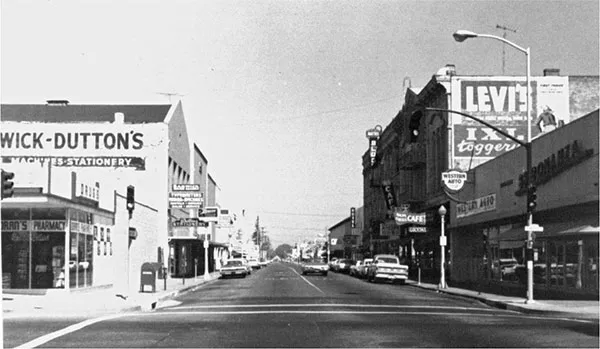
View of Main Street at First Street, Napa, two blocks north of Fagiani’s Cocktail Lounge, as it appeared in the 1970s. Courtesy of the Napa County Historical Society.
O’Sullivan’s was situated on First Street at Juarez; the Aquarius was downtown on First, and Mike’s Club was nearby on Coombs Street. Don’s was located at Third Street, where it dead-ended (at that time) at Soscol Avenue. The Depot, Red Carpet, Night Cap and Napa Bowl (which had its own bar and its own troubles) were strung along Soscol. Jack’s Club, at Soscol and Silverado Trail, was the dedicated-drinker spot. On the north end of town, Trancas Street, with its collection of drinking establishments, was a world of its own.
Alcohol-related arrests were common, often for the simple offense of being drunk in public. According to Officer Hess, “The next time you met a person whom you’d arrested for bar fighting or on a DUI, they would apologize.”
There was no Public Defender’s Office at that time; the crime rate simply did not warrant one. If a criminal defendant could not afford to retain counsel, the judge appointed a local lawyer from a rotating list of attorneys, even though few of these appointed attorneys had criminal defense experience.
In 1974, Napa was still a small town, a pleasant place to live, work and raise a family.
![]()
2
THE FAGIANI FAMILY
Anita Fagiani Andrews’s father, Nick Fagiani, owned the well-known Fagiani’s Cocktail Lounge. Her uncle Andrew Fagiani was a Napa County supervisor. Muriel Fagiani, her sister, was a schoolteacher known as the watchdog of local government because she regularly attended meetings of the Napa City Council, County Board of Supervisors and the local school board. Anita was a longtime secretary at Napa State Hospital.
Nick Fagiani opened his bar in 1945 and ran it until his death in 1969, when his daughters inherited it. To retain the valuable liquor license issued by the Alcoholic Beverage Commission to their father, the sisters continued to operate the bar. The license allowed sale of alcohol to bar patrons as well as to customers purchasing alcohol to take off-premises. Thus, Fagiani’s was both a bar and a liquor store, and it was called, appropriately, Fagiani’s Cocktail Lounge and Liquor Store.
Those on-site/off-site liquor sale licenses were valid as long as the bar continued to operate, but if it closed for a six-month period, the license would be terminated and could not be reissued. Both sisters were determined to keep the bar open. Because they couldn’t afford to hire staff, they agreed to alternate shifts as bartender during evenings and on weekends, even though they both had day jobs.
Anita Fagiani was popular growing up. As an eighteen-year-old, she was chosen Miss Napa County. At the time of her death, she was fifty-one years old and divorced, with two daughters. For a number of years, she had a boyfriend, but they had broken up shortly before her death.
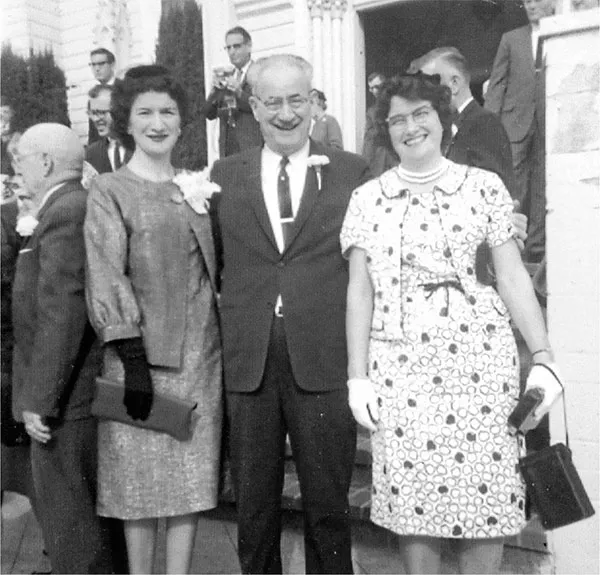
Murder victim Anita Fagiani Andrews (left) with her father, Nicola, and sister, Muriel. Courtesy of the Napa County District Attorney’s Office.
Anita dressed well and enjoyed accessorizing with jewelry. She was neat and fastidious, a person of set habits and routines to which she adhered faithfully. She always opened the bar around 5:00 p.m. after getting off work at Napa State Hospital, and she closed up between 9:00 p.m. and 11:00 p.m., depending on how many customers were present. There were usually few patrons, so ordinarily she was able to lock up around 10:00 p.m.
At the start of each evening, Anita parked her 1967 Cadillac in front of the bar, unlocked the padlock on the front door and switched on the neon light to signal that Fagiani’s was open. In small towns like Napa, the police know a lot about the local business owners and their habits. They knew Fagiani’s was now owned by the two sisters and that there were no employees. Napa police were also aware that the two women alternated shifts and only one was on duty at any given time. And they knew Fagiani’s catered to mostly male patrons in a not-so-nice part of town.
Fagiani’s Cocktail Lounge as it appeared in the 1970s. Courtesy of the Napa County Historical Society.
Patrol officers had a routine for checking on the bar. The officer on duty on a given evening would drive down Main Street to see if Anita’s Cadillac was parked in front. He would shine his spotlight on the front door. If the padlock was unlocked and the outside light on, he would assume the bar was open and everything was fine. However, if the Cadillac was not parked in front, the door was padlocked, the outside light was out and only an interior light was showing, it meant the bar was not open and no one was inside. This informal routine had worked well for the five years since the sisters had taken over the bar.
But on the night of the murder, it happened that the patrol officer did not follow the usual routine. If he had, he would have noticed something suspicious: the padlock on the front door was unlocked, but the Cadillac was gone. That might have led the officer to check inside the bar and immediately discover Anita’s body. In that case, law enforcement could potentially have gained a substantially greater head-start in searching for the Cadillac, increasing the odds of locating the car and identifying the murderer.
Instead, thirty-seven years would pass, and the killer would commit more murders before he was finally apprehended and brought to justice.
![]()
3
WEDNESDAY, JULY 10, 1974
The number one topic of discussion around the town of Napa during the week of July 10, 1974, was what Mayor Ralph Bolin called “an unseasonable rainstorm.” Although the rain eased the fire danger from the intense July heat, when the storm hit it played havoc on the City Police Department since its new building, then under construction, had no roof. No one expected rain in the Napa Valley during July.
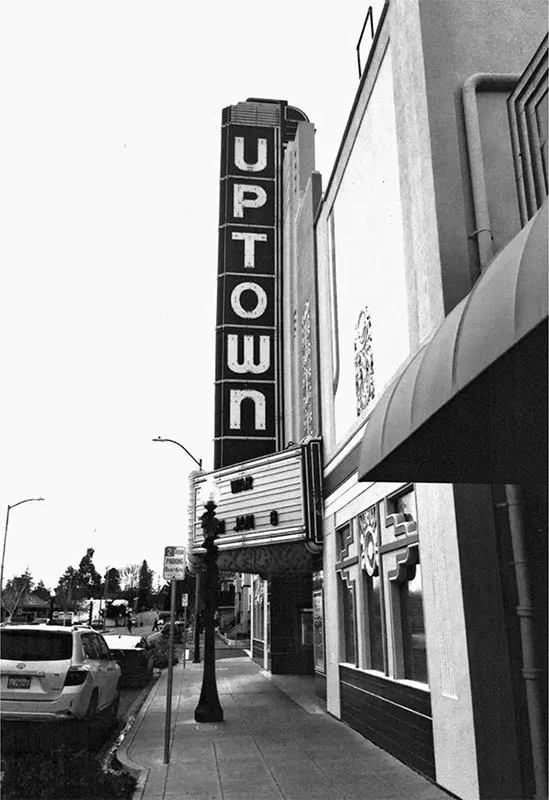
July evenings in Napa are usually warm, and that Wednesday evening was no exception. The temperature hovered in the high seventies. At Kiwanis Park, several blocks south of downtown, teams of teenage girls were playing fast-pitch softball. Across the river to the east, high school boys played baseball under the lights at the Napa fairgrounds ballpark. The Uptown Theatre was showing The Great Gatsby, starring Robert Redford and Mia Farrow.
None of that mattered to Al Mufich, Al Mackenzie or David Luce as they strolled down Third Street to the Happy Hours bar, one of their favorite hangouts, to grab a beer and chat. Next, they intended to visit Catania’s Pizza Parlor on Silverado Trail, where Al Mackenzie was playing steel guitar in the band.
Mackenzie was personable, smart and fun to be around, a happy, playful man who liked to enjoy himself. Luce enjoyed his friends and liked sharing beers with them. Mufich, as later described by David Luce, was “a bit odd. He was older than we were, had a full beard with shoulder-length white hair and was eccentric. Sometimes his behavior could be pretty strange. He could be loud, boisterous, belligerent and abusive. Al was a Napa native, so he knew everything about everybody.”
Recent photo of the restored Uptown Theatre on Third Street, several blocks west of Fagiani’s Cocktail Lounge. Photo by Raymond A. Guadagni.
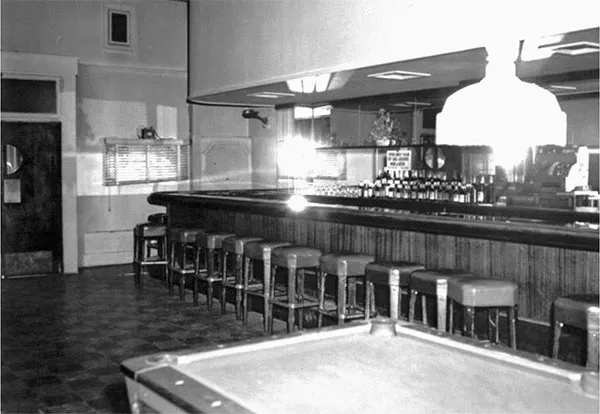
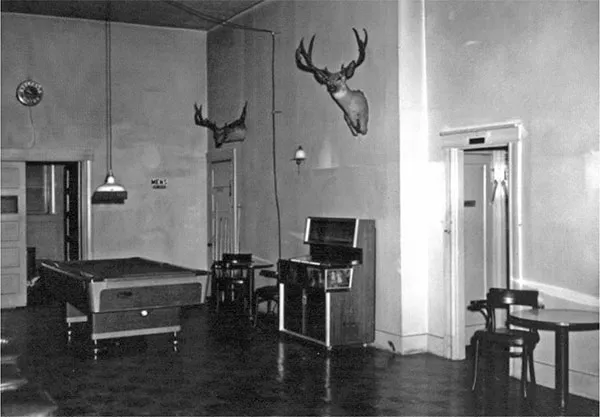
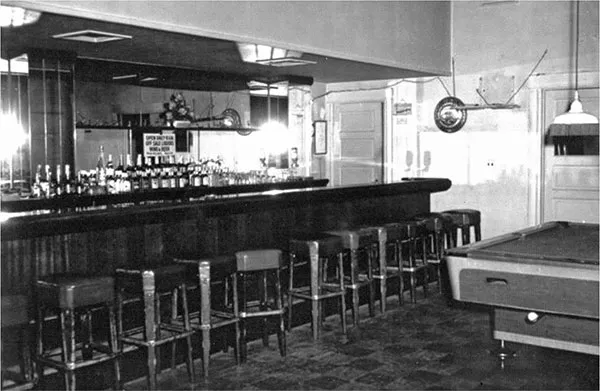
After a few rounds of beer, the three men left Happy Hours and made their way down Third to Main Street. They still had some time before Mackenzie’s musical performance, and as they neared the corner, they decided to add a stop at Fagiani’s Cocktail Lounge. When one entered Fagiani’s through the front door, the wooden bar ran along the left wall, with stools all the way down toward the back of the room. A pool table sat in the middle of the room. Along the opposite wall were a few tables with chairs and a jukebox. Three taxidermy deer heads looked down on the scene. At the end of the bar was a small storage room for supplies. A staircase led to offices upstairs. Even in 1974, the bar looked like something out of an earlier era. The beautiful, old-fashioned countertop had a backdrop of mirrors and a colorful array of liquor bottles; the basic commercial pool table with its green felt top appeared to have been heavily used over the years. The barstools were old but in fair condition, and the tables across from the bar showed wear.
The three friends arrived at Fagiani’s around 9:00 p.m., settling on the three stools closest to the front door. Al Mufich sat nearest the entrance,and David Luce sat in the middle with Al Mackenzie on Luce’s right. Sitting close to the front door was intentional. “When I go into a bar,” Luce explained, “I survey the entire inside to see who’s there and where they are, because things happen in bars, fracases occur, and you have to know where all the players are.”
Police photo taken inside Fagiani’s Cocktail Lounge on July 11, 1974, showing the front entrance, bar and pool table. Courtesy of the Napa County District Attorney’s Office.
Police photo taken inside Fagiani’s Cocktail Lounge on July 11, 1974, showing pool table, jukebox, taxidermy deer heads and customer table. Courtesy of the Napa County District Attorney’s Office.
Police photo taken inside Fagiani’s Cocktail Lounge on July 11, 1974, showing the back end of the bar and the door to the storage room. Courtesy of the Napa County District Attorney’s Office.
As the three friends settled in, they noticed a man sitting on a barstool toward the back of the room. “T...