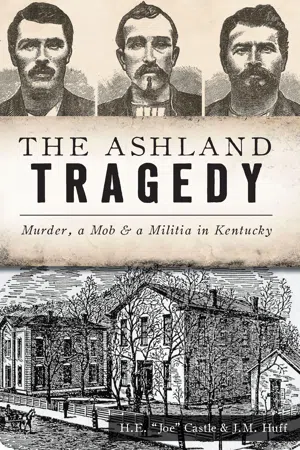
This true crime history recounts the notorious nineteenth-century murder of three Kentucky children and the shocking aftermath once arrests were made.
On Christmas Eve 1881, a horrible crime shook the small town of Ashland, Kentucky, and captivated the entire nation. Three children were brutally murdered and their house set ablaze. Nothing in the small town's past had prepared it for what followed. Three men were convicted of the crimes, and two were sentenced to death. But the murderers were protected by the governor's untrained militia, which would eventually turn their guns on Ashland's innocent citizens.
Much of these events were recorded at the time by James Morgan Huff, founder of the
Ashland Republican newspaper, in a booklet titled
The Ashland Tragedy. Now author and Ashland native H.E. "Joe" Castle builds on Huff's work to reveal the full, true story of one of the darkest chapters in the history of Kentucky.
- 179 pages
- English
- ePUB (mobile friendly)
- Available on iOS & Android
eBook - ePub
About this book
Information
Print ISBN
9781467146647
Subtopic
North American History1
INTRODUCTION
After breakfast, Deputy Armstrong delivered the new suit of clothes sent to Ellis Craft from his mother. “I slept sound last night,” Craft said. “I never woke till the sun came in at the window. I haven’t seen the sun rise for many a day, and I asked them to awake me that I might take my last look at it. I have given up all hope. In a few hours I will be a dead man. You are going to hang an innocent man.”3
At 12:34 p.m. on October 12, 1883, Ellis Craft was taken from the jail to the street, where a buggy waited to carry him to the gallows. A guard of armed men surrounded the buggy as it passed through teeming streets and houses filled with eager spectators. A crowd of more than five thousand men, women and children assembled round about the scaffold to witness the first public hanging in Carter County, Kentucky. Accompanied by Sheriff Holcomb and his deputies, Craft was greeted by Reverend J.P. Pinkerton as he ascended the platform.4
The pine scaffold had been framed in a hollow surrounded by hills, allowing unobstructed views for the large gathering. A low-lying blanket of dark gray clouds releasing a drizzling rain would have made a better backdrop for the day’s dreary event. Instead, the sun shone brightly and warmth filled the air, providing the setting with an autumn carnival–like atmosphere.
It is here, many folks thought, and even hoped, an admission of guilt would spring forth. The gallows have yielded many eleventh-hour confessions, and it was widely known Craft had staunchly maintained his innocence from the very beginning of this renowned ordeal.
This was a day many thought might never come, for though Craft had been convicted twice of the terrible crime, he had managed to capture for himself a great deal of conjectured support. Some, once certain of Craft’s guilt, now weren’t altogether convinced Craft had anything to do with the murders. During his lengthy incarceration at Lexington, Craft had routinely received visits from thousands of admirers and enough favorable press to elevate his status to that of a cultic celebrity. Therefore, a confession today would remove all doubt and clear the minds of any misgivings over his hanging. Horses were muzzled and children hushed as Craft began to speak.
Dear friends you all know why I’m here and I know that all of you have wished to hear what I have to say. I have been charged with a crime for which I am innocent. Now you all know this is not the time or place to tell a lie. I’ve said before and I say again, you might as well hang a newborn babe for I am as innocent of this crime as the babe. I was not at the Gibbons’ house the night that awful crime was committed. Would that I was, for if I were those precious girls would be alive today. I loved those children dearly and would never have thought to harm a hair on their heads. And now as I am about to swing between the heavens and the earth, I’ll tell you what I think caused my death. False witnesses and men like Mr. Heflin, Mr. Campbell and Mr. Russell have desired to see me hang. But I believe that one day God, in His great power and mercy, will see to it that the guilty one will be hung.5
The previous morning, Craft, under heavy guard, was taken to the Little Sandy River on the outskirts of Grayson and baptized again, this time by Reverend Pinkerton. The reverend said he’d talked to dying men before, but he’d never met a man such as Craft. He said Craft showed no remorse and bitterly accused wealthy men of setting him up merely for the reward. He also said Craft seemed strikingly calm for a man in his predicament. He talked at length about his friends and family. Then he asked the reverend to write a letter to his mother and father to inform them that he died innocent and in peace.6
Later on that same day, Craft received an encouraging letter from Detective Alf Burnett, who claimed to have found the true guilty parties and protested Craft’s innocence to Governor J. Proctor Knott. In the letter, Burnett claimed to make an arrest soon, and he begged the governor for a respite on Craft’s behalf. This letter, along with other letters Craft had received, afforded the condemned the hope his neck might be saved before the trap door would be sprung.7
Ellis Craft entered his twenty-ninth year on this earth [in July of this year, 1883], and as he stood on the scaffold, he surveyed the large crowd through small, dark eyes that did not disclose the look of a killer. But then seldom ever does a face betray the wicked thoughts or the devilish bent of one’s character. The son of a Baptist preacher, Craft was raised in the light of the good book, yet he had gained for himself the reputation of a scamp and a hooligan, being described as a man of inordinate animal passions who would go to unusual lengths to gratify them. His past was peppered with philandering and misdemeanors.8
The sober-minded thinker understands reputation alone does not make one a murderer, but it is difficult for even the best of jurors to disavow what is loosely known. And moreover, the people’s court of public opinion ever hastens to condemn those of sullied reputations. Despite that, Craft possessed a brash coolness and coarse charisma that—more often than not—worked in his favor. Up until now, he had always leaned on his persuasive powers and silver tongue to wriggle out of any serious trouble. Though he was adept at flowery speech, Craft’s words always carried more volume than substance. And now, even with death staring him in the face, he relished his captive audience. Any other time the authorities might have stopped him short, but given the circumstances, he was obliged to speak on.9
I’d like to thank Mr. Tyree for showing kindness to me while I’ve been in his jail, and all of the good people of Carter County for their kindness. I only wish I had the opportunity to repay you with more than just words. Folks, I know it’s too late for me, but friends don’t forget poor brother Neal. For if justice was done, he’d never been separated from his dear wife and their little children. And if justice was done, I’d still be home with my mother and father. I call upon all you mothers and fathers to teach your children right from wrong like my dear mother and father did for me. I have a good father and mother who raised me right. I stand here before all of you and my God and declare that I am innocent of murdering those children. And I hope the Gibbonses and Thomases can find a way to forgive me for something that others have done.10
As he completed his speech, Craft broke into song and sang a hymn:
Did Christ o’er sinners weep,
And shall our cheeks be dry?
Let floods of penitential grief
Burst forth from every eye.
The Son of God in tears
The wondering angels see:
Be thou astonished, O my soul;
He shed those tears for thee.11
Incredibly, Craft maintained his composure despite the somber and piteous occasion. Among the spectators, many cheeks became dampened with tears, especially those of Craft’s family and friends. Others were naturally saddened by the solemn event. Craft had maintained a cool appearance since the day the jury sentenced him to hang, and it had been his calm demeanor and flamboyance that had since caused some to doubt his guilt. For those who believed the jury rightly convicted him, justice was but a few moments away.
As he paused with his head bowed, the multitude stood silent, supposing Craft to be praying. Having tarried longer than what he considered necessary, Reverend Pinkerton stepped forward to speak—all at once, Craft raised his head toward heaven and continued singing:
He wept that we might weep;
Each sin demands a tear;
In Heaven alone no sin is found,
And there’s no weeping there.
The crime that had brought Ellis Craft to the gallows was committed nearly two years previous, in neighboring Boyd County, at the outskirts of the industrious city of Ashland. Geiger’s Addition to Ashland, Geigersville and East Ashland all refer to that same community in which this most horrible crime took place. The news of this crime captivated the entire nation, and were it not for the trial of a demented lawyer-turned-assassin named Charles Guiteau who shot President Garfield, this crime and its aftermath would have received more national notoriety than any other during its time. The Cincinnati Enquirer described it as “one of the most atrocious and hellish murders ever committed in a civilized community.”12
The Atlanta Constitution called it a terrible tale of inhuman depravity and “the greatest criminal sensation that ever occurred in this section.”13
The Portsmouth Times read: “In all the annals of crime there certainly is chronicled no more horrible deed of utter heartlessness, of fiendish brutality and total depravity than this.”14
The Ironton Register had this to say about it: “Never did a tragedy, in all this region, arouse such indignation as the murder of those innocent children. Every phase of the story was revolting and every feature of the bloody deed most inhuman.”15
Ashland, Kentucky, is situated on the Ohio River 15 miles above Huntington, West Virginia, and 130 miles below Cincinnati, Ohio. The city was laid out by engineer Martin T. Hilton and named in 1854 by Levi Hampton, a close friend of the Great Compromiser, Henry Clay.16 Hampton proposed to rename the settlement, heretofore known as Poage Settlement, after Henry Clay’s Lexington, Kentucky farm—Ashland.17
Although they were natives of Scotland, the Poages came to colonial America from Ireland in the early eighteenth century, and soon after the Revolutionary War, they left Virginia for Kentucky. As the soil was rich in iron ore deposits, the pig-iron industry began to flourish and several furnaces sprang up. By 1875, seventy-nine charcoal furnaces had been built and placed in operation, and the area soon became one of the country’s leading producers of iron.18
The first locomotive, the Constitution, arrived in Ashland in 1856, and the railroad boosted the city’s progress and prosperity at a remarkable rate.19 As the farming and iron industries increased, so did the population. Schools, churches and hotels were constructed to nurture the intellectual, spiritual and social needs of the citizens, who would be described in 1857 by Sophia Poage Payne in a letter to her son as “a social religious sort of folks.”20
Industry and growth in Ashland slowed a bit during the Civil War, but the effect was not drastic. In a state divided like no other, Northeastern Kentucky, which included Ashland and Boyd County, remained overwhelmingly loyal to the Union. The citizens collaborated to form their own Ashland Home Guards to protect their families, homes and neighbors from any would-be guerrilla raiders.21
And in comparison, Ashland braved the war with only moderate difficulty. The people of Ashland had grown to work and worship, fraternize and fight, if need be, as a unified and well-disposed assembly. The local farmers knew how to work the land and make it bountiful. The industry leaders were enterprising as well as knowledgeable. Religious leaders were strong men of faith. The city’s government was composed of honest and hardworking men. All the ingredients were in place for the inhabitants of Ashland to enjoy happy, prosperous and safe lives. The people of Ashland and those who would come to live there were a like-minded lot who shared the same philosophies of life: work hard, live right and enjoy the fruits of labor. Unlike many of the towns that popped up along the Ohio River, Ashland failed to follow the rowdy river town blueprint. There was no time or tolerance for miscreants and scoundrels. The need for a jail didn’t arise until five years after the city was laid out, and that was prompted only by the passing of an ordinance stating that all hogs running loose on the streets would be arrested. Meandering hogs tracking mud through the stores was bad for business.22
The town progressed, and the people prospered harmoniously. Eventually, the jail would house more than just hogs and minor offenders, yet for the most part, the city’s collective voice of justice kept lawlessness in check. And as added security, a town marshal was elected along with district constables.
By all accounts, the manner in which this town developed seems as if it were constructed by divine design. But nothing could have prepared its people for what was about to thrust them into a national spotlight of horror. For on Christmas Eve 1881, a sinister wind would blow through the outskirts of Ashland and enlarge upon itself until it had encompassed the entire city in a cyclone of unthinkable evil.
2
THE FIRE
The five o’clock whistle at the Norton Iron Works indicated the end of work for the day shift. On this Friday, December 23, 1881, however, it also signaled the beginning of the Christmas holiday. Christmas was just two days away and whatever preparations were left would be made with the usual frantic, yet joyful efforts. And this is where our story begins.
The Christmas season traditionally brings out the best in people. For a time, once a year, hustling and hoardi...
Table of contents
- Front Cover
- Half Title
- Title Page
- Copyright
- Contents
- Preface
- 1. Introduction
- 2. The Fire
- 3. The Search
- 4. Gibbons Found
- 5. A Confession
- 6. The River Chase
- 7. Neal’s Trial
- 8. Craft’s Trial
- 9. Burnett’s Theory
- 10. George Ellis
- 11. New Trials
- 12. River Massacre
- 13. Resolve and Recovery
- 14. Ellis Craft
- 15. William Neal
- 16. Commentary
- Brief Biographies
- Pictures
- Notes
- About The Authors
Trusted by 375,005 students
Access to over 1.5 million titles for a fair monthly price.
Study more efficiently using our study tools.
Frequently asked questions
Yes, you can cancel anytime from the Subscription tab in your account settings on the Perlego website. Your subscription will stay active until the end of your current billing period. Learn how to cancel your subscription
No, books cannot be downloaded as external files, such as PDFs, for use outside of Perlego. However, you can download books within the Perlego app for offline reading on mobile or tablet. Learn how to download books offline
Perlego offers two plans: Essential and Complete
- Essential is ideal for learners and professionals who enjoy exploring a wide range of subjects. Access the Essential Library with 800,000+ trusted titles and best-sellers across business, personal growth, and the humanities. Includes unlimited reading time and Standard Read Aloud voice.
- Complete: Perfect for advanced learners and researchers needing full, unrestricted access. Unlock 1.5M+ books across hundreds of subjects, including academic and specialized titles. The Complete Plan also includes advanced features like Premium Read Aloud and Research Assistant.
We are an online textbook subscription service, where you can get access to an entire online library for less than the price of a single book per month. With over 1.5 million books across 990+ topics, we’ve got you covered! Learn about our mission
Look out for the read-aloud symbol on your next book to see if you can listen to it. The read-aloud tool reads text aloud for you, highlighting the text as it is being read. You can pause it, speed it up and slow it down. Learn more about Read Aloud
Yes! You can use the Perlego app on both iOS and Android devices to read anytime, anywhere — even offline. Perfect for commutes or when you’re on the go.
Please note we cannot support devices running on iOS 13 and Android 7 or earlier. Learn more about using the app
Please note we cannot support devices running on iOS 13 and Android 7 or earlier. Learn more about using the app
Yes, you can access The Ashland Tragedy by E. Joe Castle in PDF and/or ePUB format. We have over 1.5 million books available in our catalogue for you to explore.