- 163 pages
- English
- ePUB (mobile friendly)
- Available on iOS & Android
eBook - ePub
About this book
In the 1850s, the eyes of the world were on Kansas. The Civil War in Kansas will be an overview of the years 1854-1865, since the war began in Kansas nearly seven years before it spread to the rest of the nation. From the repeal of the Missouri Compromise to its entry in the Union, Kansas played a small role in the war as a whole, but its effects on the state were nonetheless important. With regards to the Kansas citizens who played a part, it would be an understatement to call them "colorful." From John Brown to Jim Lane, Kansans made headlines throughout the nation and the world. Bisel presents the history of Kansas during the Civil War years in an accessible way that will satisfy history buffs as well as enlighten novices.
Information
Chapter 1
A Peaceful Valley
Isaac Cody was not idly waiting for the passage of the Kansas-Nebraska Act. He had already obtained permission to put up a “cheep [sic] cabin” in the Kansas Territory and had signed a government contract to supply hay to Fort Leavenworth. He was ferrying his family across the Missouri River to their temporary home when he received the dispatch that President Pierce had signed the law almost two weeks earlier, on May 30, 1854. The next day, he unpacked his surveying tools and began outlining land claims.
Isaac and his wife, Mary, had begun planning this trip in the previous fall. A young son had died after a fall from a horse, and Mary was disconsolate. This move was just the sort of distraction that the family needed. Isaac’s correspondence with Iowa congressmen informed him that the bill creating the new territory would likely be voted on during the winter session. Isaac was by no means a nomad, but he had made more than one move seeking a better life and had enjoyed some financial success. When the Codys loaded their six surviving children into a wagon and left Iowa, they did not camp along the roadside at night, as did most other pioneers, but were instead able to afford the “best hotels” along the way.
Crossing the state line into Missouri, the children encountered black people for the first time, most of them slaves or servants. They were a great curiosity to the children, and they asked if these were Indians.
Isaac’s brother, Elijah Cody, was a successful businessman in Weston, Missouri. He encouraged his brother to come west and told him that it was a beautiful country. The Kansas countryside in spring did not disappoint the Codys. Riding out to “Government Hill” at Fort Leavenworth, the family saw the Salt Creek Valley for the first time: “[I]t was filled with Trains and cattle and mules running around. There must have been Hundreds of White covered wagons waiting there to make up their Train to start West,” wrote Julia Cody Goodman. “Father and Mother both made the remark that if they could get their house in that beautiful valley, there would be their Home.”2
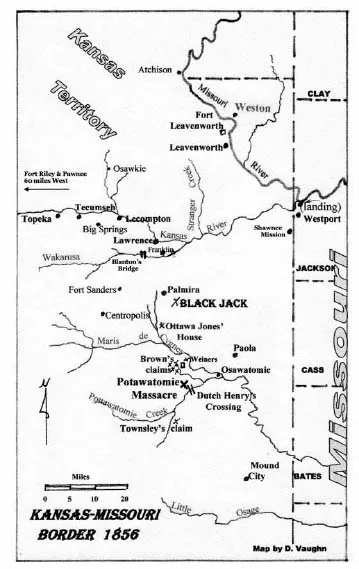
The Kansas/Missouri border in 1856. Dale Vaughn.
The Codys soon learned that a Kansas spring is not to be trusted. The climate can turn at any moment, but the political climate may have been far more dangerous.
Most of the early settlers in that area of the Kansas Territory supported the extension of slavery. One could almost throw a rock from Missouri to the territory when the river was down, and thus many Missourians had their eyes on that “beautiful valley” for a long time, just waiting for the federal government’s blessing to lay stake to it. Young Willie Cody (later in life the world-famous “Buffalo Bill”) recalled that many of those proslavers came over with whiskey and, when the bottles were empty, drove them into the ground to mark their claim.3
Ironically, on the same day the Codys arrived, settlers were gathering at the Kickapoo Indian trading post to organize into the Salt Creek Squatters Association. It was a common practice to establish some order in the land claim business. A register of claims and a board to handle disputes were appointed, in addition to a “vigilance” committee (which included Isaac) to enforce decisions. Another item of business was the treatment of abolitionists. The vigilantes would make sure that abolitionists were not welcome in this neighborhood.4 This is one example of the many groups organized in the image of a governmental entity with no governmental authority whatsoever. The only true power they possessed was that of the gun.
Isaac Cody was included in this group because his neighbors assumed that his politics would be the same as his brother’s. Elijah Cody was not only a prominent businessman in Weston, but he was also a prominent slaveholder. They soon found differently, though.
“Father was a plain spoken man,” Julia Cody Goodman recalled, “and these Missourians soon found out how Father stood on that as they would go back and tell about Elijah Cody’s Brother being for Kansas to be a Free state, and they would come back and howl the slander about Father. But he would [continue to] talk.”5
Isaac went about his business and hired several men to fill his hay contracts with the fort. In all his dealings, he made no attempt to disguise his political views. In the middle of September, Isaac was traveling between his home and Fort Leavenworth. A crowd of mostly proslavery advocates started to heckle Isaac and demanded a speech.
“He tried to beg off,” said Julia, “offering every excuse.” They grabbed him, put him atop a freight box and then began shouting questions at him:
One of the men called out, You are the man that wants Kansas Territory to be a Free state, don’t you? He went on talking on various questions and some one called out again, Say, Cody, you want to make Kansas a free state. He sayed yes. With that a man jumped on the Box and called him a Damed Abolicetionist and grabed at him.6
Young Willie was likely not present, but his later memoirs carried a description of the incident, probably a combination of the accounts he was told. He wrote that the crowd was hissing and shouting:
“You black abolitionist, shut up!” “Get down from that box!” “Kill him!” “Shoot him!” and so on. Father, however, maintained his position on the dry-goods box, notwithstanding the excitement and the numerous invitations to step down, until a hot-headed pro-slavery man, who was in the employ of my Uncle Elijah, crowded up and said: “Get off that box, you black abolitionist, or I’ll pull you off.”
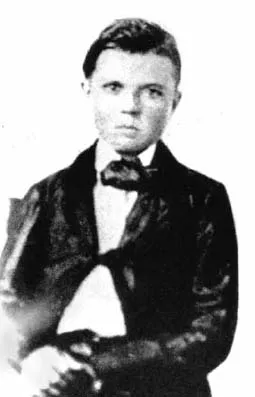
William F. “Buffalo Bill” Cody, circa 1858, at about twelve years old. Cody’s father, Isaac, was one of the first martyrs to the cause of abolitionism. Kansas State Historical Society.
Father paid but little attention to him, and attempted to resume his speech, intending doubtless to explain his position and endeavor to somewhat pacify the angry crowd. But the fellow jumped up on the box, and pulling out a huge bowie knife, stabbed father twice, who reeled and fell to the ground. The man sprang after him, and would have ended his life then and there, had not some of the better men in the crowd interfered in time to prevent him from carrying out his murderous intention.7
Julia said that as her father fell, a neighbor, Dr. Hathaway, “got to him and they took him in to the store and he done what he could for him. They did not try to do anything with this man, Mr. Dunn. They broke up the meeting.”8
Mrs. Cody was summoned, and it was decided that Isaac should not go home but rather should go to Elijah’s home to recuperate. It was considered safer there, an ironic conclusion since the Charles Dunn (who had done the stabbing) was employed by Elijah Cody. Bill’s memoirs reflected, “My uncle of course at once discharged the ruffian from his employ.”9
Young Willie did not record his reaction to his father’s stabbing, but his sister, Julia, did. Julia recalled that Willie (a child of only eight at the time) “would cry and then he would say, Oh, I wish I was a man; I would just love to kill all of those Bad men that want to kill my Father, and I will when I get big.”10
Missouri newspapers took a somewhat different view of Dunn’s actions. From the Democratic Platform in Liberty:
A Mr. Cody, a noisy abolitionist, living near Salt Creek in Kansas Territory, was severely stabbed, while in a dispute about a claim with Mr. Dunn, on Monday week last. Cody is severely hurt, but not enough it is feared to cause his death. The settlers on Salt Creek regret that his wound is not more dangerous and all sustain Mr. Dunn in the course he took. Abolitionists will yet find “Jordan a hard road to travel.”11
According to all accounts recorded by the family, the next few months were full of “misfortunes and difficulties.” Proslavery gangs showed up at the Cody home periodically to finish the job that Dunn had started, but Isaac would not be deterred from his work. Often forced to hide or travel with escorts, he helped establish Grasshopper Falls as a free state community. His visits to his family were all too brief and often interrupted. He sometimes left his horse with a neighbor and walked home to avoid detection, and he was often ill, never fully healing from the stab wounds. Julia Cody Goodman recalled one of those rare times at home when her father lay in bed, sick:
The next day he was not able to get up and was in bed up stairs and as mother and sister Martha were sitting there a man rode up to the Door and threw the reighns [reins] off of his Horses neck and he walked in and asked mother to fix him some Dinner. So Sister Martha went to fixing it for him. He asked mother where that Damd Abolitionist Husband was and that he had the Knife, and he took out of the scabrt [scabbard] and sharpened on his whet stone and sayed that was to take his heart’s blood wherever he could find him.
Mother spoke up; she sayed, Julia, you and Willie take the children up stairs. We went up, took the 3 sisters up stairs. Father had heard all that had been sayed. He sayed, Now you will have to protect me as I am too sick. Willie, you get your gun—it always stood behind the closet door—and Julia you get that ax, and Father sayed, Now if that man starts to come up stairs, Willie, you shoot, and Julia, if Willie misses him, you hit him with the ax, for he might deside to search the House.
But mother talked to him while he was Eating and after he got through he looked around and sayed, I see something I can make use of. That was Father’s Leather sadle bags. He took them down and sayed, When ever that Damd Abolitionist comes in we will be on the Look out for him and we will fix him as we are gone to kill ever one of these Abolitionists until we clear this Territory of them; and then he left…We had to be on the watch all the time when ever he was home.12
In such a climate, it is difficult to imagine how any kind of ordinary life existed or how one could maintain the commitment to political ideals. The Codys did both. They continued to plant crops and raise livestock, despite theft and destruction. And the family continued to grow.
In May 1855, Mary Cody gave birth to a boy, named Charles Whitney in honor of one of the other founders of Grasshopper Falls. Word spread to the two nearby Indian tribes. The Kickapoo chief brought gifts of beads, moccasins and other Indian playthings. Mrs. Cody responded by giving him some sugar. Several days later, according to Julia, the Delaware chief arrived, also bearing gifts, and he also received a reciprocal gift of sugar. The Delaware chief also made it plain that the Kickapoo chief had usurped his position by visiting the Codys, as it was the Delaware who had dominion. It was one memory of territorial Kansas that the Codys could look back on and smile.
Chapter 2
That “Damned Yankee Town”
Joseph Savage was one of about sixty brave souls who left Boston for the Kansas Territory in August 1854. A smaller group had left in July. His heart was heavy at having to leave his family behind, but his spirits were buoyed by the hearty cheers of the townspeople as the train left the depot. The band played “Oh! Susanna” and “Auld Lang Syne,” which was sung with new verses. A card with a printed poem was passed to the enthusiastic well-wishers, and this would become the anthem of the free state settlers. Penned by John Greenleaf Whittier, the words recalled the spirit of America’s founding:
We cross the prairie as of old,
The pilgrims cross the sea,
To make the West, as they the East,
The homestead of the free!
We go to rear a wall of men
On Freedom’s southern line,
And plant beside the cotton tree
The rugged northern pine!
“[T]he song was sung by many with tears in their eyes,” recalled Savage.
Savage studied his travel mates. “A few were enthusiastic young men, willing, and perhaps anxious, to become martyrs to their principles—who would go out of their way to let pro-slavery men know their sentiments,” he speculated. “But most were modest, quiet men—men of brains and backbone.”
Traveling hundreds of miles by rail, the group boarded a steamer at Buffalo, New York, and crossed Lake Erie to Detroit. The ride proved a ripe opportunity for speeches and resolutions regarding their future in Kansas. It was considered a particularly good omen when a little bird flew onto the boat. It was likened to the journey of Columbus, alerted that land was near by the presence of a bird. The travelers finally reached the Mississippi River, where they joyfully bathed and boarded a steamer headed for St. Louis and then another steamer that would take them to Kansas City and beyond.
“We arrived at Kansas City just seven days from Boston, and were provided with cotton tents of the Aid Society,” Savage recorded, “and camped by a nice spring of water just north of the city, over the line in Kansas Territory.”
The travelers, now so near their destination, purchased provisions and wago...
Table of contents
- Front Cover
- Half Title
- Title Page
- Copyright
- Dedication
- Contents
- Foreword, by Richard B. Myers
- Preface
- Acknowledgements
- Introduction. The Kansas Image
- Chapter 1. A Peaceful Valley
- Chapter 2. That “Damned Yankee Town”
- Chapter 3. Propaganda and Privation
- Chapter 4. Old Osawatomie
- Chapter 5. Air Castles
- Chapter 6. Government
- Chapter 7. The Wakarusa War
- Chapter 8. Same Song, Second Verse
- Chapter 9. Black Jack
- Chapter 10. Insurrection
- Chapter 11. Another Enemy
- Chapter 12. Peculiar Minds
- Chapter 13. Battle of the Spurs
- Chapter 14. Treason
- Chapter 15. The Thirty-fourth Star
- Chapter 16. The Fox and the Lyon
- Chapter 17. The War Chieftain
- Chapter 18. The Problem with Slavery
- Chapter 19. The Enigma
- Chapter 20. City of Sorrow
- Chapter 21. Order No. 11
- Chapter 22. Mine Creek
- Epilogue
- Appendix
- Notes
- Bibliography
- About the Author
Trusted by 375,005 students
Access to over 1.5 million titles for a fair monthly price.
Study more efficiently using our study tools.
Frequently asked questions
Yes, you can cancel anytime from the Subscription tab in your account settings on the Perlego website. Your subscription will stay active until the end of your current billing period. Learn how to cancel your subscription
No, books cannot be downloaded as external files, such as PDFs, for use outside of Perlego. However, you can download books within the Perlego app for offline reading on mobile or tablet. Learn how to download books offline
Perlego offers two plans: Essential and Complete
- Essential is ideal for learners and professionals who enjoy exploring a wide range of subjects. Access the Essential Library with 800,000+ trusted titles and best-sellers across business, personal growth, and the humanities. Includes unlimited reading time and Standard Read Aloud voice.
- Complete: Perfect for advanced learners and researchers needing full, unrestricted access. Unlock 1.5M+ books across hundreds of subjects, including academic and specialized titles. The Complete Plan also includes advanced features like Premium Read Aloud and Research Assistant.
We are an online textbook subscription service, where you can get access to an entire online library for less than the price of a single book per month. With over 1.5 million books across 990+ topics, we’ve got you covered! Learn about our mission
Look out for the read-aloud symbol on your next book to see if you can listen to it. The read-aloud tool reads text aloud for you, highlighting the text as it is being read. You can pause it, speed it up and slow it down. Learn more about Read Aloud
Yes! You can use the Perlego app on both iOS and Android devices to read anytime, anywhere — even offline. Perfect for commutes or when you’re on the go.
Please note we cannot support devices running on iOS 13 and Android 7 or earlier. Learn more about using the app
Please note we cannot support devices running on iOS 13 and Android 7 or earlier. Learn more about using the app
Yes, you can access The Civil War in Kansas by Debra Goodrich Bisel in PDF and/or ePUB format, as well as other popular books in History & North American History. We have over 1.5 million books available in our catalogue for you to explore.