- 147 pages
- English
- ePUB (mobile friendly)
- Available on iOS & Android
eBook - ePub
About this book
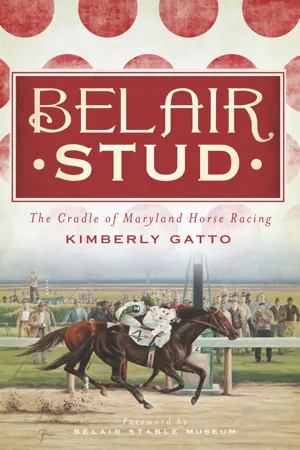
From their opening in 1740 through the 1955 closing, Belair Stud Farm became known as one of the most important stables in American racing. Although the high-profile murder of the farms final owner, Billy Woodward, eventually forced the farm to close, it did produce an extraordinary number of winning horses throughout its expansive history. The farm claims three Kentucky Derbies, three Preakness Stakes, and six Belmont Stakes, winning titles in several prestigious English races. It remains one of two stables to have produced more than one Triple Crown winner, and it is also the only stable to have produced father-son Triple Crown winners. Its list of legendary thoroughbreds includes Gallant Fox, Omaha, Johnstown, Granville, and Nashua. However in addition to the history of champion thoroughbreds, there is a second history devoted to the many interesting people whose own stories are part of the Belair Stud farm, including Samuel and Benjamin Ogle, "Sunny" Jim Fitzsimmons, former slave Andrew Jackson, and even George Washington.
Information
Chapter 1
ORIGINS OF BELAIR
Centuries before Nashua first set foot on a racetrack, the estate now known as Belair was established in Collington, Prince Georges County, Maryland (now known as Bowie). The parcel, measuring five hundred acres and bearing the early name of Catton, was situated within the heart of Maryland’s tobacco farming area. It was patented in 1681 by the Calvert family, the first proprietors of the Maryland Colony, for a man by the name of Robert Carvile. An attorney by trade, Carvile was far too engrossed in his legal practice to spend much time developing the property. In 1698, he sold Catton to Colonel Henry Ridgely for the sum of £100.
Over the next few years, Ridgely made various improvements to the property, including the construction of a house, various outbuildings, an arbor and a barn. Colonel Ridgely operated Catton as a plantation with the assistance of about thirty-two slaves. When Ridgely passed away in 1699, the property was bequeathed to his wife, Mary. Several years later, Mary Ridgely married the Reverend Jacob Henderson, rector of Maryland’s Queen Anne Parish.
As owner of Catton, Henderson had reason to believe that others were trespassing on the property and petitioned the land office to resurvey its boundaries. The new survey estimated the land at 1,410 acres—nearly three times the size of its original tract. When a new deed was issued in 1721, the property was given the name of Belair.
In 1731, British cavalry captain Samuel Ogle was appointed provincial governor of Maryland by Charles Calvert, fifth baron of Baltimore, and dispatched to colonial America. Ogle, the son of a prominent family, was born in 1694 in Northumberland, England. In early October 1731, Ogle boarded a ship from his homeland for the rough two-month journey to Annapolis.
As part of his compensation as governor, Ogle was granted £3,000 to establish a residence in the new colony. After several years as a bachelor, Ogle decided to purchase the land on which he would build a home. In March 1737, he partnered with a friend, Benjamin Tasker Sr., to purchase Henderson’s Belair property. The price was of the land was £500, with each man contributing half of the total. Several months after the purchase, Ogle purchased Tasker’s share of the property, thereby becoming the sole owner of the Belair estate.
Tasker and Ogle had much in common. Tasker was the son of an Englishman and, like Ogle, maintained considerable wealth and a prominent social standing. A successful businessman, Tasker was one of the founders of the Baltimore Ironworks Company. He would hold several colonial offices over the years, including mayor of Annapolis, and would later serve as proprietary governor of Maryland.
The two men also shared an appreciation for fine horses. According to sources, Samuel Ogle was instrumental in the early breeding of English blooded horses in America. He imported several Spanish Barb mares to the new colony and, as early as the year 1735, had sent one such mare to Virginia to be bred to the stallion Bulle Rock.1 In the years to follow, Ogle would become the owner of several racehorses and would later be credited with the establishment of the Annapolis Subscription Plate, the oldest formal recorded horse race in Maryland.
In 1741, the families of Ogle and Tasker were officially joined by marriage. In a union that likely raised eyebrows at the time, Governor Ogle, at the age of forty-seven, married Tasker’s eighteen-year-old daughter, Anne. Known affectionately as “Nancy,” the lovely Anne Tasker was “a much sought-after belle.”2 She was gifted not only with beauty and style but also with intelligence and sophistication. Anne, unlike many women of colonial days, was able to read and express herself in writing.
Less than a year after the nuptials, Ogle’s term as governor ended. Another Maryland resident, Thomas Bladen, had married into the family of Lord Baltimore and, in an example of nepotism, was appointed the new governor. With his term as governor completed, Ogle and his wife packed up their belongings and boarded a ship for a stint in England. Upon departure, Ogle left Tasker in charge of the Belair property, with instructions to construct a home on the purchased land.
While the Ogles were in England, Tasker oversaw the construction of the Belair mansion—“the grandest [home] in the region” with “a magnificent, all-encompassing view of the plantation.”3 As labor was scarce at that time, the mansion took several years to construct. The home, a Georgian-style brick mansion, was situated on an incline, with windows on all sides to allow the sun to pervade the rooms. The sprawling property boasted gardens with terraces, a greenhouse, a deer park and various other buildings. When the Ogles returned to Maryland in 1747, they took residence of the grand estate.
Ogle operated Belair as a full plantation and kept numerous animals on its vast acreage. In addition to horses, Belair housed an assortment of other species, including cattle, hogs, oxen, sheep, fowl and, at one point, a buffalo. In order to properly care for the animals, Ogle hired a young man by the name of Jacob Green to oversee the stables and plantation.
Also in residence at Ogle’s Belair were two prized English Thoroughbreds. These horses, a stallion called Spark and a mare named Queen Mab, were gifts to Ogle from England’s Lord Baltimore. Spark was foaled in 1743 and had originally been presented to Frederick, Prince of Wales. He was sired by Aleppo (from the line of the Darley Arabian) out of a mare called Miss Colvill. Also of royal lineage, Queen Mab was bred by Thomas Smith and foaled at the Royal Stud at Hampton Court in England. Spark and Queen Mab were the first English Thoroughbreds to be imported into Maryland.
The arrival of Queen Mab and Spark at Belair was instrumental in the early development of the American Thoroughbred racehorse. In the years to come, these horses would establish the bloodlines that would propel Belair into the “Cradle of Thoroughbred Racing” in America.
Chapter 2
TASKER’S SELIMA
In May 1752, Maryland mourned the death of Governor Samuel Ogle. After a lengthy illness, Ogle passed away at his home in Annapolis, leaving behind his wife, Anne Tasker, and the couple’s three young children. The bulk of Ogle’s estate, including the Belair property, was bequeathed to his three-year-old son, Benjamin. Due to the child’s age, the governor’s will named his wife’s brother (and Tasker’s son), Colonel Benjamin Tasker Jr., as interim manager of the Belair estate.
Colonel Tasker, at age thirty-two, had already gained prominent political and social standing in the community. He was also a noted horseman who was engaged in the breeding of Thoroughbred racing bloodstock. Colonel Tasker began his breeding efforts by mating Spark with Belair’s Spanish mares but quickly determined his preference for the more elegant English bloodlines. Author Fairfax Harrison wrote in his 1929 book, The Belair Stud, “Colonel Tasker was the first in Maryland to learn the lesson that if one is to breed at all it is worthwhile only to breed ‘true’ and from the best.”4
Tasker evidently had an eye for “the best,” as was proven when he imported the mare Selima in the fall of 1750. Foaled on April 30, 1745, Selima was a daughter of the Godolphin Arabian out of Shireborn, a mare from the personal stable of Queen Anne. The Godolphin Arabian was one of the original three foundation stallions (along with the Darley Arabian and the Byerly Turk) who created the Thoroughbred as a breed. Also known as the Godolphin Barb, the striking “gold touched” bay was foaled in 1724, likely in Yemen or Tunisia, and was shipped to France to the stable of King Louis XIV. The horse was purchased in Paris by Englishman Edward Coke, who shipped the animal to his homeland in 1729. After Coke’s death, the Arabian was sold to Francis Leonard, Second Earl of Godolphin, from whom the horse would derive its name. A prominent breeder, Godolphin owned a farm near Newmarket, the premier horse-racing area in England.
According to legend, the Godolphin Arabian was originally thought too small to be a breeding stud. However, when a broodmare by the name of Lady Roxana rejected her proposed mate, she was covered by Godolphin’s bay stallion. The results were impressive, as the foal of this mating, Lath, became the greatest racer of his day. The second breeding of Lady Roxana with the Godolphin Arabian produced Cade, a five-time leading sire in Great Britain and Ireland. Regulus, another colt sired by the Godolphin Arabian, was undefeated on the track and led the aforementioned sire list for a period of eight years. With such exceptional offspring credited to his name, the Godolphin Arabian was recognized as a leading racehorse stallion and would be bred only to the finest mares.
The veterinary surgeon William Osmer, as quoted by historian C.M. Prior, described the Godolphin Arabian as follows:
There never was a horse (at least, that I have seen) so well entitled to get racers as the Godolphin Arabian; for, whoever has seen this horse must remember that his shoulders were deeper, and lay farther into his back, than those of any horse ever yet seen. Behind the shoulders, there was but a very small space ere the muscles of his loins rose exceedingly high, broad, and expanded, which were inserted into his hindquarters with greater strength and power than in any horse I believe ever yet seen of his dimensions, viz fifteen hands high.5
Stamped with the stunning good looks of her sire, Selima was a lovely bay with a symmetrical star and a white hind coronet. The mare caught the eye of Colonel Tasker, who was completing an English tour of duty in September 1750. Impressed by the mare’s attractive conformation, Tasker purchased Selima for an unknown sum and shipped her to the Belair farm. Records allege that Selima was in foal when she was purchased by Tasker; however, there is no record of any offspring born to her at that time. It is assumed that the foal was aborted or died during the long and tenuous journey overseas.
After arriving safely at Belair, Selima was trained for Tasker and made her racing debut at Annapolis in May 1752. There she defeated another English mare, Creeping Kate, and earned a purse of fifty Spanish gold coins (known as pistoles) for Belair Stud.
Around the time that Selima was training at Belair, a young Virginian named William Byrd III spent his days boasting about his wealth. Byrd’s father and grandfather had made a fortune in the fur trade business, which left young William with more money than he could handle. Byrd fit the caricature of a proverbial showoff who enjoyed singing his own praises to anybody who would listen. The young man was also a reckless gambler who was notorious for making frivolous bets. On one occasion, Byrd lost thousands of English pounds in a single card game while playing against the Royal Duke of Cumberland.
By 1752, Thoroughbred races were becoming increasingly popular in Virginia and its surrounding areas. In response, Byrd—who was unable to resist gambling of any sort or kind—opted to give the prestigious “sport of kings” a try. In his estimation, success would be easy; all he would need was an appropriate horse. As was characteristic of Byrd, he did not give the acquisition much thought. Soon he had purchased Tryal, a ten-year-old chestnut Thoroughbred—a horse without any racing history.
When the horse arrived on the ship from England, Byrd could barely wait to show off his new purchase. He made a bold decree, challenging any horse owner who dared to face Tryal in a race. With money as no object, Byrd offered up a hefty purse of 500 Spanish pistoles—enough, according to Smithsonian magazine, to “furnish a mansion or buy a dozen slaves.”6 The race was to be a winner-take-all duel over four miles near the Williamsburg colony.
With such a large sum of money at stake, several prominent horse breeders responded to Byrd’s call. Colonel Francis Thornton of Virginia would enter an unnamed gray mare. Breeder John Tayloe II, also from Virginia, would bring two imported Thoroughbreds, Childers and Jenny Cameron. And Colonel Tasker of Belair would cross state lines to enter Selima. With five horses entered at 500 pistoles apiece, the winner’s purse was the largest for any horse race at that time.
The race took place on December 5, 1752, at Anderson’s Race Ground in Gloucester, Virginia. Few specific details are known. According to sources, however, Selima would likely have walked 150 grueling miles to the Race Ground, as horses were not transported by cart at that time. The other horses also would have been hand-walked to the event but were housed within a few short miles of the destination. In the race, the horses would have carried approximately 140 pounds and were likely ridden by young African American slaves.
According to Smithsonian, “The only known newspaper account was a brief report in Annapolis’ Maryland Gazette listing the order of finish and referring to the occasion as ‘great.’” That order of finish was not in William Byrd’s favor. Selima garnered her second win in as many starts, defeating Tryal and the others over Virginia’s rough terrain. The finish was listed as Selima, Tryal, Thornton’s mare and Tayloe’s two imports, in that order, and the event was heralded as the first “major” horse race in the new colony.
William Byrd was disgusted. Not only did his Tryal fail to win the race, but Byrd had embarrassed himself and fellow Virginians by allowing a Maryland horse to defeat them. At that point, a decree was issued to ban all Maryland horses from competing in Virginia. Maryland breeders thwarted this rule by sending their mares out of state to deliver foals. For Byrd’s part, while he continued to import horses, he never entered another race.
Following this epic victory, Selima began the next phase of her life as a broodmare at Belair Stud. There she produced six foals for Colonel Tasker. Among them was Selim, a handsome bay colt foaled in 1759. Known as “the terrible Selim” due to his difficult temperament, Selim was one of the most successful racehorses of his time. He made his debut at the age of four and was undefeated for five straight years, ultimately retiring at age thirteen with very few losses. Selim’s most well-known race occurred in 1766, when he bested the equally famous Yorick, a Virginia-bred chestnut, for a purse of 100 pistoles.
What originated as a keen judgment by Colonel Tasker on a visit to England turned out to be a monumental development in the history of Thoroughbred racing. Selima was to become the foundation mare of the American Thoroughbred breed, with her early descendants including immortals such as Lexington, Foxhall and Hanover.
Selima’s memory continues to live on in Maryland and throughout the entire horse-racing community. In her honor, the Selima Stakes for two-year-old fillies was established at Laurel Race Course in 1926. At the time of its origin at the Maryland State Fair, the race offered the richest purse for fillies at that time. Fittingly, the winner’s trophy would be donated by Belair Stud (and William Woodward, owner at that time), with the following inscription: “This cup and cover is presented by the Belair Stud, in memory of Selima (by the Godolphin Arabian), imported to Belair in the reign of George the Second. Selima became the ancestress of Hanover, Foxhall, and many fine racehorses.” A plaque featuring a bronze likeness of the broodmare Selima would later be commissioned by Woodward; it would be affixed to the stable wall, further honoring Selima’s place in the history of Belair.
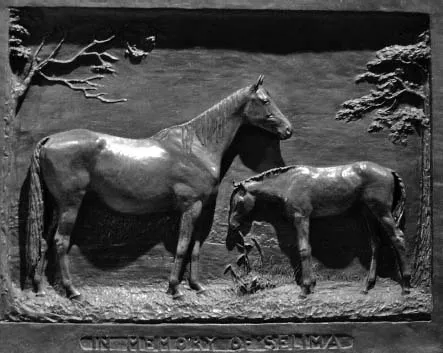
The Selima plaque commissioned by William Woodward. Courtesy of the Belair Stable Museum.
Racing historian John Hervey wrote of Selima:
In Selima we behold one of those majestic matriarchs whose greatness is monumental. She was the queen of the turf in her day, and when sent to the stud disseminated an influence through a large family of both sexes that makes the history of her descendants synonymous with that of the American turf and breed of horses. A statement that might seem extravagant were it not in broad terms the truth.7
Chapter 3
THE TASKERS AND THE OGLES
With Selima settled into life as a broodmare, Colonel Tasker managed all aspects of the Belair estate. He also served as guardian and executor of the late governor’s will and oversaw the education of young Benjamin Ogle. In the years following Governor Ogle’s death, Anne and the children had moved b...
Table of contents
- Front Cover
- Title Page
- Copyright
- Dedication
- Contents
- Foreword
- Acknowledgements
- 1. Origins of Belair
- 2. Tasker’s Selima
- 3. The Taskers and the Ogles
- 4. The Early Woodward Era
- 5. William Woodward, Master of Belair
- 6. The Roaring Twenties
- 7. The Fox of Belair
- 8. Omaha, the Belair Bullet
- 9. Other Belair Favorites
- 10. A Changing of the Guards
- 11. Nashua the Great
- 12. Triumph and Tragedy
- 13. Belair Lives On
- Appendix A. Offspring of Selima
- Appendix B. Pedigrees of Key Belair Horses
- Appendix C. Racing Records of Key Belair Stud Champions
- Appendix D. Winners of Key Races Named for Belair or Its Horses
- Notes
- About the Author
Trusted by 375,005 students
Access to over 1.5 million titles for a fair monthly price.
Study more efficiently using our study tools.
Frequently asked questions
Yes, you can cancel anytime from the Subscription tab in your account settings on the Perlego website. Your subscription will stay active until the end of your current billing period. Learn how to cancel your subscription
No, books cannot be downloaded as external files, such as PDFs, for use outside of Perlego. However, you can download books within the Perlego app for offline reading on mobile or tablet. Learn how to download books offline
Perlego offers two plans: Essential and Complete
- Essential is ideal for learners and professionals who enjoy exploring a wide range of subjects. Access the Essential Library with 800,000+ trusted titles and best-sellers across business, personal growth, and the humanities. Includes unlimited reading time and Standard Read Aloud voice.
- Complete: Perfect for advanced learners and researchers needing full, unrestricted access. Unlock 1.5M+ books across hundreds of subjects, including academic and specialized titles. The Complete Plan also includes advanced features like Premium Read Aloud and Research Assistant.
We are an online textbook subscription service, where you can get access to an entire online library for less than the price of a single book per month. With over 1.5 million books across 990+ topics, we’ve got you covered! Learn about our mission
Look out for the read-aloud symbol on your next book to see if you can listen to it. The read-aloud tool reads text aloud for you, highlighting the text as it is being read. You can pause it, speed it up and slow it down. Learn more about Read Aloud
Yes! You can use the Perlego app on both iOS and Android devices to read anytime, anywhere — even offline. Perfect for commutes or when you’re on the go.
Please note we cannot support devices running on iOS 13 and Android 7 or earlier. Learn more about using the app
Please note we cannot support devices running on iOS 13 and Android 7 or earlier. Learn more about using the app
Yes, you can access Belair Stud by Kimberly Gatto in PDF and/or ePUB format, as well as other popular books in History & North American History. We have over 1.5 million books available in our catalogue for you to explore.