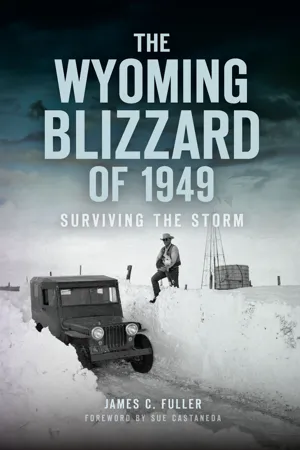
A Wyoming historian shares an in-depth look at the historic storm and its devastating aftermath through the stories of those who survived.
The Blizzard of 1949 took Wyoming and neighboring states by surprise. In January of that year, snow, wind and frigid temperatures devastated the northern plains. The storm stranded hundreds of motorists on the highways and stalled nearly two dozen trains at depots throughout the state. For nearly two months, towns and ranches were marooned by enormous drifts, some reportedly eighty feet tall.
Communities pulled together to assist not only their neighbors but also anyone unable to escape the snowstorm. Drawing on meticulous research and numerous in-person interviews, author and historian James Fuller recounts these harrowing stories of tenacity and fortitude.
- 259 pages
- English
- ePUB (mobile friendly)
- Available on iOS & Android
eBook - ePub
About this book
Information
CHAPTER 1
SMALL-TOWN WYOMING
Small towns across Wyoming dealt with the challenges of having thousands of stranded passengers in their towns during the blizzard. These towns all dealt with the influx of people, but it was Green River, Wyoming, that took the brunt of those marooned on trains. Several national newspapers estimated somewhere around 12,000 passengers were stranded in Green River. With a population of just 3,187, the incursion of this many people increased the city by an incredible 376 percent, making it understandable that Green River did not have a plan for such an inundation of people. Aboard the six stalled trains in Green River, the passengers made national news swiftly, as noted athletic teams were aboard. Football teams included the Villanova University Wildcats, Drake University Bulldogs and the East All-Stars football squad, which had just returned from its match-up with the West All-Stars in San Francisco, where the East won a close game by a score of 14–12. Not only were there football teams but the University of Wyoming Cowboys and Hamline University Pipers basketball teams as well. Rounding out these athletic teams was the University of Michigan Wolverines hockey team.
The excitement of having these sports teams in Green River was a treat for many in the small Wyoming town, who had probably not been able to attend college athletic games. Most exciting to those in Green River was the arrival of the University of Wyoming Cowboys basketball team, which had recently participated in the Los Angeles Invitation Basketball Tournament. The Cowboys had taken third place in the tournament, defeating the University of Montana with the assistance of what the newspapers called the “bright star of the game Ron Livingstone, the Cowboys towering center, at 6’10”, who racked up seventeen of the team’s winning points, with the assistance of point guard Len Larson, who scored an additional ten points.” The Cowboys boarded the train in Los Angeles along with the Hamline University Pipers basketball team, which had won first place in the tournament, defeating the Wyoming Cowboys, 37–35, in what the Missoulian called “one of the wildest finishes of the tourney before a roaring crowd of 4,424.”14 With both teams in town, a game between the two squads was a possibility and the hope of many Cowboy fans. Coach Joe Hutton of the Pipers remarked in an article to the Star Tribune, “We tried to get a game with Wyoming at the high school, but their coach Ev Shelton had gone ahead to Laramie.”15 Over the years, many have claimed a game did take place in Green River. However, a game between the two squads never took place. In an interview, former team member Kerwin Engelhart recalled that during his time in Green River, the Wyoming squad wanted to play a game against Hamline. Engelhart stated that his coach said since they had just defeated Wyoming in Los Angeles a few days earlier, there was no reason to play them again: “There was nothing to be gained by our team.” Although Hamline had handed Wyoming a devastating loss in Los Angeles, Engelhart noted the relationship was very cordial among all the teams, including the Cowboys and the Pipers.
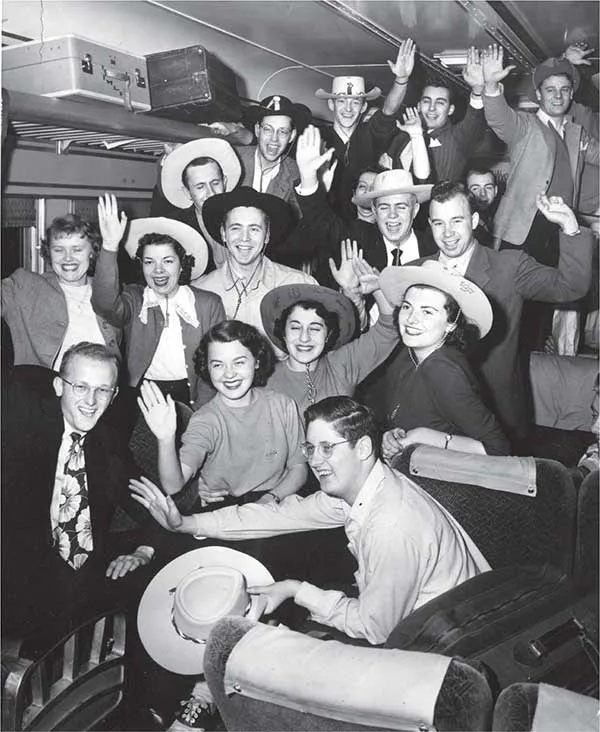
Stranded Northwestern University students on trains in Cheyenne, Wyoming. Courtesy of Northwestern University Library.
Hamline’s perspective of being stranded in Wyoming was different than might have been expected. Engelhart said that upon finding out more about their situation, his fellow teammates were excited since they had never experienced anything like this in Minnesota. He went on to say this excitement quickly declined, as frustration set in. The members of the basketball team had been on the road for quite some time and were anxious to get home. Engelhart said he remembered Coach Hutton contacting the school and informing them of what was going on.16 A newspaper article confirmed Engelhart’s statement, as the paper noted Hutton made a long-distance phone call to assure fellow Minnesotans that the Pipers were hale and hearty and all were anxious to get home, perhaps by Saturday. Hutton also mentioned in the article that the team worked out at the high school gym in Green River to occupy the time. Engelhart said he recalled the workouts with his team but emphatically stated that there was no game between the two squads. Coach Hutton praised the residents of Green River and how they accommodated so many people. He stated, “The people here are treating us swell, they are putting on special matinees at the theater for the people on the trains, and they threw a dance at the gym last night.” He went on to say, “There is plenty to eat, we all eat and sleep on the train, but we have to take turns eating. I guess they’re serving someone all day long.” Hutton continued as he told about his team and the obsession with their new trophy. “The players weren’t letting the huge trophy they won at Los Angeles out of their sight. Vern Mikkelson, had been named the keeper of the cup because he’s got one of his own to look after.”17 Finally, like any great father and coach, Hutton asked those on the phone with him to first call his daughter Barbara and let her know the team was all right. He also asked that his daughter call the wives of players Jim McDonald and Bob Lundsten, since according to the coach they had been married less than a year and he guessed their marriages were getting the supreme test.18
Two other passengers facing similar situations as the college students were Stacey Green and his colleague Theodore Pratt, who were both staff members of the University of Oregon. Green was part of the music faculty, and fellow university colleague Theodore Pratt was a dean on campus. They shared their Wyoming adventures with their local Rotary Club members after their return to Eugene, Oregon. Green and Pratt, who were returning from a trip east, found themselves stranded in Egbert, Wyoming. Green went into detail of what he saw in this small Wyoming town. He described “the thriving metropolis of Egbert, as a community where the railroad station was the last word in architecture when the Union Pacific first pushed its tracks across the country.” He went on to explain that downtown Egbert consisted of the tiny train station, a single country store and an old schoolhouse. He further stated that the residential area was made up of five or six houses, and the town was devoid of trees. He went on to say the town “was surrounded by the horizon,” which for many even today would make this a great place to live. Green recounted these events to a local Oregon newspaper, the Eugene Guard. In Green’s account, it appears he was impatient and frustrated with the length of time it was taking to get to his original destination. When he described it to the paper, his initial statement was that it took “three endless days and nights.” Although Green seemed impatient, he gave a great account of what was happening and the craziness surrounding his incarceration by the blizzard.
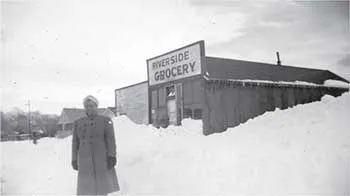
Florence Pantle standing in front of the Riverside Grocery. Author’s photo.
Recalling the rescue efforts, Green noted the patience of many was growing thin. Arriving in Cheyenne by bus on Tuesday, January 3, many anticipated a train to their final destinations, but this, unfortunately, did not happen. The optimism of many waned as the schedules, according to Pratt, continued to change in the early hours of the following day, with no train pulling into the Cheyenne Depot. As frustrations mounted, tempers flared, and Cheyenne police had to incarcerate several passengers in the city jail, where they stayed into Wednesday, when the railroad company paid their fines. This incident clearly showed not just passengers were beginning to feel the strain of the storm’s grasp. Green and his fellow passengers finally boarded a train at two o’clock on Wednesday, afternoon, January 4. There was one positive aspect from all of this, as Green reported the trip back to Portland, where “service to all passengers and all meals [were] on the house.” Of course, Green did not let his audience down, as he took the opportunity to leave one final remark regarding his unplanned trip to Wyoming. He stated, “The morale of the passengers was good all through the ordeal, and the Union Pacific employees were to be congratulated on their efforts, with the exception of employees at the Cheyenne station who could learn a lot about handling people.” It is apparent that not everyone stranded in Wyoming had the same experience or observation of the efforts taken by those across the state. As many of Egbert’s residents were assisting in the entertainment, feeding and lodging of those stranded, other towns across the state were dealing with similar issues.19
Twenty-four miles north of Torrington was the small outpost of Burge, Wyoming. The post office was established in 1913, but by 1949, when the blizzard came through, it had already been dissolved. Reports came from those still living in the Burge area as they informed those in Goshen County of the conditions in Burge. Mrs. W.H. Backhaus, who authored the article, started out saying that those there in Burge had been snowed in for thirty-nine days since the blizzard had come through. She reported, just like others across the state, that snowdrifts had buried the corrals, sheds, water tanks, and haystacks.
Mrs. Backhaus praised Mr. Erland “Bud” Anderson, their local Conoco fuel man, who, despite the blowing snow, wind and drifts, ensured that his customers received the fuel they needed during the storm. She said Bud would traverse through the pastures and make his way through the drifts. When he became tired and could no longer continue, he would sleep in the cab of his truck. Bud was resourceful, as in some cases he left fuel in barrels so those in the community could come and get their allotted amounts of fuel.
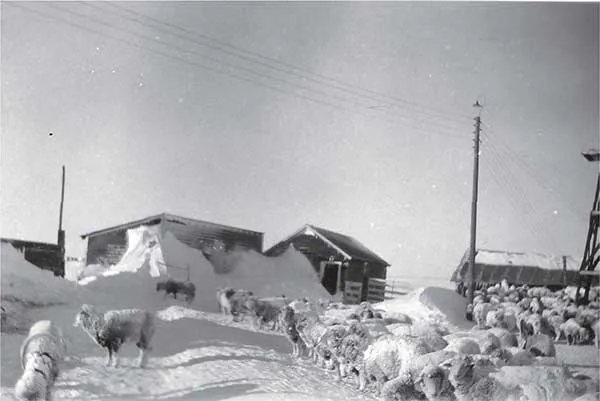
Sheep at the Emerich ranch roam about as they walk over the corral fences with the assistance of snowdrifts. Courtesy of Senator Fred Emerich.
Another couple residing in Burge was Wayne and Velda Childers, whose residence was considered by truckers, ranchers and surrounding neighbors to be the halfway point between Torrington and Van Tassell, Wyoming. Mrs. Backhaus said she could not begin to fathom how many cups of coffee and lunches Velda had served to those who were stranded or had stopped during the blizzard. According to Mrs. Backhaus, while Velda was serving up meals, Wayne “could always find a pack of cigarettes for someone who was out, and helped motorists whose cars were giving problems.”
Of course, communication was critical to the community, and the local radio station from Scottsbluff, Nebraska, was praised for broadcasting not only the weather but also road conditions there in the community in and around Burge. The telephones were working just fine, according to Mrs. Backhaus, and if a family needed something and another family had enough to spare, they gladly helped those in need. Mrs. Backhaus also mentioned that some of their neighbors were not as fortunate. Mr. Andy C. Grosjean and his wife, Mamie, had been without mail or any other resources for over four weeks. This was because the Grosjeans lived near the state line of Nebraska and were not close enough to neighbors to get assistance. Mrs. Backhaus told of Frank Lewis and Ord Anstey, two other ranchers in the community who, with their little blue jeep, made it over the Nebraska state line to feed their cattle, but other ranches had more substantial losses regarding their cattle. Of those who lost the heaviest in cattle were Joe McManaman, Frank Lewis, Russel H. Foote and the Backhauses. Frank lost forty of his best calves, while the Backhauses lost twenty-seven cows and one calf. Mrs. Backhaus was unsure of the losses of others in the community but understood they were similar to those she had mentioned.
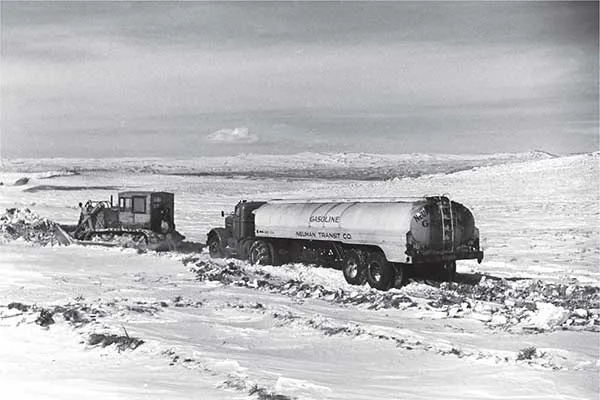
A bulldozer dragging a fuel truck over the hill, trying to get the fuel truck back to town. Courtesy of John Moyer.
As always, there was a bit of humor through the trials faced during the storm. Mrs. Backhaus mentioned that Leonard Loxterkamp, Ord Anstey, Frank Lewis and George Backhaus had not shaved for quite some time and now had the look of the old ’49ers. Of course, the men made a pact not to shave their beards until the first social occasion when they would have the opportunity to “show the ladies what good looking beards they have to protect their faces.” The children in the community, of course, worried whether they might have to attend summer school since there had been no attendance at the school since December 20, 1948. Per Mrs. Backhaus, the schoolteacher, Mrs. Hirch, had been there waiting for school to open, which probably wasn’t what the students wanted to hear. Finally, Mrs. Backhaus ended her artic...
Table of contents
- Front Cover
- Title Page
- Copyright
- Dedication
- Contents
- Foreword, by Sue Castaneda
- Preface
- 1. Small-Town Wyoming
- 2. Marooned on Wyoming’s Roads and Rails
- 3. Business as Usual
- 4. Neighbors Helping Neighbors
- 5. Conclusion
- Notes
- About the Author
Trusted by 375,005 students
Access to over 1.5 million titles for a fair monthly price.
Study more efficiently using our study tools.
Frequently asked questions
Yes, you can cancel anytime from the Subscription tab in your account settings on the Perlego website. Your subscription will stay active until the end of your current billing period. Learn how to cancel your subscription
No, books cannot be downloaded as external files, such as PDFs, for use outside of Perlego. However, you can download books within the Perlego app for offline reading on mobile or tablet. Learn how to download books offline
Perlego offers two plans: Essential and Complete
- Essential is ideal for learners and professionals who enjoy exploring a wide range of subjects. Access the Essential Library with 800,000+ trusted titles and best-sellers across business, personal growth, and the humanities. Includes unlimited reading time and Standard Read Aloud voice.
- Complete: Perfect for advanced learners and researchers needing full, unrestricted access. Unlock 1.5M+ books across hundreds of subjects, including academic and specialized titles. The Complete Plan also includes advanced features like Premium Read Aloud and Research Assistant.
We are an online textbook subscription service, where you can get access to an entire online library for less than the price of a single book per month. With over 1.5 million books across 990+ topics, we’ve got you covered! Learn about our mission
Look out for the read-aloud symbol on your next book to see if you can listen to it. The read-aloud tool reads text aloud for you, highlighting the text as it is being read. You can pause it, speed it up and slow it down. Learn more about Read Aloud
Yes! You can use the Perlego app on both iOS and Android devices to read anytime, anywhere — even offline. Perfect for commutes or when you’re on the go.
Please note we cannot support devices running on iOS 13 and Android 7 or earlier. Learn more about using the app
Please note we cannot support devices running on iOS 13 and Android 7 or earlier. Learn more about using the app
Yes, you can access The Wyoming Blizzard of 1949 by James C Fuller in PDF and/or ePUB format, as well as other popular books in History & North American History. We have over 1.5 million books available in our catalogue for you to explore.