- 163 pages
- English
- ePUB (mobile friendly)
- Available on iOS & Android
eBook - ePub
On this Day in Florida History
About this book
Florida is steeped in a cultural blend of history unmatched by any other state. One day at a time, author and historian Nick Wynne offers a glimpse of this quirky and fascinating story, beginning with the 1539 arrival of Hernando de Soto. On February 22, 1959, the legendary five-hundred-mile race at Daytona first began. On March 22, 1982, the space shuttle "Columbia" launched from Cape Canaveral. Camp Blanding experienced a Nazi prisoner riot on December 22, 1943. Enjoy a notable nugget of history a day or a month at a time with this celebration of Sunshine State heritage.
Information
JANUARY
January 1
1885—Florida Has a New Constitution: Florida’s fifth constitution, created by a Constitutional Convention that met in Tallahassee on June 9, 1885, went into effect today and remained the basic law of the Sunshine State until 1968. The 1885 constitution replaced the “carpetbag” constitution of 1868. In the 1920s, the 1885 constitution was amended to include a prohibition on the imposition and collection of a state income tax, a provision to encourage investment in land development.
1914—First Scheduled Commercial Air Flight: The first scheduled commercial airplane flight was made today from St. Petersburg to Tampa. Tony Jannus, a pioneering aviator, opened the service with his flying boat, the Benoist, which could haul one passenger and a small amount of freight. A.C. Pheil, former mayor of St. Petersburg, purchased the first passenger ticket for $500. Jay Dee Smith was Jannus’s mechanic. Two daily round trips were flown for twenty-eight consecutive days.
January 2
1830—Henry Morrison Flagler, Railroad and Hotel Magnate, Is Born: Henry Morrison Flagler, founder of the Florida East Coast Railway and developer of the Florida east coast tourist industry, was born today in Hopewell, New York. Flagler, whose interest in Florida stemmed from visits to St. Augustine, combined his railroad interests with hotels and steamships. An early partner with John D. Rockefeller in Standard Oil, Flagler spent millions on his Florida projects, eventually constructing the longest railroad over water with his Florida Overseas Railroad, which connected the mainland to Key West.
1979—Popular Governor Bob Graham Inaugurated: On this day, “Bob” (D. Robert) Graham was inaugurated as the Sunshine State’s thirty-eighth governor. Graham was born on November 9, 1936, in Coral Gables. He graduated from the University of Florida in 1959 and received a law degree from Harvard Law School in 1962.
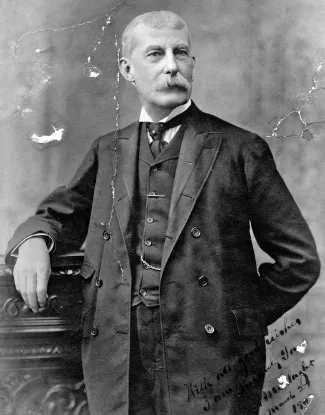
Henry Flagler’s hotel and railroad empires stretched the length of the Sunshine State’s east coast from Jacksonville to Key West. He visited St. Augustine in 1878 and became enchanted with the prospects of making money on Florida tourism, land sales and his railroads. In the 1880s, he started construction on the Ponce de Leon Hotel in St. Augustine, and by 1896, his enterprises stretched as far south as Miami. By 1912, Key West was added to the Flagler empire. Richard Moorhead Private Collection.
January 3
1861—Secession Convention Meets in Tallahassee: Delegates to the Florida Secession Convention met in Tallahassee to take up the question of secession. Edmund Ruffin of Virginia arrived to confer with Governor Madison Starke Perry and members of the convention.
1967—First Republican Governor Since Reconstruction Inaugurated: Claude Roy Kirk Jr. was installed as Florida’s thirty-sixth governor today. Kirk was born on January 7, 1926, in San Bernardino, California. He lived in a variety of locales during his youth and graduated from high school in Montgomery, Alabama, when he was seventeen. He enlisted in the Marine Corps and, after officer training at Quantico, Virginia, was commissioned as a second lieutenant. He left the marines in 1946 and entered law school. He received his law degree in 1949. Kirk returned to active duty in 1950 and served in combat in Korea. After the war, he entered the insurance and investment business in Jacksonville, eventually heading up the Kirk Investments Company. A former Democrat, he was successful in his 1966 campaign for the governorship and became the first Republican to hold this position since the end of Reconstruction. In 1978, he ran an unsuccessful campaign for governor as a Democrat. In 1988, he failed in his bid for the U.S. Senate as the Democratic nominee.
January 4
1863—First Governor of Florida Dies: William Dunn Moseley, Florida’s first governor under statehood (1845–49), died on this day. Moseley was born at Moseley Hall, Lenoir County, North Carolina, on February 1, 1795. He attended the University of North Carolina with James K. Polk, later president of the United States. After college, he practiced law in Wilmington, North Carolina, and entered public service as a state senator. In 1835, Moseley purchased a plantation in Jefferson County, Florida, and resided there until 1851. A member of the territorial legislature, Moseley defeated Richard Keith Call, the third and fifth territorial governor of Florida, in a contest to become the first governor of the new state of Florida. In 1851, Moseley moved to Palatka, where he was a planter and fruit grower.
1961—Florida’s Governor During Civil Rights Turbulence Inaugurated: Thomas LeRoy Collins, the thirty-third governor of Florida, took the oath of office today. Collins was born on March 10, 1909, in Tallahassee. A graduate of Leon High School, Collins attended the Eastman School of Business at Poughkeepsie, New York, and received a law degree from Cumberland University. He married Mary Call Darby, the great-granddaughter of two-time territorial governor Richard Keith Call. Collins’s terms were marked by the rise of the civil rights movement in Florida, and through his leadership, Florida avoided much of the violence and turmoil that marked desegregation in other southern states.
January 5
1929—Sarazen Wins Miami Open Golf Tournament: Gene Sarazen won the $750 first prize at the Miami Open Golf Tournament, played at the Bayshore/LaGorce course. His score was 294 for 72 holes. This was his third consecutive win.
1965—Democrat Hayden Burns Enters Governor’s Office: William Hayden Burns took the oath of office today to become Florida’s thirty-fifth governor (1965–67). Burns was born on March 17, 1912, in Chicago, Illinois. He attended Jacksonville public schools and Babson College. During World War II, Burns served in the U.S. Navy. Although eligible for a second two-year term, he was defeated by Claude Roy Kirk Jr., a Republican, in 1966.
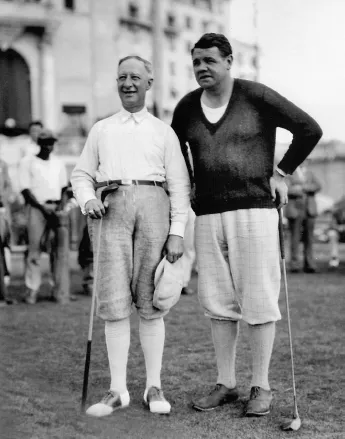
When Flagler’s railroad and hotels opened Miami to development, the area boomed. Soon, anyone who was anyone could be found on the beaches or playing golf at the luxury hotels that were in abundance. Governor Al Smith (left) and baseball hero George “Babe” Ruth pose in front of the Miami Biltmore in 1931. Historical Association of South Florida, Miami.
January 6, 1925
Governor to Preside Over Florida Land Boom: John Wellborn Martin took the oath of office today as Florida’s twenty-fourth governor with high expectations that the boom in Florida property sales would continue indefinitely. Martin was born on June 21, 1884, in Marion County. Admitted to the bar in 1914, he began to practice law in Jacksonville. From 1917 until 1924, Martin was the mayor of Jacksonville. Unfortunately, Martin’s expectations of continued prosperity were soon dashed, and he presided over the beginning of the Florida “bust.” During his administration, Florida began an expansive program of highway construction, direct state appropriations to finance public schools and the distribution of free textbooks to students in grades one through six. In 1928, he was defeated in his bid for a U.S. Senate seat. In 1932, he lost a bid to regain the governor’s office.
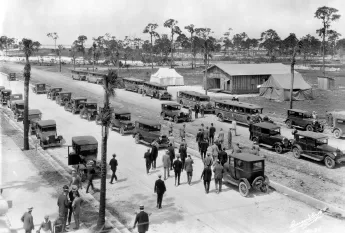
During the land boom of the 1920s, developers sent free buses as far away as Kansas and Iowa to bring prospective buyers to the Sunshine State. Buyers were housed and fed while they toured prospective new town sites. Of course, some people saw the eagerness of developers to get them to come to Florida as an opportunity for an “all expenses paid vacation!” Burgert Brothers Collection, Tampa Public Library.
January 7
1903—Zora Neale Hurston, Noted Author, Born: Florida author Zora Neale Hurston was born today. Some controversy exists as to the actual place of her birth. Some authorities claim it was in Eatonville (east of Orlando), but the latest scholarship places her birthplace in Alabama. Regardless of where she was born, Hurston certainly considered Eatonville her home and centered many of her stories there.
1911—Popular Actress Thelma “Butterfly” McQueen Born in Tampa: Thelma “Butterfly” McQueen was born today in Tampa. McQueen gained enduring fame for her portrayal of Prissy in the 1939 epic Gone with the Wind. McQueen hated her given name, Thelma, and legally changed her first name to Butterfly. An accomplished screen and Broadway actress, McQueen’s first role would become her most identifiable, along with the famous words: “I don’t know nothin’ ’bout birthin’ babies!”
January 8
1853—New Railroad Company Created: David Levy Yulee and his financial partners incorporated the Florida Railroad Company today. The railroad ran between Fernandina and Cedar Key and was completed in 1860, just a few months before the outbreak of the Civil War. After the war, the railroad enjoyed a few years of prosperity, but it eventually fell on hard times and was purchased. It was later abandoned.
1965—“Murph the Surf” Arrested for Burglary: Jack “Murph the Surf” Murphy and a companion were arrested today in Miami. They were suspects in the American Museum of Natural History robbery of October 1964, in which the fabled “Star of India,” the world’s largest sapphire, was stolen.
January 9
1861—Convention Agrees to Postpone Final Vote: In Tallahassee, the final debate on the Ordinance of Secession concluded in late afternoon. Delegates agreed to postpone a final vote until January 10. Governor Madison Starke Perry and governor-elect John Milton were both strong supporters of secession. In a minority opinion, former territorial governor Richard Keith Call, acting as a private citizen, argued that secession would bring only ruin to the state.
1990—Shuttle Columbia Launched Successfully: Shuttle STS-32, Columbia, was launched today from Cape Canaveral. The launch was NASA’s thirty-third successful mission and the ninth mission for the Columbia. Astronauts on board were Daniel C. Brandenstein, the commander, and crew members James D. Wetherbee, Bonnie J. Dunbar, Marsha S. Ivins and G. David Low. Crew members were tasked with deploying the Syncom IV-F5 defense communications satellite and with retrieving NASA’s Long Duration Exposure Facility. Columbia landed safely on January 20, 1990, at 1:35:37 a.m. Pacific standard time on Runway 22 of Edwards Air Force Base in California.
January 10
1861—Secession!: Governor Madison Starke Perry read a telegram to the delegates at the Florida convention from Florida’s congressional delegation, informing them that “Federal troops are said to be moving or about to move on Pensacola forts.” This warning, given just before the final debate on the state’s secession ordinance, created a sense of urgency among the delegates. After two hours of debate, the secession convention approved the measure by a vote of 62–7. Florida thus became the third state to leave the Union. In Tallahassee, crowds danced in the street. Fireworks, a large parade and the ringing of church bells created an atmosphere of celebration and joy. In Pensacola, the commanding officer of Federal forces consolidated his men in Fort Pickens. Later that evening, Union lieutenant H. Erben led a raiding party that battered in the gates of Fort McRee. The Union raiding party spiked the guns of the fort and dumped about a dozen barrels of gunpowder into the sea.
1888—Luxury Hotel Opens in St. Augustine: Construction on Henry Flagler’s famous Ponce de Leon Hotel, one of the earliest luxury resorts in Florida, was completed today in St. Augustine. The hotel is now the main building of Flagler College, a private institution of higher learning. It is currently open to the public for guided tours.
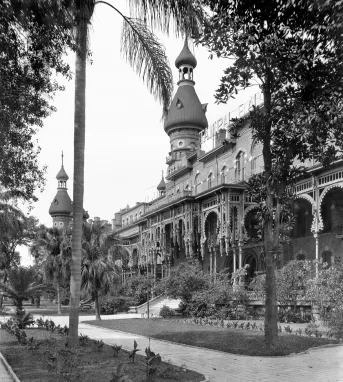
The friendly rivalry between Henry Plant and Henry Flagler stimulated Florida’s economy during the late 1800s. Flagler pressed southward along the Atlantic coast while Plant pursued his interests in central Florida and along the Gulf coast. Henry Plant Museum, Tampa.
January 11
1839—Delegates Approve New Constitution in St. Joseph’s: Florida’s first constitution was signed by members of the constitutional convention meeting in St. Joseph’s today. Although the document would not become the law of the land in 1839, as Florida was still only a federal territory, it provided the basic framework for the first state constitution in 1845.
1861—The Independent Nation of Florida: The Ordinance of Secession, approved by the secession convention on January 10, 1861, was signed today. Florida became an “independent nation” until it joined the Confederate States of America on January 28. Soon-to-be governor John Milton unfurled the new flag of Florida, a white silk banner with three stars. The stars represented the three southern states that had seceded—South Carolina, Mississippi and Florida. An official Florida flag was adopted later, although a number of flags were used by Floridians.
January 12
1888—Florida’s Newest Attraction: The Ponce de Leon Hotel in St. Augustine, the first of what eventually would be a twelve-hotel chain owned by the Florida East Coast Hotel Company (part of the Flagler System), officially opened today. Upon their arrival in St. Augustine, guests were astounded when the generators were turned on and one million light bulbs lit up the hotel. Guests were invited to a sumptuous feast and an elaborate program of entertainment as the celebration of the opening got underway.
1942—Floridian Wins Medal of Honor: Lieutenant Alexander (Sandy) Nininger Jr. of Fort Lauderdale was killed in action today in Bataan, Philippine Islands. He became the first U.S. soldier to be awarded the Congressional Medal of Honor in World War II.
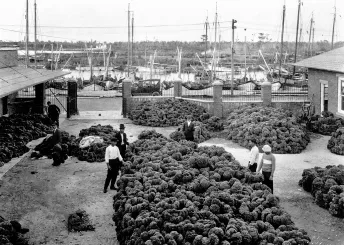
The sponge docks of Tarpon Springs and the lively Greek community of shops and restaurants drew hordes of tourists to this village on Florida’s Gulf coast. Even today, tourists seeking the colorful and unusual in the Sunshine State find their way to Tarpon Springs. The Richard Moorhead Private Collection.
January 13
1982—Air Florida Plane Crashes into the Potomac River: A twin-engine Air Florida jet (Air Florida Flight 90), bound for Tampa, crashed into the Potomac River today immediately after takeoff from Washington’s national airport. Some seventy-eight persons were killed. The jet, encumbered by ice on the wings, crashed into the Fourteenth Street Bridge and struck a truck and at least four cars. Horrified commuters and emergency personnel worked to rescue the passengers from the icy waters of the river. Traffic was so snarled that emergency vehicles were forced to resort to using the sidewalks to reach the crash scene. Some investigators suspected that the mass firing of the air controllers by the Reagan administration five months earlier contributed to the disaster, although the final report of the national Transportation Safety Board did not place any blame on this occurrence.
1993—Another Successful Shuttle Launch: Space Shuttle Endeavour (STS-54) was sent into space today from Cape Canaveral. Its primary mission was to deploy a tracking and data-relay satellite and carry out a number of scientific experiments on X-ray radiation and microgravity. The mission was under the command of John H. Casper, and crew members included Don...
Table of contents
- Front Cover
- Title Page
- Copyright
- Contents
- Introduction
- January
- February
- March
- April
- May
- June
- July
- August
- September
- October
- November
- December
- Bibliography
- About the Author
Trusted by 375,005 students
Access to over 1.5 million titles for a fair monthly price.
Study more efficiently using our study tools.
Frequently asked questions
Yes, you can cancel anytime from the Subscription tab in your account settings on the Perlego website. Your subscription will stay active until the end of your current billing period. Learn how to cancel your subscription
No, books cannot be downloaded as external files, such as PDFs, for use outside of Perlego. However, you can download books within the Perlego app for offline reading on mobile or tablet. Learn how to download books offline
Perlego offers two plans: Essential and Complete
- Essential is ideal for learners and professionals who enjoy exploring a wide range of subjects. Access the Essential Library with 800,000+ trusted titles and best-sellers across business, personal growth, and the humanities. Includes unlimited reading time and Standard Read Aloud voice.
- Complete: Perfect for advanced learners and researchers needing full, unrestricted access. Unlock 1.5M+ books across hundreds of subjects, including academic and specialized titles. The Complete Plan also includes advanced features like Premium Read Aloud and Research Assistant.
We are an online textbook subscription service, where you can get access to an entire online library for less than the price of a single book per month. With over 1.5 million books across 990+ topics, we’ve got you covered! Learn about our mission
Look out for the read-aloud symbol on your next book to see if you can listen to it. The read-aloud tool reads text aloud for you, highlighting the text as it is being read. You can pause it, speed it up and slow it down. Learn more about Read Aloud
Yes! You can use the Perlego app on both iOS and Android devices to read anytime, anywhere — even offline. Perfect for commutes or when you’re on the go.
Please note we cannot support devices running on iOS 13 and Android 7 or earlier. Learn more about using the app
Please note we cannot support devices running on iOS 13 and Android 7 or earlier. Learn more about using the app
Yes, you can access On this Day in Florida History by Nick Wynne in PDF and/or ePUB format, as well as other popular books in History & North American History. We have over 1.5 million books available in our catalogue for you to explore.