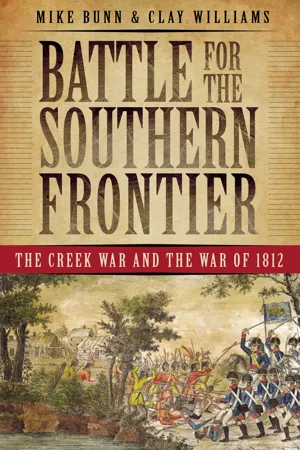
eBook - ePub
Battle for the Southern Frontier
The Creek War and the War of 1812
- 131 pages
- English
- ePUB (mobile friendly)
- Available on iOS & Android
eBook - ePub
About this book
This comprehensive book is the first to chronicle both wars and document the sites on which they were fought. It sheds light on how the wars led to the forced removal of Native Americans from the region, secured the Gulf South against European powers, facilitated increased migration into the area, furthered the development of slave-based agriculture and launched the career of Andrew Jackson.
Information
Biographies
David Adams
An officer in the Georgia militia, Major General David Adams led a raid on Creek towns on the upper Tallapoosa River in December 1813. His campaign resulted in the destruction of the town of Nuyaka.
John Armstrong
John Armstrong served as the U.S. secretary of war from January 1813 to September 1814. He called for the formation of the armies that would eventually crush Red Stick resistance and was one of the architects of the three-pronged strategy of attack they followed. Armstrong frequently clashed with his subordinates, often disregarded established chain-of-command procedures and was ultimately forced to resign in the wake of charges that he neglected the defenses of Washington, D.C., after that city fell to the British in the summer of 1814.
Jeremiah Austill
Jeremiah Austill became celebrated for his role in two daring episodes during the Creek War. Following the attack on Fort Sinquefield in September 1813, he rode alone forty miles at night to relate the news to General Claiborne at Mount Vernon, and returned the next day with orders for the settlers from the general. His most well-known exploit occurred a few months later, when he participated in the famous Canoe Fight.
Timpoochee Barnard
The son of a Scotch trader and a Yuchi woman, Timpoochee Barnard led a group of Yuchi warriors in support of U.S. forces during the war. At the Battle of Calabee Creek, Barnard’s command played a vital role in helping prevent the rout of General John Floyd’s troops. Barnard later fought against Red Stick forces under General Andrew Jackson in the First Seminole War.
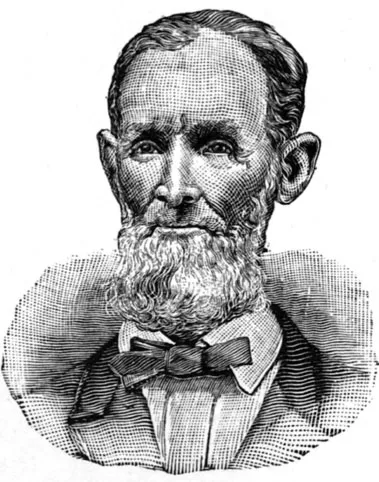
Jeremiah Austill in his later years. From H.S. Halbert and T.H. Ball, The Creek War of 1813 and 1814.
(Barnard’s grave site is located in Fort Mitchell Historic Landmark Park on Highway 431 a few miles south of Phenix City, Alabama.)
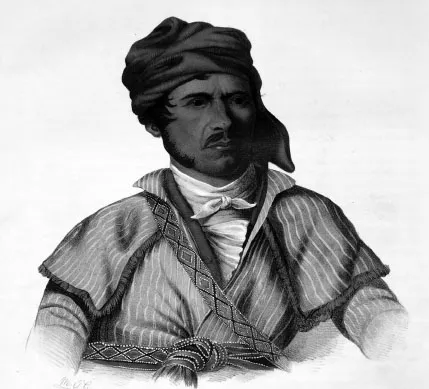
Timpoochee Barnard. Courtesy of the Columbus Museum (Gift of Henry Schwob, 1989.8).
Daniel Beasley
Daniel Beasley, the commander of the garrison at Fort Mims, is most remembered for disregarding reports of Red Stick activity prior to their attack in August 1813. Largely as a result of his negligence, Red Sticks took the fort by total surprise. Beasley became one of the first casualties of the battle, as he was killed while trying to close one of the fort’s open gates during the initial Red Stick charge.
Big Warrior (Tustunnuggee Thlucco)
Big Warrior, allegedly one of the largest of the Creeks in stature, was a prominent leader of allied Creeks who resided in the village of Tuckaubatchee. Though he welcomed Tecumseh to the town in 1811, he remained an ally of the United States once the conflict began. Red Sticks eventually forced him to leave Tuckaubatchee for his decision, and he relocated to Coweta, where in October 1813, he helped lead an attack on a band of Red Sticks. Big Warrior was among the first of the Creek dignitaries at the signing of the Treaty of Fort Jackson to speak against the agreement.
Willie Blount
Willie Blount served as governor of Tennessee during the Creek War and the War of 1812. When he received word of the massacre at Fort Mims, he authorized an army of militia under the command of Andrew Jackson to assist in putting down the Red Stick rebellion. He personally raised a significant amount of money, in excess of what the federal government had authorized, to support Tennessee troops in the field during the war. Although at one point Blount urged Jackson to give up his campaign after most of his army returned home when their enlistments expired, Blount did provide support to Tennessee’s war efforts in defeating the Red Sticks. Counties in Tennessee and Alabama are named in his honor.
James Caller
A militia commander in Washington County, Mississippi Territory, James Caller organized the expedition that ambushed a Red Stick force at the Battle of Burnt Corn Creek. In the confusion following the battle, Caller became separated from his troops and got lost. He was not found until over two weeks later.
William Carroll
William Carroll served under Andrew Jackson during his campaigns against the Red Sticks and the British in the War of 1812. Born in Pittsburgh, he later settled in Tennessee and joined the militia. He quickly gained Jackson’s favor, who appointed him brigade inspector. Carroll displayed noteworthy leadership and bravery in several battles, including Talladega, Emuckfau Creek, Enitachopco Creek and Horseshoe Bend. Carroll continued his service with Jackson during hostilities with Britain, playing an important role in the victory at New Orleans. He eventually served as governor of Tennessee. Carroll County, Tennessee, is named in his honor.
Joseph Carson
A commander in the Mississippi Territorial militia, Joseph Carson was one of the top-ranking military officials in the Tensaw District. At different times he was stationed at Fort Stoddert, Fort Glass and Fort Madison, but he is most well known for leading troops at the Battle of Holy Ground in December 1813.
Ferdinand L. Claiborne
A longtime military veteran and commander of the Mississippi Territorial militia, Ferdinand L. Claiborne was sent to the Tensaw area with his command in the summer of 1813. From his headquarters at Fort Stoddert, he oversaw preparations for defense of the region against Red Stick attack. He led the first organized offensive into Red Stick territory after the fall of Fort Mims, which culminated in the destruction of the Holy Ground. Suffering from poor health, he retired to his home in Natchez after the campaign.
William Charles Cole Claiborne
Few rose in the political ranks faster than William C.C. Claiborne, the governor of Louisiana during the War of 1812. A Tennessee Supreme Court justice at age twenty-one and a U.S. congressman at age twenty-five, he later became governor of the Mississippi Territory. Claiborne also oversaw the transfer of Louisiana to the United States following the Louisiana Purchase and served as governor of the Territory of Orleans prior to becoming governor of the state in 1812. Claiborne worked diligently to gather men and supplies to defend New Orleans, despite serious disagreements with Andrew Jackson. After the conflict, he served briefly in the U.S. Senate until his death in 1817. Counties in Tennessee and Mississippi are named in his honor.
Alexander Inglis Cochrane
British Vice Admiral Alexander Cochrane served as an officer in the British navy during the American Revolution, in several later campaigns against France and as governor of Guadalupe prior to the War of 1812. Appointed commander of the North American station in early 1814, Cochrane ordered several raids along the Chesapeake and helped plan the attacks on Washington, D.C., and Baltimore. He eventually became fixated on capturing the Gulf Coast and orchestrated the supplying of hostile Creeks and former slaves for the British offensive. He decided to attack New Orleans directly and was instrumental in the actions against that city. After the British defeat there, he orchestrated the capture of Fort Bowyer at Mobile Point.
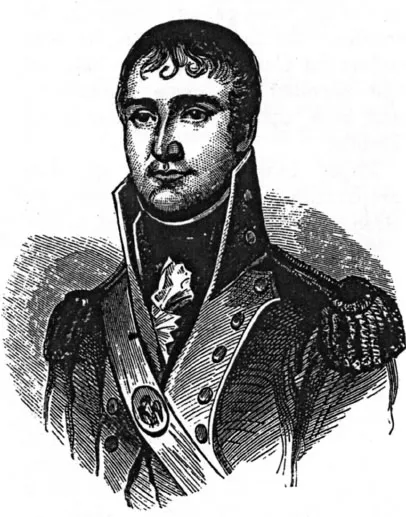
W.C.C. Claiborne. From Benson J. Lossing, The Pictorial Field-Book of the War of 1812.
John Cocke
A longtime politician, John Cocke led volunteers from East Tennessee in the Creek War. His failure to combine his force with that of Andrew Jackson out of fear that he might not achieve the glory he sought led to the unfortunate attacks on the Hillabee Creeks, who had previously surrendered to Jackson. Later in the war, Jackson had Cocke arrested for insubordination. Cocke later won acquittal, however, and remained active in politics throughout his life, serving in the U.S. House of Representatives for eight years.
John Coffee
John Coffee served with Andrew Jackson throughout the campaigns of the Creek War and the War of 1812. A longtime friend and associate of Old Hickory, Coffee settled in Middle Tennessee and had become a surveyor, merchant and developer by the time of the war. In Coffee’s first tour with Jackson, he led a contingent of troops to Natchez in the Mississippi Territory. During Jackson’s campaigns against the Red Sticks, he led mounted volunteers and participated in several encounters. He served as ranking commander on the field in the American victory at Tallushatchee, and he also played an important role in preventing the Red Sticks from escaping at Horseshoe Bend. Coffee also participated in the capture of Pensacola and the defense of New Orleans. Counties in Alabama, Georgia and Tennessee are named in his honor.
James Cornells
James Cornells had his plantation burned and his wife kidnapped after refusing to join the Red Sticks shortly before the Battle of Burnt Corn Creek in 1813. He attempted to warn the commander at Fort Mims of the approach of Red Sticks, but was ignored. After the war, he served at Fort Claiborne and had the opportunity to guard William Weatherford, who had come to the fort for protection after having threats made against him by angry residents.
Martha Crawley
Red Sticks captured Martha Crawley after their attack on a small settlement near the Duck River in Tennessee in May 1812. In the attack, led by Little Warrior, seven whites were killed. Treated poorly and believing that she would soon be killed, Crawley escaped from her captors near modern-day Tuscaloosa, reportedly through the assistance of a Native American woman and a white settler named Tandy Walker. Her accounts of the attack and her treatment at the hands of her captors caused alarm among white settlers and friendly Creeks and helped spur Agent Benjamin Hawkins to order that Little Warrior’s band be brought to justice.
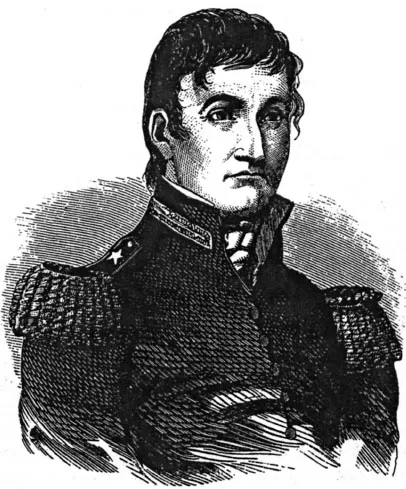
John Coffee. From Benson J. Lossing, The Pictorial Field-Book of the War of 1812.
David Crockett
Legendary Davy Crockett of Tennessee volunteered to fight in the Creek War. He served mostly as a scout and teamster and saw little action, although he was present at the battle of Tallushatchee. After the war, he served several terms in the Tennessee legislature and was elected to the U.S. Congress. Crockett later fought for the independence of Texas from Mexico, dying at the Alamo in 1836. Crockett County, Tennessee, is named in his honor.
Samuel Dale
One of the most celebrated American heroes of the Creek War, Sam Dale witnessed Tecumseh’s famous speech at Tuckaubatchee in 1811 and participated in the Battle of Burnt Corn Creek and the campaign against the Holy Ground. He is most famous for his role in the Canoe Fight, in which he and two others killed nine Red Stick warriors in the Alabama River. Just prior to the Battle of New Orleans, Dale was hurriedly dispatched from Georgia to deliver an important message to General Andrew Jackson from the U.S. secretary of war. He arrived as the battle was raging. He later served in the Alabama legislature and subsequently spent his last years in Mississippi. Dale County, Alabama, and the community of Daleville, Mississippi, are named in his honor.
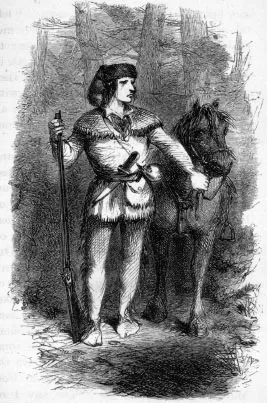
Sam Dale. From J.F.H. claiborne, Life and Times of General Sam Dale, the Mississippi Partisan. courtesy of the Mississippi Department of Archives and History.
(His grave site, marked by a memorial to him and his accomplishments, is in Sam Dale Historical Site, located just off Highway 39, north of Meridian, Mississippi.)
Governor Peter Early
Peter Early succeeded David Mitchell as governor of Georgia in 1813, taking office just after open conflict between U.S. and Red Stick forces began. He remained in office for the duration of the war. Early County, Georgia, is named in his honor.
Thomas Flournoy
From his headquarters in New Orleans, Thomas Flournoy commanded the Seventh Military District, which included Louisiana, Tennessee and the Mississippi Territory, at the beginning of the Creek War. When General Thomas Pinckney was given overall command of the war effort against the Creeks, Flournoy nominally maintained control of all other military affairs in his district. He eventually resigned his post in frustration at not being granted total control of his territory.
John Floyd
John Floyd was selected by Georgia governor Peter Early in 1813 to lead an expedition against the Red Sticks by the militia of that state. He trained his army in central Georgia in the early fall of 1813 before leading them into Red Stick territory. From Fort Mitchell, he led troops in the campaigns that resulted in the battles of Autossee and Calabee Creek. He was subsequently sent to Savannah in anticipation of an expected British attack on that city, which never materialized. Floyd County, Georgia, is named in his honor.
Josiah Francis (Hillis Hadjo)
One of the most prominent of the Red Stick prophets and a veteran of several actions during the Creek War, Josiah Francis was one of many leading Creeks born to a Native American woma...
Table of contents
- Front Cover
- Title Page
- Copyright
- Dedication
- Contents
- Preface to the Fourth Edition
- Preface
- Acknowledgements
- Introduction
- Timeline
- Origins of Conflict
- From Burnt Corn to the Holy Ground
- Across the Chattahoochee
- The Path to Horseshoe Bend
- Securing the Gulf South
- Conclusion
- Biographies
- Original Documents
- Bibliographic Essay and Notes on Sources
Trusted by 375,005 students
Access to over 1.5 million titles for a fair monthly price.
Study more efficiently using our study tools.
Frequently asked questions
Yes, you can cancel anytime from the Subscription tab in your account settings on the Perlego website. Your subscription will stay active until the end of your current billing period. Learn how to cancel your subscription
No, books cannot be downloaded as external files, such as PDFs, for use outside of Perlego. However, you can download books within the Perlego app for offline reading on mobile or tablet. Learn how to download books offline
Perlego offers two plans: Essential and Complete
- Essential is ideal for learners and professionals who enjoy exploring a wide range of subjects. Access the Essential Library with 800,000+ trusted titles and best-sellers across business, personal growth, and the humanities. Includes unlimited reading time and Standard Read Aloud voice.
- Complete: Perfect for advanced learners and researchers needing full, unrestricted access. Unlock 1.5M+ books across hundreds of subjects, including academic and specialized titles. The Complete Plan also includes advanced features like Premium Read Aloud and Research Assistant.
We are an online textbook subscription service, where you can get access to an entire online library for less than the price of a single book per month. With over 1.5 million books across 990+ topics, we’ve got you covered! Learn about our mission
Look out for the read-aloud symbol on your next book to see if you can listen to it. The read-aloud tool reads text aloud for you, highlighting the text as it is being read. You can pause it, speed it up and slow it down. Learn more about Read Aloud
Yes! You can use the Perlego app on both iOS and Android devices to read anytime, anywhere — even offline. Perfect for commutes or when you’re on the go.
Please note we cannot support devices running on iOS 13 and Android 7 or earlier. Learn more about using the app
Please note we cannot support devices running on iOS 13 and Android 7 or earlier. Learn more about using the app
Yes, you can access Battle for the Southern Frontier by Mike Bunn,Clay Williams in PDF and/or ePUB format, as well as other popular books in History & North American History. We have over 1.5 million books available in our catalogue for you to explore.