Discover the German influence on the Derby City in this collection of historical essays.
The first German immigrants arrived in Louisville nearly two hundred years ago. By 1850, they represented nearly twenty percent of the population, and they influenced every aspect of daily life, from politics to fine art. In 1861, Moses Levy opened the famed Levy Brothers department store. Kunz's "The Dutchman" Restaurant was established as a wholesale liquor establishment in 1892 and then became a delicatessen and, finally, a restaurant in 1941. Carl Christian Brenner, an emigrant from Lauterecken, Bavaria, gained notoriety as the most important Kentucky landscape artist of the nineteenth century. C. Robert and Victoria A. Ullrich edit a collection of historical essays about German immigrants and their fascinating past in the Derby City.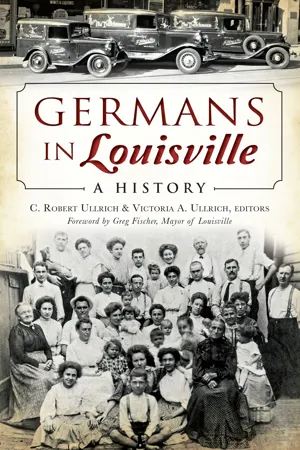
eBook - ePub
Germans in Louisville
A History
- 63 pages
- English
- ePUB (mobile friendly)
- Available on iOS & Android
eBook - ePub
Germans in Louisville
A History
About this book
Information
1.
OVERVIEW
Germans were one of the largest European groups to come to the United States. Although several Germans were part of the Jamestown colony, the first permanent German settlement in America was not established until 1683. In that year, Franz Daniel Pastorius led a group of Mennonites and Quakers from Krefeld, Westphalia, to found Germantown, northwest of Philadelphia.
About one-third of the Germans who came to America during the colonial period settled in Pennsylvania, where they became known as the “Pennsylvania Dutch.” Most of the others who immigrated during this period went to Upstate New York, Maryland, Virginia and the Carolinas.
Among the early German immigrants to America were the Bruner, Blankenbaker and Funk families. Their descendants came to eastern Jefferson County as early as 1789, when Christ Lutheran Church was established near Brunerstown (now Jeffersontown). The early settlers of Jeffersontown included many German-speaking migrants from the Germanna colonies of Virginia, as well as others from Maryland and Pennsylvania and a few new arrivals from Germany.
Many settlers of German ancestry also were found in Louisville in the late eighteenth century. Among these was a Mr. Kaye, who built the first brick house in the city in 1789. However, it is believed that the first Germanborn immigrant to settle in Louisville was Augustus D. Ehrich, a master shoemaker from Königsberg, Prussia, who arrived in 1817.
German immigration to Louisville progressed slowly in the early nineteenth century until the introduction of steamboat travel on the Mississippi and Ohio Rivers. As upriver travel from New Orleans became easier, the German populations of river cities, such as Evansville (Indiana), Louisville, St. Louis and Cincinnati, began to flourish.
By the 1830s, distinct German immigrant neighborhoods had formed both east and west of the Louisville city center. The first churches in which German was spoken were established in the eastern neighborhood known as Uptown (now Phoenix Hill). St. Paul Evangelical Church, the first German Protestant church in Louisville, was founded in 1836. St. Boniface Catholic Church, the first German Catholic church and only the second Catholic church in the city, was established in 1837. St. John Evangelical Church was founded in 1843, the Zion Reformed Church was established in 1849 and St. Martin of Tours Catholic Church was founded in 1853. Other German Protestant churches founded before the Civil War included Methodist and Baptist churches, but the first Lutheran church was not established until 1878.
In the western neighborhood, Immaculate Conception (St. Mary) Catholic Church was established in 1845. St. Peter Evangelical Church was formed in 1847, and St. Luke Evangelical Church was founded in 1850. St. Peter Catholic Church was established south of Broadway in 1855.
Temple Adas Israel, the first Jewish congregation in Louisville, was organized by German immigrants in late 1842, and it was chartered early the next year. Adas Israel was reformist in its outlook, so in 1851, Beth Israel was founded to serve more traditional Jews.
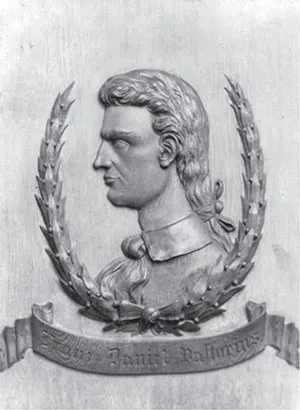
Franz Daniel Pastorius sculpture, Philadelphia. Courtesy Library of Congress.
In 1849, the administration of St. Boniface Catholic Church was assumed by Austrian Franciscan priests assigned to Louisville from Cincinnati. Later, St. Martin of Tours Church and several other German Catholic churches also were staffed by the Franciscans. In 1858, Bishop Martin J. Spalding sent Father Leander Streber, OFM, the pastor of St. Martin of Tours Church, to Germany to seek nuns to teach German children in his parish and other parishes in the Diocese of Louisville. Three Ursuline sisters from Straubing, Bavaria, arrived in Louisville that year and immediately began teaching at St. Martin of Tours School. By the turn of the century, Ursuline sisters staffed all of the schools in the German-speaking Catholic parishes.
Schools also were established by several German Protestant congregations, most notably St. Paul Evangelical Church and St. John Evangelical Church. Both the First German Lutheran Church (now Concordia) and the Second German Lutheran Church (now Redeemer) organized long-lived schools in the late nineteenth century.
The first of the German public schools, the Freie Bürgerschule, was established in 1852. The German-English Academy, attended by future Supreme Court justice Louis D. Brandeis, was founded by William N. Hailmann in 1865. Hailmann established one of the first ten kindergartens in the United States at his school. All of the German schools, public and parochial, were noted for their emphasis on bilingual education.
St. Joseph Catholic Orphan Society was founded in 1849 in the wake of a cholera epidemic. Father Karl Boeswald of Immaculate Conception Church and Father Otto Jair, OFM, of St. Boniface Church collaborated to establish the society, which later had branches at six German Catholic parishes. The German Protestant Orphan Asylum was established in 1851, and the German Baptist Orphan’s Home was founded in 1871.
There were at least twenty-eight German-language newspapers in Louisville. The first of these, the Volksbühne, appeared in 1841 but was short-lived. The Beobachter am Ohio, which had the support of liberal Germans, lasted from 1844 to 1856, and the Volksblatt and Omnibus were published well after the Civil War. However, the most successful German-language newspaper was the Louisville Anzeiger, first published on February 28, 1849. The Anzeiger became a daily newspaper several months after its founding and did not cease publication until 1938.
German brew masters practiced their skills in many breweries both small and large, such as Armbruster’s Brewery, the Frank Fehr Brewing Company, Senn & Ackermann Brewing Company and the Oertel Brewing Company. German beer gardens abounded, the most popular of which was Woodland Garden, founded in 1848. Phoenix Hill Park, another popular beer garden, was associated with the Phoenix Brewing Company. Also, Germans were important in the whiskey industries with the Weller Brothers, the Stitzel Brothers and the Bernheim Brothers being among the most prominent.
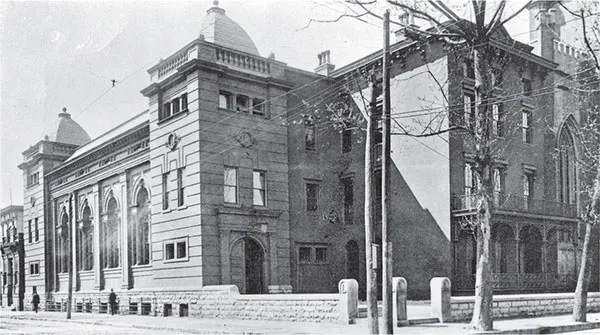
Liederkranz Hall. Courtesy Filson Historical Society.
The Liederkranz Singing Society was founded in 1848. This society was one of the founding members of the Nord-Amerikanischer Sängerbund (North American Singers Association) and hosted its second Sängerfest (singing festival) in 1850. The Orpheus Choral Society, founded in 1849, was one of the most prominent among the Louisville singing groups. In 1865, the Singing Federation of Louisville was founded and included the Liederkranz, Orpheus and Frohsinn singing groups. The first Liederkranz Hall, located on Market Street, was completed in 1873 and became the center of German social life in Louisville. Also, a number of Germans were members of the Louisville Philharmonic Society, which once was conducted by the Bavarian Louis Hast.
The Louisville Turnverein, among the first of the German gymnastics societies in the United States, was founded on September 2, 1850. The first Turnfest (gymnastics festival) in Louisville was held in 1852 on the Stein and Zink farm on Salt River Road. In 1854, the Turnverein dedicated the first Turner Hall on Market Street between Third and Fourth Streets. Many of the early Turners had liberal political views and were regarded with suspicion by American-born citizens.
German businessmen established many financial institutions, but the best known was the German Insurance Company, founded in 1854. In its early history, the German Insurance Company conducted business both as an insurance company and also as a bank. However, in 1872, new state laws made it necessary to separate the insurance and banking functions of the company; thus, the German Insurance Bank was established. By this time, too, the company had outgrown its original building, so a new building was planned on the north side of Market Street between Second and Third Streets. The new structure, designed by C.L. Mergell, opened amid much fanfare in 1887.
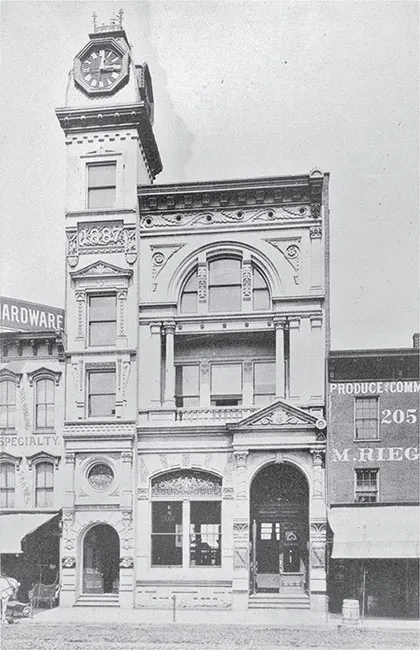
German Insurance Company, about 1889. Courtesy University of Louisville Rare Books.
The German Bank, founded in 1869, erected a building at Fifth and Market Streets in 1914, which is now on the National Register of Historic Places. Other well-known German financial institutions included the German Security Bank, established in 1867, and the German National Bank, founded in 1875.
By 1850, the German-born population of Louisville had grown to 7,502, which was about 20 percent of the total population. Including the children of German immigrants, about 12,500 persons were members of German households. About half of the German-speaking population was Catholic.
The unsuccessful European revolutions of 1848 resulted in the immigration of many educated Germans to the United States, where they became known as Forty-Eighters. The Forty-Eighters, who advocated liberal political views, were extremely outspoken. Most German immigrants, especially those with strong religious beliefs, did not agree with the Forty-Eighters, whose actions colored the opinions of American-born citizens about Germans.
The Forty-Eighters, unable to align themselves with any of the established national political parties, formed the Bund Freier Männer (League of Free Men) in 1853. A group of these men in Louisville, led by newspaper editor Karl Heinzen, authored the Louisville Platform, which was published in March 1854 and espoused the abolition of slavery, equality of women and other liberal principles. These ideas conflicted with the philosophy of the anti-foreigner, anti-Catholic American (“Know-Nothing”) Party, which found broad support in Louisville. George D. Prentice, the editor of the Louisville Daily Journal, supported the American Party in a series of inflammatory editorials preceding the gubernatorial and congressional elections of August 1855.
On election day, Monday, August 6, 1855, American Party committees, supported by the police, took control of the polls and attempted to allow only card-carrying American Party members to vote. Fights broke out and violence escalated as nativist mobs ransacked and burned German businesses and homes in the Uptown neighborhood. Only the intervention of Mayor John Barbee prevented the destruction of St. Martin of Tours Church and the newly constructed Cathedral of the Assumption. After leaving German neighborhoods, rioters proceeded to Irish neighborhoods on West Main Street, where Quinn’s Row was burned and owner Francis Quinn was killed. Father Karl Boeswald, the pastor of the German Immaculate Conception Church, was called to attend an injured parishioner and was mortally wounded by stone-throwing rioters as he left the church rectory. On August 7, the Louisville Daily Journal reported that twenty-two had died in the riots, but other estimates suggest that many more were killed. Following Bloody Monday, many Germans left Louisville, and those who immigrated later avoided Louisville in favor of other cities. The 1860 census of Louisville showed that the German population of Louisville had decreased to less than 20 percent of the total population.
German immigrants were among the strongest supporters of the Union during the Civil War. They voted overwhelmingly for pro-Union candidates in state elections in 1861, helping to ensure that Kentucky stayed in the Union. Out of a total German population of about 13,000, more than 1,200 men joined the Union army. In addition, German-born residents of Louisville contributed money to the Union cause, volunteered for work in hospitals and prepared meals and made clothing for soldiers. Turner Hall was converted into a hospital for sick and wounded soldiers. German contributions to the Union cause did much to change the attitudes of native-born Louisvillians toward them. Even Louisville Daily Journal editor George D. Prentice wrote articles praising the German immigrants. In 1865, Louisvillians elected their first German-born mayor, Philipp Tomppert.
German immigration slowed during the Civil War but resumed in earnest afterward, reaching a peak in 1882. Germans were active participants in the economic and professional expansion of Louisville in the post–Civil War period. By the end of the century, Ahrens & Ott Manufacturing Company (the predecessor of American Standard) was engaged in producing plumbing fixtures. The Henry Vogt Machine Company made steam boilers, while the C.C. Mengel & Brother Company manufactured wood products. J.F. Hillerich & Son was one of several Louisville businesses that manufactured bats for the new American pastime of baseball.
Germans were well represented in the food industries, such as wholesale and retail groceries that sold meats, produce and dairy products. Butchertown was an area of Louisville where many Germans established meatpacking businesses. The Fischer Packing Company was founded in 1899 by Henry Fischer, a German immigrant. In addition, Germans, especially German-speaking Swiss, were involved in dairying, with family farms operated by the Zehnders, Von Allmens, Bisigs and Ehrlers being among the best known.
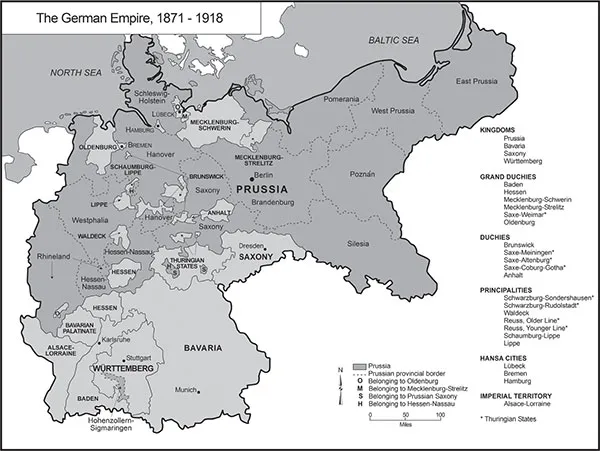
Germany at the peak of immigration to America. Copyright German Historical Institute, Washington, D.C., and James Rettalack, 2007.
While many Germans were engaged as hoteliers, none were more successful than Louis and Otto Seelbach. Louis Seelbach emigrated from Bavaria in 1869 and opened his first tavern on Main Street in 1874. His brother Otto joined him in 1878, and they opened a hotel at Sixth and Main Streets in 1886. After nearly twenty years, the Seelbachs were able to build a grand Beaux-Arts hotel at Fourth and Walnut Streets, which was completed in 1905. That hotel is famous for its European marble and wood construction and for its Rathskeller, which is decorated with Rookwood pottery tiles. Although the Seelbachs sold their hotel in 1926, it still operates as the Seelbach Hilton Louisville.
Many Germans were engaged in the restaurant business from the very early days of immigration to Louisville. However, the best-known German restaurants were, undoubtedly, the Vienna Bakery & Restaurant and Kunz ’s “The Dutchman” Restaurant. The Vienna opened in 1893 and relocated to an Art Nouveau building on Fourth Street in 1905. Kunz’s was established as a wholesale liquor establishment in 1892 and then became a delicatessen and, finally, a restaurant in 1941.
Several well-known Louisville department stores were established by German immigrants. These included Levy Brothers, founded by Henry and Moses Levy in 1861; Kaufman-Straus, begun by Henry Kaufman in 1879; and Besten and Langen Company, founded by Henry Besten about 1892. Loevenhart & Company was established in Lexington, Kentucky, by the German brothers Lee and Henry Loevenhart in 1867, and they opened a Louisville store in 1898. Byck Brothers & Company, founded by Louis and Werner Byck, was established in 1902.
German bakeries and confectioneries were found throughout Louisville. Many original German bakeries still exist, among them Heitzman’s Bakery and Plehn’s Bakery. Ehrmann’s Bakery was located in the Mid-City Mall until the mid-1990s. Schimpff’s Confectionery, still operating in Jeffersonville, Indiana, was opened by German immigrant Gustav Schimpff in 1891.
Many Germans were involved in the fine arts in Louisville. For example, Carl Christi...
Table of contents
- Front Cover
- Title Page
- Copyright
- Dedication
- Contents
- Foreword, by Greg Fischer
- Acknowledgements
- 1. Overview
- 2. Immigration, Xenophobia and Bloody Monday
- 3. Catholic Churches
- 4. Franciscan Friars
- 5. Ursuline Sisters and Catholic Schools
- 6. Protestant Churches
- 7. Protestant and Secular Schools
- 8. German Christian Orphanages, Hospitals and Elder Care
- 9. Jewish Community and Synagogues
- 10. Newspapers
- 11. Breweries
- 12. Saloons and Beer Gardens
- 13. Singing Societies
- 14. The Turners
- 15. Butchertown
- 16. Germans in the Mexican War and the Civil War
- 17. Manufacturing
- 18. Agriculture and Food Industries
- 19. Whiskey Industries
- 20. Hotels and Restaurants
- 21. Dry Goods and Department Stores
- 22. Dairies
- 23. Bakeries and Confectioneries
- 24. Pharmacies
- 25. Funeral Homes and Cemeteries
- 26. Germantown and Schnitzelburg
- 27. Anti-German Sentiment during the World Wars
- 28. German Cultural Influences in Modern Times
- Bibliography
- About the Authors
Trusted by 375,005 students
Access to over 1.5 million titles for a fair monthly price.
Study more efficiently using our study tools.
Frequently asked questions
Yes, you can cancel anytime from the Subscription tab in your account settings on the Perlego website. Your subscription will stay active until the end of your current billing period. Learn how to cancel your subscription
No, books cannot be downloaded as external files, such as PDFs, for use outside of Perlego. However, you can download books within the Perlego app for offline reading on mobile or tablet. Learn how to download books offline
Perlego offers two plans: Essential and Complete
- Essential is ideal for learners and professionals who enjoy exploring a wide range of subjects. Access the Essential Library with 800,000+ trusted titles and best-sellers across business, personal growth, and the humanities. Includes unlimited reading time and Standard Read Aloud voice.
- Complete: Perfect for advanced learners and researchers needing full, unrestricted access. Unlock 1.5M+ books across hundreds of subjects, including academic and specialized titles. The Complete Plan also includes advanced features like Premium Read Aloud and Research Assistant.
We are an online textbook subscription service, where you can get access to an entire online library for less than the price of a single book per month. With over 1.5 million books across 990+ topics, we’ve got you covered! Learn about our mission
Look out for the read-aloud symbol on your next book to see if you can listen to it. The read-aloud tool reads text aloud for you, highlighting the text as it is being read. You can pause it, speed it up and slow it down. Learn more about Read Aloud
Yes! You can use the Perlego app on both iOS and Android devices to read anytime, anywhere — even offline. Perfect for commutes or when you’re on the go.
Please note we cannot support devices running on iOS 13 and Android 7 or earlier. Learn more about using the app
Please note we cannot support devices running on iOS 13 and Android 7 or earlier. Learn more about using the app
Yes, you can access Germans in Louisville by C. Robert Ulrich, Victoria A. Ulrich, C. Robert Ulrich,Victoria A. Ulrich in PDF and/or ePUB format, as well as other popular books in History & North American History. We have over 1.5 million books available in our catalogue for you to explore.