- 147 pages
- English
- ePUB (mobile friendly)
- Available on iOS & Android
eBook - ePub
About this book
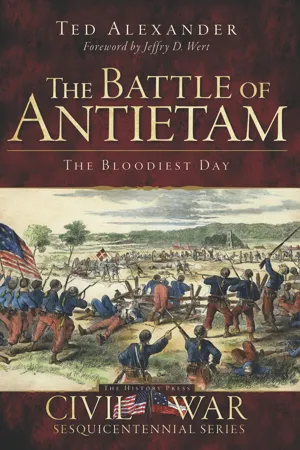
The heavy fog that shrouded Antietam Creek on the morning of September 17, 1862, was disturbed by the boom of Federal artillery fire. The carnage and chaos began in the East Woods and Cornfield and continued inexorably on as McClellan's and Lee's troops collided at the West Woods, Bloody Lane and Burnside Bridge. Though outnumbered, the Rebels still managed to hold their ground until nightfall. Chief historian of the Antietam National Battlefield, Ted Alexander renders a fresh and gripping portrayal of the battle, its aftermath, the effect on the civilians of Sharpsburg and the efforts to preserve the hallowed spot. Maps by master cartographer Steven Stanley add further depth to Alexander's account of the Battle of Antietam.
Information
1
High Tide
Imagine a river…about 500 yards wide, from two to three feet deep, the water very swift. Now it is just as full of men as it can be for 600 or 700 yards, up and down, yelling and singing all sorts of war and jolly songs, and in this connection you must find room for eight or twelve regimental bands in the river all the time, the drums beating, the horns a tootin and the fifes a screaming, possibly every one of them on a different air, some “Dixie,” some “My Maryland, My Maryland,” some “the Girl I Left Behind Me,” some “Yankee Doodle.” All the men are apparently jolly. I, at least did not feel very jolly, though I imagine some of them contemplated the serious side of the situation.
This was the recollection of Private John W. Stevens of the 5th Texas, written sometime after the war. Stevens went on to write, “I could not for the life of me suppress a feeling of sadness as I beheld this vast concourse of humanity wading the river, so full of music and apparently never once thinking that their feet (many of them) would never press the soil on the south side of the Potomac again.” Indeed, Stevens, his fellow Texans and many other young Southerners were about to embark on one of the bloodiest campaigns of the Civil War.1
The year 1862 was the decisive one of the war. Indeed, many historians consider it the true high tide of the Confederacy. It was the high tide in many ways: Militarily, the South mounted offensives on a one-thousandmile front in the late summer and fall of 1862. Economically, the South was severely crushed by the loss of the majority of its major ports in 1862. Diplomatically, it was checkmated by Lincoln’s Emancipation Proclamation after Antietam in the late summer of 1862. Morale on the homefront was severely challenged in 1862, with major losses on the battlefield and devastation to thousands of miles of territory and major cities.
The late historian Bell Wiley, in his insightful book The Road to Appomattox, presented one of the first attempts to analyze Confederate defeat more than fifty years ago. Esteemed historian James McPherson takes this theme further in his book Crossroads of Freedom: Antietam, the Battle That Changed the Course of the Civil War. He goes further than Wiley in that he provides a good analysis of the diplomatic sphere of operations during that period. Both authors view 1862 as the decisive year of the war. 2
The Confederacy was on a roll in the summer of 1861. Union forces had been soundly defeated at First Manassas and Wilson’s Creek. The Battle of Ball’s Bluff, on October 20, 1861, was a minor affair with little strategic importance, yet it would cast a long shadow. It was fought with about 1,700 men on each side. However, the Rebs were veterans, and the Yanks were green. The fight, just upstream from the nation’s capital near Leesburg, Virginia, ended in a Union rout. Indeed, it was a massacre as the green Yankees leaped to their deaths in the river or were shot as they tried to swim or board nearby rowboats. More than 200 Union soldiers were killed or wounded and another 714 captured or missing. Confederate losses were 33 killed and 115 wounded or missing.3
The nation was shocked—especially the Lincoln family—when one of the Union commanders at Balls Bluff, Colonel Edward Baker, was killed. Baker had been a close friend of the president, dating back to their Illinois legislative years. He had served as a legislator from Illinois, as a volunteer officer in the Mexican War and as senator from Oregon. The Lincoln family so admired him that they named one of their sons Edward Baker Lincoln.
These Confederate victories gave rise to overconfidence in the South. Zealous politicians and editors echoed the belief in Southern superiority. John M. Daniel, in an editorial in the Richmond Examiner on September 27, 1861, proclaimed, “The battle of Manassas demonstrated, at once and forever, the superiority of the Southern soldiers, and there is not a man in the army, from the humblest private to the highest officer, who does not feel it. The enemy knows now that when they go forth to the field they will encounter a master race.”4
But by late 1861 and into early 1862, the tide had begun to turn against the Confederacy. One of the first events in this negative turn involved the largest naval land-sea operation ever launched by U.S. forces until World War II. The Port Royal Expedition of November 1861 would usher in the Union blockade.
With fifty ships (not counting twenty-five coal vessels that had departed the day before) and sixteen thousand soldiers and sailors, Captain Samuel F. DuPont departed Hampton Roads, Virginia, on October 29, 1861. The destination was Port Royal Sound, South Carolina. It was an unpleasant voyage, and heavy gales off Cape Hatteras threatened the success of the expedition.
On November 3, the flotilla managed to reach its destination, but not without some casualties. The USS Isaac Smith had to throw its armament overboard to keep from sinking. The Governor, a transport ship with a battalion of marines on board, did sink, and some twenty marines drowned.
However, the Confederates were outnumbered, outgunned and outshipped. Two forts guarded Port Royal Sound with about fifty guns, twelve hundred men and three gunboats. DuPont’s flotilla literally shelled the Confederates into submission, and Port Royal’s defenses surrendered on November 7. This victory was great for morale in the North. And it was the first of many combined army-navy operations during the war.
By the way, in 1860, the U.S. Navy had forty-two warships. By 1861, it possessed eighty-two ships with 7,600 men. By 1865, six hundred naval ships were in operation, and 51,500 men were serving.5
This was the beginning of a series of coastal victories by the North. By the spring of 1862, Roanoke Island, New Bern and Fort Macon, North Carolina; Fort Pulaski, Georgia; and Pensacola, Florida, had fallen into Union hands. This meant both loss of ports for commerce and loss of forts.
In March 1862, Confederate forces in Northern Virginia, under Joseph E. Johnston, evacuated their base around Centreville, leaving valuable supplies behind. Meanwhile, Lincoln had found a general with potential. Major General George B. McClellan had won a number of small victories against the Confederates in western Virginia. He was brought back east to take command of a new army dubbed the Army of the Potomac. In April, this army, led by McClellan, began the movement to take Richmond that became known as the Peninsula Campaign.
In May, the Confederates abandoned Norfolk, and the ironclad CSS Virginia (aka Merrimac), unable to navigate the shallower depths of the James River, was blown up rather than face capture by Union forces. These events had a profound influence on Southern morale. The New York Times announced that the fall of Norfolk “was second in importance only to that of New Orleans.” The loss of the CSS Virginia prompted Confederate ordnance chief Josiah Gorgas to state, “No one event of the war, not even the disaster of Ft. Donelson, created such a profound sensation as the destruction of this noble ship.” The James River was now open to within seven miles of Richmond. As McClellan moved on Richmond, panic set in, causing members of the Confederate Congress to rush home and President Jefferson Davis and other cabinet members to send their families farther south.6
In the Western Theater, the situation was even more disastrous. The fall of Forts Henry and Donelson in February 1862 was a crippling blow that cost valuable manpower: fifteen thousand prisoners. It also led to the capture of Nashville soon after. This was the first of the Confederate state capitals to fall. A valuable center for horse trading, Nashville also gave the Federals access to key waterways leading to the heart of the South and the collapse of western Tennessee.
The bloody Battle of Shiloh, on April 6–7, 1862, was another Union victory that grasped more territory from the Confederacy. It also cost the life of General Albert Sydney Johnston, who was mortally wounded there. Johnston was one of the first national heroes of the Confederacy and the highest-ranking Confederate general killed in the war. Within weeks, the Confederates abandoned their base at the important rail center of Corinth, Mississippi, leaving it to be occupied by the Union.
On April 8, the Confederate stronghold at Island #10 on the Mississippi River fell to a combined Union army and navy force. This victory yielded approximately seven thousand Confederate prisoners.
On April 25, New Orleans, the largest city in the Confederacy and a key urban center and port, fell to Union admiral David G. Farragutt. On June 6, 1862, the important river town of Memphis was captured by the Yankees.
Meanwhile, in the Trans-Mississippi West, things were no better for the Confederacy. The Union victory at Pea Ridge, Arkansas, on March 7, 1862, for all practicality established Federal control of the state of Missouri for the rest of the war.7
The story was the same in the Southwest, too. In July and August 1861, Lieutenant Colonel John R. Baylor led the 2nd Texas Mounted Rifles up the Rio Grande Valley into New Mexico. On August 1, he proclaimed the creation of the Confederate territory of Arizona (comprising what are today Arizona and New Mexico below the thirty-fourth parallel), with himself as governor.
In mid-December 1861, Brigadier General Henry H. Sibley marched into the territory with a Confederate army of twenty-six hundred. On February 21, 1862, he defeated a numerically stronger force of Federals under Colonel Edward R.S. Canby at Val Verde. Sibley next occupied Santé Fe, which had been evacuated by the Federals, who destroyed all the supplies they were not able to carry rather than have them fall into Confederate hands.
Events took a turn for the worse for the Confederates when most of their supply train was destroyed by the 1st Colorado Volunteers near Glorieta on March 28, 1862. Lack of supplies, a hostile population and news that Colonel James H. Carlton’s two-thousand-man “California Column” was coming to Canby’s rescue checkmated Confederate designs on New Mexico and Arizona. Sibley withdrew to San Antonio, and the Union army in New Mexico spent the rest of the war guarding the territory against Indian raids.
If the Confederates had secured the Southwest, they could have gone on to California, with its important ports of San Diego and San Francisco. They would also have had access to the gold and silver fields of California, Colorado and Nevada. Perhaps such clout would have yielded diplomatic recognition from England or France. But it just did not happen. And no other efforts were mounted by the Confederacy to take the Southwest.8
Thus, by the spring of 1862, one year after the war had started, the cancer of Union army occupation had started to eat away at sizable portions of the Confederacy. The Union dominated much of the Atlantic Coast, the border states of Maryland, Kentucky and Missouri, much of Tennessee and a large portion of the Mississippi River.
Despite the gloomy picture for the South, the situation would start to change in the summer of 1862. Out of the despair of defeat would come renewal. In the Deep South, morale was raised by the exploits of cavalry raiders John Hunt Morgan and Nathan Bedford Forrest. These “Wizards of the Saddle” completely disrupted the rail and communication lines of Union general Don Carlos Buell’s army, forcing that commander to stop his offensive attack farther into the South.
In July, Morgan led his cavalry into Kentucky, calling for its citizens to “rise and arm, and drive the Hessian invaders” from the state. Meanwhile, Forrest and his cavalry captured an entire Union garrison at Murfreesboro, Tennessee. These raids were a national sensation, causing tangible damage to the Union war effort in the West and great consternation among Yankee authorities. In addition, they made Morgan and Forrest idols in the South and solidified the mystique of the Southern horseman.9
But it was in Virginia that the most dramatic morale-raising events took place. On May 31, 1862, Confederate general Joseph E. Johnston was seriously wounded at the Battle of Fair Oaks. In response, President Jefferson Davis appointed General Robert E. Lee to temporary command of the Army of Northern Virginia.
In response to the Union threat, Lee moved against McClellan’s army on June 26, in what became known as the Seven Days’ Campaign. Within a week, McClellan was forced to withdraw his army from in front of Richmond to a position along the James River that was covered by the gunboats of the Union navy. Corresponding with this were Stonewall Jackson’s acclaimed Valley Campaign, in which he defeated several Union armies, and a spectacular raid by Confederate general Jeb Stuart’s cavalry around McClellan’s army.
With McClellan neutralized, Lee soon led his army north, where he took on another Union force: Major General John Pope’s Army of Virginia. With Major General Stonewall Jackson leading the way, Pope was forced to withdraw from his line along the Rappahannock River and move back toward Washington. Jackson even managed to march around Pope and destroy his supply base at Manassas Junction.
The decisive battle in the campaign, dubbed Second Manassas, took place on August 29 and 30. Pope’s army was soundly defeated and retreated back to Washington.10
Therefore, by the late summer of 1862, things were looking up for the Confederacy. Perhaps the braggadocio was not empty after all. Maybe one Southerner ...
Table of contents
- Front Cover
- Title Page
- Copyright
- Dedication
- Contents
- Foreword
- Preface and Acknowledgements
- 1. High Tide
- 2. Two American Armies
- 3. Sharpsburg and Environs
- 4. Prelude to a Bloodbath
- 5. Cornfield and East Woods
- 6. West Woods and Dunker Church
- 7. Bloody Lane
- 8. Burnside Bridge and Beyond
- 9. One Vast Hospital
- 10. Thenceforward and Forever Free
- 11. Future Generations Will Swell with Pride
- Appendix
- Notes
- Bibliography
- About the Author
Trusted by 375,005 students
Access to over 1.5 million titles for a fair monthly price.
Study more efficiently using our study tools.
Frequently asked questions
Yes, you can cancel anytime from the Subscription tab in your account settings on the Perlego website. Your subscription will stay active until the end of your current billing period. Learn how to cancel your subscription
No, books cannot be downloaded as external files, such as PDFs, for use outside of Perlego. However, you can download books within the Perlego app for offline reading on mobile or tablet. Learn how to download books offline
Perlego offers two plans: Essential and Complete
- Essential is ideal for learners and professionals who enjoy exploring a wide range of subjects. Access the Essential Library with 800,000+ trusted titles and best-sellers across business, personal growth, and the humanities. Includes unlimited reading time and Standard Read Aloud voice.
- Complete: Perfect for advanced learners and researchers needing full, unrestricted access. Unlock 1.5M+ books across hundreds of subjects, including academic and specialized titles. The Complete Plan also includes advanced features like Premium Read Aloud and Research Assistant.
We are an online textbook subscription service, where you can get access to an entire online library for less than the price of a single book per month. With over 1.5 million books across 990+ topics, we’ve got you covered! Learn about our mission
Look out for the read-aloud symbol on your next book to see if you can listen to it. The read-aloud tool reads text aloud for you, highlighting the text as it is being read. You can pause it, speed it up and slow it down. Learn more about Read Aloud
Yes! You can use the Perlego app on both iOS and Android devices to read anytime, anywhere — even offline. Perfect for commutes or when you’re on the go.
Please note we cannot support devices running on iOS 13 and Android 7 or earlier. Learn more about using the app
Please note we cannot support devices running on iOS 13 and Android 7 or earlier. Learn more about using the app
Yes, you can access Battle of Antietam by Ted Alexander in PDF and/or ePUB format, as well as other popular books in History & North American History. We have over 1.5 million books available in our catalogue for you to explore.