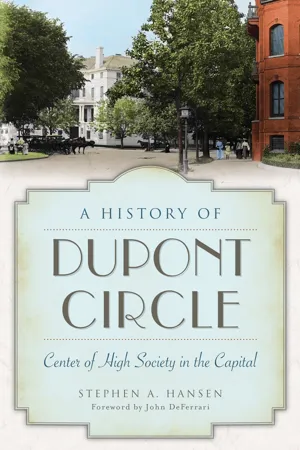
- 208 pages
- English
- ePUB (mobile friendly)
- Available on iOS & Android
eBook - ePub
About this book
During the Gilded Age, Dupont Circle was Washington's undisputed center of wealth, power and status. Over twenty years, it evolved from small farms and an overrun city cemetery to a community of grand homes for society's elite. Residents included future president William Taft, inventor Alexander Graham Bell, newspaper publisher Cissy Patterson and many more. From the intimate dinners and receptions of the Cave Dwellers to the lavish balls of Mary Townsend and others in the "smart set," Dupont Circle marked each social season in the capital. Satirized in Mark Twain's novel "The Gilded Age," the nouveau riche lifestyle of Dupont Circle was fodder for newspaper celebrity gossip. Author Stephen Hansen brings to life the intriguing history of Washington's famed Dupont Circle.
Information
1
THE EARLY DAYS
The Dupont Circle neighborhood is located on part of a seventeenth-century Maryland land grant that was known as “Widow’s Mite.” Widow’s Mite was surveyed in 1664 for John Langworth and patented in 1686 for William Langworth, his young son, who was killed in an Indian attack. The land was subdivided and sold many times, eventually ending up in the hands of Anthony Holmead and James Lingan, among others, when it was purchased by city commissioners for use as the capital city in 1791. Holmead built his first house north of Dupont Circle in 1750, and it was later bought by Joel Barlow, who renamed it “Kalorama.” Lingan owned about 157 acres of Widow’s Mite, which fell mostly below Florida Avenue within the boundaries of the federal city and is where the Dupont Circle neighborhood is located.
SLASH RUN
Slash Run, sometimes called “Shad Run,” was a stream that ran a zigzag course down from the north, coming within a block to the east of the circle itself, and then wound its way down to Connecticut Avenue and Desales Street (now the location of the Mayflower Hotel), where it then turned west and ran into Rock Creek. There was mostly marshy ground through much of its course, with such dense growth of bushes and vines that the only way through was by cutting or slashing, hence the name. At the top of Slash Run, butcher John Little had placed his slaughterhouse in the 1850s and would dump animal entrails and blood into the stream. The insanitary odors arising downstream were very unpleasant in warm weather, especially as the area started to get more populated. Yet, where the brook made a bend about where the Mayflower Hotel is located today, it created a swamp that became a very popular swimming hole. In spite of the marshy ground and slashes, there was still some solid ground that attracted the area’s earliest settlers—either dead or alive.
HOLMEAD’S CEMETERY
In 1807, the city government established the Western Burial Ground Cemetery on a plot of about one-third of an acre at the edge of the city at Twentieth Street and Florida Avenue. The land had been a gift from Anthony Holmead and is where he placed his own family cemetery. It became known popularly as “Holmead’s Cemetery.” The cemetery was intended to serve for general burials for people of all denominations, with a separate section set aside for the African Americans.
The creation of the cemetery mandated the opening of the first street through the neighborhood, Twentieth Street, so that it could be accessed from downtown. But all that was probably ever done was the clearing of a crude wagon path through the brush. For a long time, the cemetery was not enclosed, and mail coaches going between Washington and Baltimore would roll through its grounds.
A number of Native Americans, soldiers of the War of 1812 and other prominent people were buried in Holmead’s Cemetery, including the eccentric Methodist minister Lorenzo Dow and early Washington surveyor Nicholas King. Dow, who died in 1834, was an itinerant revivalist preacher and an important figure in the Second Great Awakening. He is said to have preached to more people than any other preacher of his era. For a time, his autobiography was the second-bestselling book in the United States, exceeded only by the Bible.
Holmead’s Cemetery held some notorious figures as well. One was the first man executed in the city, Patrick McGurk, who had badly beaten his wife and caused their twins to be stillborn. Relatives of others buried in the cemetery were so incensed that such a man was buried with their own that they exhumed his body and reburied it outside the cemetery. Upon learning of his relocation, McGurk’s friends one night reburied him in his intended cemetery lot. Again, relatives of the deceased rallied and exhumed the body, this time burying it in the thicket on the banks of Slash Run, never to be found again. Another of the more notorious burials was that of Lewis Payne, one of the Lincoln assassination conspirators who was hanged in 1865.
For half a century, second only to Congressional Cemetery, Holmead’s Cemetery was the city’s leading burial site, with thousands of bodies placed there for what was assumed to be their final resting place. Its straight walks, well-grown cedars and peaceful setting attracted throngs of visitors, friends and relatives of the departed.
About a year after the cemetery was established, a Scotsman by the name of Guy Graham settled in the Dupont Circle area and, around 1808, built a wood-frame house in what is now the west side of the 1700 block of Connecticut Avenue. Graham was a laborer and was involved in the creation of the new city, helping to clear the path for Pennsylvania Avenue from the Capitol to the Treasury building. Years later, some of his descendants remembered his describing how the trees were cut so as to fall across the road and then filled in with stone and gravel to make the roadbed. For some time, he also served as the caretaker of Holmead’s Cemetery.
One block to the south of Holmead’s Cemetery, proprietor Eden Ridgway had a tavern. Ridgway’s Tavern was well placed at the intersection of Twentieth Street and Florida Avenue, then called Boundary Street, on the section used as a shortcut along the north edge of the city from the old Bladensburg Road to Georgetown. It was in the right location to take advantage of the considerable traffic to the graveyard, Joel Barlow’s Kalorama estate and the port of Georgetown.
WILLIAM O’NEALE
In 1794, William O’Neale moved from Chester County, Pennsylvania, to open a stone quarry at Mount Vernon and one along the western boundary of the city to provide freestone for Washington’s new public buildings. It was grueling work, not only for the hired men and slaves, but also for O’Neale himself. “Keep the yearly hirelings at work from sunrise to sunset—particularly the Negroes,” the city’s commissioners told him. But the use of slave labor so frustrated O’Neale that he abandoned the quarries to stake his own claim in the new capital.
O’Neale was originally from Ulster, Ireland—the birthplace of Andrew Jackson’s father as well. His wife, Rhoda Howell O’Neale, told everyone in Washington that she was the sister of Richard Howell, the governor of New Jersey at that time, but there is no evidence of this relationship. She may have made this claim to gain entrance to Washington’s newly burgeoning social society.
In 1794, O’Neale built a wood-frame house at the corner of Twentieth and I Streets, just four blocks west of the White House, and set himself up in the business of cutting and selling cordwood, coopering barrels and building stoves, as well as selling coal and feed. When he had made enough money, he built a large brick house to the west of his house at Twenty-first and I Streets and put both his houses up for sale. But investors were not flocking to the new capital city as was hoped in the 1790s, and he was unable to sell them. In 1800, he turned the brick house into O’Neale’s Tavern, a boardinghouse and general store, which later became better known as Franklin House.
In 1819, O’Neale bought some land just north of Dupont Circle on the eastern part of Connecticut Avenue, where he built a large two-story brick house with a full-width porch facing south to the downtown area that he referred to as his farm. He surrounded the house with an orchard and a garden. The farm became so well known that the area of Dupont Circle was simply referred to as “by Billy O’Neale’s.” Here, O’Neale would quietly spend his summer months without the concerns of feeding and entertaining lodgers and surrounded by his family.
William O’Neale was well known and liked by official society, although he and his family were never be able to join their ranks. Virginia congressman John Randolph was one of the many boarders at Franklin House and had gotten along famously with O’Neale. Upon his return from his posting in Russia, a reception was held for Randolph that O’Neale attended. But Randolph feigned to not recognize O’Neale. When he was reminded that he had lived at the boardinghouse, Randolph replied, “Oh yes, Billy O’Neale, [the] victualler. Well, what do you want?”
THE INNKEEPER’S DAUGHTER
O’Neale’s young daughter Margaret, known as “Peggy,” was a celebrity at Franklin House. She was beautiful, well-educated, spoke French and could play the piano exceedingly well, and she quickly ingratiated herself with those who stayed at the boardinghouse.
At the age of fifteen, Peggy eloped with thirty-nine-year-old John Timberlake, who was a purser in the U.S. Navy. She had tried to elope once before with another gentleman, but her father caught her sneaking out a window and ordered her back inside the house.
The Timberlakes had become good friends with a twenty-eight-year-old widower, newly elected U.S. senator from Tennessee and close friend of Andrew Jackson, John Henry Eaton. When Timberlake was away on a four-year sea voyage on the USS Constitution, Margaret and John Eaton were often seen parading arm in arm, and talk began that the two were having an affair. Timberlake died of pulmonary disease in 1828 while away on the voyage. There were rumors that he had actually committed suicide because of despair over Peggy’s infidelity.
With the encouragement of President Andrew Jackson and throwing the customary period of one year of mourning aside, Peggy and John Eaton were married only months after Timberlake’s death, scandalizing official society, especially the women. Among one of the most scandalized was Vice President John C. Calhoun’s wife, Floride, who led other cabinet wives in an orchestrated attempt to snub and ostracize Peggy Eaton. Andrew Jackson’s niece, Emily Donelson, who had become the surrogate First Lady after the death of Rachel Jackson, also sided with the Calhoun faction. Martin Van Buren, a widower and the only unmarried member of the cabinet, sided with Jackson and John Eaton.
Hoping to quell the rumors, a sympathetic Jackson appointed Eaton as his secretary of war, which only exacerbated the situation, further enraging his opponents, especially the Calhouns. When he was advised against making the appointment because of Peggy’s reputation, Jackson barked, “Do you suppose that I have been sent here by the people to consult the ladies of Washington as to the proper persons to compose my cabinet?!”
The controversy finally resulted in the resignation of all but one member of Jackson’s cabinet over a period of a few weeks in the spring of 1831. They were replaced with Jackson’s trusted friends and advisors, which became known as the “Kitchen Cabinet” as they apparently did sometimes met in the White House kitchen. The situation became widely known as the Peggy Eaton affair or the Petticoat Scandal. Jackson later appointed Eaton governor of Florida and then, in 1836, as minster to the Spanish court, where Peggy quickly became a favorite of Queen Christina.
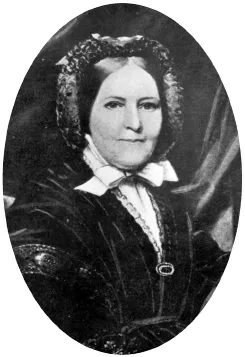
Margaret “Peggy” O’Neale Eaton. Courtesy State Archives of Florida, Florida Memory.
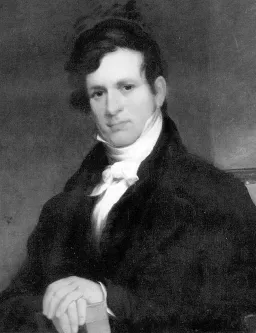
John Henry Eaton. Library of Congress.
William O’Neale died at his Dupont Circle farm in 1837 at the age of eighty-six while Peggy was still in Spain and was laid to rest in Holmead’s Cemetery. When Rhoda O’Neale died in 1860 at the age of ninety, Peggy inherited, along with other properties the O’Neales owned around town, the farm in the Dupont Circle neighborhood.
Peggy Eaton’s scandalous life did not end with her effects on President Jackson’s cabinet. By the time John Eaton had died in 1856, Peggy had finally gained the respect of her socially elite associates in Washington, but her acceptance was to be short-lived. Only three years after Eaton’s death, the then fifty-nine-year-old Peggy married her granddaughter’s nineteen-year-old Italian dancing instructor, Antonio Gabriele Buchignani, who was working at Marini’s Dancing Academy. She was once again shunned by society.
It was uncertain exactly what Peggy was thinking, but it was clear that Buchignani was nothing more than a two-bit gigolo out for a wealthy American widow’s money. Buchignani was never satisfied with the amount of money Peggy provided for him, and what she did give him was spent immediately. He was also caught stealing the family silver, and Peggy was forced to cover for him with the authorities. The couple moved to New York City so Antonio could set up his own import business of Italian wines and other products.
In 1866, Buchignani demanded that Peggy sign everything she owned over to him or he would leave her. In order to get him to stay, she signed over all her real estate, which consisted of nineteen houses and six square blocks that included the farm in Dupont Circle. Fortunately, she did not sign over the family home at Twentieth and I Streets. Buchignani then promptly sold the farm to the Hopkins brothers from Georgetown. The farmhouse stood at 1617 Connecticut Avenue until about 1895, when it was razed for a house for the widow of a gold miner, Ellen Mason White Colton, which still stands on the site today and has been converted to a storefront.
After seven years of marriage, Buchignani ran off to Italy with his wife’s fortunes as well as her seventeen-year-old granddaughter, Emily Randolph, whom he would marry after he and Margaret divorced in 1869. The couple lived lavishly on Peggy’s money, but it quickly ran out. After scamming an Italian nobleman in Paris, Antonio set out for Montreal. Reports at the time also placed him in Texas and Memphis, Tennessee, where he was supposedly posing as a doctor. Antonio ultimately ended up back in New York, where Peggy was still residing. Learning that he was back in town and had just secured a loan for $15,000, Peggy had him arrested, but a wealthy New York lawyer put up the bond for his release. He was then arrested for the abduction of a minor, but he was acquitted and fled back to Montreal. In spite of all this, Margaret wrote in her memoirs: “The fact is, I never had a lover who was not a gentleman and was not in a good position in society.” Buchignani and Mary Randolph did have a family together, with his children also his former wife’s great-grandchildren.
Peggy died in poverty in 1879 at the age of eighty-one at Lochiel House, a boardinghouse on Ninth Street. Antonio died in New York City in 1891 at the age of fifty-seven. The 1936 movie The Gorgeous Hussy was based on the life of Peggy O’Neale and starred Lionel Barrymore as Andrew Jackson and Joan Crawford as Peggy.
DOUGLASS’S FLOWER GARDENS
In 1826, John Douglass established a flower garden and greenhouse at Florida Avenue and Twentieth Street. In its early days, the garden was mostly devoted to the raising of market produce, but it later became one of the finest flower establishments in the city. In the 1840s, Douglass built greenhouses at the northeast corner of Fifteenth and G Streets in connection with the garden. The Evening Critic reported that “the gardens are the most complete in the United States, and there is no necessity for going to any other place for floral decorations.”
In 1881, as a gesture of her deep sorrow for Lucretia Garfield and the people of the United States after President Garfield’s assassination, Queen Victoria sent a large wreath of white tuberoses to the funeral that she ordered from Douglass florists. The wreath was placed on the president’s casket as his body lay in state in Washington, D.C., and during his funeral in Cleveland. Lucretia Garfield was so touched by the queen’s gesture that she preserved the wreath after the funeral, sending it to Chicago to be preserved with a wax treatment. Today, visitors to James A. Garfield National Historic Site can see the wreath from Douglass florists still displayed in the Memorial Library’s vault.
HOPKINS BRICKYARD
Due to the high clay content of the local soil, the brick-making business flourished in the Dupont Circle area from the 1840s to 1870s. Thomas Corcoran, a brother of Washington banker, philanthropist and art collector William Corcoran, established a brickyard around 1840 northwest of Dupont Circle and tried to make a go of the business for several years.
In 1856, Georgetown brothers John and George Hopkins bought Corcoran’s brickyard and, four years later, also bought the O’Neale farm. George Hopkins took up residence in the O’Neale house while his brother, John, continued living in Georgetown. In 1858, John died, leaving nine orphaned children who then moved in with their uncle George. The Hopkins family continued in the business, and with the explosive need for more housing after the Civil War, the brickyard’s business took off. With its tempering sheds, kilns, offices and outbuildings scattered around the area, it blocked the course of Massachusetts Avenue west of the circle.
Due to the smoke that the Hopkins brickyard produced, by 1870, it was considered a nuisance, and a bill was introduced in Congress for its removal. But the Hopkins family continued the business in its location until 1875, when the value of the land exceeded the profitability of making bricks. Hopkins’s brickyard was so well known that newspapers in the 1920s were still making references to the “days of Hopkins’s brickyard,” perhaps as a nostalgic memory of how rural Dupont Circle had been not long before. The old road into the brickyard, the one-block Hopkins Street, just off P Street between Twentieth and Twenty-first Streets, is all that remains of the brickyard today.
Into the 1850s, the Dupont Circle area remained an isolated village, accessible by only one road—Twentieth Street, then simply known as “the Road,” wh...
Table of contents
- Front Cover
- Title Page
- Copyright
- Dedication
- Contents
- Foreword
- Preface
- Acknowledgements
- Introduction: Wealth, Power and Status in Dupont Circle
- 1. The Early Days
- 2. A New Government and a New Neighborhood
- 3. Development Slowly Begins
- 4. The Fashionable West End
- 5. The Not-So-Gay Nineties
- 6. The Palaces of Vanity Fair
- 7. The Scions of Dupont Circle’s Gilded Age
- Map of People and Locations
- Selected Bibliography
- About the Author
Trusted by 375,005 students
Access to over 1.5 million titles for a fair monthly price.
Study more efficiently using our study tools.
Frequently asked questions
Yes, you can cancel anytime from the Subscription tab in your account settings on the Perlego website. Your subscription will stay active until the end of your current billing period. Learn how to cancel your subscription
No, books cannot be downloaded as external files, such as PDFs, for use outside of Perlego. However, you can download books within the Perlego app for offline reading on mobile or tablet. Learn how to download books offline
We are an online textbook subscription service, where you can get access to an entire online library for less than the price of a single book per month. With over 1.5 million books across 990+ topics, we’ve got you covered! Learn about our mission
Look out for the read-aloud symbol on your next book to see if you can listen to it. The read-aloud tool reads text aloud for you, highlighting the text as it is being read. You can pause it, speed it up and slow it down. Learn more about Read Aloud
Yes! You can use the Perlego app on both iOS and Android devices to read anytime, anywhere — even offline. Perfect for commutes or when you’re on the go.
Please note we cannot support devices running on iOS 13 and Android 7 or earlier. Learn more about using the app
Please note we cannot support devices running on iOS 13 and Android 7 or earlier. Learn more about using the app
Yes, you can access A History of Dupont Circle by Stephen A Hansen in PDF and/or ePUB format, as well as other popular books in History & North American History. We have over 1.5 million books available in our catalogue for you to explore.