- 163 pages
- English
- ePUB (mobile friendly)
- Available on iOS & Android
eBook - ePub
About this book
Four generations of Japanese Americans broke down racial and cultural barriers in California by playing baseball. Behind the barbed wire of concentration camps during World War II, baseball became a tonic of spiritual renewal for disenfranchised Japanese Americans who played America's pastime while illegally imprisoned. Later, it helped heal resettlement wounds in Los Angeles, San Francisco, the Central Valley and elsewhere. Today, the names of Japanese American ballplayers still resonate as their legacy continues. Mike Lum was the first Japanese American player in the Major Leagues in 1967, Lenn Sakata the first in the World Series in 1983 and Don Wakamatsu the first manager in 2008. Join Kerry Yo Nakagawa in this update of his 2001 classic as he chronicles sporting achievements that doubled as cultural benchmarks.
Information
Chapter 1
THE BEGINNINGS: JAPANESE AMERICAN BASEBALL IN HAWAII
In 1899 I formed a baseball team, made up of mostly boys in my home, and called it “Excelsior.” Being the only team among the Japanese, its competitors were Hawaiians, Portuguese and Chinese. The team turned out to be a strong one and won several championship cups and pennants at Boy’s Field on Vineyard Street in the Palama Settlement.
—Reverend Takie Okumura
The story of Japanese American baseball is nearly as old as the story of baseball itself. It begins in the Pacific paradise once known as the Sandwich Islands, where Japanese workers came to labor in the sugarcane fields. Some of these workers returned to Japan; many stayed. In time, a number of their sons, like so many immigrants of other nationalities, became part of the community by adopting America’s national game.
MIGRATION TO THE MAINLAND
In May 1935, the first Hawaiian statehood bill was introduced into the U.S. House of Representatives. In October, six members of a congressional committee arrived in Hawaii to conduct statehood hearings, and 90 out of 105 witnesses testified in favor of statehood. In October 1937, another committee appointed by Congress held extensive hearings on Hawaii; 41 of the 67 witnesses favored statehood. Throughout these congressional hearings of the 1930s, the fear of a Japanese electoral majority was most often cited as a reason not to grant statehood to Hawaii.
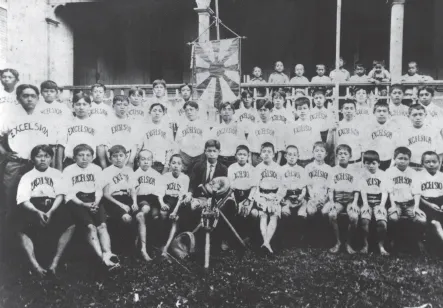
Organized by Reverend Takie Okumura (behind equipment), the Excelsiors baseball team formed in 1899 in Honolulu and was the first Japanese American baseball squad. Courtesy Makiki Christian Church.
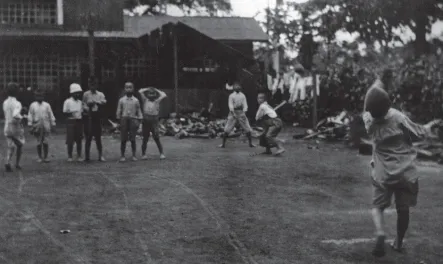
The Excelsiors practicing in Palama Settlement, Honolulu, circa 1900. There were forty-five boys in Takie Okumura’s boys’ home, enough to organize five teams. Courtesy Makiki Christian Church.
It wasn’t until August 21, 1959, that Hawaii officially became a state. Long before statehood, many gifted players yearning to prove that they could compete outside the pro ranks of the islands began venturing to the mainland and Japan. A number of players were sponsored by fellow Nisei working the farm belts of California. Some of these ballplayers opened the doors of opportunity at the turn of the century by speaking English and having the knowledge to read. They established farming leases and could cut through the red tape of Alien Land Laws and anti-immigration standards. By using the name of the American-born son (Nisei), Issei immigrants could purchase and lease the land. For new immigrants of any descent other than Japanese, life did not offer as many obstacles and gauntlets. Major-league aspirations were at the very bottom of the priority list because of the hardships of survival and discrimination.
Some of Hawaii’s homegrown products did very well for themselves on California’s baseball diamonds despite the void created by the absence of their parents and families. These early immigrants from Hawaii had friends or fellow ballplayers sponsor their trip over to the mainland to play ball. Their friends’ families assured them work, food and lodging. On Sundays, they could feel at home again on the playing field. A spirit of familiarity and fellowship despite skin color and racial barriers brought out the best in these athletes. Italians, Germans, Jews, Armenians and Irish all were busy trying to establish themselves in America’s new world. Baseball was about claiming a piece of space and proving how American you really were, if given a chance to play on a level playing field. It would be much more difficult for Japanese Americans to find the playing field in the “real” world.
Chapter 2
BASEBALL IN JAPAN: ORIGINS AND EARLY TOURS TO AND FROM JAPAN
We like to believe that countries having a common interest and a great sport would rather fight it out on the diamond than on the battlefield. We hope some day Japan can send to this country a team of players able to meet the best in the U.S. and prove to the Americans that the so-called yellow peril wears the same clothes, plays the same game, and entertains the same thoughts. In other words that we are “brothers.” Once that conviction becomes universal, all of us, whether we live in Tokyo or Appaloosas, can sing together “Take Me Out to the Ball Game,” and in doing so can forget the trivialities that from time to time threaten to disrupt our friendly relations.
—The Sporting News, 1934
Baseball tradition states that the game was invented in 1839 by Abner Doubleday in a small cow pasture in Cooperstown, New York. Thirty-three years later, the term “baseball” was first defined in an English–Japanese dictionary as tama asobi (ball playing). Later, an 1885 sports book defined baseball as dakyu onigokko (playing tag with a batted ball). These early references show how quickly the game took root in Japan. With its beautiful symmetries and mathematical logic and mysteries, the discipline of baseball found a congenial second home far from the country of its origin. It also became an important vehicle of cultural exchange across the Pacific. For American-born Japanese, baseball provided a connection to the ancestral country even as it enabled them to become “Americanized.”
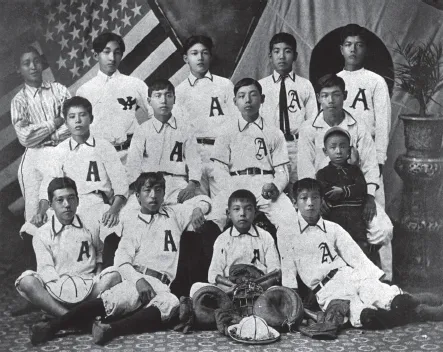
Founded by Steere Noda (middle row, third from left), this Honolulu Asahi team became one of the first Hawaiian Nisei teams to tour Japan in 1915, finishing the tour with an 8-6 record. Courtesy Lilian Yajima.
THE INTRODUCTION OF BASEBALL TO JAPAN
One of the first missionaries of baseball in Japan was Horace Wilson. This American schoolteacher brought the American pastime to Japan in 1872. Like most new resident teachers in this era, Wilson was considered a baseball enthusiast, and he had a keen interest in introducing the sport to his students.
Upon his arrival in Japan, Wilson became a teacher at Ichiban Chugaku (First Middle School of the First University Division) in Tokyo. The school, which eventually developed into Tokyo University, was renamed Kaisei Gakko the following year. That same year, a fairly large athletic field was built at the school, and baseball was soon being played with great passion and enthusiasm. Research by the Japanese Baseball Hall of Fame has indicated that baseball was also introduced by American teachers in Kumamoto at the Kumamoto Yogakko (School of Western Learning). Other places where the game was introduced included the Kaitakushi Kari Gakku (Temporary School of Hokkaido Development) in Tokyo and foreign settlements in Yokohama and Kobe.
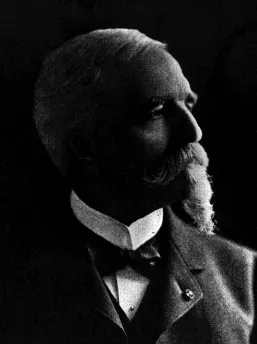
Considered to be a Japanese educator and baseball “missionary,” American schoolteacher Horace Wilson introduced baseball to his Japanese students at Tokyo’s Ichiban Chugaku in 1872. Courtesy San Francisco Library.
There was some opposition by the Japanese government to having baseball in the school systems. Many believed that baseball was a foreign entity and should not be played at Japanese institutions of higher learning. The proper Japanese student took judo or kendo (Japanese fencing) or disciplines that focused more on developing the mental, physical and spiritual aspects of the self. Horace Wilson, however, was a mathematics teacher who might have seen unique aspects of baseball that paralleled his teaching. In the game of baseball, you can be a success at the plate three out of ten times as a batter. You can be a legend if you hit four for ten. If you walk the first batter in an inning, seven out of ten times he will score; if you start the batter out with a strike, seven out of ten times it will lead to an out. One can speculate that Wilson saw that there were many statistical and mathematical truths that could be explored through baseball more than through any other sport or extracurricular subject.
Wilson could have seen the spiritual aspects of learning a game that requires a team of players to flow with one mind. He might have realized that his students could benefit from the many life lessons that baseball teaches. Pitchers were not always going to throw a no-hitter; batters were not able to hit home runs in every at-bat. Winning and losing were part of the fabric of the game. Even the physics of baseball presented mysteries that seemed mathematically unfathomable. The theory of hitting a round ball with a round bat squarely befuddled the minds of many who analyzed the sport. Horace introduced a new equation with geometric variables to the students, and they responded to his teaching. An early block-print image in a Japanese history book depicts a sketch of children playing baseball for students to research.
Another visionary pioneer in Japanese history was Japan’s first baseball writer, poet Shiki Masaoka. Masaoka noted that baseball was a foreign game to almost all his countrymen. “There are very few persons in Japan who play baseball or understand it,” he wrote. “Baseball had its start in America where it is a national game, just like sumo [wrestling] is to us and bullfighting is to the Spaniards.”
Masaoka identified Hiroshi Hiraoka as a major “player, teacher and crusader for baseball.” Hiraoka was one of the lucky youths the Japanese government had sent abroad to study Western ways. It was in New York City, where he had been ordered to go to school, that he encountered urban baseball. He got hooked on the sport and returned to Japan in 1876 and registered four “firsts” in Japanese baseball. In 1878, he organized the first baseball club and called it the Shimbashi Athletic Club (SAC). Hiroshi was an engineer for the Shimbashi Railway Station, the birthplace of railway in Japan. Near this station, he planned and built Japan’s first field dedicated exclusively to baseball. The plot of land where the field was laid out belonged to the Tokugawas, the powerful clan that had ruled Japan for centuries. Hiraoka persuaded the family to agree to the sale of the land for the new Western game of baseball. The two other “firsts” credited to Hiraoka were the introduction of the uniform and of the curve ball. Hiroshi had brought back from his journey American baseball equipment, a uniform concept he copied and up-to-date knowledge of the game. He also became acquainted with Albert G. Spalding (founder of the Spalding Athletic Equipment Company). Spalding, then a pitcher for the Boston Red Stockings, gave Hiroshi several sets of baseball equipment and a new baseball book.
Because of Hiroshi’s influence, the SAC took a lead role in spreading the word on baseball, with members coaching other teams in the Tokyo area. After the first baseball field was built, the first official game was with an outside team, Komaba No Gakko (Komaba Agricultural School). Two more teams were quickly organized: the Tameike Club (TC) and the Shirogane Club. These four teams dueled with one another for the right to challenge the Yokohama foreigner team. The outcome would decide the championship of Japan. Hiraoka and the SAC gave baseball a huge boost, and schools such as Meiji Gakuin, Aoyama Gakuin and Keio Gijuku were quickly competing.
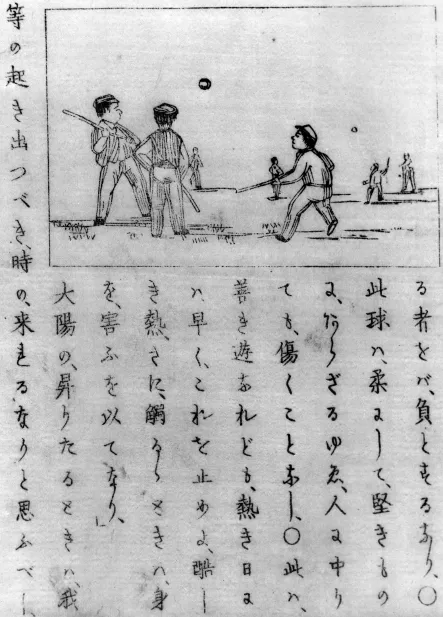
This 1874 woodblock print and simple description of baseball appeared in the Japanese history book Shogaku Tokuhon (Primary School Reader) and demonstrated the popularity that baseball had achieved in Japan only one generation after the game had been invented in America. Courtesy Japan Hall of Fame.
In 1886, a baseball team was formed at Ichiko (First High School). One year later, the SAC team broke up, with most of its players joining the TC. The most dominant schools of the future were the schools whose players were instructed by former members of the SAC.
During the 1890s, baseball in Japan was dominated by the Ichiko teams. On March 23, 1896, Ichiko won a historic and unexpected 29–4 victory against the Yokohama school at the Yokohama Country and Athletic Club. The game was widely reported in local newspapers, and the publicity spurred interest in baseball throughout Japan. Many alumni of Ichiko went on to coach at schools throughout the country.
In 1894, Kanoe Chuma, a former player for Ichiko, translated “baseball” as yakyu (literally “field ball”) in the school’s alumni magazine. Ever since, yakyu has been the established Japanese name for baseball.
EARLY NISEI TOURS FROM AMERICA
As early as 1914, there was a steady flow of teams traveling the “Bridge Across the Pacific,” with teams from the United States going to Japan and Japanese university teams visiting America. This bridge of goodwill was very significant in terms of diplomacy and fellowship between the two countries.
Among the teams visiting Japan were those made up of Nisei. Since the semipro Nisei were competing throughout California, Oregon, Washington, Hawaii and the Rocky Mountain states, the next logical step was to travel to Japan. It was a golden opportunity to compete with college-level teams and heavily recruited merchant teams from Japan that took their baseball very seriously.
The first Nisei team to go to Japan was Frank Fukuda’s Seattle Asahi. Fukud...
Table of contents
- Front Cover
- Title Page
- Copyright
- Dedication
- Contents
- Acknowledgements
- Preface, by Noriyuki “Pat” Morita
- Foreword
- Introduction
- 1. The Beginnings: Japanese American Baseball in Hawaii
- 2. Baseball in Japan: Origins and Early Tours to and from Japan
- 3. Dreams of Opportunity: Issei Pioneers on the Mainland
- 4. Baseball Crazy: The Nisei Come of Age
- 5. Breaking Barriers
- 6. Desert Diamonds Behind Barbed Wire
- 7. Postwar Baseball in America and Japan: Resettlement, Reorganization and Reconciliation
- 8. Sansei, Yonsei, Shin Issei and Japanese Nationals Step Up to the Plate
- 9. Celebrations and Remembrances
- 10. Extra Innings
- Appendix: A Timeline of Asian American Baseball, by Bill Staples
- Selected Bibliography
- About the Author
Trusted by 375,005 students
Access to over 1.5 million titles for a fair monthly price.
Study more efficiently using our study tools.
Frequently asked questions
Yes, you can cancel anytime from the Subscription tab in your account settings on the Perlego website. Your subscription will stay active until the end of your current billing period. Learn how to cancel your subscription
No, books cannot be downloaded as external files, such as PDFs, for use outside of Perlego. However, you can download books within the Perlego app for offline reading on mobile or tablet. Learn how to download books offline
Perlego offers two plans: Essential and Complete
- Essential is ideal for learners and professionals who enjoy exploring a wide range of subjects. Access the Essential Library with 800,000+ trusted titles and best-sellers across business, personal growth, and the humanities. Includes unlimited reading time and Standard Read Aloud voice.
- Complete: Perfect for advanced learners and researchers needing full, unrestricted access. Unlock 1.5M+ books across hundreds of subjects, including academic and specialized titles. The Complete Plan also includes advanced features like Premium Read Aloud and Research Assistant.
We are an online textbook subscription service, where you can get access to an entire online library for less than the price of a single book per month. With over 1.5 million books across 990+ topics, we’ve got you covered! Learn about our mission
Look out for the read-aloud symbol on your next book to see if you can listen to it. The read-aloud tool reads text aloud for you, highlighting the text as it is being read. You can pause it, speed it up and slow it down. Learn more about Read Aloud
Yes! You can use the Perlego app on both iOS and Android devices to read anytime, anywhere — even offline. Perfect for commutes or when you’re on the go.
Please note we cannot support devices running on iOS 13 and Android 7 or earlier. Learn more about using the app
Please note we cannot support devices running on iOS 13 and Android 7 or earlier. Learn more about using the app
Yes, you can access Japanese American Baseball in California by Kerry Yo Nakagawa in PDF and/or ePUB format, as well as other popular books in History & North American History. We have over 1.5 million books available in our catalogue for you to explore.