eBook - ePub
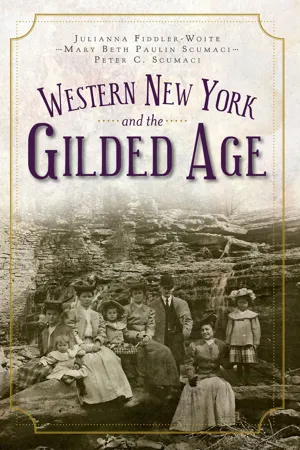
Western New York and the Gilded Age
- 131 pages
- English
- ePUB (mobile friendly)
- Available on iOS & Android
eBook - ePub
Western New York and the Gilded Age
About this book
Born from the success of the Erie Canal, the communities of Western New York enjoyed a century of growth and prosperity during America's Gilded Age. Buffalo was one of the richest cities in America and dominated industry and politics, producing two presidents. Wealth and architectural opportunity enticed figures like Frank Lloyd Wright, while the events of the Pan-American Exposition and a presidential assassination and inauguration attracted the world's attention. Drawing on the natural resources of Niagara Falls and profiting from a friendly relationship with Canada, the people of Western New York enjoyed luxurious leisure time and documented their adventures in photo albums and postcards. It is these images and remembrances, beautifully reproduced in this book, that capture this charming time in Western New York's history.
Information
Chapter 1
BIG BUSINESS
Although settlements existed in Western New York (WNY) previously, the true birth of the region can be traced to 1823, when digging began for the Buffalo portion of the Erie Canal. Over the next twenty years, the population of WNY increased by 145 percent, and the business landscape changed dramatically. Now, scattered among WNY’s ordinary residents were some of the most powerful men in the nation. Their stories were captivating and their impact eternal.
PROMINENT BUSINESSMEN
William G. Fargo (1818–1881)
The Buffalo waterfront was the focal point of many successful businesses in the 1800s. In 1844, William G. Fargo began a legendary express business with partner Henry Wells. By 1851, Wells Fargo & Co. had a monopoly on the express industry, expanded to railroad shipping and proudly delivered between San Francisco and New York. Wells Fargo soon became a staple of American culture and will forever be celebrated by the song “The Wells Fargo Wagon” from Meredith Wilson’s The Music Man.
As a result of his wealth and success, Fargo was elected mayor of Buffalo in 1861. In 1870, he completed construction of his new home, which was one of the most elaborate and costly mansions in the state. The Fargo Mansion covered two city blocks, from Pennsylvania Avenue and West Avenue to Jersey Street and Fargo Avenue. The home, which contained a five-story tower, was the first in the city to have an elevator. The dwelling was said to have golden doorknobs and contain wood from all states in the Union.
John Blocher (1825–1911)
John Blocher was a Civil War soldier who served in New York’s 78th Regiment. Upon returning to WNY, Blocher began manufacturing shoes and boots, dabbling in real estate and opening breweries. By the 1870s, he had become one of Buffalo’s wealthiest citizens. Professionally, however, Blocher is most often associated with his vision of “a home where aging men and women may enjoy their senior years.” The Blocher Homes opened in Williamsville in 1906. This facility remained a staple of the village landscape for generations and is presently operated by Beechwood.
Despite their business success, the Blochers may best be remembered for the Blocher Mausoleum in Forest Lawn Cemetery and the fascinating story behind its creation. The legendary tale revolves around Nelson Blocher and the family’s Irish maid, Katherine, with whom Nelson was in love. Disapproving of Nelson’s feelings, however, his parents sent him overseas in 1881, and the maid was dismissed. Upon his return in 1882, Nelson was shocked to discover that his love was gone and all that remained behind was her Bible. Heartbroken, Nelson canvassed the globe throughout 1883 but never found her. Exhausted and sick with fever, Nelson eventually took to his bed. He died on January 24, 1884, with Katherine’s Bible clutched to his chest.
Riddled with guilt, the Blochers commissioned the infamous mausoleum as a tribute to their only son. Constructed of Italian marble, the monument displays Nelson on his deathbed, flanked by his parents, John and Elizabeth. Nelson clings to a Bible, and an angel hovers overhead. The angel, it was said, was likened after the Blochers’ maid, Katherine. Clearly, the symbolism is as rich as the architecture.
Darwin D. Martin (1865–1935) and Frank Lloyd Wright (1867–1959)
Darwin D. Martin was born in Bouckville, New York, and left home at age thirteen to work as a soap slinger for the Larkin Soap Company. Impressing the company leaders with his strong work ethic, Martin was brought to Buffalo, where he became an executive in the Larkin administration. By 1902, Martin had become a millionaire and forged a working relationship and friendship with aspiring architect Frank Lloyd Wright. He commissioned Wright to begin work on his personal estate in 1902 and the new Larkin Administrative Building in 1904.
The friendship of Darwin D. Martin and Frank Lloyd Wright is forever evident at 125 Jewett Parkway in the city of Buffalo. This location, which is within the Parkside East Historic District, was designed by renowned landscape architect Fredrick Law Olmsted. Martin purchased the property in 1902, and Wright began construction in 1903. The resulting Darwin D. Martin Complex was added to the National Registry of Historic Places in 1975 and became a National Historic Landmark in 1986.
Wright remained Martin’s friend throughout his lifetime and stood by him when the stock market crash eliminated his fortune. The men attempted various business partnerships, but none came to fruition. Following Martin’s death, the estate was abandoned by his destitute widow and remained vacant for two decades.
E.G. Spaulding (1809–1897)
One of the wealthiest figures of early WNY was banker and politician E.G. Spaulding. In 1847, E.G. Spaulding was voted mayor of Buffalo and eventually served in Congress as a member of the Whig Party. Throughout his political career, Spaulding was a staunch supporter of Abraham Lincoln and proudly hosted a congratulatory dinner at the National Hotel in Washington, D.C., following his election.
Outside of politics, E.G. Spaulding was prominent in the banking business, operating Spaulding Bank on the second floor of the Spaulding Exchange, one of the finest buildings of its time. Located at 162 Main Street, the Spaulding Exchange would later be torn down to make room for the Memorial Auditorium.
Regardless of the travels of his political career, the WNY area remained Spaulding’s home, and he owned elaborate mansions in both Buffalo and Grand Island. On the homefront, Spaulding married three times and was widowed by each. Next to presidents Grover Cleveland and Millard Fillmore, Spaulding was Buffalo’s most illustrious citizen of his era. At the time of his death, his estate was worth over $4 million, making him Buffalo’s wealthiest citizen.
THE AUTOMOBILE INDUSTRY
E.G. Spaulding’s granddaughter, Edith, joined another of Buffalo’s prominent families when she wed William Allen Gardner. William’s grandfather, Noah Gardner, was one of the incorporators of the Buffalo Savings Bank and had amassed quite a fortune. According to the 1912 Genealogical and Family History of Western New York, William’s father, William Hamilton Gardner, was prominent in the automobile industry and served as director of the Pierce Arrow Motor Car Company.
In the early part of the twentieth century, the Pierce Arrow Motor Car Company produced some of the most luxurious automobiles on the market. The company, however, began as a bicycle manufacturer and did not venture into autos until the Pan-American Exposition of 1901. At that time, George N. Pierce & Company built two cars and submitted them for exhibition at the exposition’s opening. The Pierce Motorette was a two-and-three-quarters-horsepower automobile with a maximum speed of fifteen miles per hour....
Table of contents
- Front Cover
- Half Title
- Title Page
- Copyright
- Dedication
- Contents
- Acknowledgements
- Introduction. The Gilded Age
- Chapter 1. Big Business
- Chapter 2. Politics and Patriotism
- Chapter 3. Creating Communities
- Chapter 4. Travel and Transportation
- Chapter 5. Luxury and Leisure
- Chapter 6. Waterfalls and Wonders
- Conclusion. The Circle of Life
- Bibliography
- About the Authors
Trusted by 375,005 students
Access to over 1.5 million titles for a fair monthly price.
Study more efficiently using our study tools.
Frequently asked questions
Yes, you can cancel anytime from the Subscription tab in your account settings on the Perlego website. Your subscription will stay active until the end of your current billing period. Learn how to cancel your subscription
No, books cannot be downloaded as external files, such as PDFs, for use outside of Perlego. However, you can download books within the Perlego app for offline reading on mobile or tablet. Learn how to download books offline
We are an online textbook subscription service, where you can get access to an entire online library for less than the price of a single book per month. With over 1.5 million books across 990+ topics, we’ve got you covered! Learn about our mission
Look out for the read-aloud symbol on your next book to see if you can listen to it. The read-aloud tool reads text aloud for you, highlighting the text as it is being read. You can pause it, speed it up and slow it down. Learn more about Read Aloud
Yes! You can use the Perlego app on both iOS and Android devices to read anytime, anywhere — even offline. Perfect for commutes or when you’re on the go.
Please note we cannot support devices running on iOS 13 and Android 7 or earlier. Learn more about using the app
Please note we cannot support devices running on iOS 13 and Android 7 or earlier. Learn more about using the app
Yes, you can access Western New York and the Gilded Age by Julianna Fiddler-Woite,Mary Beth Paulin Scumaci,Peter C. Scumaci in PDF and/or ePUB format, as well as other popular books in History & North American History. We have over 1.5 million books available in our catalogue for you to explore.