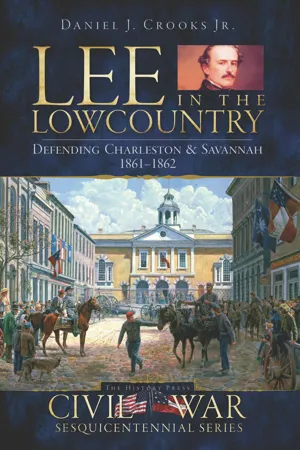
This Civil War biography sheds light on the Confederate General's first year serving the newly formed Southern Republic.
Early in the Civil War, General Robert E. Lee was given command of the Department of South Carolina, Georgia and East Florida. Making him, in effect, the first line of defense for for Confederacy and two of its key cities: Charleston and Savannah. In
Lee in the Lowcountry, Charleston historian Danny Crooks examines this period in Lee's career, in which he faced with confusion and convoluted loyalty among the ranks.
Using Lee's own words and those of his contemporaries, Crooks helps the reader to understand why Lee, and only Lee, could bring order to the early chaos of the war. He also reveals how Lee acquired the two most famous trademarks of his wartime career while in the Lowcountry. Long hours in the saddle prompted Lee to grow his signature beard and, while at Pocotaligo, he acquired his beloved equine companion, Traveller.
- 219 pages
- English
- ePUB (mobile friendly)
- Available on iOS & Android
eBook - ePub
About this book
Information
CHAPTER 1
Mustering the Troops
Already they begin to cry out for more ammunition, and already the blockade is beginning to shut it all out.
—Mary Boykin Chesnut, July 16, 1861
Loyalty is an envious virtue. When hostilities began between the North and the South, Robert E. Lee was an officer in the United States Army. The Union courted Lee with impressive offers, but Lee was a Virginia man first and foremost. On the day after Virginia seceded from the Union, Lee declined to continue in the Federal service. In a letter to General Winfield Scott on April 20, 1861, Lee wrote, “Save in defense of my native state, I never desire again to draw my sword.”
The previous January, while commanding the Department of Texas from Fort Mason, Lee had written to his distant cousin Martha Custis Williams. In words rich with patriotic spirit, Lee had addressed the forthcoming conflict and stated clearly his allegiance. To “Markie,” he wrote:
I hope you have seen Lolo often since his return & receive good news from Orton. My letters from home frequently mention him & in one of the last it was stated that he & Custis were looking forward to captaincies in the Army of the Southern Republic! The subject recalls my grief at the condition of our country. God alone can save us from our folly, selfishness & short sightedness. The last accounts seem to show that we have barely escaped anarchy to be plunged into civil war. What will be the result I cannot conjecture. I only see that a fearful calamity is upon us & fear that the country will have to pass through for its sins a fiery ordeal. I am unable to realize that our people will destroy a government inaugurated by the blood & wisdom of our patriot fathers, that has given us peace & prosperity at home, power & security abroad & under which we have acquired a colossal strength unequalled in the history of mankind. I wish to live under no other government, & there is no sacrifice I am not ready to make for the preservation of the Union save that of honour. If a disruption takes place I shall go back in sorrow to my people & share the misery of my native state & save in her defence there will be one soldier less in the world than now. I wish to for no other flag than the “Star Spangled Banner,” & no other air than “Hail Columbia.”
Lee’s historical sense of the nation was that America was well worth the efforts and sacrifices of the revolutionaries. His own father had become famous fighting the British. Men Lee emulated, George Washington foremost, had risked everything for a country that was now ripping at the seams. Yet, above all, like generations before him, Lee placed his homeland of Virginia first in duty and honor.
On April 12, 1861, at four thirty in the morning, the schism became a fact of history—the Rebels began their bombardment of Fort Sumter in Charleston Harbor. On April 23, 1861, the same day that George McClellan was named major general over Ohio’s volunteers, Brigadier General Lee was given full command of Virginia’s military. In this role, General Lee functioned as the organizer of an army, not as a field commander. Under Lee’s guidance, thousands of recruits were eventually equipped, drilled and readied for action.
In preparing Virginia for war, Lee knew full well that no force he mustered could conquer the North. He had been a member of the Federal army for so long that he knew the strength of its manufacturing facilities and the size of the population from which it could draw troops.
What he knew he could do was to successfully defend Virginia from invasion. To Daniel Ruggles, commander of Rappahannock River Defenses, Lee wrote on April 24, 1861: “You will act on the defensive, station your troops at suitable points to command the railroads.” Lee had full confidence in Ruggles, a brigadier general of Virginia Volunteers, West Point graduate and veteran of the Mexican War.
Virginia’s forces were volunteers and, like Lee himself, ready to do whatever was necessary to defend their homeland. Lee promoted their patriotism and dedication to a cause both noble and grand. He spoke foremost to the honor of Virginia. Bonded by this sentiment, against a common foe, the assembly of an army began.
Manpower would initially be drawn from standing militia units, which numbered over 100,000 across Virginia. The state had a long militia tradition that dated back to the American Revolution. Next came the volunteers, of which there was no shortage. Lee established a series of recruitment centers across the state, where companies could be raised at the local level. The command structure would take shape as each company elected its officers. Once brought to camp around Richmond, these companies would form into regiments.
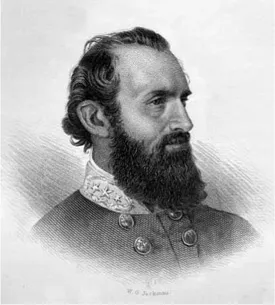
The “Stone Wall”: General T.J. Jackson. Courtesy of Douglas W. Bostick.
Major Thomas J. Jackson had served as a professor of physics and as artillery instructor at Virginia Military Institute. Prone to bizarre rituals and rooted in a determined Presbyterian faith, Jackson was thought of as a natural leader, capable and determined, almost to a fault.
On April 27, Lee wrote to Jackson, outlining his preference for organization of the units:
You will proceed, without delay, to Harper’s Ferry, Virginia, in execution of the orders of the governor of the State, and assume command of that post. After mustering into the service of the State such companies as may be accepted under your instructions, you will organize them into regiments or battalions, uniting, as far as possible, companies from the same section of the State. These will be placed under their senior captains, until field officers can be appointed by the governor.
The organizational structure of the army that Lee chose greatly contributed to its future success. Rather than build an army at corps strength, Lee emphasized the mobility of an army of brigades. Lee knew the armies of the North were big but slow because of their size; tens of thousands of troops and thousands of wagons could not outmaneuver one quick and effective battalion.
The men arrived in camp wearing every possible combination of uniform. Some wore blue, some gray, some blue and red and some butternut. Plumes and rosettes decorated their hats, and many wore fancy sashes and gloves. Boots and brass shined in the sun, as did the contagious smiles of the recruits as they met men from locales previously unknown. Here, common cause united shoemakers, bankers and farmers. Family members turned to the home tasks of knitting socks and sewing the regimental flags. Women’s Relief Societies began gathering scrap cloth for bandages and raising money for medical supplies.
The work of building defenses continued to require General Lee’s attention. On April 29, Lee wrote to Colonel Andrew Talcott, a Virginia railroad engineer. Talcott, a West Point graduate, was now sixty-four years of age, but he was eager to serve as the chief engineer for the State of Virginia.
Lee’s directives provided for improved river defenses:
You will proceed up James River, to the vicinity of Burwell’s Bay, & select the most suitable point which, in your judgement, should be fortified, in order to prevent the ascent of the river by the enemy…you will then proceed to the mouth of the Appomattox, and there perform the same service, selecting some point below the mouth of that river…
Lee’s letter to Talcott is indicative of the manner in which Lee gave orders. Lee could not presume to know specifically where to situate a fort, so he deferred to Talcott’s abilities to make a decision and build upon it. General Lee’s deference to his subordinates was a hallmark of his military career. Acting otherwise, Lee could appear to others to be arrogant and assuming, traits not consistent with his sense of being a gentleman or a general.
On April 30, 1861, Lee wrote to his wife about the age of so many of the eager recruits. Lee observed:
That I could not consent to take boys from their schools and young men from their colleges and put them in the ranks at the beginning of the war when they are not needed. The war may last ten years. Where are our ranks to be filled from then?
The Richmond training center was named “Camp Lee” after R.E. Lee’s father. Cadets from Virginia Military Institute served as drillmasters. Major Jackson was now assigned to supervise these cadets as they carried out their duties. Each cadet worked to teach the basics of drill formation, trying to instill some semblance of military bearing in each new soldier. In just four weeks, seventeen regiments had been formed. It was only a matter of time before their ranks began to dwindle, not from a hail of Yankee bullets, but from disease.
Calvin Conner, a member of South Carolina’s Catawba Rifles, wrote home from Manassas junction:
There is but one thing I fear much and that is sickness which is rapidly increasing in our ranks. There is more sickness in our regiment at this time than there has been…and there has been several deaths for which as I said before we ought to be thankful that we have escaped so far without being called to render up our account at the bar of God away from amidst the many kind and loved ones at home. I often feel sad when I see a poor soldier lying upon his blanket with none of the many comforts of which he has been used to at home for I know that they must feel bad. They have no one to feel and care for them in the camp amongst strangers who can fill the place of a kind and affectionate mother or sister, and I fear there are a great many that never know how to appreciate their kind until now.
As he reviewed the new troops who were able-bodied, Lee was optimistic that soon they may even have a rifle to carry. The Federal arsenals that had been seized provided some rifles that were suitable for combat, most being the .69-caliber smoothbore musket, but there were not nearly enough for everyone. State supplies consisted of antiquated flintlocks, dating from the previous century.
The difference between a flintlock and a musket using a primer cap was tremendous on the battlefield. A soldier could reasonably expect to get off three rounds per minute with the .69 caliber; with a flintlock, one round per minute was usually the case.
Lee wrote to Major Francis M. Boykin Jr., directing the distribution of these arms. General Lee instructed Boykin accordingly:
To enable you to supply any deficiency in arms in the companies, 200 muskets of the old pattern, flint-locks, will be forwarded by Col. Jackson, the commanding officer at Harper’s Ferry, to your order, from whence you must take measures to receive them & convey them to their destination, under guard, if necessary. I regret that no other arms are at present for issue.
Later in May, Lee instructed Jackson to offer a bounty for muskets: “You are authorized to offer the payment of $5 a piece for each musket that may be returned of those taken possession of by the people in and about Harper’s Ferry.” Apparently, during the seizure of the arsenal by Southern troops, several of the precious rifles fell into the hands of local citizens.
For heavy artillery, there were hundreds of big guns at the naval yard at Norfolk that had been seized by Virginia’s troops. Among them were many rifled Dahlgren guns, artillery highly effective against enemy ships and fortifications. The foundries and shipbuilding and repair facilities were also at the disposal of the Confederacy. Lee directed the manufacture of tons of gunpowder, while blacksmiths turned to making bayonets.
For the cavalry, there were plenty of horses, but no pistols or sabers. These would have to come from England until Southern armories could catch up with orders. Lee knew that an army must be mobile, and that would take wagons, hundreds of them, to support the needs of an army on the march. While more were made, wagons were sometimes commandeered to get the job done. Next, Lee turned to the immediate need of each man in arms: food.
The state of food preservation in 1861 consisted mostly of smoking meat or preserving it with salt. Pickled vegetables were often compromised by poor corking, which allowed air in, thus spoiling the goods. Canning was not an accomplished art, and often the cans of rations turned rancid in transit. The one staple component of a soldier’s diet—bread—came mostly in the form of a perforated biscuit known as “hardtack.” Regrettably, many a man on both sides of the battle line was forced to make a meal of only this one commodity, and then only after soaking it in water to loosen up the worms so they could first be removed.
Lee would make good use of foragers, who would help his men live off the land. If the land failed them, then it would be an unfortunate part of war to have to take from people’s stores as they moved through populated areas. Later in the war, soldiers would find that for a starving army, there was only the finest line between paying useless Confederate money for chickens and outright pilferage.
Soon, the Virginia troops for which Lee was responsible were transferred to the War Department’s supervision, leaving Lee effectively out of a job. Lee then served as President Davis’s advisor. Acting at times on his own and without official directive, Lee oversaw the reinforcement of defensive earthworks around Richmond. He wrote of his activities to his wife:
I have just returned from a visit to the batteries and troops on James and York rivers, etc., where I was some days…Yesterday I turned over to it the command of the military and naval forces of the State, in accordance with the proclamation of the Government and the agreement between the State and the Confederate States. I do ...
Table of contents
- Cover
- Title
- Copyright
- Dedication
- Contents
- Preface
- Introduction
- Chapter 1. Mustering the Troops
- Chapter 2. Yankees on the Run
- Chapter 3. In the Shadow of Cheat Mountain
- Chapter 4. Ready for War
- Chapter 5. The Loss of Port Royal
- Chapter 6. Trying to Do Much with Little
- Chapter 7. Picking a Target
- Chapter 8. Smoke and Stones
- Chapter 9. Reconciliation
- Chapter 10. A Confederacy in Crisis
- Chapter 11. General Lee's Army
- Bibliography
Trusted by 375,005 students
Access to over 1.5 million titles for a fair monthly price.
Study more efficiently using our study tools.
Frequently asked questions
Yes, you can cancel anytime from the Subscription tab in your account settings on the Perlego website. Your subscription will stay active until the end of your current billing period. Learn how to cancel your subscription
No, books cannot be downloaded as external files, such as PDFs, for use outside of Perlego. However, you can download books within the Perlego app for offline reading on mobile or tablet. Learn how to download books offline
Perlego offers two plans: Essential and Complete
- Essential is ideal for learners and professionals who enjoy exploring a wide range of subjects. Access the Essential Library with 800,000+ trusted titles and best-sellers across business, personal growth, and the humanities. Includes unlimited reading time and Standard Read Aloud voice.
- Complete: Perfect for advanced learners and researchers needing full, unrestricted access. Unlock 1.5M+ books across hundreds of subjects, including academic and specialized titles. The Complete Plan also includes advanced features like Premium Read Aloud and Research Assistant.
We are an online textbook subscription service, where you can get access to an entire online library for less than the price of a single book per month. With over 1.5 million books across 990+ topics, we’ve got you covered! Learn about our mission
Look out for the read-aloud symbol on your next book to see if you can listen to it. The read-aloud tool reads text aloud for you, highlighting the text as it is being read. You can pause it, speed it up and slow it down. Learn more about Read Aloud
Yes! You can use the Perlego app on both iOS and Android devices to read anytime, anywhere — even offline. Perfect for commutes or when you’re on the go.
Please note we cannot support devices running on iOS 13 and Android 7 or earlier. Learn more about using the app
Please note we cannot support devices running on iOS 13 and Android 7 or earlier. Learn more about using the app
Yes, you can access Lee in the Lowcountry by Daniel J. Crooks in PDF and/or ePUB format, as well as other popular books in History & Historical Biographies. We have over 1.5 million books available in our catalogue for you to explore.