"One of country music's greatest songwriters has given us his own private tour of the collective genius of his profession." —Malcolm Gladwell, bestselling author and host of the
Revisionist History podcast
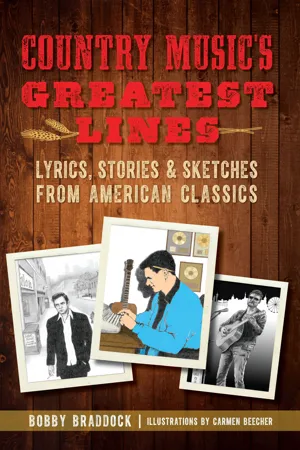
Bobby Braddock, the only living songwriter to have written number-one country songs in five consecutive decades, celebrates standout lines in more than eighty country masterpieces. Unique stories give the reader a behind-the-scenes look at classics from Hank Williams, Bill Anderson, Roger Miller and Merle Haggard, as well as twenty-first-century icons like Alan Jackson, Taylor Swift and Eric Church. Artist Carmen Beecher brings these tales to vivid life with strikingly realistic illustrations of seldom-seen songwriters, easily recognizable superstars and unforgettable song characters. From late 1940s jukebox hits to present-day chart toppers, Braddock and Beecher offer a magical journey from the songwriter's pen to the singer's lips to the listener's ear.
"
Country Music's Greatest Lines works as an insider's take on the business of country, and it also sent me to a dozen records I wanted to hear immediately. Braddock and Beecher evoke the mythology of country without sentimentalizing the music or its creators. It's a remarkable achievement." —
Nashville Scene
"We see how stand-alone powerful and effective a few well-crafted lines can be, even when removed from the context of the entire song.
" —
Sounds Like Nashville
"Country songs, from Hank Williams till today, remain faithful to their tradition of reminding their listeners about the life they live. Braddock, a 60-year creator of songs, remembered that when he decided to write this book." —
American Songwriter
eBook - ePub
Country Music's Greatest Lines
Lyrics, Stories & Sketches from American Classics
- 179 pages
- English
- ePUB (mobile friendly)
- Available on iOS & Android
eBook - ePub
Country Music's Greatest Lines
Lyrics, Stories & Sketches from American Classics
About this book
Information
Subtopic
North American HistoryCHAPTER 1
1940s AND 1950s
The silence of a falling star/Lights up a purple sky
“I’M SO LONESOME I COULD CRY”
Written by Hank Williams
Recorded by Hank Williams for MGM
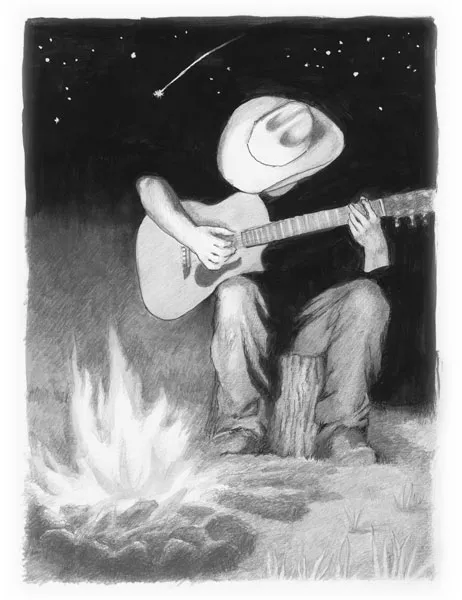
“Hear that lonesome whippoorwill / He sounds too blue to fly / The midnight train is whining low / I’m so lonesome I could cry.” Sometimes called “the Hillbilly Shakespeare,” homely, skinny Hank Williams burst onto the scene at age twenty-two, and by age twenty-nine he was gone. Country music’s first touring singer/writer superstar was, like many of the future country stars, a farm boy from the South who looked like a cowboy from the West. In fact, his band—made up mostly of Alabamians like himself—was called The Drifting Cowboys. So from this 1949 Hank Williams song, this imagery comes to mind: a lonesome cowboy sitting by the campfire, as a distant star, like Hank’s star, shoots across the midnight sky and burns out. “The silence of a falling star / Lights up a purple sky / And as I wonder where you are / I’m so lonesome I could cry.”
If my wife and I are fussin’, brother that’s our right/’Cause me and that sweet woman’s got a license to fight
“MIND YOUR OWN BUSINESS”
Written by Hank Williams
Recorded by Hank Williams for MGM
When Hank Williams—country music’s substance-abusing superstar of the late 1940s and early 1950s—was a kid in southern Alabama, he learned to play guitar from a black street singer named Tee Tot. You could hear that African American influence whenever Hank wrote an occasional “twelve-bar blues.” The first verse of the twelve-bar blues tune “Mind Your Own Business” was right out of the life of Hank and his wife, Audrey. Men and women have been making love and war ever since the world began, and the country songs of Hank Williams’s era often became hits when the listening audience identified with his lyrics. So when the line about “if the wife and I are fussin’” started blaring out of mid-twentieth-century car radios, ears started perkin’ up throughout small-town and rural America as ol’ Hank’s words painted a portrait of the listeners’ own lives.
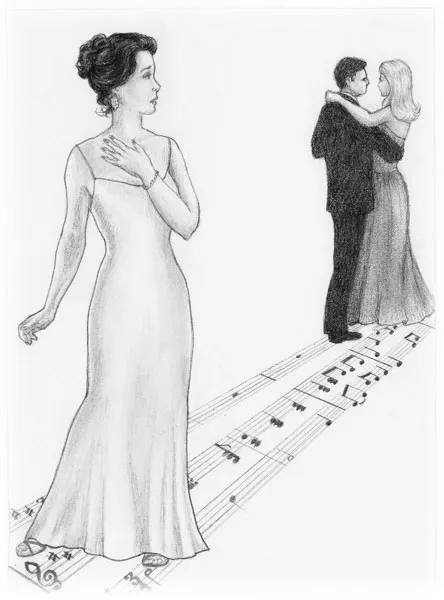
Yes, I lost my little darlin’ the night they were playing/The beautiful Tennessee Waltz
“THE TENNESSEE WALTZ”
Written by Pee Wee King and Redd Stewart
Recorded by Patti Page for Mercury and by many, many others
This song doesn’t have any profound lines—in fact, it has just one simple verse and chorus that are then repeated—but all the lines together tell a simple, intriguing story that, along with a beautiful melody, captures a snapshot of a long-ago time and place. When Pee Wee King wrote it in 1946 as an instrumental for his band, the Golden West Cowboys, it was “No Name Waltz.” Two years later, Redd Stewart and Pee Wee put words to it, and it became “Tennessee Waltz,” which they took to Fred Rose at Acuff-Rose Publishing. From 1948 to 1968, it was on the country charts by Pee Wee King (twice), Cowboy Copas, Roy Acuff and Lacy J. Dalton; in the R&B charts by Erskine Hawkins, Stick McGhee and Johnny Jones; and on the pop charts by Guy Lombardo, Les Paul & Mary Ford, Jo Stafford, Spike Jones, the Fontaine Sisters, Anita O’Day, Bobby Comstock, Jerry Fuller and Sam Cooke. But it was Patti Page, changing the title from “Tennessee Waltz” to “The Tennessee Waltz,” who brought the song such enduring and endearing fame. Patti’s version, featuring her singing harmony with herself, was both a country and pop hit, topping the pop charts for an incredible thirteen weeks and selling 6 million copies. It also became the Tennessee state song and the all-time biggest-selling song in Japan.
I take the chance / to lose my Soul, my life, my pride /I take the chance /To be with you
“I TAKE THE CHANCE”
Written by Charlie Louvin and Ira Louvin
Recorded by The Browns for RCA Victor
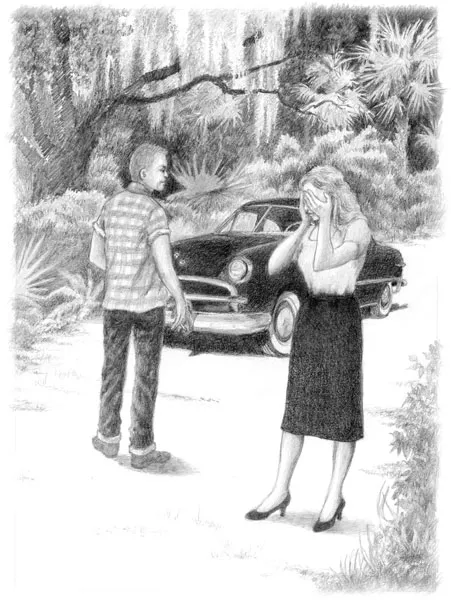
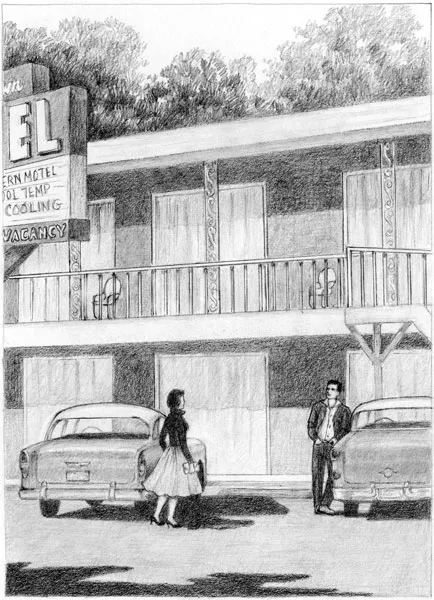
“I Take the Chance” was written by the Louvin Brothers, Ira and Charlie, the renowned duo whose sweet, perfect harmonies bridged the gap between country and bluegrass. It was recorded by The Browns—Jim Ed, Maxine and Bonnie—another great sibling act who would have their biggest record to date with this song and then, three years later, become world famous for their huge pop-country crossover hit “The Three Bells.” “I Take the Chance” was a staple of the country music diet: the cheatin’ song. Let’s use our imagination and go back to 1956, one day during lunch hour. Two cars are parked in front of a motel room on the edge of town. A pretty young woman in her early twenties, a secretary for a local attorney, emerges from a Chevrolet and walks toward a trim, handsome guy standing by his Oldsmobile, a building contractor a few years older than she is, from a larger city a few counties away. They had met when he hired her boss to represent him in a lawsuit a few months before. He’s married, she’s single. He tells her he loves her and hopes to marry her someday. He is the love of her life. Then imagine the characters several decades later. He’s recently widowed and lives in a nursing home and barely remembers his long-ago girlfriend. In fact, he barely remembers anything. And the long-ago girlfriend’s children, grandchildren and great-grandchildren would be shocked and appalled if they knew her secret. She gave up on the building contractor decades ago, married a nice man (now deceased), raised a family and now focuses on her church work and her hobby of making stuffed animals. But sometimes when she falls asleep at night, once again she’s a pretty young woman in a tight black sweater and green skirt with crinolines, walking into a motel room with a trim, handsome man wearing dark slacks and a windbreaker jacket. They took the chance—for a memory.
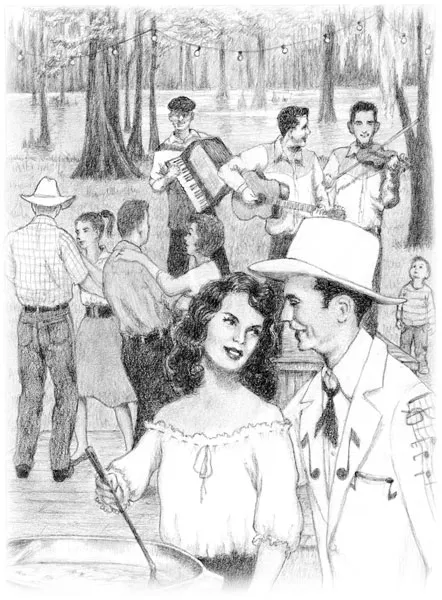
Jambalaya, Crawfish Pie, and Filé Gumbo
“JAMBALAYA (ON THE BAYOU)”
Written by Hank Williams
Recorded by Hank Williams for MGM
When Sony/ATV bought country music publishing giant Acuff-Rose in 2001, two of the greatest assets acquired were Acuff-Rose creative director Troy Tomlinson (who within three years would be heading up the entire Sony publishing organization in Nashville) and the catalog of legendary artist/writer Hank Williams. “Jambalaya,” which spent fourteen weeks at #1 on Billboard’s country charts in 1952—and made the Top 20 on Billboard’s pop charts—was one of the biggest hits of Hank’s career. “Jambalaya? Ma cher amio? Thibodaux? Fontaineaux?” Was Hank a world traveler who spent some time in France? No, he was exposed to Cajun French culture—and some of the language—just two states away from his native Alabama, in the swamps of southern Louisiana. This area was settled by French Canadians from the Acadian (hence “Cajun”) region in the late eighteenth century. Cajun music, featuring fiddles and accordions and often sung in the original tongue, became a major subgenre of country music. “My Yvonne, the sweetest one, me oh my oh / Son of a gun we’ll have big fun on the bayou.”
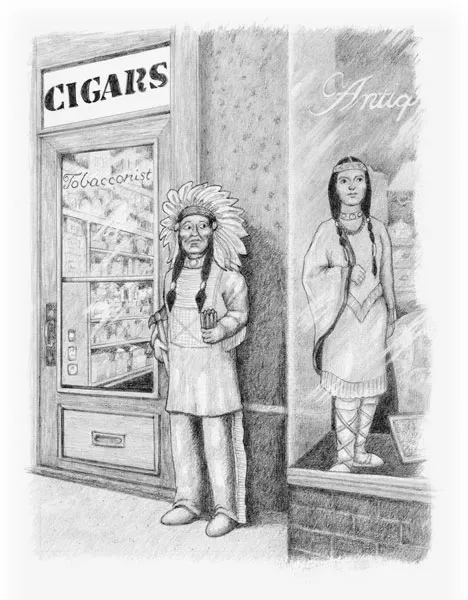
Kaw-Liga was a wooden Indian,/Standin’ by the door,/He fell in love with an Indian maiden,/Over in the antique store
“KAW-LIGA”
Written by Hank Williams and Fred Rose
Recorded by Hank Williams, by Charley Pride and by Hank Williams Jr.
Fred Rose came to Nashville from Evansville, Indiana, by way of St. Louis, Chicago, New York’s Tin Pan Alley and Hollywood. He and Grand Ole Opry star Roy Acuff founded Acuff-Rose Publishing Company in the early 1940s, and within a few years, their prize songwriter, Hank Williams, was the fastest-rising star in country music. Rose, with songs like “Blue Eyes Crying in the Rain,” was a great songwriter himself and often acted as Hank’s “song doctor,” adding a little polish to the country boy’s genius. So when Rose’s name actually appeared on the record as co-writer, like this one, you knew that the publisher’s contribution was major. “Kaw Liga” (named after a little community in Alabama where Hank owned a fishing cabin) was the only Hank Williams song that was pure fantasy and his only record with a fadeout. “Kaw Liga” spent thirteen weeks at #1; then it flipped over and “Your Cheatin’ Heart” was #1 for six weeks, making it a genuine two-sided hit and Hank’s biggest record ever. Unfortunately, Hank Williams died of a drug overdose on New Year’s Day 1953 and never lived to see the record’s success. “Kaw Liga” would also be recorded by Hank Williams Jr. (and by Charley Pride, making it the only hit about a Native American sung by an African American).
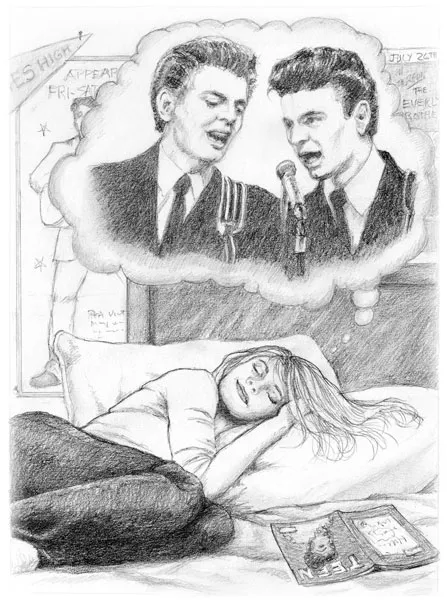
Only trouble is, gee whiz/I’m dreamin’ my life away
“ALL I HAVE TO DO IS DREAM”
Written by Boudeleaux Bryant
Recorded by the Everly Brothers for Fraternity
The greatness of this line is that “gee whiz” spoke the language of millions of American teenagers, even though it was written by a thirty-eight-year-old man, Boudeleaux Bryant. The Everly Brothers, hitmakers on both the pop and country charts, became the biggest duo of the early rock ’n’ roll era on the strength of songs that Boudeleaux Bryant wrote by himself (such as this one and “Bird Dog”) or co-wrote with his wife, Felice (like “Bye Bye Love” and “Wake Up Little Suzie”). They both wrote several solo hits for other artists, and together they wrote the country classic “Rocky Top.” Boudeleaux and Felice Bryant are in the Songwriters Hall of Fame, Nashville Songwriters Hall of Fame, Georgia Music Hall of Fame and the Country Music Hall of Fame.
Today I passed you on the street/And my heart fell at your feet
“I CAN’T HELP IT (IF I’M STILL IN LOVE WITH YOU)”
Written by Hank Williams
Recorded by Hank Williams for MGM
What could hurt more than walking down the street and passing your ex-girlfriend who’s oblivious to you as she gushes over the new love at her side? Like so many Hank Williams songs, the words to this one seem palpable, coming from his tortured soul to our ears. That is, until we get to the bridge of the song and realize that even Hank Williams, the greatest of them all, was not perfect and could come up with a clunker once in a b...
Table of contents
- Front Cover
- Title Page
- Copyright
- Dedication
- Contents
- Words
- Author’s Notes
- Illustrator’s Notes
- Chapter 1: 1940s and 1950s
- Chapter 2: 1960s
- Chapter 3: 1970s
- Chapter 4: 1980s
- Chapter 5: 1990s
- Chapter 6: Twenty-First Century
- Glossary of Songs by Chapter
- About the Author
- About the Illustrator
Trusted by 375,005 students
Access to over 1.5 million titles for a fair monthly price.
Study more efficiently using our study tools.
Frequently asked questions
Yes, you can cancel anytime from the Subscription tab in your account settings on the Perlego website. Your subscription will stay active until the end of your current billing period. Learn how to cancel your subscription
No, books cannot be downloaded as external files, such as PDFs, for use outside of Perlego. However, you can download books within the Perlego app for offline reading on mobile or tablet. Learn how to download books offline
Perlego offers two plans: Essential and Complete
- Essential is ideal for learners and professionals who enjoy exploring a wide range of subjects. Access the Essential Library with 800,000+ trusted titles and best-sellers across business, personal growth, and the humanities. Includes unlimited reading time and Standard Read Aloud voice.
- Complete: Perfect for advanced learners and researchers needing full, unrestricted access. Unlock 1.5M+ books across hundreds of subjects, including academic and specialized titles. The Complete Plan also includes advanced features like Premium Read Aloud and Research Assistant.
We are an online textbook subscription service, where you can get access to an entire online library for less than the price of a single book per month. With over 1.5 million books across 990+ topics, we’ve got you covered! Learn about our mission
Look out for the read-aloud symbol on your next book to see if you can listen to it. The read-aloud tool reads text aloud for you, highlighting the text as it is being read. You can pause it, speed it up and slow it down. Learn more about Read Aloud
Yes! You can use the Perlego app on both iOS and Android devices to read anytime, anywhere — even offline. Perfect for commutes or when you’re on the go.
Please note we cannot support devices running on iOS 13 and Android 7 or earlier. Learn more about using the app
Please note we cannot support devices running on iOS 13 and Android 7 or earlier. Learn more about using the app
Yes, you can access Country Music's Greatest Lines by Bobby Braddock,Carmen Beecher in PDF and/or ePUB format, as well as other popular books in Media & Performing Arts & North American History. We have over 1.5 million books available in our catalogue for you to explore.