- 281 pages
- English
- ePUB (mobile friendly)
- Available on iOS & Android
eBook - ePub
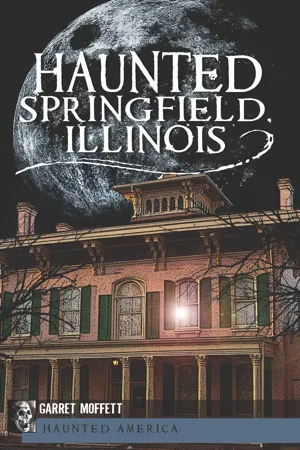
Haunted Springield, Illinois
About this book
Springfield has launched a lot of history, from the career of Abraham Lincoln to the wagon train that bore the Donner party to their fate. While taking this tour with Garret Moffett, you will come face to face with the history that has refused to leave. Meet the Gibson Girl who turned society circles into séances during her life and the vengeful actor who held down a leading role as mischief maker after death. And maybe you should pause before you shake the hand of a Civil War reenactor at Camp Butler, just to make sure that his skin isn't as gray as his coat.
Information
ABRAHAM LINCOLN AND HIS FAREWELL
Abraham Lincoln is said to have believed in the supernatural world. Accounts by Lincoln himself tell us about many strange visions and foreboding dreams that he had throughout his life, and one dream in particular may have predicted his death. Stories of Lincoln’s ghost posthumously wandering are known all over the world. His troubled soul is said to haunt the White House, his tomb site and even the very streets of Springfield. Local folklore claims that Lincoln walks the streets after midnight between the Old State Capitol and his Eighth Street home. There are two buildings that truly resonate with the spirit of Lincoln in the historic district—the Old State Capitol and his law office. However, the remaining law office site was Lincoln’s second and third law office; his first and last office sites no longer survive.
The day before he left for Washington, Lincoln went down to the office to tie up loose ends with his partner, William Herndon. Upon arrival, Lincoln looked up at the “Lincoln and Herndon” sign swinging from its rusty hinges and asked Herndon to leave it up. In a low voice, he said, “Give our clients to understand that the election of a president makes no change in the firm of Lincoln and Herndon.” The men went upstairs to conclude their business, and when finished, they descended the stairs to the street. Lincoln declared, “If I live, I’m coming back sometime, and we’ll go on practicing like nothing ever happened.” Lincoln explained that the sorrow at parting from his old friends was great and made greater by his irrepressible feeling that he would not come back alive.
“If I live.” Already, Lincoln was haunted by the notion that he might not return to Springfield alive. Tragically, his fears would prove all-too justified. Herndon was troubled by this statement. He tried to argue with Lincoln, but they were interrupted by well-wishers as they reached the street. Lincoln clasped Herndon’s hand warmly and disappeared down the street, never to return to his office again.
Lincoln’s fatalist view surfaced again in his famous farewell speech, delivered at the Great Western Railroad Depot. On that cold, rainy February morning before a crowd of well-wishers, Lincoln said, “Now I leave not knowing when, or if ever I may return.” Lincoln would return to Springfield and the Old State Capitol one more time, and that would be posthumously.
THE OLD STATE CAPITOL
The Old State Capitol building was important to Lincoln long before he made a big name for himself politically. He picked up his pay warrants in the state auditor’s office when serving in the Illinois legislature. He argued more than four hundred cases in front of the Illinois Supreme Court. And he could often be found long into the night, shooting the breeze with fellow attorneys or researching cases in the law library.
It was in this building that citizens of Springfield said farewell to Lincoln for the final time at the last of his twelve funerals. This funeral was especially poignant and heartbreaking. Lincoln wasn’t just their fallen president; he was also their friend and neighbor. He had carried their children through town on his shoulders and greeted them on the streets as he passed on his way to work. On May 3, 1865, the entire dome of the capitol was sheathed in black, but the columns below and the festoons along the cornices of the building were done in twisted spirals of black and white cloth. Nearly every public building and most of the businesses downtown were draped in black mourning accoutrements.
The doors to the Old State Capitol were opened shortly after 10:00 a.m., and an immense throng of people poured in. Springfield’s population at that time was 12,000 people, but an estimated 150,000 people had poured into town to pay their last respects. Only about 80,000 made it into the capitol. For twenty-four hours, they filed into the Old State Capitol, six abreast, braving the scorching hot day in their formal suits and dresses for the chance to take one final look at Lincoln’s face. Hardly anyone cried over the coffin—most were too shocked by what they saw—but when they reached the street, they broke down, leaning on one another for support. At 10:00 a.m. the next day, May 4, the doors to the Hall of Representatives were closed, and the undertaker reverently cleaned Lincoln’s face one last time before closing the casket. As veteran soldiers carried the casket out the front doors, a choir of 250 singers on the capitol steps burst into song, and twenty-one guns were fired. The casket was placed in an elaborate hearse, and the funeral procession set off for Oak Ridge Cemetery. Though his body was laid to rest, Lincoln’s spirit will not rest. His coffin was opened five more times to verify his remains and moved about seventeen times for his protection. In life, Lincoln did have happier days at his home in Springfield before the war, but is his hometown now haunted by his ghost?
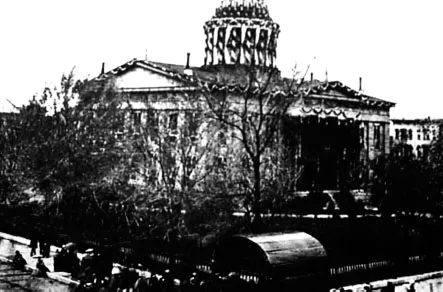
The State Capitol in mourning for Abraham Lincoln’s funeral in Springfield, Illinois, on May 3 and 4, 1865.
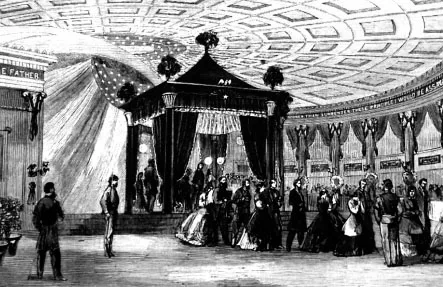
A Harper’s Weekly sketch of Lincoln’s funeral inside the Hall of Representatives of the Illinois State Capitol.
THE HOME OF THE LINCOLN FAMILY
One evening at dusk, a guided tour group was walking through the Lincoln neighborhood park. They had made their way toward the end of the street, past the Lincoln home, when the guide noticed five people lagging behind at the intersection in front of the house. The guide was about to call out for them to catch up when all five of them suddenly turned and stepped away from something at the same time. They seemed to be anxious about something, so the guide walked back to the group to see what was going on. He found them clearly unnerved; all five of them were convinced they had heard a horse and carriage coming up the street behind them. They claimed to hear the horse’s hooves hitting the muddy street, and even the jingle of the carriage was clear to them. It was so sudden and pronounced that they quickly turned to get out of its way and to have a look, but all they saw was an empty street. The phantom carriage has been encountered a few times by visitors to the neighborhood, but the pungent smell of phantom horses wafting through the neighborhood occurs with more frequency.
But is Lincoln’s home haunted? It is generally thought that the Lincoln home is not haunted by Lincoln. But there is suspicion that the home may be haunted by Mary and possibly the boys. There has been an apparition seen in the kitchen and parlor areas of the home. The ghostly figure is seen only for a moment, and it appears to be only about five feet tall. Mary was five feet, four inches tall, and the kitchen and parlor are two rooms where Mary would have spent a fair amount of time. The question becomes: why would Mary be haunting the home?
Perhaps not all hauntings occur out of an untimely or tragic death or unresolved issues on the part of the deceased. Perhaps some hauntings occur out of a bond or love for a place. When Mary lived in this home, it was the best and happiest time of her life. Mary was very popular here in Springfield; she threw fantastic dinner parties that were well attended, and her husband was a rising political star. Though an almost four-year-old Eddie Lincoln died in this home in 1850, Tad and Willie were born and raised here, also making for cherished memories. From the very first day Mary arrived in the White House to the very last day of her life, her life was nothing more than a downhill spiral into despair. It would make sense that Mary’s spirit would linger in her Springfield home, where she was happiest.
Staff members before the National Park Service was involved in the upkeep of the home occasionally spoke of the phantom pitter-patter of children’s feet running up and down the upstairs hall accompanied by childlike giggles. On one occasion, a staff member opening up the house one morning believed he briefly saw a child’s hands holding on to the upstairs railing. The rocking chair in the living room area was said to rock on its own—and it did, right before the eyes of visitors! However, the gentleman caught tugging on a fishing line tied to the chair no longer works at the home.
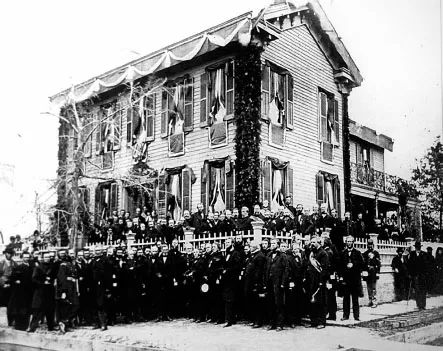
The Lincoln home draped in funeral bunting for the funeral of Abraham Lincoln, May 3, 1865.
Lincoln was fascinated by his dreams and spent time trying to decipher and interpret them. Lincoln was very much a deep thinker and sought knowledge and wisdom even beyond his dreams and visions. Since boyhood, the young farm boy sensed there was a greater task for him, a divine providence that he was destined to do something great. Lincoln also believed God was trying to send him messages through his visions and dreams, so he spent considerable time discussing them with family and friends, seeking the hidden knowledge from God. One of his most disturbing dreams occurred in the Lincoln home on election night.
On the night Lincoln learned he won the election for the presidency of the United States, Springfield celebrated big time. Fireworks and cannon fire celebrations went on late into the night. It wasn’t until the early hours of the morning that a tired and exhausted president-elect broke from the celebrations and retired to his home. When he made it home, he went to his bedroom and laid back on a couch. He could see a little round mirror sitting atop a bureau across the room and suddenly saw a strange vision in the mirror. Not sure what he was seeing, Lincoln no doubt tried to logically explain it away. He may have said something like, “Oh, my eyes are playing tricks on me. I’m exhausted, it’s late and it’s been an excitable day.” But moments later, Lincoln looked back into the mirror. The vision reappeared, and this time it was quite clear what he was seeing. He could clearly see a silhouette image of two faces—his face, in fact—opposing each other nose to nose. But what struck Lincoln as odd was that one of the faces seemed to have a healthy skin color while the other one was pale and quite gray, like the color of death. Again, Lincoln tried to dismiss this very odd occurrence, and perhaps it was some time before he could doze off to sleep.
The next day, he told Mary about this bizarre vision, and she believed she knew what the image meant. She believed that the two faces represented Lincoln being elected to a first and second term as president. But the pale and gray image meant he would not survive his second term. This dark omen would haunt Lincoln throughout his entire presidency.
But Lincoln was not the only one in the Lincoln saga with precognitive abilities. Perhaps his fate was written well before his presidency.
In 1838, John Wilkes Booth was only six months old when his mother wrote a poem titled “The Mother’s Vision” in response to a recurring dream. It foreshadowed her son’s fate:
Tiny, innocent white baby hand,
What force, what power is at your command,
For evil, or good? Be slow or be sure,
Firm to resist, too pure to endure—
My God, let me see what this hand shall do
In the silent years we are attending to;
In my hungering Love, I implore to know on this ghostly night
Whether ’twill labour for wrong, or right,
For—or against Thee?
SPIRITUALISM, THE LINCOLNS AND THE WHITE HOUSE
Throughout the 1850s and 1860s, Spiritualism emerged for the first time and was the new rage across the United States. It was well practiced by the social elite of Washington. By the 1860s, over two million people were practicing Spiritualism across the country, using psychics and mediums to contact the dead and to gain insight into the future.
Once settled in the White House, Mary was introduced to Cranston Laurie, a well-known Georgetown medium of the day, and she quickly embraced the spiritualist movement, attending a great number of séances in Washington and subsequently hosting at least eight known séances in the Red Room of the White House. (I dare say, she likely held more.) Lincoln attended two of those séances.
There is some evidence to suggest that Lincoln developed an interest in Spiritualism and the séances that had become social events across the nation. After all, it appears that Lincoln himself may have had a genuine gift of sight. In 1862, a trance medium named Nettie Coburn sat in the Red Room of the White House waiting for President Lincoln to enter. Mrs. Lincoln insisted that her husband bear witness to Nettie’s most unusual gift. Granted, there were plenty of charlatans about using parlor tricks to take advantage of the Lincolns, but Miss Nettie’s ability was impressive, and she had a solid reputation amongst the Washington elite.
When Miss Nettie came out of her trance, she found herself standing before Lincoln, who was sitting back in a chair with his arms folded. Several others in attendance were speechless. Miss Nettie, who had no recollection of what she said during her trances, was told she had been talking about the Emancipation Proclamation, which was not yet public knowledge. She seemed to know details that were known only to Lincoln and his cabinet members at best, and even if some of the information had leaked to the public, how could she know the fine details of the Emancipation? It just did not seem plausible to the president. She further informed the president that he must not abate the issue or delay its enforcement. She declared that it would be the crowning achievement of his life. Although much of Lincoln’s cabinet was against the Emancipation, Miss Nettie nobly stated that Lincoln should “stand firm to his convictions and fearlessly perform the work and fulfill the mission for which he had been raised up by an overruling Providence.”
Lincoln responded, “My child, you possess a very singular gift; but that it is of God no doubt. I thank you for coming here tonight. It is more important than any one present can understand.”
During his White House years, Lincoln had numerous meetings with Miss Nettie to gain insight into matters at hand. She once advised the president to restore troop morale by visiting soldiers on the battlefront while avoiding the officers. In one of her trances, she even drew a battle plan on a map—a plan that was known only to Lincoln—and thus gave him confidence that he had devised a winning strategy. She helped Mary contact her deceased children, Eddie and Willie. And in the final meeting between Lincoln and Miss Nettie in April 1865, she even warned the president of the impending danger that was just days away.
Though Lincoln died in April 1865, Mary Lincoln would continue to practice spiritualism and consult mediums for years until her death.
In 1862, eleven-year-old Willie Lincoln had passed away at the White House. This death was very hard on the Lincolns, as Willie had become their favorite child. Mary’s bereavement was so out of control that she was told if she could not collect herself, she would have to be sent to an asylum. She made claims that the ghostly apparition of Willie Lincoln appeared at the foot of her bed each night for several weeks and that some nights he would bring sweet Eddie, with his boyish smile, providing her comfort that her boys had crossed over into the light and were okay. Perhaps this is how Mary finally worked through her grief.
But Lincoln didn’t fare much better. The grief-stricken president locked himself in his cabinet room for several days. When one of Lincoln’s secretaries, Salmon Chase, came in to check on him, he found a melancholy Lincoln sitting behind a desk piled high with toys Willie had once played with. Lincoln said to Chase, “Do you ever find yourself talking with the dead? Ever since Willie’s death, I catch myself involuntarily talking to him, as if he were here with me, and I feel that he is.” Perhaps Lincoln wasn’t seeing Willie’s ghostly apparition; perhaps he was feeling the presence of his son. It’s also thought that because Lincoln refused to let go of Willie’s spirit, the boy’s spirit lingered on in the White House.
Whereas stories about Lincoln’s ghost in the Springfield home are virtually nonexistent, stories about Lincoln’s ghost in the White House are common. White House staff, presidents, first ladies and even visiting dignitaries all have spoken of bizarre encounters in or near the Lincoln Bedroom, such as unexplained rapping on walls and doors around the room, shadowy figures and a presence believed to be Lincoln...
Table of contents
- Front Cover
- Half Title
- Title Page
- Copyright
- Dedication
- Contents
- Acknowledgements
- Lincoln’s New Salem
- Abraham Lincoln and His Farewell
- The Fateful Donner Party
- Springfield’s Dr. Frankenstein
- The Civil War and Camp Butler
- The Gibson Girl Haunting of Lawrence House
- The Inn at 835
- The Split-House Haunting
- The Ghostly Edwards Place
- The Virgil Hickox House and Norb Andy’s
- The Old Hutchinson Cemetery and Springfield High School
- The Ghost of Rudy
- Sinister Joe Neville
- Springfield’s Haunted Castle
- About the Author
Trusted by 375,005 students
Access to over 1.5 million titles for a fair monthly price.
Study more efficiently using our study tools.
Frequently asked questions
Yes, you can cancel anytime from the Subscription tab in your account settings on the Perlego website. Your subscription will stay active until the end of your current billing period. Learn how to cancel your subscription
No, books cannot be downloaded as external files, such as PDFs, for use outside of Perlego. However, you can download books within the Perlego app for offline reading on mobile or tablet. Learn how to download books offline
Perlego offers two plans: Essential and Complete
- Essential is ideal for learners and professionals who enjoy exploring a wide range of subjects. Access the Essential Library with 800,000+ trusted titles and best-sellers across business, personal growth, and the humanities. Includes unlimited reading time and Standard Read Aloud voice.
- Complete: Perfect for advanced learners and researchers needing full, unrestricted access. Unlock 1.5M+ books across hundreds of subjects, including academic and specialized titles. The Complete Plan also includes advanced features like Premium Read Aloud and Research Assistant.
We are an online textbook subscription service, where you can get access to an entire online library for less than the price of a single book per month. With over 1.5 million books across 990+ topics, we’ve got you covered! Learn about our mission
Look out for the read-aloud symbol on your next book to see if you can listen to it. The read-aloud tool reads text aloud for you, highlighting the text as it is being read. You can pause it, speed it up and slow it down. Learn more about Read Aloud
Yes! You can use the Perlego app on both iOS and Android devices to read anytime, anywhere — even offline. Perfect for commutes or when you’re on the go.
Please note we cannot support devices running on iOS 13 and Android 7 or earlier. Learn more about using the app
Please note we cannot support devices running on iOS 13 and Android 7 or earlier. Learn more about using the app
Yes, you can access Haunted Springield, Illinois by Garret Moffett in PDF and/or ePUB format, as well as other popular books in History & North American History. We have over 1.5 million books available in our catalogue for you to explore.