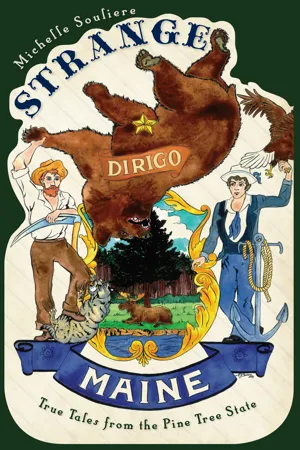
- 163 pages
- English
- ePUB (mobile friendly)
- Available on iOS & Android
eBook - ePub
About this book
Maine is well known as a land of fresh air and clean water, as the home of L.L. Bean and as one of the most popular camping and outdoor recreation destinations in the country. But what lies behind this idyllic facade? Unmapped roads. Whispering rocks. Deadening fog. Ghost pirates. Lonely islands. THINGS in the woods. This is the great state of Maine, home of Stephen King, land of the Great Northern Woods and all the mystery that lies within their dark footprint. What better setting than this for tales of strange creatures, murderers, madmen and eccentric hermits? From the "Headless Halloween of 1940" to the mystery of who lies in the grave of V.P. Coolidge; from Bigfoot sightings to the "witch's grave" in a Portland cemetery, writer and illustrator Michelle Souliere brings to life these strange-but-true tales from the Pine Tree State.
Information
Topic
HistoriaSubtopic
Historia de NorteaméricaChapter 1
The Witch’s Grave and Other
Marked Monuments
Like any other state, a fair share of Maine’s accepted history is memorialized in the continued presence of its monuments. From the stiff to the sublime, from the ancient to the modern, these reminders of Maine moments and people passed on are scattered all over the state. Some, though, seem to generate a history of their own beyond the events mentioned on their commemorative plaques. This chapter tours some lesser-known Maine graves in search of a few examples of this longstanding memorial architecture and the culture of personality it was made to commemorate and continues to create.
The first original research article I undertook for publication in the Strange Maine Gazette was about the history of a Portland monument. It was a devilish project, one full of false leads, obscure scrawlings and ruined graves—just what I was looking for, in other words.
THE MYSTERY OF THE WITCH’S GRAVE
One of the many urban legends of Maine that I have dug up is from my own town, Portland. The city houses a handful of large cemeteries in various states of repair. The oldest and smallest are the Eastern and Western Cemeteries, located on the east end and west end of Portland, respectively. Like many urban graveyards, they have suffered the same ravages as the city that surrounds them.
Eastern Cemetery is Portland’s oldest burying ground. It was founded in 1668 on land at the base of Munjoy Hill overlooking Portland Harbor and was eventually closed to further burials in 1858 when it became evident that there was no more room for additions to its plots, according to the nonprofit group Spirits Alive.
Until a recent revitalization, it was weed-filled and kept under lock and key because so many vandals had made off with the old slate headstones, rudely breaking off the eerie hand-carved skull and crossbones artwork to take back to their apartments as the ultimate in “cool” home decoration accessories. Spirits Alive, founded by Christina White in 2006, has spearheaded efforts between local citizens and the City of Portland, which owns the site, to encourage public involvement in the upkeep and renewal of the grounds—with great success, too. Spirits Alive has done a terrific job in making the cemetery more visible and has established a great assortment of educational programs, such as a lively lecture series, walking tours of the cemetery highlighting its many prominent and intriguing past Portlanders and an annual “Walk Among the Shadows” tour during Halloween season (started in 2008), during which volunteer actors create a deliciously eerie mood in the graveyard and bring back to life the history of its inhabitants.
However, we must turn our gaze to the other side of the city peninsula, where the Western Cemetery makes its home overlooking the Fore River Basin. Portland’s second-oldest cemetery came under the city’s control in 1829, and it remained active until 1910. Its history is fragmented due to the loss of many records in the Great Fire of 1866, including a drawn plan of the cemetery plots, as noted by Karen Batignani. The mysteries left in Western Cemetery by the fire’s wake are enough to fill a book all on their own.
In recent years, Western Cemetery became a popular place for Portland dog owners to bring their pets for exercise outdoors. In 2001, this activity became the focus of a campaign to ban dogs from the graveyard. Epithets were hurled during the heated debate, including the abject labeling of Portland as the “Desecration Capitol of the World.” The pet owners’ unleashed canines were finally barred from Western Cemetery by a city vote, and today their antics have been relocated to a previously vacant lot behind the St. John Street neighborhood.
In 2003, the Western Cemetery Restoration Project was launched by Greater Portland Graves, and the mausoleums along the back slope of the grounds were repaired. The project was extensively documented tomb by tomb with before-and-after photos, which are available at the group’s website.
Today, despite these good intentions and improvements, the cemetery still looks neglected. When I visited, large forty-ounce beer bottles were smashed across the tombstones, a vagrant was perched on a nearby mausoleum roof drinking his brown-bagged alcohol in broad daylight and the graveyard was a jumble of broken glass and shattered headstones, with a distinct air of desolation and abandonment.
In among the more staid gravestones of slate and limestone, there is one that stands out. Not only is it an impressive grave—even lacking the top spar that originally formed a full stone cross at its head—but it is also the subject of rampant rumor among various youths and adults of the area who are intrigued by the odd and wondrous. What do they say?
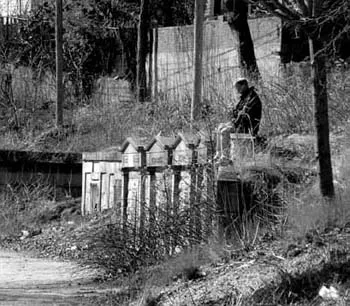
An anonymous man perches atop the Western Cemetery mausoleums with a forty-ounce bottle of beer on a sunny March afternoon.
Some of them say it is a witch’s grave and others, a vampire’s. A friend of mine who moved to Portland in her early adulthood during the 1980s told me that one of the first local legends she heard was about this grave. Friends told her the rumor that if a person stood on the grave at midnight during a full moon the soul would be sucked out of their body. More reasonable explorers of the truth point out that the prominent cross that mounts the sarcophagus and the use of the word “diaconus” in the Latin inscriptions that wreath the stone indicate that the man buried there is a deacon and not a diabolical being.
The speculations could only have been encouraged by the elaborateness of the grave. It is crowned by what must have been a cross at one point, though it had been whittled down to a “T” shape at the time of my visit and now lies completely dismantled, with another piece missing as well. The grave is decorated here and there by carved Celtic knot work on its rough-hewn russet stone and stands out amid the rubble of broken limestone grave markers in its iron fenced plot.
The standing cross is mounted on a decorative base covered with a peculiar raised pattern that looks like a strange cellular structure. Latin scripts in an ornate typeface (which may explain some of the errors in epitaph transcription) are found circling this base, which extends from under the cross to form the frame of a bevel-topped sarcophagus. Of the cross that was carved on the sarcophagus’s surface, only the bottom part remains. The raised pattern and the exquisite Latin text have drastically deteriorated—whether this is because of vandals, or simply because of weather and age, it is hard to tell.
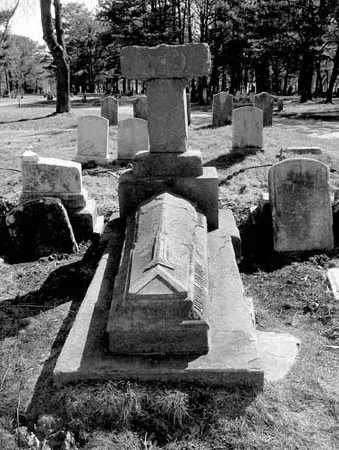
The grave of Reverend John W.C. Baker, with its intriguing sarcophagus design.
Intrigued by the stories and mystified by the craftsmanship lavished on the monument itself, I set out to find out what the truth of the matter was. Initially, this led me to many dead ends.
This grave is incorrectly attributed to “W.A. Baker” in Virginia Greene’s handwritten manuscript from 1938 that transcribes the cemetery’s population stone by stone, held at the Maine Historical Society. This erroneous moniker is repeated in William B. Jordan Jr.’s book, Burial Records 1811–1980 of the Western Cemetery in Portland Maine. Add also to these decades of error and omission the fact that Greene’s transcriptions of the grave’s epitaphs are sketchy at best—hard to read, often wrong and with substantial segments of the text left out.
There was no death certificate on file in the Portland Public Library’s Vital Records archive for a matching Baker, nor in the Maine Historical Society’s collection of obituaries.
In fact, upon closer inspection of newspaper notices of the time, it is revealed that the grave is that of Reverend John W.C. Baker—an entirely different first name and second (now third) initial from the given records to which everyone refers as a matter of course.
After consulting with the local Episcopal archivist, Elizabeth Maule, I discovered that his full name was Reverend John White Chickering Baker and that he perished of consumption (the romantic Victorian term for the wasting disease of tuberculosis). When he died in 1871, he was only thirty-three.
The reason I couldn’t find any death certificate for him in the Maine vital records was because he died overseas, in England. The Eastern Argus of February 27, 1871, contains an article describing the melancholy occasion:
The last sad rites were performed over the remains of the late Rev. John W.C. Baker, son of E.W. Baker of this city, at St. Luke’s Cathedral Saturday afternoon…The remains which were brought from England by the steamer of last week were encased in a gable top casket of English oak wood, upon the top was a red cross running nearly the entire length…The service performed, the remains were borne out by the vestrymen, the clergy acting as pall bearers, and accompanied to the cemetery. At the grave the choir chanted, “I heard a voice from heaven.”
From the remains of the monument visible today, one can see that the theme of design used in the coffin was continued on its stone housing.
The Latin inscriptions on the stone are still present, although some are almost completely obliterated by substantial weathering. The closest I can come to an accurate transcription is this hackneyed text, cobbled together from Greene’s documentation and my own visit to the site, paired with my very imperfect grasp of Latin:
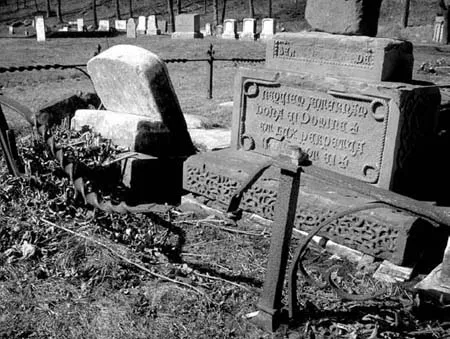
The deteriorating epitaph on Reverend Baker’s grave.
Requiem AeternamDona ei DomineEt lux perpetuaLuceat ei.Via crucis—Via lucisO vos [next word is illegible]Orame pro Anima JohannisW.C. BakerDiaconi qui namusOct 13, 1837–Feb 1, 1871Rest EternalGive oh LordAnd light everlastingShine.Way of the cross—Way of lightOh you […]Pray for the soul of JohnW.C. BakerDeacon who is namedOct 13, 1837–Feb 1, 1871
The grave remains a romantic, gothic monument to a bygone day and the tragic death of a young man of the cloth, far from home and long before his time was due.
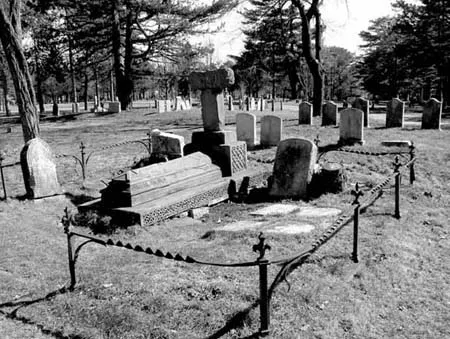
The Baker family plot, Western Cemetery, Portland.
The rumors will no doubt continue to circulate about the dead man’s mythical character, if simply because his ruddy sandstone monument intriguingly stands out—tall and strong, even if broken, and ornate among the mostly plain and sober white and gray stones of the rest of the cemetery’s populace.
People will linger in its shadow, leaving pennies and other offerings at the base of the stone, and the young deacon will find his final resting place kept company many a night by living souls, unable to stay away because they are curious about him.
THE WELL-GUARDED LIBBEY MAUSOLEUM
It’s not uncommon for me to collect new and interesting stories from frien...
Table of contents
- Cover
- Title
- Copyright
- Dedication
- Epigraph
- Contents
- Preface
- Acknowledgements
- Introduction: Strange Maine?
- CHAPTER 1. THE WITCH’S GRAVE AND OTHER MARKED MONUMENTS
- CHAPTER 2. CRIME ON THE COAST AND ELSEWHERE
- CHAPTER 3. PLACES THAT GO BUMP IN THE NIGHT
- CHAPTER 4. WHAT MONSTERS ROAM IN THE MAINE WOODS?
- CHAPTER 5. ODDITIES AND EPHEMERA
- Afterword
- Bibliography
- About the Author
Trusted by 375,005 students
Access to over 1.5 million titles for a fair monthly price.
Study more efficiently using our study tools.
Frequently asked questions
Yes, you can cancel anytime from the Subscription tab in your account settings on the Perlego website. Your subscription will stay active until the end of your current billing period. Learn how to cancel your subscription
No, books cannot be downloaded as external files, such as PDFs, for use outside of Perlego. However, you can download books within the Perlego app for offline reading on mobile or tablet. Learn how to download books offline
Perlego offers two plans: Essential and Complete
- Essential is ideal for learners and professionals who enjoy exploring a wide range of subjects. Access the Essential Library with 800,000+ trusted titles and best-sellers across business, personal growth, and the humanities. Includes unlimited reading time and Standard Read Aloud voice.
- Complete: Perfect for advanced learners and researchers needing full, unrestricted access. Unlock 1.5M+ books across hundreds of subjects, including academic and specialized titles. The Complete Plan also includes advanced features like Premium Read Aloud and Research Assistant.
We are an online textbook subscription service, where you can get access to an entire online library for less than the price of a single book per month. With over 1.5 million books across 990+ topics, we’ve got you covered! Learn about our mission
Look out for the read-aloud symbol on your next book to see if you can listen to it. The read-aloud tool reads text aloud for you, highlighting the text as it is being read. You can pause it, speed it up and slow it down. Learn more about Read Aloud
Yes! You can use the Perlego app on both iOS and Android devices to read anytime, anywhere — even offline. Perfect for commutes or when you’re on the go.
Please note we cannot support devices running on iOS 13 and Android 7 or earlier. Learn more about using the app
Please note we cannot support devices running on iOS 13 and Android 7 or earlier. Learn more about using the app
Yes, you can access Strange Maine by Michelle Y. Souliere in PDF and/or ePUB format, as well as other popular books in Historia & Historia de Norteamérica. We have over 1.5 million books available in our catalogue for you to explore.