A look at the lesser-known heroics of Kentucky soldiers, from the French and Indian War to World War II.
Daniel Boone is celebrated as a Kentucky frontiersman, but what about his service in the French and Indian War? Custer's Last Stand in the Great Sioux War is legendary, but few remember Custer's "next-to-last-stand" in Elizabethtown, where he was sent to suppress the Ku Klux Klan and hunt down moonshiners just before heading to the Montana Territory and into history. Join Kentucky historian Berry Craig as he unearths the forgotten heroics of Kentucky soldiers, beginning with the French and Indian War and ending with World War II. Featuring tales of warriors from a diverse range of backgrounds, Hidden History of Kentucky Soldiers honors generations of Kentuckians who put their lives on the line for their country.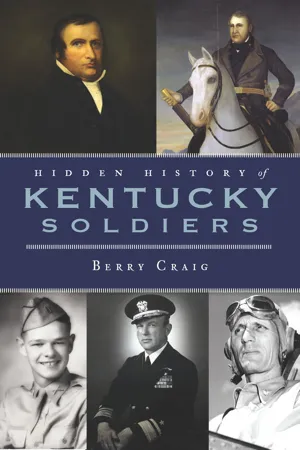
- 99 pages
- English
- ePUB (mobile friendly)
- Available on iOS & Android
eBook - ePub
Hidden History of Kentucky Soldiers
About this book
Information
CHAPTER 1
THE FRENCH AND INDIAN WAR AND THE AMERICAN REVOLUTION
“IT WAS NO MERE FROLICSOME PASTIME TO THE DRIVERS”
Strictly speaking, Daniel Boone was not a soldier when he received his baptism of fire in the French and Indian War.
“He was a British army contract employee, sort of like a Halliburton employee today,” said James Tomasek, a ranger at Fort Necessity National Battlefield, near Farmington, Pennsylvania.
A twenty-year-old wagon driver, Boone barely escaped with his life in the one-sided backwoods battle of July 9, 1755, that went down in history as Braddock’s Defeat. General Edward M. Braddock commanded a 2,400-man column of British regulars and Virginia and North Carolina militia that was nearly wiped out by a smaller force of French and French Canadian soldiers and Native Americans at what is now Braddock and North Braddock, Pennsylvania. The adjacent communities are near Pittsburgh, the site of French-held Fort Duquesne, Braddock’s objective.
The general was mortally wounded in what was also called the Battle of the Monongahela. Approximately 900 of his 1,400 soldiers engaged were listed as killed or wounded. Enemy casualties were reportedly fewer than 100.
Boone was a Pennsylvania native. But he was living with his family in the Yadkin Valley of North Carolina when he signed up for army service. He might have been seeking adventure or, at least, relief from farming, which he found tedious.
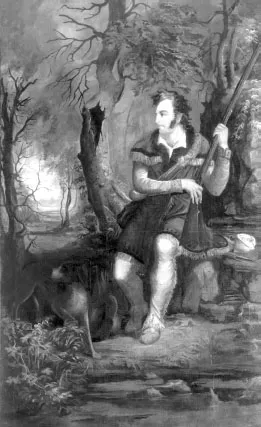
Daniel Boone. Courtesy of the Kentucky Historical Society.
“Boone accompanied the one hundred North Carolina troops under Captain Waddell, not as a soldier, but as a wagoner, conveying the baggage of the company,” according to The Life of Daniel Boone, a book written by Lyman C. Draper and edited by Ted Franklin Belue. Boone’s job was hardly glamorous, the book says: “It was no mere frolicsome pastime to the drivers. Their most unwearied care and patience were requisite in conducting the heavily laden baggage-wagons over hills and mountain, through streams, ravines, and quagmires.”
Braddock expected to capture stonewalled, star-shaped, cannon-bristling Fort Duquesne, where the Allegheny and Monongahela Rivers converge to form the Ohio—downtown Pittsburgh today. Braddock’s volunteer aide was another future famous American: Lieutenant Colonel George Washington of the Virginia militia.
From Cumberland, Maryland, Braddock’s column crept northwestward. To accommodate his wheeled artillery, Braddock’s engineers widened a narrow road Washington had built to Fort Necessity in 1754.
The French attacked Washington and forced him to surrender the tiny, log-walled backwoods bastion in a clearing called the Great Meadows. He gave up, coincidentally, on July 4, 1754. The French burned Fort Necessity and returned to Fort Duquesne.
Beyond Fort Necessity, Braddock blazed his own road through the dense forests and occasional clearings. To speed up the advance, he divided the column. Braddock headed the lead group of about 1,400 men, which included Boone. The rest trailed several miles behind.
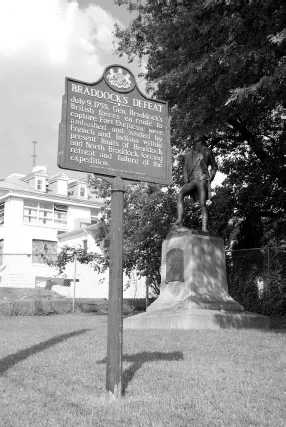
Washington statue, Braddock, Pennsylvania. Courtesy of the author.
The terrain forced Braddock to ford the Monongahela River twice. Shortly after the second crossing—about eight miles from Fort Duquesne—between three hundred and nine hundred French troops and Indian warriors collided with the forward British column. A small memorial park at the battle site in Braddock features a bronze statue of George Washington.
Repulsed, the French and Native Americans dashed into the woods and turned the tide. Hiding behind rocks and trees, they made short work of the redcoats, who stood up and fought European style. About 450 of Braddock’s men were killed, and a like number were wounded.
After Braddock fell, the British regulars panicked, and the battle became a rout. Washington and the Virginia and North Carolina militia took cover and returned fire. But they, too, were forced to withdraw with the enemy in pursuit.
Meanwhile, Boone and the other wagoners waited anxiously in the rear. Ordered not to retreat when shooting started, the wagon drivers “watched the regulars flee by them,” Michael A. Lofaro wrote in The Life and Adventures of Daniel Boone.
Boone was about a half-mile from where the battle started, according to Daniel Boone: The Life and Legend of an American Pioneer, by John Mack Faragher. “Officers hastened their companies forward, leaving a guard for the wagons. As they rushed against the stalled front, the entire army crushed together like an accordion. Chaos soon prevailed amid the rain of fire. In the rear, snipers began to take their toll.”
Boone and the teamsters were ordered to stay put and hold their horses at the ready for advancing to the front.
Faragher wrote:
But with balls whistling past their heads, many of them cut their horses from the wagons and galloped away during the first minutes of the battle…According to Boone, he remained. Nowhere could the enemy be seen, only the bursts of their rifle fire amid the trees and the men dropping “like Leaves in Autumn,” as one British officer later remembered.
The battle lasted for almost three hours, Faragher explained. Many of the colonial troops killed or wounded were likely shot by redcoats who thought they were Indians hiding in the forest.
A higher proportion of the officers fell. Washington had two horses killed under him, and though balls tore through his uniform, he somehow emerged without a wound. In the rear, two officers, father and son, were shot dead while Boone held his team. Braddock attempted to organize a retreat, but the wagons now blocked passage to the rear…The Indian cries and the sight of the troops rushing past, death on their faces, finally unnerved Boone. He jumped onto his lead horse, slashed its harness free, and galloped hard for the river.
According to Faragher, the Boone family long lamented the Battle of the Monongahela in a sad ballad:
Until he saw all attempts were in vain,
From sighs and tears he could scarcely refrain.
Poor Brittons, poor Brittons, poor Brittons remember,
Although we fought hard, we were forced to surrender.
Boone was especially lucky to evade capture, according to Lofaro. He added that Indians tortured to death a dozen redcoat captives.
Likewise, Faragher wrote that
Canadians and Indians quickly overran the wagons, but they did not pursue the fleeing men across the ford, for they turned to plundering the rations of rum and other supplies, scalping the dead and rounding up the wounded, who were led back to the fort to be tortured and burned at the stake. The Battle of the Monongahela, Boone’s initiation into forest warfare, was one of the bloodiest and most disastrous British defeats of the eighteenth century.
Boone evidently left the battle scene on foot and headed east to visit relatives in Exeter, Pennsylvania, his birthplace, Faragher wrote. Death almost caught up with him at a bridge over the Juniata River Gorge.
“He suddenly was confronted by a big, half-drunk Indian man standing in the center of the bridge,” Faragher wrote. “‘He drew knife on me,’ old Boone remembered, ‘flourishing it over his head, boasting that he had killed many a Long Knife, and would kill some more on his way home.’”
Boone was unarmed, evidently having lost his weapons when he fled the slaughter on the Monongahela. When the Native American lurched at Boone, he ran toward his assailant. “Using his low center of gravity to advantage, he drove his shoulder hard under the big man’s ribs, lifting him off his feet, throwing him back and off the side of the bridge. He plunged forty feet to the jagged rocks below,” according to Faragher.
The author said Boone was elderly when he told the story of killing the Indian to the sons of one of his longtime friends. He said the man was the first of only three Indians he ever killed, Faragher added.
To Boone, slaying a fellow human being was “nothing to crow about, certainly nothing he could repeat to his Quaker kin in Exeter, and there is no record of Boone ever telling this story to the members of his own family,” Faragher explained. “‘Boone had very little of the war spirit,’ one contemporary wrote. ‘He never liked to take life and always avoided it when he could.’ It was an aspect of his character that the Indian haters never could understand.”
After a while, Boone returned to his family in the Yadkin Valley. “The experience he acquired in Indian warfare was not lost upon him,” Draper wrote. “He gained too on Braddock’s campaign some glimpses of the inviting loneliness of the fertile glades of the Upper Ohio Valley.”
Boone’s experience included a fateful meeting with John Findley, another wagoner. Findley was an experienced frontiersman who had roamed across the Appalachians.
He thrilled Boone with tales of the Great Meadow, a true land of milk and honey he said was beyond the mountains. It was the Bluegrass region of Kentucky, which the ever-wandering Boone, accompanied by Findley, would see for himself in 1769.
THE TEENAGE HEROINE OF FORT JEFFERSON
History barely records the story of Nancy Ann Hunter, teenage heroine of old Fort Jefferson, the site of which is next to the Mississippi River near Wickliffe, the Ballard County seat.
Kentucky historians Temple Bodley and Samuel M. Wilson suggested that had the youth lived in New England, with its plentiful printing presses and book publishers, “Nancy Ann Hunter would be celebrated in history, romance and song, and known to every school girl in the land.”
While Chickasaw warriors besieged Fort Jefferson during the Revolutionary War, Hunter, fifteen, reputedly braved a gauntlet of Indian gunfire to retrieve a cow and a calf. “In the fort were many infants, likely to die for want of nourishment,” Bodley and Wilson claimed in their 1928 History of Kentucky. “Bringing that cow into the fort meant the saving of young lives.”
Not a trace remains of Fort Jefferson, a one-hundred-square-foot strongpoint with log walls that General George Rogers Clark built just below the confluence of the Ohio and Mississippi Rivers in 1780. A pair of state historical society markers on U.S. Highway 51 at the entrance to the Fort Jefferson Cross, a ninety-foot crucifix, tells about the fort.
The signs do not mention Hunter. Little else is known of the young woman. But she was among about five hundred pioneers and soldiers who defended or took refuge in the fort named for Thomas Jefferson and constructed while Kentucky was the westernmost part of Virginia.
Fort Jef...
Table of contents
- Front Cover
- Half Title
- Title Page
- Copyright
- Dedication
- Contents
- 1. The French and Indian War and the American Revolution
- 2. The War of 1812
- 3. The Texas Revolution and the Mexican-American War
- 4. Fenians and Custer’s “Next-to-Last Stand” and Last Stand
- 5. To the Spanish-American War
- 6. World War I
- 7. World War II
- Bibliography
- About the Author
Trusted by 375,005 students
Access to over 1.5 million titles for a fair monthly price.
Study more efficiently using our study tools.
Frequently asked questions
Yes, you can cancel anytime from the Subscription tab in your account settings on the Perlego website. Your subscription will stay active until the end of your current billing period. Learn how to cancel your subscription
No, books cannot be downloaded as external files, such as PDFs, for use outside of Perlego. However, you can download books within the Perlego app for offline reading on mobile or tablet. Learn how to download books offline
Perlego offers two plans: Essential and Complete
- Essential is ideal for learners and professionals who enjoy exploring a wide range of subjects. Access the Essential Library with 800,000+ trusted titles and best-sellers across business, personal growth, and the humanities. Includes unlimited reading time and Standard Read Aloud voice.
- Complete: Perfect for advanced learners and researchers needing full, unrestricted access. Unlock 1.5M+ books across hundreds of subjects, including academic and specialized titles. The Complete Plan also includes advanced features like Premium Read Aloud and Research Assistant.
We are an online textbook subscription service, where you can get access to an entire online library for less than the price of a single book per month. With over 1.5 million books across 990+ topics, we’ve got you covered! Learn about our mission
Look out for the read-aloud symbol on your next book to see if you can listen to it. The read-aloud tool reads text aloud for you, highlighting the text as it is being read. You can pause it, speed it up and slow it down. Learn more about Read Aloud
Yes! You can use the Perlego app on both iOS and Android devices to read anytime, anywhere — even offline. Perfect for commutes or when you’re on the go.
Please note we cannot support devices running on iOS 13 and Android 7 or earlier. Learn more about using the app
Please note we cannot support devices running on iOS 13 and Android 7 or earlier. Learn more about using the app
Yes, you can access Hidden History of Kentucky Soldiers by Berry Craig in PDF and/or ePUB format, as well as other popular books in History & Military & Maritime History. We have over 1.5 million books available in our catalogue for you to explore.