A Civil War historian explores one of the conflict's most dramatic and significant yet overlooked battles.
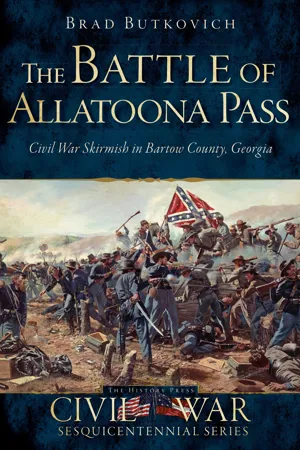
In the 1840s, engineers blasted through 175 feet of earth and bedrock at Allatoona Pass, Georgia, to allow passage of the Western & Atlantic Railroad. Little more than twenty years later, both the Union and Confederate armies fortified the hills and ridges surrounding the gorge to deny the other passage during the Civil War. In October 1864, the two sides met in a fierce struggle to control the iron lifeline between the North and the recently captured city of Atlanta.
Though small compared to other battles of the war, this division-sized fight produced casualty rates on par with or surpassing some of the most famous clashes. In this expertly researched volume, Brad Butkovich explores the controversy, innovative weapons and unwavering bravery that make the Battle of Allatoona Pass one of the war's most unique and savage battles.
- 207 pages
- English
- ePUB (mobile friendly)
- Available on iOS & Android
eBook - ePub
About this book
Information
Topic
HistoriaChapter 1
To Fill Their Ranks
After hours of enduring relentless sun, choking smoke and quenchless thirst, the soldiers in the lonely fort atop the hill did not realize, at first, that the battle had ended. The sporadic gunfire from the enemy outside suddenly stopped. Nobody wanted to be the first to invite a lead ball to the forehead, so several cautious soldiers removed their hats, placed them on the end of their rifle’s ramrods and slowly raised them above the walls of the fort. When nothing happened, furtive glances above the parapet replaced the hats. None drew enemy fire. With a rush of adrenaline, first one man and then half a dozen leapt over the walls. The fearless were quickly followed by the willing, and soon scores of men were filing out of the fort into open ground. Ignoring the carnage before them, order replaced chaos, and the officers hastily assembled scouts and skirmishers to pursue the enemy down the road they had taken. When they reached the first crossroads, they spied their quarry, more than two hundred yards distant, marching away and disappearing from sight.1
Emotions subdued and held in check during combat burst forth like an open floodgate. Cries of triumph and victory tore from the throats of the Union men and reverberated among the nearby hills. Soldiers shook hands and embraced one another with unabashed affection. Then came the tears. Tears of joy, tears of exhaustion and tears of anguish, for the living were not alone among the triumphant.2
Lieutenant William Ludlow emerged from the fort to confront a ghastly sight. The ditch surrounding the fortification had been used as an ad hoc trench by the defenders, and it was filled with a carpet of dead and wounded men. The injured writhed and struggled in their agony to remove themselves, while the dead continued their vigil. The survivors came to find and assist their wounded comrades, and soon every house and building in the surrounding community was filled to capacity. Casualties stretched far beyond the immediate garrison, and Ludlow toured the devastation. Following a ridge down from the fort, he retraced his steps from that morning. He passed a house and a ravine where his Confederate opponents had assembled for their final attacks. Cannon fire from the fort had torn them to shreds, as did the firepower of their new repeating rifles. Their mangled and upturned bodies gave mute testimony to the power of man’s latest weapons of war.
Still, the sight that appalled Ludlow the most was the scene at the outer redoubt, or small fort, just beyond the house. The main struggle for the garrison had begun there earlier that morning. He found it difficult to stand before the carnage without a rush of tears, and a spasm of pity clutched at his throat. The men in the outpost had been ordered to hold it to the last, and earthworks were filled with bodies in blue and butternut uniforms. Bayonets and rifle butts had been used freely, and many of the dead remained locked together in their final embrace. The defenders had endeavored to fulfill their order to hold, as Ludlow would write decades later, with supreme fidelity.3
As the lieutenant surveyed the aftermath of the battle, a surgeon joined him and invited him to one of the makeshift hospitals. As they walked, the man surprised Ludlow with an unexpected detail: among the wounded soldiers was a woman in Confederate uniform. The lieutenant was taken aback, and the surgeon asked him to try and pick her out from among her comrades. As they made their way among the wounded, Ludlow confessed that he saw no woman. The doctor stopped at a bed on which lay a young soldier, tanned and freckled, leaning on one elbow and smoking a corncob pipe.
“How do you feel?” asked the doctor.
“Pretty well,” the young soldier replied, “but my leg hurts like the devil.”
“That is the woman,” the doctor said as he turned to Ludlow. He explained that she was a member of the Missouri brigade they had just fought. She had followed her husband and one or two brothers to fight off the invaders. When they were killed earlier in the war, having no other home but their regiment, she took up a musket and joined the ranks. Now she would lose a leg for the cause.4
What a cause it must have been, too, that enlisted young women to stand shoulder to shoulder with a generation willing to sacrifice all for what they believed. On a bright October day in 1864, the consequences of that cause played out in a most violent manner among the hills and trenches of a small outpost named Allatoona Pass.
Chapter 2
Three Cheers for Joe Johnston!
General John Bell Hood was a failure as an army commander, at least so far, and he would have to work hard to keep his job. Atlanta had fallen. Preventing the city from falling into Union hands could have denied Abraham Lincoln the military victory he needed to remain in office in the upcoming November presidential election. Unfortunately, Hood was at the helm of the Confederate army responsible for its defense and proved unable to stop the massive Union armies commanded by Major General William Tecumseh Sherman from capturing the city on September 2. Morale was low, desertions were up and Hood had to come up with a plan to reverse his fortune, and the Confederacy’s as well.5
The progress of the rebellion looked grim. The year 1864 had been a brutal one, characterized by marginal victories, lost territory and, above all, massive casualties. In Virginia, the spring and summer campaign had been marked by a series of battles between Confederate general Robert E. Lee and his Union opponent, Lieutenant General Ulysses S. Grant. These battles ended in a deadlock before the city of Petersburg and the capital of Richmond. Confederate successes along the Red River in Louisiana and a momentary threatening of the Union capital had done little to reverse the overall course of the war. The fall of Atlanta after a four-month campaign had been a devastating blow. With the war in Virginia stalled, all eyes were on the adversaries in Georgia to make the next move.
Hood had a number of issues to resolve. First, he had to decide on the next course of action for his Army of Tennessee. Originally at Lovejoy Station after the fall of the city, Hood moved the army north to Jonesborough, site of the final battle of the campaign, on September 8. On the eighteenth, he shifted the army west to the small town of Palmetto, southwest of Atlanta, with the right of the line touching the West Point Railroad and the left resting on the Chattahoochee River. From there, he could wait to see what Sherman in Atlanta would do. Alternately, he could take the initiative and act first. It wasn’t in Hood’s nature to wait, and if he had learned anything from his former commander, Lee, it was that maintaining the initiative was paramount to success.
The question then became one of objectives. Attacking Sherman directly in Atlanta was out of the question, as the Union armies there outnumbered his and were ensconced behind the very earthworks Hood had occupied less than a month before. Transferring the army to another theater of the war was politically unfeasible, as it would invite Sherman to march unopposed through the nation’s heartland to either Mobile or Savannah. Hood set his mind on the one remaining option: to move the Army of Tennessee north of Atlanta, destroy Sherman’s railroad supply line between Atlanta and Chattanooga and force the Federals to attack him on his terms. If Sherman declined battle and moved toward the coast instead, Hood could attack him from behind, deny him supplies and forage for his men and defeat him in isolation. Hood had advocated taking the offensive as early as the sixth, shortly after abandoning Atlanta, and he telegraphed his latest plan to the authorities in Richmond on the twenty-first.6
That same evening, Hood learned that Confederate president Jefferson Davis had accepted an earlier invitation to visit the army and was on his way. Presidential visits to the Army of Tennessee by Davis were nothing new, and they were not always viewed in a positive light. In the opinion of one Texan, a visit from Davis portended disaster. The president had consulted with General Braxton Bragg before the defeat at Stone’s River in 1862, visited the army to quell a near mutiny among the senior leadership before the rout at Chattanooga in 1863 and was now on the way to personally evaluate the situation and decide on the best course of action. “Now after all that experience, he comes here just after the fall of Atlanta to concoct some other plan for our defeat and display of his Generalship,” lamented the Texan.7
Strategic decisions weren’t the only ones on the table. Several prominent politicians were clamoring for Hood’s removal after the loss of Atlanta, and it was an issue that Davis couldn’t ignore. He would have to make a decision whether to keep Hood or replace him. If he replaced Hood, who could he find to fill the position? In addition, personnel conflicts were again sapping the proficiency of the army’s high command. Hood placed much of the blame for the loss of Atlanta on the shoulders of his senior corps commander, Lieutenant General William J. Hardee. Something had to be done to salvage whatever harmony remained in the army’s high command, not to mention the morale of the army itself.8
Davis arrived in Palmetto on the twenty-fifth, accompanied by two aides-de-camp. He and Hood immediately set to work crafting a workable plan of action. The commanding general laid out his plan in detail: move on Sherman’s supply line, bring him to a decisive battle on the Confederates’ terms if he marches to oppose Hood or pursue and isolate Sherman if he marches for the coast. Davis was in general agreement. Hood later wrote that he also put forth the contingency of invading Tennessee if practicable, but Davis later denied it in his own postwar writings. Regardless, the plan to cross north of the Chattahoochee and strike the railroad was agreed to in principle.9
The next day, Hood, Davis and their staffs rode out to the works and made an informal tour of the army. The result was more than a little embarrassing for the two on at least one occasion. While riding the lines and reviewing the men in Stewart’s Corps, Colonel William H. Clark of the 46th Mississippi cried out in his thin voice, “Three cheers for President Davis and Gen. Hood!” Raising his sword aloft, he raised a yell, but it was only answered feebly by one or two others. Then, somebody else in the ranks shouted, “Three cheers for Gen. Joe Johnston!” the officer Davis had replaced with Hood in the middle of the Atlanta Campaign. This was responded to enthusiastically, and soon the entire brigade was yelling. The chagrin of the two men was palpable, and even Hood was forced to acknowledge it, or another similar incident, in his memoirs. The feeling was not universal. That evening, the president was serenaded by the band of the 20th Louisiana, and afterward, the men called on him to make a speech. He gave a short, spirited oration that called for a return to middle Tennessee and was heartily received by those present. The speech was followed by several others, including ones from Hood, General Howell Cobb and displaced Tennessee governor Isham G. Harris.10
The president spent the next day, the twenty-seventh, conferring with the remaining senior leadership of the Army of Tennessee. He first met with corps commanders Lieutenant General Alexander P. Stewart and Lieutenant General Stephen D. Lee in a house not far from Hood’s tent. Afterward, he held a private meeting alone with General Hardee. Later in the evening, close to 6:00 p.m., Davis and his retinue mounted their horses for the return ride to the railroad station. He was playing his hand close to his chest and had not announced a final decision to anyone. As Hood remembered it, Davis remarked that “he might find it necessary to assign another to the command of the Army, but I should continue to pursue my proposed plan, at least till a decision was reached in the matter.” With that, Davis left, boarded the train and proceeded to Montgomery, Alabama.11

Campaign map from Jonesborough to Cartersville. Courtesy of the author.
The wait was not a long one. The next day, Hood received the following telegram:
Relieve Lieutenant-General Hardee from duty with the Army of Tennessee, and direct him to proceed at once to Charleston, S.C., and assume command of the Department of South Carolina, Georgia, and Florida.
Later, he received an additional telegram:
GENERAL: I have anxiously reflected upon the subject of our closing conversation, and the proposition confidentially mentioned. It seems to me best that I should confer with General Beauregard, and if quite acceptable to him, to place him in command of the department, embracing your army and that of General R. Taylor, so as to secure the fullest co-operation of the troops, without relieving either of you of the responsibilities and powers of your special commands, except so far as would be due to the superior rank and the above assignment of General Beauregard. He would necessarily, if present with either army, command in person. Before final action there will be time for you to communicate with me, and I shall be glad to have your views. In the mean time you will of course proceed as though no modification of existing organization was contemplated.
Hood had won. He would remain in command of the Army of Tennessee, with a nominal superior overseeing a larger department. He had also rid himself of a subordinate whom he no longer trusted and received final permission to embark on his proposed offensive. But his success carried with it a new responsibility. He would have to deliver a victory.12
Chapter 3
As Shots from a Magazine-Gun
Major General William Tecumseh Sherman was the hero of the day. While the North had enjoyed some small successes, such as the capture of Mobile Bay in early August, the war had reached a stalemate in the two main theaters, Virginia and Georgia. Sherman’s victory at Atlanta changed that. In an instant, Lincoln’s prospects for reelection improved dramatically. Northern newspapers heralded the victory. Grant ordered his artillery in front of Petersburg and Richmond to bombard the enemy trenches in salute, “firing a national salute, or thirty-six rounds from each battery. The firing commenced about eleven o clock. You cannot imagine either the sight or the sound. The pyrotechnical display would have done honor to the fourth of July, and the noise satisfied the most uproarious of urchins.”13
The fall of Atlanta saw Sherman’s armies deployed south of the city opposite Hood near Lovejoy Station. Sherman controlled three armies, in modern terms an army group, formally designated the Military Division of the Mississippi. However, this high-sounding title was rarely used among the troops. Each man considered himself a member of one of the three individual armies. The Army of the Cumberland, commanded by Major General George H. Thomas, was the largest of the three. It was further divided into three army corps: the Fourth, Fourteenth and Twentieth. The Fourth and Fourteenth were with Sherman outside Lovejoy, while the Twentieth had stayed behind and now occupied the city of Atlanta itself. Major General Oliver O. Howard’s Army of the Tennessee—not to be confused with the Confederate Army of Tennessee—was the next largest. It also had three corps, but each corps was typically smaller than its Cumberland counterpart. These three corps were the Fifteenth, Sixteenth and Seventeenth Army Corps. Finally, the smallest was the Army of the Ohio, which was actually only one infantry corps, the Twenty-third, and one cavalry division. The corps was led by Major General John M. Schofield. In total, Sherman had about 81,758 men present for duty in and around Atlanta.14
Ultimately, Sherman decided against crushing Hood’s army at Lovejoy, even though he outnumbered it at least two to one. He had achieved his goal—that is, capture the important railroad and industry hub of Atlanta and prevent Johnston or Hood from sending reinforcements to Lee in Virginia. The Confederates had a fairly strong position, although not one that couldn’t...
Table of contents
- Front Cover
- Half Title
- Title Page
- Copyright
- Dedication
- Contents
- Preface
- Acknowledgements
- Introduction
- 1. To Fill Their Ranks
- 2. Three Cheers for Joe Johnston!
- 3. As Shots from a Magazine-Gun
- 4. Bring Relief to Our Only Precious Cause
- 5. We Shall Be “Minute Men”
- 6. The Yanks Had His Hogs
- 7. To Destroy Is a Soldier’s Joy
- 8. I Will Pitch Into Them
- 9. A Needless Effusion of Blood
- 10. The Bayonet Was Freely Used
- 11. Trusting in the God of Battles
- 12. We Hold Out
- 13. Silence Sir! Or I Will Have You Shot!
- 14. Tell My Wife I Loved Her to the Last
- 15. The Enemy Suffered Very Severely
- Appendix A: Grave of the Unknown Soldier
- Appendix B: The Allatoona Blockhouse
- Order of Battle
- Notes
- Bibliography
- About the Author
Trusted by 375,005 students
Access to over 1.5 million titles for a fair monthly price.
Study more efficiently using our study tools.
Frequently asked questions
Yes, you can cancel anytime from the Subscription tab in your account settings on the Perlego website. Your subscription will stay active until the end of your current billing period. Learn how to cancel your subscription
No, books cannot be downloaded as external files, such as PDFs, for use outside of Perlego. However, you can download books within the Perlego app for offline reading on mobile or tablet. Learn how to download books offline
Perlego offers two plans: Essential and Complete
- Essential is ideal for learners and professionals who enjoy exploring a wide range of subjects. Access the Essential Library with 800,000+ trusted titles and best-sellers across business, personal growth, and the humanities. Includes unlimited reading time and Standard Read Aloud voice.
- Complete: Perfect for advanced learners and researchers needing full, unrestricted access. Unlock 1.5M+ books across hundreds of subjects, including academic and specialized titles. The Complete Plan also includes advanced features like Premium Read Aloud and Research Assistant.
We are an online textbook subscription service, where you can get access to an entire online library for less than the price of a single book per month. With over 1.5 million books across 990+ topics, we’ve got you covered! Learn about our mission
Look out for the read-aloud symbol on your next book to see if you can listen to it. The read-aloud tool reads text aloud for you, highlighting the text as it is being read. You can pause it, speed it up and slow it down. Learn more about Read Aloud
Yes! You can use the Perlego app on both iOS and Android devices to read anytime, anywhere — even offline. Perfect for commutes or when you’re on the go.
Please note we cannot support devices running on iOS 13 and Android 7 or earlier. Learn more about using the app
Please note we cannot support devices running on iOS 13 and Android 7 or earlier. Learn more about using the app
Yes, you can access The Battle of Allatoona Pass by Brad Butkovich in PDF and/or ePUB format, as well as other popular books in Historia & Historia de la Guerra de Secesión. We have over 1.5 million books available in our catalogue for you to explore.