![]()
ASYLA
Even in 1896, it took some time to process paperwork and make arrangements. Defense attorney Lewis C. Mengert was appointed Celia Rose’s legal guardian by the State of Ohio on December 12, providing someone to sign off on the paperwork to commit Ceely to the asylum. Sheriff James Boals escorted her out of the Richland County Jail and into a carriage on December 17. He accompanied her to the Toledo State Hospital, where she was signed into the institution’s admissions book as patient no. 1937.
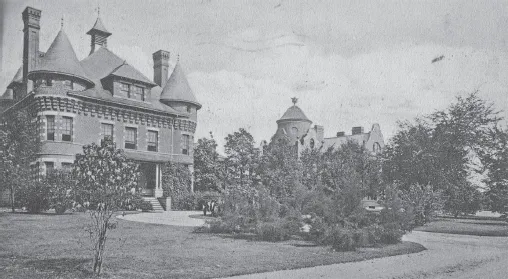
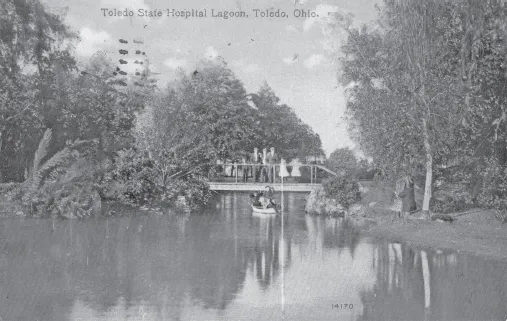
The Toledo State Hospital was part of the state system of lunatic asylums distributed throughout the state. In the late 1800s, Richland County mental patients were committed to the Toledo facility, which remained the case until a newer hospital opened in Lima in 1915. The asylum in Toledo had been built in 1888, designed by architect Edward O. Fallis. It was designed in the progressive manner of the day, on what was termed the “cottage plan,” housing patients in numerous small dorms and only putting the most severely disturbed patients in larger group dorms. Fallis designed the complex in an attractive Flemish baroque style, with several lagoons on the landscaped grounds, which made the hospital an attractive picnic location around the turn of the century. After the phasing out of the state hospital system in Ohio, the entire complex was demolished in the 1970s.
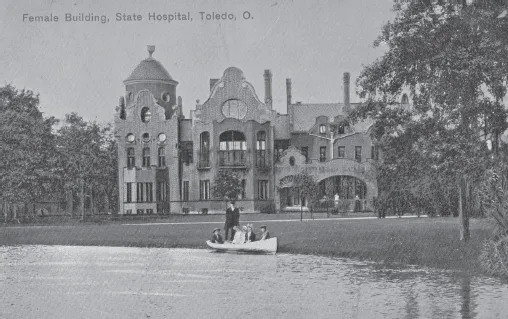
It is not known exactly where Celia Rose was housed at the Toledo facility. One vintage postcard identifies an ornate building as “the female dorm,” but with a total of thirty-two separate dorm buildings on the campus, there is no guarantee that Ceely was housed there.
A vintage postcard of the administration building of the Toledo State Hospital. Author’s collection.
Indeed, precious little is known of Ceely’s time in the state hospitals. But to fully tell that story, I must depart from our historical narrative to explain some of the maneuvering it takes to research a case like this. Hoping to find some trace of records for Ceely’s institutionalization, I contacted state officials. I was told that most old records from the state hospitals had been destroyed. I asked if any records at all survived from Toledo. The woman I spoke with said that, yes, a small group of records did remain from Toledo, but it was unlikely the patient I was searching for would be in them. I said, “But the search could be done, correct?” She said, “It could be done, but we aren’t likely to find anything.” “But,” I said, getting irritated, “you can, in fact, do the search I’m requesting, yes?” The woman sighed and said, yes, they could do the search, even though it was extremely unlikely there would be anything.
A week later, I got a call back from the state. The woman was quite perky and said that she was amazed: they actually found something. She said that it was only a few things, but it was indeed for the patient I was researching.
“Great!” I said. “Can you send them to me?”
“No,” the woman replied. “Mental patient records can only be released to the nearest surviving kin. Are you related to Celia Rose?”
“No,” I said. “I’m a historical researcher. You mean to tell me that even after all these years, these records are not available to historians?”
A vintage postcard of the landscaped grounds and lagoons at the Toledo State Hospital. Author’s collection.
“That is correct,” she said.
“But you can release them to the patient’s nearest surviving relative?” I said.
“Yes,” she said.
“Great,” I said. “I’ll have him call you.”
In my process of researching the case, I had come into contact with a genealogical researcher named Jerry Pearson of Chillicothe, Ohio, who was attempting to untangle the knot of Rose family trees in southern Ohio, as he was descended from a Rose. Another genealogical researcher put me in contact with Jerry, and I immediately asked if his Roses were the same as the ones I was researching. I noted that we both showed a David Rose.
Jerry responded promptly but not encouragingly, citing that there were at least three known David Roses who lived in Pike County, Ohio, around the time of the Civil War.
I said that “mine” was the father of Ceely Rose, the notorious poisoner of Pleasant Valley, who had wiped out her entire family with rat poison mixed in their food.
“That’s an amazing story,” Jerry e-mailed. “But not my family. I’ve never heard of anything like that.” But as a final confirmation, he sent me the dates of “his” David Rose. It was the same person.
What Jerry and I were slowly able to piece together was that we were indeed working on the same family. The almost unimaginable trauma these murders, the trial and publicity must have had caused evidently led to an unusual course. The Rose and Easter families of southern Ohio had conferred and made a big decision: They were never going to speak of Celia Rose ever again, so that the younger generations would never have to know that a murderer in their own family had once obliterated an entire branch of the tree. The vow of silence had lasted for more than a century.
A vintage postcard of a female dorm at the Toledo State Hospital. Author’s collection.
Jerry was floored once he realized beyond a doubt that we were talking about the same family. “Um, sorry to break the news,” I said.
“It’s all right,” Jerry said. “I come from the sane side of the family. You shake the family tree hard enough, some nuts are going to fall out.” Jerry was able to confirm the incidence of other mental health issues in the family. He was particularly intrigued by the trial testimony that referred to David Rose’s sister as having two mentally infirm children. David’s younger sister, Martha Jane, was Jerry’s great-great-grandmother. According to him, she lived in Latham when she married John Wesley Davis, later moving to Highland County and marrying Joseph Barrett. This matched her name with the name of David Rose’s sister given in trial testimony. Additional proof was provided by Jerry, who said that Martha had her brother David listed by his June 2, 1829 birthdate in her diary, although she had never been able to bring herself to write in his death date, even though she lived until 1907.
Jerry said that while he wasn’t aware of Martha Jane having two children with mental problems, he was able to trace down one, William A. Barrett, who apparently never left home. The 1900 census for Brush Creek, Highland County, shows William, age twenty-seven, living at home. No occupation is given for him, which seems significant. He appears to be the same William A. Barrett later listed as a patient at the Ohio Hospital for Epileptics in Gallipolis, Ohio, on a World War I draft card. His nearest relative is listed in extremely sloppy handwriting as (possibly) “James B. Leety” of Greenfield, Ohio, or at least that was how the record was transcribed into online digital databases. Greenfield straddles the border of Highland and Ross Counties, which is certainly home territory for the Rose family, but there is no James B. “Leety” to be found there, in any period. There is, however, a James B. Setty, who, it turns out, was the husband of William A. Barrett’s half sister, Elizabeth Jane Davis. And it also turns out that Greenfield is less than five miles away from South Salem, Ohio, where Ceely’s nephew John Long was living in 1896. Finally, the threads were beginning to tie everything together.
Jerry Pearson said that the impression he had received of Martha Jane (Rose) Barrett was that she was a very sad and isolated woman who may well have herself suffered from a mental health condition such as severe depression or bipolar disorder. These pieces of information confirm the testimony about mental issues in the Rose family.
Since the state would not release Celia Rose’s few surviving records to me, I had Jerry contact the department. It sent the records to him, and he immediately copied me on the spotty documents. The female patient register describes Celia Rose by filling in a very few of the blanks on the form:
No.: 1937
Name: Celia Rose
Age: 23
County: Richland
Date of Admission—Month: Dec., Day: 17, Year: 1896
Civil Condition: 5
No. of Children:
Age of Youngest:
Nativity: Ohio
Degree of Education: Com.
Habits of Life: Good
Religious Persuasion:
Color of Hair: Light
Color of Eyes: Blue
Height—Ft: 5, In: 8
Weight: 155
Age at 1st Attack: 23
Number of Previous Attacks and Duration of Each:
Duration of Present Attack:
Readmission:
Accompanying Bodily Diseases on Admission:
Apparent or Alleged Causes—Predisposing Causes—Insane Relatives:
Other: Heredity
Exciting: Congenital
Form of Mental Order: Imbecile
Particular Propensities: Homicidal
Affectations of Sense & Intellect:
That was all expected information. What wasn’t expected was the next piece of data:
Date of Discharge—Month: Nov, Day: 10, Year: 1897
Time in Asylum—Years: Mos: 10, Days: 13
Cause of Discharge: Recovered
This was a stunning piece of information. We knew for a fact that Celia Rose died not at Toledo but rather at the newer Lima State Hospital, to which she had been transferred in 1915. She passed away in March 1934. How could she have lived all these years in the state asyla when she was pronounced cured and released in 1897?
It seems that this is the kind of strange historical happening that will never be found in any detailed documentation. The nearest I can conjecture is based on a few bare newspaper references. On June 14, 1899, almost three years after the first poisoning, a report ran in the Mansfield Daily Shield headlined “Celia Rose: Report that She Is at Liberty.” The article quoted a now lost issue of the Butler Enterprise that claimed that a rumor had ripped through Pleasant Valley that Celia Rose had been liberated from the Toledo State Hospital and was living the life of a recluse with relatives in Ross County.
“The people are much stirred up,” the article said, “over the intelligence that the woman has regained her freedom.”
Attorney Lewis C. Mengert, Ceely’s legal guardian, was asked to comment. He said that he knew nothing of the report that Celia was at large, and if she was, it was without his knowledge or consent.
Nothing is cited as the origin of this report other than to say that it came from “a reliable source.” It indicates that she was free, and the Toledo State Hospital’s admissions book supports that, stating quite plainly that she was judged cured and released. If this happened, who had taken her? With family connections already having been demonstrated in Ross County, it seems likely that she went to live with John Long or other family members who may have established contact with her once she was in the asylum.
One thing seen repeatedly in this case is the estimation by many people that Celia Rose was not insane. Removed from the situation in Pleasant Valley that had spiraled out of control, Ceely Rose settled down and apparently offered little trouble to her caregivers. Word has even passed down through family channels in the Lima area that Ceely became a favorite of the staff at that hospital.
But we know beyond a doubt that Celia Rose died in the state hospital system. So, what happened? There is no emendation or readmission entry for her in the Toledo State Hospital system. The next reference to her is in 1915, when she was transferred to the new Lima State Hospital. But a follow-up in the Daily Shield was published on July 24, 1899, where Sheriff Boals confirmed having seen Ceely at the Toledo State Hospital on the previous Saturday. Considering that the Toledo State Hospital was reachable by telegraph, there is no conceivable reason why it should have taken Mansfield authorities five weeks to confirm Ceely’s location if she were still, in fact, a patient at the asylum.
Jerry Pearson and I conferred over this, and aft...