- 131 pages
- English
- ePUB (mobile friendly)
- Available on iOS & Android
eBook - ePub
Cleveland in World War II
About this book
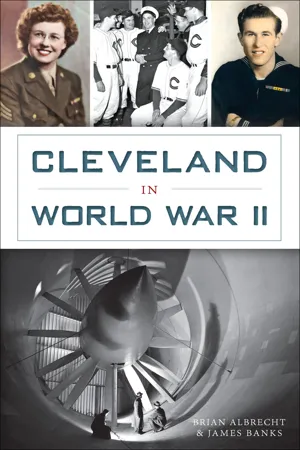
Berthed on the Cleveland lakefront, the battle-hardened submarine USS Cod serves as a proud reminder of the wartime contributions from the Greater Cleveland community. Clevelanders did their duty and more, from round-the-clock work on the factory assembly lines to the four Medal of Honor recipients on the front lines. The Cleveland Bomber Plant churned out thousands of B-29 parts, while Auto-Ordnance Co. developed the design for the Thompson submachine guns used by GIs on nearly every battlefield. Indians pitcher Bob Feller left the game to go into the service, and Clarence Jamison flew with the famed Tuskegee Airmen. Through interviews and archival material, authors Brian Albrecht and James Banks honor a time when Clevelanders of all stripes answered the call to arms.
Information
1
CLEVELAND MOBILIZES THE HOMEFRONT
The suddenness of war shifted the nation’s attention from the economic struggle of chasing phantom jobs to a riveting focus on attacking our enemies. The new priority of the war diverted personal struggles and erased doubts caused by the Depression. Americans now had a wider vision: they must answer the call to arms, to come to the aid of the nation. It was as if the population had just received a massive injection of patriotism.
The sense of community that engulfed Cleveland and all Americans was created by the intensely emotional expenditure of energy driven by and focused on a cause larger than the self. Perhaps it was the combined experience of individual deprivation of the Great Depression followed by instantly awakening to a different, but greater, challenge that nurtured a culture of cooperation and unity. Tom Brokaw captured it in the phrase “the greatest generation.”
There was a keenly felt sense of personal innocence regarding the “sneak attack” by Japan. The lament “We were neutral” confirmed America’s virtue. It was if the United States’ splendid isolation kept it from the chaos of the rest of the world, the vast oceans like a blanket of comforting insulation. Americans could avoid the contagion of war if they remained observers. Europe always had problems. Indeed, the phrase “the phony war” confirmed Europe’s aging charade as a nonissue for the United States.
In an instant, America’s naïve vision of the world vanished in the death, fire and tragedy of Pearl Harbor. Families with those in the service were immediately impacted. Radio, newspapers, newsreels and even Hollywood films knitted the nation into a continental tapestry of total commitment “for the duration,” as the slogan went.
The concept of a global war encompassing all the major oceans, the islands in the far Pacific, the coast of North Africa and the landmass of Europe not only tested one’s awareness of geography but also presented a staggering strategic challenge for engaging the enemy. Where would the Allies strike back at the enemy? Prior to the attack on Pearl Harbor, most Americans would have been hard pressed to find it on a map.
Unlike our current media-savvy culture obsessed with images, 1940s America had only the radio (AM of course) as a national platform. It could inform and unite, as well as entertain millions simultaneously. President Franklin Roosevelt (FDR) was the first president to use and master this audio media, putting him directly in touch with the electorate. In a national crisis, the nation turns to its president. The nation was facing its second and worst national catastrophe.
FDR’s many “fireside chats” put Americans in direct touch with the president, a form of communication they had come to embrace during the Depression years. It was as if he spoke directly to each citizen. His patrician voice resonated, giving hope to the 25 percent of unemployed workers in 1933. Having just been elected to an unprecedented third term in 1940, the president now faced a global war.
The president; his wife, Eleanor; and their four sons were in uniform, setting a leading example of total commitment to the war effort. FDR’s distant cousin Teddy also had four sons who served in the Great War. One, Quentin, perished in a dogfight in the skies of France.
With the approach of George Washington’s birthday in late February 1942, Clevelanders and the rest of the nation were told to have world maps ready for a major radio address. By the evening of the chat, maps of the world were in short supply. Clevelanders young and old gathered around the radio awaiting the urgent message. In some homes, the radio was a piece of furniture dominating the living room. Some may recall staring into the speaker to catch every word.
The president, with the gravitas befitting the commander in chief, took to the air to describe the kind of war and the sacrifices that lay ahead. On Monday, the twenty-third, in the Cleveland darkness on a twelve-degree winter’s night, a fatherly professor of geography explained the importance of the far Pacific islands. With a delicate measure of optimism countered by the reality of some setbacks, the president outlined America’s road ahead. This remarkable geography lesson and candid review of the challenges facing America warrants a quick look.
By celebrating the birth of the father of our country and linking it with the Spirit of ’76, FDR said this allowed “us to talk to each other about things as they are today and things as we know they shall be in the future.” It was a new kind of war, with unknown geographical locations, some mere dots on the vast Pacific. “I have asked you to take out and spread before you a map of the whole earth, and to follow with me the references which I shall make to the world encircling battle lines of this war.” It was estimated that 80 percent of the public were at their radios with maps following along as they listened eagerly to the president’s message.
In addition to the geography lesson, the president urged production to support the demands of a global war while admitting, “We have suffered losses and there would be more.” However, “your government has unmistakable confidence in your ability to hear the worst, without flinching or losing heart.”4
Militarily, the war was both a strategic and logistical nightmare. America’s allies needed to be included, requiring deft discussions. The Big Three—Franklin Roosevelt; Winston Churchill, the prime minister of England; and Joseph Stalin, the premier of Soviet Russia—presented a curious but vital trinity.
Of the three countries, only the United States and Great Britain were free of occupation forces. Stalin and the Red army were critical to the success of defeating Hitler, but the close relationship between the two English-speaking democracies created tension and suspicion within Stalin’s strategic interests.
With Roosevelt and Churchill dominating global strategy, the president concentrated on the European Theater of Operations (ETO). The so-called Germany first strategy seemed misplaced, since it had been the “Japs” who attacked the United States. In the early months after Pearl Harbor, it was the navy, marines and army shouldering much of the battle in the far Pacific. Japan’s control of the Pacific ultimately required amphibious landings, combining naval, air and land forces in a series of island assaults.
Underlying the urgency and furious pace of community involvement was genuine worry about another attack. The fear of invasion was more prevalent on both coasts, but Cleveland experienced a stunning demonstration a few weeks after Pearl Harbor. Earle L. Johnson taught the city, and the nation, a lesson when flying his own plane. He “bombed” several Cleveland factories with one-hundred-pound sacks of flour. The white roofs were the shocking proof that added impetus to the county’s efforts in civilian defense.5
Johnson, a well-known Cleveland businessman, was the national commander of the Civil Air Patrol (CAP) in 1942, becoming part of the national organization of the Office of Civil Defense. The CAP, under his leadership, expanded to include over 200,000 civilian volunteers.6
Before Pearl Harbor, the United States had walked a delicate diplomatic tightrope of neutrality and preparedness. In September 1939, President Roosevelt issued a proclamation declaring the United States’ status as a neutral nation, while simultaneously urging the strengthening of its defenses. By May 1941, German submarine attacks had taken a devastating toll on the country’s shipping. In response, the president issued Executive Order 8757, creating the Office of Civilian Defense (OCD).
The OCD coordinated federal civilian defense measures with state and local governments. Under the leadership of the War Department Service Commands, Cleveland was named the coordinating center for the Fifth Service Command. The OCD symbol featured a white triangle inside a blue circle, and personnel wore white armbands and helmets.
By 1942, the nation responded to the call. Over five million were enlisted in various aspects of civilian defense. However, as the fear of a direct attack lessened, some aspects of the program were discontinued. But for most of the nation, 1942 was a year of rigorous vigilance and readiness.
To coordinate clocks and avoid confusion over the start and end of daylight saving time, the president issued an executive order requiring all clocks to remain on daylight saving time, known as “war time,” until the end of the war. Obviously, the four time zones remained unchanged.
In January 1942, the Cuyahoga County Council for Civilian Defense was established under the leadership of William A. Stinchcomb. The county was divided into twenty-nine air raid report centers all linked to Cleveland’s Central Police District No. 1 on Payne Avenue. The various report centers were further divided into zones and the zones into sectors.
Booklets, pamphlets and films flooded area offices. The popular “What Can I Do?” listed dozens of citizen-based activities to win the war. In addition to air-raid wardens, blackout drills, training seminars and myriad other “action” venues was the coveted Victory-Home Award for households. If one met the list of expectations and instructions, a Victory-Home Award with a certificate was displayed on the front door.
The five criteria were:
- This home follows instructions of its air-raid warden.
- This home conserves food, clothing, transportation and health.
- This home salvages essential materials.
- This home refuses to spread rumors.
- This home buys War Savings Bonds and Stamps regularly.7
Additional volunteer positions were emergency food and housing staff, chaplains, decontamination and demolition experts, rescue squads, messengers, road repair crews and nurses’ aides. By 1943, volunteerism in all aspects of the OCD ballooned to a staggering twelve million volunteers.
In Cleveland, Director Stinchcomb headed a massive volunteer bureaucracy that, by the war’s end, numbered eighty thousand people with a budget of more than $150,000. Initially, the confusion, duplication and rivalry prompted some false starts. Eager volunteers required training that could not be rushed. Each OCD unit was required to include auxiliary fire, police and medical personnel.
Throughout the spring and summer of 1942, both city- and countywide blackouts and air raid drills were tested. In one of the more inventive tactics, a “smokeout” was attempted. According to The Encyclopedia of Cleveland History, local factories generated a layer of black smoke to prevent enemy aircraft from seeing their targets.
The role of Cleveland’s volunteers extended into the surrounding communities. One of the more remarkable leaders was Anthony B. Kurtz, the senior warden for Report Area 25. According to local historian Ken Lavelle, Kurtz organized a staff of twenty-eight nuns from the Incarnate Word Academy on Pearl Road, in the village of Parma Heights.
Lakewood had as many as 252 sector chiefs, and each warden had a sign in his front yard designating the home as that of a warden. Smaller communities like the village of Brecksville had 69 wardens and combined a bond rally with a parade and civil defense demonstration. Cleveland Fire Department battalion chief Emmet Byrne demonstrated how to put out incendiary bomb fires. The Brecksville gathering brought 3,000 participants out to raise money, cheer and learn as a “colored quartet” sang “The Old Flag Never Touched the Ground.”8
At many of the local recruiting events for volunteers, a gloss of vintage history was provided by the appearance of Brigadier General Ulysses Grant III, grandson of the president, who administered the oath of authorization.
Blackout drills were complex, not only because they required advanced notice but also because the logistics of communication regarding a specific start time was difficult for a city of nearly one million.
A countywide blackout required twenty-five thousand volunteers and was scheduled for July 29, 1942. Director Stinchcomb was reluctant to use sirens for fear of inducing panic, but telephones and messengers were totally inadequate. For a city the size of Cleveland, six thousand volunteers were needed to make sure all went dark. A front-page photo showing the city during one of the blackouts was convincing—the photo was all black.9
It was a very serious violation of the law to ignore the ample warnings and announcements of the scheduled time. A Cleveland dentist apparently did not get the word, since his home was “ablaze with light,” noted one of the wardens. The violator was fined fifty dollars. Had it been his second offense, the fine would have been doubled.10
Air raid drills were even more demanding, involving local hospitals, fire and police departments and the newly created committees. There was some confusion, noted the local news, but twenty thousand civilians were mobilized, and all of the city’s twenty-two hospitals were ready within minutes of the test. Volunteerism and action activities kept one busy, but war news was always the primary interest, as worrisome reports surfaced with increasing frequency.
THE SUMMER OF ’42
The following headline might puzzle twenty-first-century readers: “Name Woman to Lead Drive for Grease.” Mrs. N.B. Harris of 1867 Crawford Road, a member of the county’s salvage committee, headed the drive for “fats and greases.” She led 1,200 volunteers in the collection effort at twenty-nine collection areas, where donors were paid five cents per pound.
An organization of the Cleveland packing industry and renderers were also in attendance, part of the national Salvage Division...
Table of contents
- Front Cover
- Title Page
- Copyright
- Contents
- Acknowledgements
- Introduction
- 1. Cleveland Mobilizes the Homefront
- 2. Forging the Arsenal of Democracy
- 3. Family Fears: Stars in the Windows, Soldiers at the Door
- 4. From Pearl Harbor to Tokyo: Marching Across the Pacific
- 5. Cleveland Women Go to War at Home and Abroad
- 6. Black Clevelanders Fight on Two Fronts
- 7. Breaking Down the Walls of Fortress Europe
- 8. Crile General Hospital: An Oasis of Healing
- 9. Victory in Europe and Victory Over Japan Days: Dancing in the Streets
- 10. Places: Lest We Forget
- Notes
- Bibliography
- About the Authors
Trusted by 375,005 students
Access to over 1.5 million titles for a fair monthly price.
Study more efficiently using our study tools.
Frequently asked questions
Yes, you can cancel anytime from the Subscription tab in your account settings on the Perlego website. Your subscription will stay active until the end of your current billing period. Learn how to cancel your subscription
No, books cannot be downloaded as external files, such as PDFs, for use outside of Perlego. However, you can download books within the Perlego app for offline reading on mobile or tablet. Learn how to download books offline
Perlego offers two plans: Essential and Complete
- Essential is ideal for learners and professionals who enjoy exploring a wide range of subjects. Access the Essential Library with 800,000+ trusted titles and best-sellers across business, personal growth, and the humanities. Includes unlimited reading time and Standard Read Aloud voice.
- Complete: Perfect for advanced learners and researchers needing full, unrestricted access. Unlock 1.5M+ books across hundreds of subjects, including academic and specialized titles. The Complete Plan also includes advanced features like Premium Read Aloud and Research Assistant.
We are an online textbook subscription service, where you can get access to an entire online library for less than the price of a single book per month. With over 1.5 million books across 990+ topics, we’ve got you covered! Learn about our mission
Look out for the read-aloud symbol on your next book to see if you can listen to it. The read-aloud tool reads text aloud for you, highlighting the text as it is being read. You can pause it, speed it up and slow it down. Learn more about Read Aloud
Yes! You can use the Perlego app on both iOS and Android devices to read anytime, anywhere — even offline. Perfect for commutes or when you’re on the go.
Please note we cannot support devices running on iOS 13 and Android 7 or earlier. Learn more about using the app
Please note we cannot support devices running on iOS 13 and Android 7 or earlier. Learn more about using the app
Yes, you can access Cleveland in World War II by Brian Albrecht,James Banks in PDF and/or ePUB format, as well as other popular books in History & Military & Maritime History. We have over 1.5 million books available in our catalogue for you to explore.