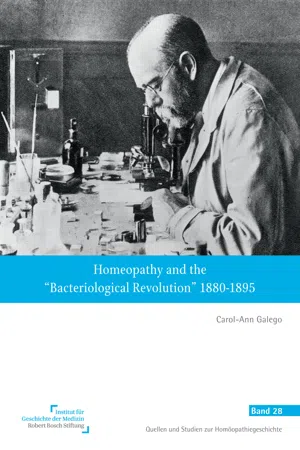
In her study, Carol-Ann Galego applies Michel Foucault's genealogical method to modern medicine's protracted war on pathogens. She excavates the early struggles that bacteriology generally, and in particular its articulation of germ theory, encountered before achieving widespread acceptance.The focus of her analysis is the responses of homeopaths in Germany and England to developments in bacteriology between 1880 and 1895 - fifteen eventful years of the "bacteriological revolution" that overlap with the fifth cholera epidemic of the nineteenth century. During these formative years, the convergence of bacteriologists' isolation and cultivation of microbes with medical efforts to quell the ravages of cholera gave rise to the now predominant understanding of infectious disease as an invasion of pathogens. At the time, however, such an antagonistic response to the threat of infectious disease was anything but unanimous. As Galego demonstrates, the nuanced understandings of disease etiology that homeopaths developed during these years, alongside their efforts to confront cholera, construct a different narrative, one that provides a fascinating counterhistory to the development of modern bacteriology and its alienating relations to microbial life.
eBook - PDF
Homeopathy and the "Bacteriological Revolution" 1880-1895
The Reception of Germ Theory and Bacteriology in 19th‐century England and Germany
- 228 pages
- English
- PDF
- Available on iOS & Android
eBook - PDF
Homeopathy and the "Bacteriological Revolution" 1880-1895
The Reception of Germ Theory and Bacteriology in 19th‐century England and Germany
About this book
Information
Table of contents
- Introduction
- Chapter One: Stuck in the Trenches: Metaphors of War and Their Stronghold on Medicine
- Chapter Two: More than Words: Genealogy and Its Relevance in the History of Infectious Diseases
- Chapter Three: The Transformation of Knowledge and Its Political Implications
- Chapter Four: A Tale of Two Worlds: Homeopathy Meets Cholera
- Chapter Five: The Tension Mounts: Isopathy and the Question of Shifting Loyalties
- Chapter Six: The Reception of Homeopathy in England
- Chapter Seven: The Reception of Bacteriology in Germany
- Conclusion
- Works Cited
- Abbreviations
Trusted by 375,005 students
Access to over 1.5 million titles for a fair monthly price.
Study more efficiently using our study tools.
Frequently asked questions
Yes, you can cancel anytime from the Subscription tab in your account settings on the Perlego website. Your subscription will stay active until the end of your current billing period. Learn how to cancel your subscription
No, books cannot be downloaded as external files, such as PDFs, for use outside of Perlego. However, you can download books within the Perlego app for offline reading on mobile or tablet. Learn how to download books offline
Perlego offers two plans: Essential and Complete
- Essential is ideal for learners and professionals who enjoy exploring a wide range of subjects. Access the Essential Library with 800,000+ trusted titles and best-sellers across business, personal growth, and the humanities. Includes unlimited reading time and Standard Read Aloud voice.
- Complete: Perfect for advanced learners and researchers needing full, unrestricted access. Unlock 1.5M+ books across hundreds of subjects, including academic and specialized titles. The Complete Plan also includes advanced features like Premium Read Aloud and Research Assistant.
We are an online textbook subscription service, where you can get access to an entire online library for less than the price of a single book per month. With over 1.5 million books across 990+ topics, we’ve got you covered! Learn about our mission
Look out for the read-aloud symbol on your next book to see if you can listen to it. The read-aloud tool reads text aloud for you, highlighting the text as it is being read. You can pause it, speed it up and slow it down. Learn more about Read Aloud
Yes! You can use the Perlego app on both iOS and Android devices to read anytime, anywhere — even offline. Perfect for commutes or when you’re on the go.
Please note we cannot support devices running on iOS 13 and Android 7 or earlier. Learn more about using the app
Please note we cannot support devices running on iOS 13 and Android 7 or earlier. Learn more about using the app
Yes, you can access Homeopathy and the "Bacteriological Revolution" 1880-1895 by Carol?Ann Galego in PDF and/or ePUB format, as well as other popular books in Medicine & Medical Theory, Practice & Reference. We have over 1.5 million books available in our catalogue for you to explore.