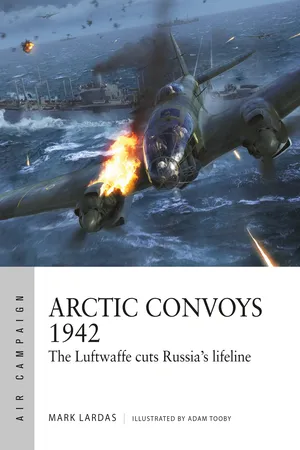
A new history of the most crucial few months of the Arctic Convoys, when Germany's air power forced the Allies to retreat to the cover of winter.
Between spring and autumn 1942, Germany was winning the battle of the Arctic Convoys. Half of PQ-15 was sunk in May, PQ-17 was virtually obliterated in July, and in September 30 percent of PQ-18 was sunk. The Allies were forced to suspend the convoys until December, when the long Arctic nights would shield them.
Mark Lardas argues that in 1942, it was Luftwaffe air power that made the difference. With convoys sailing in endless daylight, German strike aircraft now equipped and trained for torpedo attacks, and bases in northern Norway available, the Luftwaffe could wreak havoc. Three-quarters of the losses of PQ-18 were due to air attacks. But in November, the Luftwaffe was redeployed south to challenge the Allied landings in North Africa, and the advantage was lost. Despite that, the Allies never again sailed an Arctic convoy in the summer months.
Fully illustrated with archive photos, striking new artwork, maps and diagrams, this is the remarkable history of the Luftwaffe's last strategic victory of World War II.
- 96 pages
- English
- ePUB (mobile friendly)
- Available on iOS & Android
eBook - ePub
About this book
Information
THE CAMPAIGN
Battleground in the far north
Arctic convoys travelled to Russia from August 1941 until May 1945. The first convoy, code-named Dervish, departed Hvalfjörður, Iceland, on 21 August 1941. The final one, RA-67, closed the series arriving in Clyde on 30 May 1945, 23 days after Germany formally surrendered and 22 days short of four years after Nazi Germany invaded the Soviet Union.

Convoy PQ-15 was the first convoy to include a CAM ship. The ship, Empire Morn, carried a catapult-launched Sea Hurricane, or ‘Hurricat’, and provided a small measure of air cover for the convoy. (SDA&SM)
During the four years the convoys ran, the Arctic run gained a reputation as the most hazardous convoy route of the Atlantic theatre – a reputation that was merited. On a percentage basis the Arctic convoys had a higher loss rate than any other regularly scheduled convoys in the European theatre, and only the irregular Malta convoys suffered greater losses.
That reputation was gained during just one year, 1942. It was the first year Germany seriously opposed the Arctic convoys and was also the only year Germany brought the full force of the Luftwaffe against the Arctic convoys. As 1942 progressed, both sides raised the stakes, with the Allies increasing the size of their convoys and massively increasing the surface escort they provided, and with the Luftwaffe increasing the number of aircraft they used against the convoys, the variety of weapons and improving tactics.
As 1942 advanced the Luftwaffe made itself felt and Allied casualties kept mounting. They had devastated the Royal Navy in the eastern Mediterranean early in 1942, and when they turned their attention to the Arctic they proved as devastating to ships in a convoy. Britain attempted to counter the Luftwaffe’s threat as 1942 continued with increased antiaircraft protection. However, Britain lacked the one tool most effective against Luftwaffe aircraft – sufficient aircraft of their own to oppose them. Neither CAM fighters nor carrier aircraft were available early enough or present in sufficient numbers when they arrived. Therein lay the real story of the Arctic run’s violent reputation.
Origins: 21 August 1941–22 February 1942
On 21 August 1941 six merchant vessels accompanied by an oiler and escorted by nine warships departed Hvalfjörður. Five of the cargo ships flew the Red Duster; one was Dutch and all were elderly. The largest and oldest, the 11,348grt Llanstephan Castle was launched in 1914, whereas the newest, the 4,747grt New Westminster City, entered service in 1929.
While the ships were not noteworthy, their destination was: the northern Russian port city of Arkhangelsk. Established in the late sixteenth century, the city was Russia’s oldest northern port. It began as a timber port, exporting lumber to Britain, and was still largely a timber port when World War II began, with a rail link to Moscow. Nestled on the White Sea, it was icebound during the northern winter, approachable only though paths cut by icebreakers in the spring and autumn. Yet its railroad link meant supplies unloaded at Arkhangelsk could be sent to Russian battlefields or Soviet factories as needed.
The only other northern Russian ports with a rail link to inland Russia were the ports of Polyarnoe and Murmansk, located on opposite sides of Kola Bay. On the Murman coast of the Kola Peninsula, they were much newer than Archangelsk. Polyarnoe was established in 1898 and Murmansk in 1916. Their big advantage over the older port was that they remained ice-free year-round. The railroad had been built to rush war supplies unloaded at Murmansk to St Petersburg during World War I.
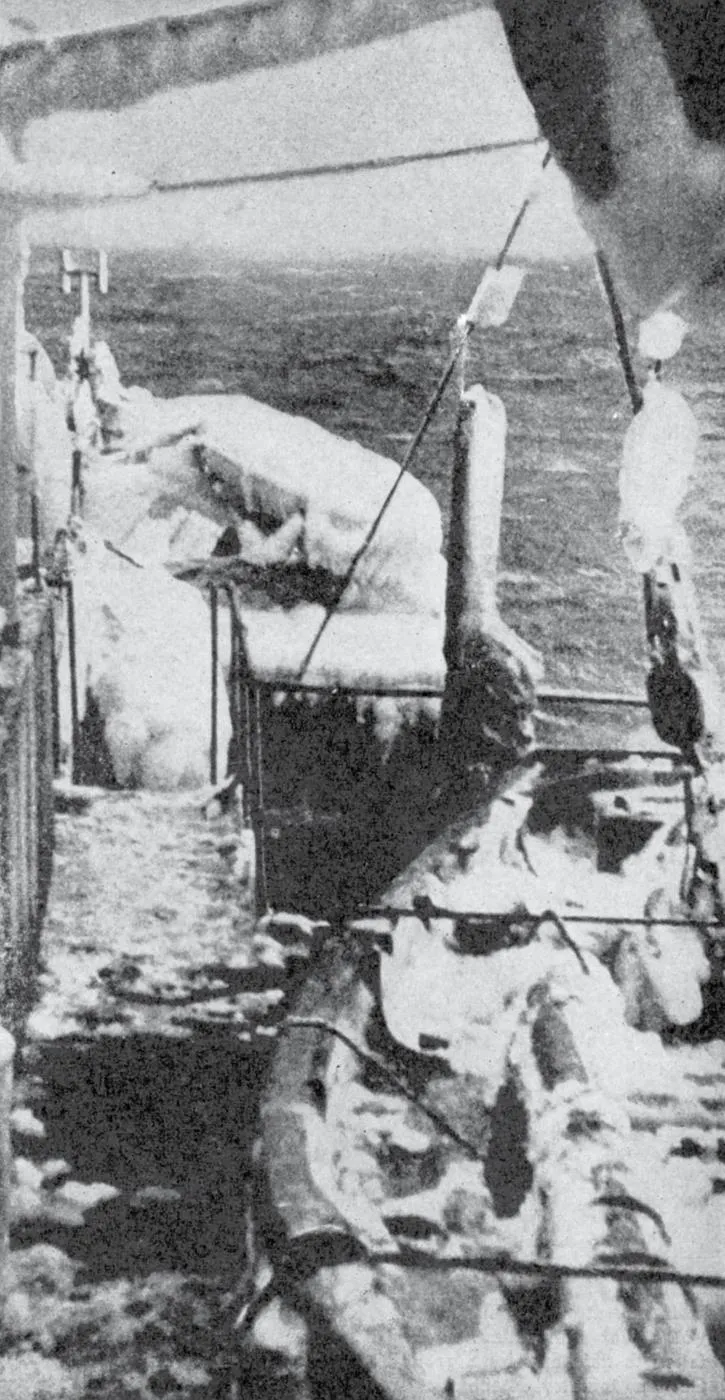
The natural hazards of the Arctic weather were compounded by the threat of Nazi aircraft, surface warships and U-boats. It was no easier for the Germans, who faced the same Arctic conditions as their Allied opponents. (AC)
In August 1941 Arkhangelsk had an edge over its Murman rival. The front line was only 15 miles from Murmansk, and Leningrad (as St Petersburg was renamed after the Russian Revolution) was newly besieged by the Axis. It was not then clear that the Soviets could keep the Axis from capturing Murmansk and, additionally, until a new railroad linking to Arkhangelsk’s Moscow line was completed in autumn 1941 what landed at Murmansk, stayed in Murmansk. Through December of that year Arkhangelsk would remain the port of destination for Britain’s Arctic convoys.
The six ships were part of a convoy code-named ‘Dervish’, hastily assembled to send cargoes needed by Great Britain’s newest ally, the Soviet Union. The ships chosen were those available, and they carried cargoes of rubber, tin and wool, raw materials desperately needed by Soviet factories. They also carried 15 crated Hawker Hurricane fighters. Dervish arrived in Arkhangelsk on 31 August.
The day before Dervish arrived, HMS Argus, the Royal Navy’s oldest aircraft carrier, along with heavy cruiser Shropshire and three destroyers left port on Operation Strength. They carried personnel from the RAF’s 151 Wing to Russia. Argus carried 24 Hurricanes, which were flown off to Vaenga, an airfield covering Murmansk, and the RAF personnel were landed at Murmansk, to assist the Soviets. The operation was covered by a Home Fleet force built around fleet carrier Victorious, two cruisers and three destroyers.
In 1941, conditions in all three Russian ports were primitive. At Arkhangelsk there were only six wharves, and these could only accommodate small ships, up to 1,000 tons. Furthermore, there were no facilities capable of carrying out major repairs, and no drydock. The oiler Aldersdale accompanied Dervish to provide fuel for the return trip, and three escorting warships were minesweepers. They provided antisubmarine protection during the voyage and remained in Russia after arrival, where they could keep the approaches clear of mines.

Aircraft carrier HMS Argus, a World War I veteran, carried the first load of Hawker Hurricanes to Russia. In Operation Strength, 24 Hurricanes flew off Argus to Vaenga, an airfield near the Murman coast. (AC)
Dervish was the first of 42 outbound convoys to Russia and 38 homeward-bound convoys from Russia via the Arctic route in World War II. While hastily arranged and improvised, it set a pattern followed later.
Churchill wanted convoys sailing to Russia once every ten days, similar to the convoy schedule in the North Atlantic. Admiralty officials convinced Churchill this was impossible, due to the heavy escort required. Dervish had a continuous escort of only three destroyers, three coal-burning antisubmarine trawlers and three minesweepers, yet it was also protected by five other escorts over at least part of the journey, including an antiaircraft cruiser. Additionally, a Home Fleet covering force went to sea in case German surface units appeared. In late 1941 the Royal Navy lacked the warships to provide a sufficiently heavy escort for a ten-day sailing schedule.
Instead, Churchill agreed to send convoys monthly. Outbound PQ convoys and inbound QP convoys were to start at roughly the same time, allowing escort resources to be maximized, and the next outbound and inbound Russian convoys constituted the first convoys in this series. The outbound ships carried cargoes on Stalin’s wish list of critical resources, and the homebound ships sailed in ballast or carried timber from Arkhangelsk.
PQ-1 departed Hvalfjörður on 28 September 1941, two days short of a month after Dervish arrived at Arkhangelsk. It was better organized than Dervish with ten cargo ships, and, except for the ancient Panamanian-flagged North King, the ships were on average a decade newer than those hastily assembled for Dervish. They carried 50,000 tons of cargo, including 20 tanks and 193 fighters. They were escorted by a heavy cruiser, a destroyer and four ocean-going minesweepers (also destined to remain ...
Table of contents
- Cover
- Title Page
- Table of Contents
- Introduction
- Chronology
- Attacker’s Capabilities
- Defender’s Capabilities
- Campaign Objectives
- The Campaign
- Aftermath and Analysis
- Further Reading
- eCopyright
Trusted by 375,005 students
Access to over 1.5 million titles for a fair monthly price.
Study more efficiently using our study tools.
Frequently asked questions
Yes, you can cancel anytime from the Subscription tab in your account settings on the Perlego website. Your subscription will stay active until the end of your current billing period. Learn how to cancel your subscription
No, books cannot be downloaded as external files, such as PDFs, for use outside of Perlego. However, you can download books within the Perlego app for offline reading on mobile or tablet. Learn how to download books offline
Perlego offers two plans: Essential and Complete
- Essential is ideal for learners and professionals who enjoy exploring a wide range of subjects. Access the Essential Library with 800,000+ trusted titles and best-sellers across business, personal growth, and the humanities. Includes unlimited reading time and Standard Read Aloud voice.
- Complete: Perfect for advanced learners and researchers needing full, unrestricted access. Unlock 1.5M+ books across hundreds of subjects, including academic and specialized titles. The Complete Plan also includes advanced features like Premium Read Aloud and Research Assistant.
We are an online textbook subscription service, where you can get access to an entire online library for less than the price of a single book per month. With over 1.5 million books across 990+ topics, we’ve got you covered! Learn about our mission
Look out for the read-aloud symbol on your next book to see if you can listen to it. The read-aloud tool reads text aloud for you, highlighting the text as it is being read. You can pause it, speed it up and slow it down. Learn more about Read Aloud
Yes! You can use the Perlego app on both iOS and Android devices to read anytime, anywhere — even offline. Perfect for commutes or when you’re on the go.
Please note we cannot support devices running on iOS 13 and Android 7 or earlier. Learn more about using the app
Please note we cannot support devices running on iOS 13 and Android 7 or earlier. Learn more about using the app
Yes, you can access Arctic Convoys 1942 by Mark Lardas,Adam Tooby in PDF and/or ePUB format, as well as other popular books in History & Military & Maritime History. We have over 1.5 million books available in our catalogue for you to explore.