Soft robotics is a subfield of robotics that encompasses the design and fabrication of robots with soft and compliant materials. Soft robots represent components like human prosthetics or biomimicking systems. Soft robotics relies on technically astute designs based on the correct choice of materials to enable a level of dexterity not possible with rigid components alone. The basic prime movers (actuators) and perception (sensors) require control systems capable of accommodating imprecise feedback data and often unpredictable reaction times. Mobility in such robots is more akin to entomological or marine systems than conventional guided vehicles. This reference is a guide to materials and systems used in soft robotics. If features 6 chapters contributed by robotics experts that review fundamental and applied topics that are important for understanding the requirements of soft robotics design projects and the physics of the polymers involved. Chapters are organized for easy reading and include references. The topics include: - Aspects of materials processing and engineering for the development of soft robotic devices - A review on biological gripping principles and their application to robotics - Information about self-sensing electroadhesive polymer grippers with magnetically controllable surface geometry - Theoretical and experimental investigations of magnetic hybrid materials - Modeling and dynamic analysis of a novel rotary soft robotic arm by transfer matrix method - Design and control of a portable continuum robot for pipe inspection assisted by a rigid manipulator This book is a suitable reference for scholars and engineers who are seeking knowledge about materials and design principles in soft robotics with its practical applications.
eBook - ePub
Soft Robotics
About this book
Information
Subtopic
Scienze applicateLearning from Nature: A Review on Biological Gripping Principles and Their Application to Robotics
J. Winand1, *, T. H. Buscher1, S.N. Gorb1
1 Department of Functional Morphology and Biomechanics, Zoological Institute of the University of Kiel, Am Botanischen Garten 1–9, D-24118 Kiel, Germany
Abstract
The process of biological evolution has resulted in a wide variety of forms, functions and strategies and this has led to distinct optimization of certain traits in organisms. Technical adoption of some “inventions of nature” might be highly beneficial for innovative developments in materials science and engineering through biomimetic studies. One prominent field of biomimetic research is related to prehension and manipulation mechanisms in robotics since these tasks are just as ubiquitous in technical environments as they are in nature. Biological end effectors with purposes ranging from simple locomotion, mating and prey catching up to delicate object manipulation have been realized there, with innumerable, sometimes subtle variants of structure and properties between them. Even though there is some coarse biological classification of biological gripping devices, the latter represent certain core principles, which evolved convergently due to the underlying basic physical phenomena. This chapter aims to categorize the most common physical principles, their advantages and shortcomings, and present a range of biological examples. Furthermore, possible transfers of functional principles from biological systems into technical environments are discussed.
Keywords: Biomimetics, Bio-inspired technology, Bionics, Manipulation, Soft grippers.
* Corresponding Author J. Winand: Department of Functional Morphology and Biomechanics, Zoological Institute of the University of Kiel, Am Botanischen Garten 1–9, D-24118 Kiel, Germany; Tel: +49 (0)431 880-4505; E-mail: [email protected]
1. Introduction
In general, biological gripping describes the act of using one or several parts of an individual’s body to create or redirect forces in such a way that the object to be gripped forms a stable mechanical connection with it, which can then be utilized in a multitude of ways. Examples include, but are not limited to, locomotion over challenging terrain features, harvesting food or catching of prey, mating behavi-
our, nest building, and communication [1]. Given this broad applicability of the generalized act of gripping and the advantages associated with it, a staggering variety of solutions evolved in natural systems. At their most basic level, however, all of them employ a specific combination of one or more elementary physical principles, the most common of which we will briefly elucidate in Section I. In Section II, the main functional principles of gripping devices in the animal kingdom will be presented and a range of examples illustrating the variability of biological grippers and their functions will be given. Afterwards, Section III will discuss the examples shown and evaluate them as to their applicability to technical environments. In addition, an overview with regard to the degree of implementation and state of the art in the biomimetic world will be provided.
2. SECTION I – PHYSICAL PRINCIPLES
As diverse and seemingly unrelated biological gripping mechanisms might seem at times, they make use of a relatively small number of physical phenomena, all of which relate to the forces contributing to contact formation between two different objects [2].
The first one of these principles is friction. When two surfaces mechanically interact in sliding contact, a force opposing the direction of motion is friction. While this is universally true for any matter (including gases and fluids), the term friction is usually used for the solid-solid aspect of the phenomenon, which is also by far the most relevant part with respect to gripping. Friction, at its very core, is rooted in the quantum mechanical Pauli Exclusion Principle, which, strongly simplified, states that no two quantum-mechanical systems may share a complete set of identical quantum numbers in the same spatial locus. This has huge implications, but with respect to the scope of this review, the most important consequence is that no two atoms may interpenetrate into each other – and by extension, neither may solid bodies. This is the elementary reason for mechanical interaction even being possible in the first place, but it also gives rise to friction. Even a hypothetical, ideally flat solid surface consists of atoms, each of which possesses an approximately spherical zone of influence, i.e., a zone of impenetrable exclusion. This actually makes it non-planar and assigns a certain “roughness” to it, in the form of ordered, hemispherically shaped exclusion zones. If this surface comes into spatial contact with another identical solid surface, there would still be mechanical obstruction of any parallel movement because those zones need to glide over one another, having to avoid each other at the same time. Furthermore, in any realistic approximation, there is no such thing as a perfectly flat solid surface, which means that different regimes of roughness ranging from the nano-scale up to macroscopic surface structures contribute to the generation of friction. The main mode of friction that needs to be considered for the purpose of this review is static friction, which describes the force with which a solid body resists lateral movement on a substrate without prior relative movement, in contrast to dynamic/kinetic friction, which describes the resistance to continuous relative movement [3]. Naturally, friction occurring for extended durations requires a closing force between both surfaces, which is called normal or load force. In many cases, this is provided simply by the Earth’s gravitational acceleration but may also be provided by any kind of mechanical actuator, for example, musculature, as exemplified in many biological gripping devices. Static friction plays at the very least a minor role in all attempts at prehending an object and reliably forming a mechanical connection with it. In many cases, static friction is the main principle behind accomplishing that task – one of the most prominent examples would be any kind of clamp gripper (e.g [4].) which works by exerting a clamping pressure on an object from opposing sides.
Apart from friction, whose influence is near-universal, there are several important core principles that are repeatedly utilized for gripping (Fig. 1). All of them create either a dynamic closing force or a static resistance to separation in the interface and can be found with varying prominence in the biological realm [5].
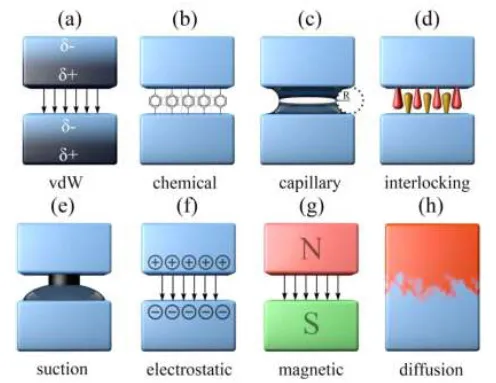
Summary of interface interactions. (a) Van-der-Waals interactions: Closing force due to electrostatic interaction between dipoles. (b) Chemical bonding: Resistance against separation either by direct chemical reactions between surfaces, forming stable chemical bonds, or mediated bonding by any type of curable adhesive, for example glues. (c) Capillary Force: Closing force due to differences in surface energy, generally mediated by fluids. (d) Mechanical Interlocking: Resistance against separation by mechanical obstruction, generally mediated by dedicated surface structures. (e) Suction Forces: Closing force due to pressure differentials. (f) Electrostatic interaction: Closing force due to interaction between charged surfaces. (g) Magnetic interaction: Closing force due to mass interactions between electron spins. (h) Diffusion: Resistance against separation due to interpenetration of polymeric chains. From [5] with permission of Wiley & Sons.
Van-der-Waals forces are omnipresent. It is a summarizing term for different kinds of electrostatic interactions between dynamic and static dipoles found in atoms and molecules. Although individually weak, they can contribute a significant portion of the adhesive force to any gripping procedure if the surfa...
Table of contents
- Welcome
- Table of Content
- Title
- BENTHAM SCIENCE PUBLISHERS LTD.
- PREFACE
- List of Contributors
- Aspects of Materials Processing and Engineering for the Development of Soft Robotic Devices
- Learning from Nature: A Review on Biological Gripping Principles and Their Application to Robotics
- Self-Sensing Electroadhesive Polymer Gripper with Magnetically Controllable Surface Geometry
- Theoretical and Experimental Investigations of Magnetic Hybrid Materials with Applications for Locomotion, Manipulation and Sensor Systems in Soft Robotics
- Modeling and Dynamic Analysis of a Novel Rotary Soft Robotic Arm by Transfer Matrix Method
- Design and Control of a Portable Continuum Robot for Pipe Inspection Assisted by a Rigid Manipulator
Trusted by 375,005 students
Access to over 1.5 million titles for a fair monthly price.
Study more efficiently using our study tools.
Frequently asked questions
Yes, you can cancel anytime from the Subscription tab in your account settings on the Perlego website. Your subscription will stay active until the end of your current billing period. Learn how to cancel your subscription
No, books cannot be downloaded as external files, such as PDFs, for use outside of Perlego. However, you can download books within the Perlego app for offline reading on mobile or tablet. Learn how to download books offline
Perlego offers two plans: Essential and Complete
- Essential is ideal for learners and professionals who enjoy exploring a wide range of subjects. Access the Essential Library with 800,000+ trusted titles and best-sellers across business, personal growth, and the humanities. Includes unlimited reading time and Standard Read Aloud voice.
- Complete: Perfect for advanced learners and researchers needing full, unrestricted access. Unlock 1.5M+ books across hundreds of subjects, including academic and specialized titles. The Complete Plan also includes advanced features like Premium Read Aloud and Research Assistant.
We are an online textbook subscription service, where you can get access to an entire online library for less than the price of a single book per month. With over 1.5 million books across 990+ topics, we’ve got you covered! Learn about our mission
Look out for the read-aloud symbol on your next book to see if you can listen to it. The read-aloud tool reads text aloud for you, highlighting the text as it is being read. You can pause it, speed it up and slow it down. Learn more about Read Aloud
Yes! You can use the Perlego app on both iOS and Android devices to read anytime, anywhere — even offline. Perfect for commutes or when you’re on the go.
Please note we cannot support devices running on iOS 13 and Android 7 or earlier. Learn more about using the app
Please note we cannot support devices running on iOS 13 and Android 7 or earlier. Learn more about using the app
Yes, you can access Soft Robotics by Gareth J. Monkman in PDF and/or ePUB format, as well as other popular books in Tecnologia e ingegneria & Scienze applicate. We have over 1.5 million books available in our catalogue for you to explore.