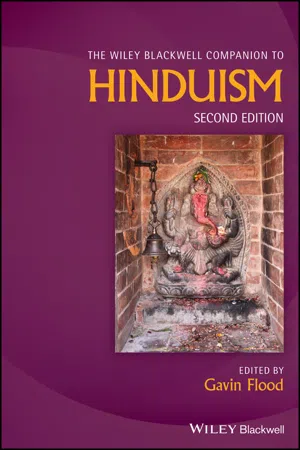
In The Hill of Devi, a lyrical collection of essays and letters recounting his travels in India, E. M. Forster describes his visit to a Hindu temple as a tourist’s pilgrimage driven by a mixture of curiosity, disinterestedness, loathing, and even fear. Like the Hindu festival scene he paints in A Passage to India, the Gokul Ashtami festival he witnesses is characterized as an excess of color, noise, ritual, and devotional fervor. Forcing himself to refrain from passing judgment, Forster finds it impossible to retain his objectivity the closer he approaches the shrine, the cavern encasing the Hindu stone images (“a mess of little objects”) which are the object of such frenzied devotion. Encircled by the press of ardent devotees, Forster is increasingly discomfited by their almost unbearable delirium. Surveying the rapt faces around him, he places the raucous scene against the more reassuring memory of the sober, stately, and measured tones of Anglican worship. His revulsion and disgust reach a peak as he advances toward the altar and finds there only mute, gaudy, and grotesque stone where others see transcendent power (Forster 1953, 64).
And then, just as Forster is about to move along in the ritual pilgrims’ formation, he turns back and sees the faces of the worshippers, desperate in their faith, hopelessly trusting in a power great enough to raise them from illness, poverty, trouble, and oppression. Transfixed by the scene, Forster sees reflected in their eyes the altered image of the deity before them. As he wends his way through the crowd, he is overwhelmed by the confusion of multiple images of the Hinduism he has just witnessed: of garlanded, ash-smeared, bejeweled stone on one hand, and of the inexpressible power of deepest personal yearnings, desires, and needs on the other. If he is disgusted by the noisy displays of Hindu worship, he is moved beyond words by the eloquent silence of the pain and tribulation from which believers seek deliverance. In their taut, compressed faces he finds a Hinduism to which he can relate, as surely as he is alienated by the other face of Hinduism blazoned by conch shells, camphor, and cymbals. He can conclude that, though “there is no dignity, no taste, no form…. I don’t think one ought to be irritated with Idolatry because one can see from the faces of the people that it touches something very deep in their hearts” (Forster 1953, 64).
Forster’s personal odyssey frames an experience of Hinduism that, in its exquisite detail and ultimate compassion, is far more nuanced than is its portrayal in some of his other better-known works. In A Passage to India Hinduism is depicted as a belief system with a “boum” effect, a metaphysically infuriating religion blurring the Manichean divisions between good and evil that inform western theology as much as western law, and comprise the dualities that help to define the nature, cause, and agent of crime as well as its punishment. But as Godbole, the novel’s comically inscrutable Brahmin character, avers portentously, how can crime be known so categorically when all participate equally in its commission? If everyone is complicit in acts of evil, would not all have to be punished equally too? It is this jumble of incoherent metaphysical murmurings, apparently sanctioned by Hindu belief, that exasperates Fielding, the English character most sympathetic to India. Unlike the colonial officers ruling the country, Fielding develops an emotional affinity with Indians, particularly the effervescent Muslim doctor Aziz. But even the resilient Fielding is overwhelmed by the bewildering course of events culminating in Aziz’s trial for rape of an English woman and then his subsequent acquittal. The trial turns Aziz into a fiery nationalist, willing to sacrifice even his friendship with Fielding to act upon his newfound political consciousness. An ecstatic scene of Hindu devotion marks the climax of the novel. As the birth of the god Krishna is celebrated, virtually turning princes and paupers alike into frolicking adolescents, the very imagery of Hinduism as an infantilizing religion fuses into the central image of the infant Krishna. It is no wonder that after the explosive confrontation between colonizer and colonized unleashed by Aziz’s wrongful arrest, no one can tell, as the English accuser Adele Quested discovers, whether evil lies in dark, hollow mountain caves or in the cavernous courtrooms of the colonial state. The raucous Hindu festival confirms the indeterminacy of events and their causes. And as the disillusioned Fielding sets sail from India soon after these events, it is only natural that he should feel the return of reassuring order and balance in his life as he passes the stately, proportionate architecture of Venice, described with barely disguised relief as “the civilization that has escaped muddle” (Forster 1970, 275). For Fielding, the decorum and harmony of the Venetian facades restore the principles of perspective and truth that had been entirely lost in the chaos of India, a chaos that is best represented by the metaphysical and aesthetic insufficiency of its religions: “The buildings of Venice, like the mountains of Crete and the fields of Egypt, stood in the right place, whereas in India everything was placed wrong. He had forgotten the beauty of form among idol temples and lumpy hills; indeed, without form, how can there be beauty?” (Forster 1970, 275).
The Modernity of Hinduism
That so sympathetic a figure as Fielding should resort to western aesthetic standards to evaluate Hinduism is a measure of how corrosive was the colonial experience even for those more favorably disposed to India. The western framework was never far from being a point of reference, even when the object was to critique the doctrinaire aspects of Christianity and uphold the east as a spiritual model for the materialistic west. An inability to view Hinduism on its own terms has shaped the study of comparative religion, whether to prove the superiority of Christianity or to show that Hinduism is part of the Christian teleology; to demonstrate, as Antony Copley calls it, a universalist theology that includes Hinduism as much as it does Christianity (Copley 1997, 58). The phase of western scholarly engagement with eastern religions, commonly referred to as the period of Orientalism, is often described as less hostile to Indian culture than the Anglicism that superseded it. Yet colonial perceptions of Hinduism should not be divided along the lines of those who were positively inclined and those who were opposed, since this assumes hostile reactions are produced by the intrusion of a western framework of reference and benevolent ones by its suspension, whereas it is clear the same frame persists regardless of whether the attitude is positive or negative.1 The comparative perspective reveals that western observers of Hinduism were just as keenly assessing Christianity’s place in European world domination as they were looking toward other belief systems to advocate the roots of a proto-religion.
The interest in other religions was inevitably sparked by the need to chart the progress of civilization on scientific principles, which included tracing the evolution of religious consciousness. The search for earlier prototypes of the more evolved religions, of which Christianity was the prime example, led scholars to seek out comparable features, such as monotheism, a salvational scheme, and notions of the afterlife, in other religions. While the earliest travelers recorded their accounts of idolatrous worship by the peoples of India (Embree 1971), later scholars found in Vedic, Sanskrit hymns some indication that the object of Hindu worship was not mere stone but an abstract entity bearing some resemblance to the object of monotheistic worship. For such scholars, “Hinduism” was located in this combination of oral and written texts, and this textualized Hinduism was soon privileged as the religion on which subsequent attention was focused. Though Sanskritic Hinduism was far from representative of the worship of diverse peoples, it was made to define a whole range of heterogeneous practices that were then lumped together to constitute a single religious tradition termed “Hinduism”.2
The new textual discoveries of the eighteenth century led British Orientalists like William Jones, Nathaniel Halhed, and Henry Colebrooke to conclude that the religion practiced by Hindus was highly evolved, confounding the colonial assumption that all cultures outside the Christian pale were primitive, tribalistic, and animistic. As a result, in acknowledgment of the religious authority colonialism and the construction of Hinduism wielded by Hindu pandits (learned, religious men) who also doubled as native informants and commentators of Sanskrit texts, British authorities scrupulously sought to co-opt them in the colonial enterprise. Rather than alienate them by opposing their practices, administrators found it more strategic to use their knowledge as the basis for codification of Hindu law. Such accommodation of native knowledge and practices was in stark contrast to colonialism’s systematic effacement of indigenous practices of religious worship in certain African societies (Hefner 1993). Whether as rank superstition or sublime philosophy, Hinduism challenged the unimpeded exercise of British rule, especially when it was perceived to be closely associated with the spread of Christianity. Because they feared that the colonial control of India would be regarded entirely as a Christianizing mission, British administrators remained at a distance from Christian missionaries and kept a close eye on their activities to ensure that they did not jeopardize their strategic relations with the comprador classes by provoking conflict with Hindus. To be sure, current scholarship gives much less attention to the colonial engagement with Indian Islam than with Hinduism (although there are notable exceptions: Lelyveld 1978; Metcalf 1982; Gilmartin 1988). The standard rationale is that Islam, like Christianity, was monotheistic, and since Christian missionaries were singularly focused on an anti-idolatry campaign, which Islam also shared, Christianity and Islam would seem to share similar goals, at least with regard to Hinduism. Yet interestingly Christian missionaries never saw themselves in alliance with Muslims in their campaign against Hinduism. In fact, there was a three-way contestation between Hindu pandits, Christian missionaries, and Muslim and Sufi pirs whose impact lies in the development of a field of apologetics asserting the claims of the respective religions. In his study of anti-Christian apologetics, Richard Fox Young suggests that “at about the time that Hindu pandits were recovering from their reluctance to counteract the threat posed by an alien and increasingly powerful religion in their midst, scholarly Christian evangelists were engaged in developing specialized terminology in Sanskrit for propagating their message more effectively than had theretofore been possible” (Young 1981, 15; Young’s focus is on Hinduism’s refutation of Christianity rather than of Islam). In this context Young deems it more appropriate to term the developments in India post-1850 not as renascent but as resistant Hinduism.
One of the most striking advances in modern scholarship is the view that there is no such thing as an unbroken tradition of Hinduism, only a set of discrete traditions and practices reorganized into a larger entity called “Hinduism” (Frykenberg 1989; von Stietencron 1989). If there is any disagreement at all in this scholarship, it centers on whether Hinduism is exclusively a construct of western scholars studying India or of anticolonial Hindus looking toward the systematization of disparate practices as a means of recovering a precolonial, national identity. Many will argue that there is in fact a dialectical relation between the two. In this view, as summarized by Richard King in Orientalism and Religion, nationalist Hindus appropriated a construct developed by Orientalist scholars and used it for their own purposes, producing the notion of a culturally superior Hinduism. In turn, nationalist adaptations of Orientalist scholarship formed the basis for contemporary (New Age?) representations of India as the eternal land of spirituality. The important point is that Orientalism remains the point of reference for Hinduism’s current identification with mysticism and spirituality. Indeed, the work of King among others suggests that it is often impossible to distinguish western understandings of Hinduism from those of Indian nationalists, since “through the colonially established apparatus of the political, economic, and educational institutions of India, contemporary Indian self-awareness remains deeply influenced by Western presuppositions about the nature of Indian culture” (King 1999, 117). In this view, all notions of Hinduism deployed by Indian nationalists to create an overarching cultural unity have little reference to the lived religious experience of the people but, rather, derive from Western readings of a textualized ...