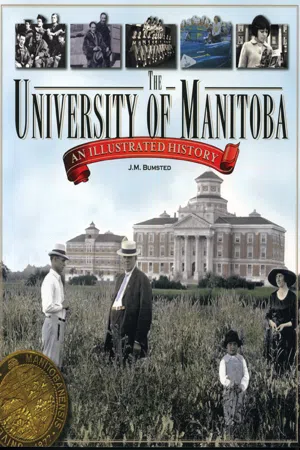
Established in 1877, just seven years after the founding of the province itself, the University of Manitoba has grown to become an international centre of research and study. It is the birthplace of discoveries such as the cure for Rh disease of newborns and the development of Canola, and its alumni include Marshal McLuhan, Margaret Laurence, Monty Hall, Israel Asper and Ovide Mercredi.Historian J.M. Bumsted looks at how the university was forged out of the assembly of several, small, denominational colleges, and how it survived and even thrived during challenges such as the 1932 defalcation and the 1950 Manitoba flood. He gives special attention to student life at the university, tracing the changes, from Freshie initiations in the 1920s and student musicals in the 1950s to the activism of the 1960s and 1970s.
The University of Manitoba: An Illustrated History is an entertaining and lively social history of an institution whose development has reflected the changes of society at large.
On 28 February 1877, An Act to Establish a Provincial University passed its third reading in the legislature of the province of Manitoba. Like so many establishments in Manitoba in those heady days, that of a university was at least extremely precipitate, if not positively premature. The province itself had only been created by the government of Canada in 1870 under pressure of armed rebellion, led by Metis who did not want to be placed in colonial tutelage. The city of Winnipeg had been incorporated three years later, when its population was about 3500 and it contained about 900 buildings. Historian George Bryce—one of the first professors at Manitoba College—later observed, “It showed a consciousness of its own importance when Winnipeg was incorporated that it at once became a city. It did not go through the chrysalis stage of village or town.” To a considerable extent, the early inhabitants of both province and city had an optimistic sense of their own destiny that partially justified this impatience.
The early establishment of a university in Manitoba has often been credited to the colleges for which the university would, for many years, act as the degree-granting body. But although the three founding colleges—St. John’s College, Manitoba College, and St. Boniface College—were willing to become part of a university, they had not particularly initiated the process of creating one. That honour must go to the province’s lieutenant-governor, Alexander Morris, who, in his 1877 speech from the throne, had pressed for the creation of a university and dragged the government of the day along with him in his enthusiasm. Until there was a university in the province, of course, bright young men who wanted higher degrees had to travel hundreds, if not thousands, of miles to acquire them. Often such men did not return to Manitoba.
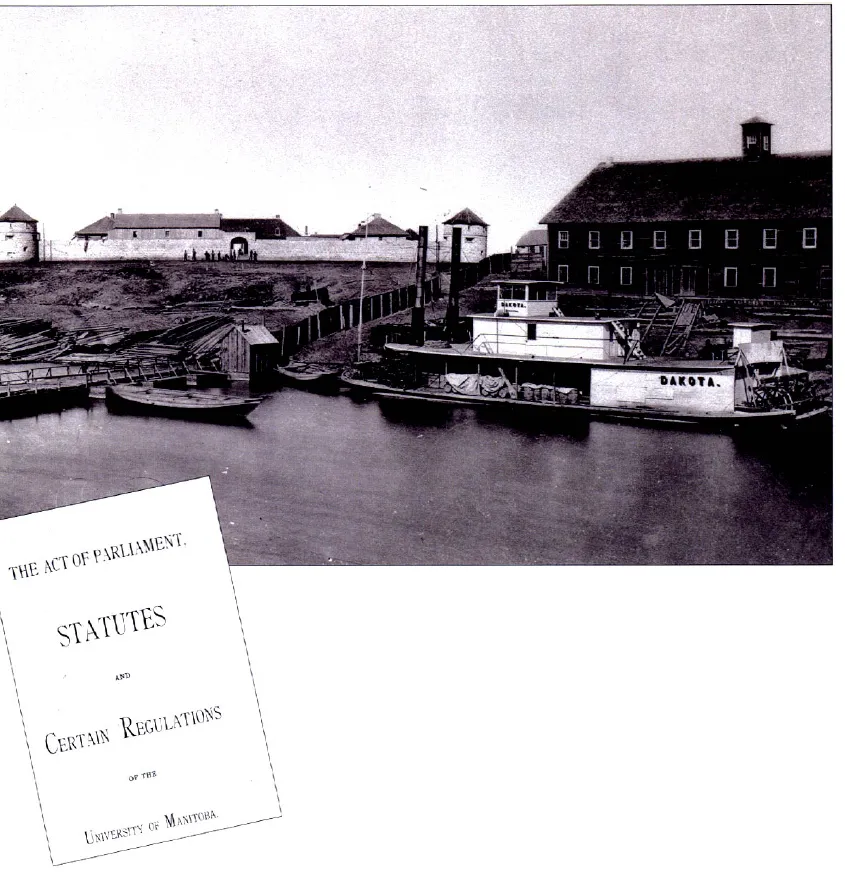
Upper Fort Garry in the early 1870s, seen from the St. Boniface side of the Red River (PAM); the title page of the 1877 University of Manitoba Act (UMA).
Follow for extended description
At the beginning, only the men were allowed to seek higher education in the province. The first woman was admitted to university examination in Manitoba in 1886, only a few years after women had first been admitted to eastern universities like Toronto and Queen’s; this student, Miss Jessie Holmes, graduated in 1889. We have no recorded reaction of a Manitoba student to this innovation, although Winnipeg clergyman Charles W. Gordon (who had been a student at Queen’s) recorded in his autobiography: “While I personally voted for the extension of university privileges to women I was conscious of a secret feeling of which I was somewhat ashamed, that something of the lofty splendor of university had departed with the advent of women. It was a little like playing baseball with a soft ball.” Such attitudes help explain why, until the twentieth century, few women could be found in the classrooms of the university or its colleges.
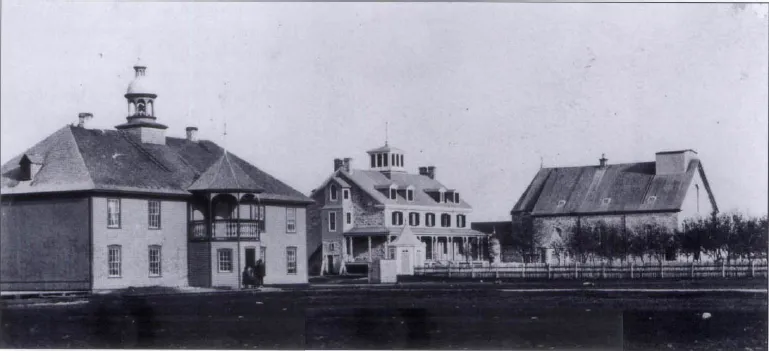
Upper Fort Garry in the early 1870s, seen from the SI. Boniface side of the Red River (PAM); the title page of the 1877 University of Manitoba Act (UMA). Above: St. Boniface College, with Bishop’s Palace and Cathedral, in 1878, just after the establishment of the University of Manitoba (PAM).
Follow for extended description
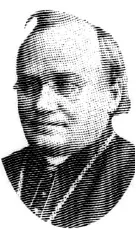
Alexandre-Antonin Tache
(1823-1894) was born in Quebec, and came to Red River in 1845. Made bishop of St.Boniface of 1853 (and archbishop in 1871), Tache was one of the main leaders of Manitoba’s francophone community and its principal advocate in the years after the Red River Rebellion. After Manitoba entered confederation in 1870, Tache fought tirelessly for guarantees of bilingualism and biculturalism in the new province.
At the time of its establishment, the University of Manitoba joined about twenty other degree-gran ting institutions of higher learning in the Dominion of Canada. Most of them were small undergraduate operations with fewer than 100 students each. A majority was, like the founding colleges of the U of M. denominational in affiliation, designed mainly to train clergymen. The new university in Manitoba was the first degree-granting institution created west of southern Ontario, It was also the first in Canada to be strictly organized on a federative basis and the first such university to survive for more than a few years. (The University of Toronto was quasi-federative, while the University of Halifax, designed to federate a number of Nova Scotia colleges, was founded in 1876, but lasted only a few years.) The early models for the new prairie university were Canadian, British, and—much less frequently—American.
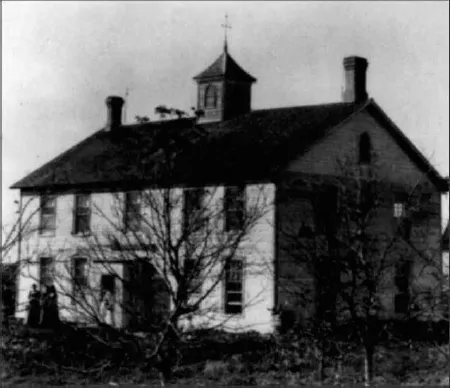
The original building of Manitoba College in the 1870s (RAM).
The university was founded in some terminological confusion and controversy. The leader of the Roman Catholic Church and francophone community in Manitoba, Bishop Alexandre Tache, had made his support of a university conditional on its having no teaching establishment of its own. Concerned about the implications of a single, secular educational institution—likely to be dominated by Protestant anglophones—Tache sought to ensure that higher education in the province would remain in the hands of the colleges, one of which was the francophone and Catholic St. Boniface College. The first university act was based largely on the Ontario University Act of 1853 and the model of the University of London, a degree-granting institution with no teaching function of its own. The confusion came over Section 10, which had different wording in the French version from that of the official version passed (in English) in the legislature. The printed statute, as translated into French, referred specifically to the University of London, and the official version had the phrase “at present” after the statement that the university would have no professors or teachers. Tache had been brought onside by assurances that the university would never teach, while the official act allowed for eventual teaching as well as examining. As a result, the bishop refused to sit on the University Council formed under the act, and was represented by a delegate.
The early meetings of the University Council were held in various rooms in the city of Winnipeg. Several students of St. John’s College were ordered to report to the first registrar in order to register. The registrar, Major E.W. Jarvis, produced a half-sheet of writing paper and had the students inscribe their names on it. The minimal functions of the early university were financed by small legislative grants and by fees for examining students and for the conferring of degrees. At the beginning, all teaching was carried on in the colleges, which were basically secondary schools with a small university component added at the top. As well as the Catholic St. Boniface College, the early university was composed of St. John’s College, which was Anglican in foundation, and Manitoba College, which was Presbyterian and had been moved in 1874 from Kildonan to Winnipeg, where it purchased a building on the northwest corner of Main and Henry streets. St. John’s and St. Boniface had both been in existence, off and on, since the earliest days of the Red River Settlement. Much of the public money for early higher education came from the province’s marriage licence fees, which in 1884 contributed $3756.49 to its support. The marriage licence fees, which were assigned to the university between 1884 and 1889, were distributed to each classical, affiliated college in proportion to the amounts paid by members of the religious denomination to which it belonged, with any surplus apportioned equally to the colleges.
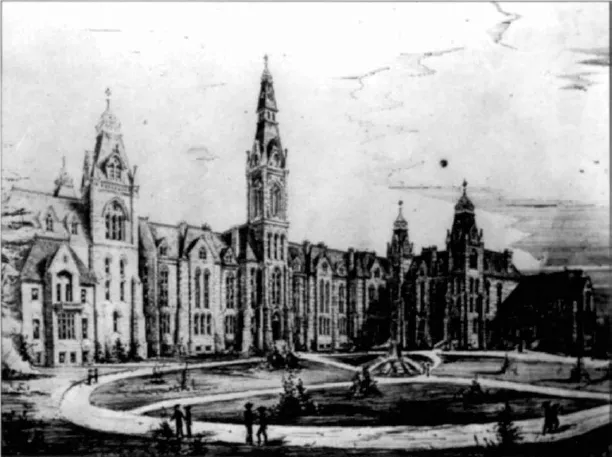
An architect’s drawings of a proposal for a greatly expanded St. John’s College, 1883 (PAM). The intention to use an English model for the college is quite evident in this drawing; the spires suggest Cambridge rather than Oxford.
Follow for extended description
In 1872 St. John’s built a new building on St. Cross Street in what is now the North End, completing it in 1874. It was a rambling two-storey building with a veranda running its entire length. The building contained classrooms, a library, a dining hall, teaching rooms, and dormitories. St. John’s moved to new quarters on Main Street at Church Avenue in 1884, but the college students were returned in 1885 to their old building. St. Boniface College laid the cornerstone for a new building just east of the cathedral in St. Boniface in 1880. The building was thirty-six metres by eighteen metres and had four storeys. It housed both classrooms and residence students. Manitoba College in 1882 erected a new building with flaring eaves and twin turrets on Ellice Avenue at Vaughan. Initially “out in the country,” as the city of Winnipeg expanded, Manitoba College had by far the best location of the three founding colleges. Wesley College, whose foundation was anticipated by the Manitoba legislature in 1877 was finally affiliated with the university in October 1888. At the time it was located in rented quarters, but it was raising funds for a building on Portage Avenue.
A Final Examination in Philosophy from 1899.
UNIVERSITY OF MANITOBA EXAMINATIONS, MAY, 1899 MENTAL AND MORAL SCIENCE-SPECIAL COURSE SC...
Table of contents
Cover
Half Title Page
Title Page
Copyright Page
Dedication
Table of Contents
Preface
Acknowledgements
Chapter 1 1877-1900
Chapter 2 1900-1915
Chapter 3 1915-1932
Chapter 4 1932-1945
Chapter 5 1945-1958
Chapter 6 1958-1970
Chapter 7 1970-1977
Epilogue
Appendix
Selected Reading
Trusted by 375,005 students
Access to over 1.5 million titles for a fair monthly price.
Study more efficiently using our study tools.
Frequently asked questions
Yes, you can cancel anytime from the Subscription tab in your account settings on the Perlego website. Your subscription will stay active until the end of your current billing period. Learn how to cancel your subscription
No, books cannot be downloaded as external files, such as PDFs, for use outside of Perlego. However, you can download books within the Perlego app for offline reading on mobile or tablet. Learn how to download books offline
Perlego offers two plans: Essential and Complete
Essential is ideal for learners and professionals who enjoy exploring a wide range of subjects. Access the Essential Library with 800,000+ trusted titles and best-sellers across business, personal growth, and the humanities. Includes unlimited reading time and Standard Read Aloud voice.
Complete: Perfect for advanced learners and researchers needing full, unrestricted access. Unlock 1.5M+ books across hundreds of subjects, including academic and specialized titles. The Complete Plan also includes advanced features like Premium Read Aloud and Research Assistant.
Both plans are available with monthly, semester, or annual billing cycles.
We are an online textbook subscription service, where you can get access to an entire online library for less than the price of a single book per month. With over 1.5 million books across 990+ topics, we’ve got you covered! Learn about our mission
Look out for the read-aloud symbol on your next book to see if you can listen to it. The read-aloud tool reads text aloud for you, highlighting the text as it is being read. You can pause it, speed it up and slow it down. Learn more about Read Aloud
Yes! You can use the Perlego app on both iOS and Android devices to read anytime, anywhere — even offline. Perfect for commutes or when you’re on the go. Please note we cannot support devices running on iOS 13 and Android 7 or earlier. Learn more about using the app
Yes, you can access The University of Manitoba by J.M. Bumsted in PDF and/or ePUB format, as well as other popular books in History & History of Education. We have over 1.5 million books available in our catalogue for you to explore.