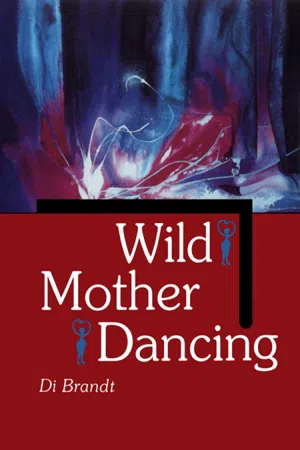
Wild Mother Dancing challenges the historical absence of the mother, who, as subject and character, has been repeatedly suppressed and edited out of the literary canon. In her search for sources for telling the new (or old, forbidden story) against a tradition of narrative absence, Brandt turns to Canadian fiction representing a variety of cultural traditions—Margaret Laurence, Daphne Marlatt, Jovette Marchessault, Joy Kogawa, Sky Lee—and a collection of oral interviews about childbirth told by Mennonite women. The results broaden, enrich, and finally recover the motherstory in ways that have revolutionary implications for our institutions and imaginations.
- 197 pages
- English
- ePUB (mobile friendly)
- Available on iOS & Android
eBook - ePub
About this book
Information
These Our Grand-mothers
Jovette Marchessault’s Like a Child of the Earth, Mother of the Grass and White Pebbles in the Dark Forests

Lorna Irvine, in Subversion, describes women’s writing as typically double, split between the requirements of public, malecentred discourse and female desire (Irvine 1986, 3-19). This doubleness, argues Irvine, echoing Lacan, implies a split within the self, an unavoidable duplicity in the female speaking subject. Irvine envisions this split as a dynamic and subversive force in women’s fiction, able to break open conventional ways of seeing and knowing. Julia Kristeva and Alice Miller have similarly demonstrated that female desire, and the female imaginary, when taken seriously as the existential, and cultural, ground of women’s experience, becomes a site of healing, both for the split female subject and for the structures that support it (Kristeva 1980; Miller 1990). Such healing often does not occur without great internal conflict, leading to separation and/or transformation; sometimes it can lead to death. Kristeva talks about the borderline of psychosis that must be risked and negotiated in order for the suffering subject to reclaim her experience from the “void” of the unnameable (1980, x). Carol P. Christ describes suicide as one of the possible tragic results if personal awakening in women is not accompanied by adequate social support (1980, 27-40). Marchessault’s preoccupation with the healing not only of the speaking subject but of the planet as a whole means that the entire universe must be called upon to witness the spectacle of ongoing violence, which perpetuates the splitting of consciousness and experience, and to participate in its reuniting through recognition and protest.
While most contemporary writers of Western European ancestry have scrupulously avoided the question of “origins” in writing because of its Christian-metaphysical implications, Marchessault leaps without hesitation into this cosmic terrain. At the end of the first volume, Like a Child of the Earth, the narrator, Jeanne (we find out her name in the third volume), exhorts us to break through our customary amnesia and recollect our magical, celestial origins:
Women, do not be stunned. Men, do not be stunned. Instead, take your throat between your two hands and force yourself to spit up a river of sleeping pills. Make connections! Interweave yourselves! Commit yourselves to memory in the time of your childhood, in the time of your permanent emotion. Tear yourselves down to the weft of your being and rally all of your memories. Memories in your cells, memories in your head, memories in your heart, in your soul, and in the infinitely mercurial memories of your spirit. (Like a Child of the Earth, 166)
She then takes us on a journey to “remember” her own blissful pre-existence among the stars, and subsequent “fall, ” through the ear and mouth of the great She-Wolf in the sky, “descending straight down like a spit from the sun” (Like a Child of the Earth, 176) into human birth as a girl child.
Gloria Orenstein describes Marchessault’s birth narrative, here (and in the later, more overtly lesbian “A Lesbian Chronicle from Medieval Quebec”), as a feminist-lesbian revisioning of the classic hero myth, in which a male child is imagined to have divine or noble origins, who is abandoned at birth, raised in exile by humble people, and eventually called to his heroic destiny as the leader of his people through certain events. In Marchessault’s version, says Orenstein, “For the first time in its long history from Sappho to Adrienne Rich, from Renee Vivien to Rita Mae Brown, an extraterrestrial heroine makes her appearance in lesbian literature, heralding the advent of a new myth of origins for woman-identified women” (Orenstein 1987, 188-89). The moment of her “sacred fall” (Like a Child of the Earth, 173) also re-enacts the traditional Christian-classical story of the hero’s fall from heaven, with these significant differences: this fall is not precipitated by pride, or hubris, as in the case of Lucifer and Icarus, but, rather, the heroine’s parent stars rejecting her, “pushing” her into generation. “That is what it is all about,” laments the narrator, remembering her life prior to earthly conception, “– it is about rejection. On earth we speak of birth, but the word birth is a word which we have borrowed from the void, from the super-void.... They were going to reject me. They were going to turn me away once again. They were going to double-lock the door and throw me out into the generation of fathers” (Like a Child of the Earth, 167). The fall is thus in itself, quite apart from the intentions of the heroine, a begetting, a birthing, a letting go, and not a separate, contrary moment from creation, as in the Christian/classical view. For Marchessault, the separation that occurs in the moment of conception and birth, and the ongoing separation into individuality – albeit traumatic and filled with “rejection” for the child – are simply part of the reproductive process, and deeply connected to the physical reality of the cosmos, that is envisioned here as a kind of primal maternal body,
What is striking here on the theme of “origins” is both the physicality of the universe, and its personal, feminine aspect. The stars are not an abstract metaphor for disembodied spirits in a male-defined heaven, nor are they alienated blobs of gravitational matter floating around in empty space. “The Milky Way,” for Marchessault, is a physical place, best described in personal, experiential terms, with fields to walk in, and sunsets to paint. It is, furthermore, deeply resonant with the image of a woman, the Grandmother. “I heard the music of an ancient dance issuing from the void,” the narrator tells us, remembering the moment just before her fall, “or, more precisely, coming from the womb of the Grandmother. Her over-flesh, over-earth, over-sea womb was coming toward us, breaking its moorings” (Like a Child of the Earth, 166). It is difficult, I think, for readers steeped in Western thought to appreciate the implications of this vision, and the radical challenge it offers to non-Native, dualistic thinking: there isn’t a fall into conception, there isn’t a fall away from Idea, or Word, or Spirit, into the body, there isn’t a fall from father sky to mother earth. There is rather a passage, a birth-giving, from one state of physical/spiritual being into another, through the celestial body of the She Wolf, her ear canal, her mouth, helped along with a swat from the paws of the presiding Great She-Bear of the sky. Our biggest mistake, according to Marchessault, is forgetting our physical/spiritual connections to the cosmos, and its formidable reproductive, regenerative power. “It was an absolutely new beginning,” exclaims the narrator at the end of Like a Child of the Earth, “and you will never make me believe that everything is motivated by the unconscious or the subconscious. I say that the whole source of motivation is metaphysical, that it falls in a direct line from the Great Spirit and from the Great She-Bear’s breasts, with every kind of admirable sign, miracle, and mutation, and it is this unique source which impregnates us” (Like a Child of the Earth, 175).
Mary Crow Dog, in her recent autobiography, Lakota Woman, offers the following explanation of the North American Native visionary practice, and describes what happened in a ceremony that was banned by the American government in the nineteenth century, and revived on a Sioux reservation in 1974:
Dreams and visions are very important to us, maybe more important than any other aspect of Indian religion. I have met Indians from South and Central America, from Mexico and from the Arctic Circle. They all pray for visions, they are all “crying for a dream,” as the Sioux call it. Some get their visions from fasting for four days and nights in a vision pit on a lonely hilltop. Others get their visions fasting and suffering during the long days of the Sun Dance, gazing at the blinding light in the sky. The Ghost Dancers went around and around in a circle, chanting until they fell down in a swoon, leaving their own bodies, leaving the earth, wandering along the Milky Way and among the stars. When they woke up they related what they had seen. Some found “star flesh” in their clenched fists, and moon rocks, so it is said. (Crow Dog 1991, 98-99)
The mythic visionary nature of the universe, in other words, is experienced by its practitioners, through dreams and rituals, as literally, physically, demonstrably real. Crow Dog describes how the missionary superintendent at Pine Ridge Sioux Indian reserve tried to discredit Native medicine men during the 1940s by “exposing” their rituals. The leading medicine man, Horn Chips, was asked to perform a yuwipi (magic) ceremony for a group of white observers, who supervised the preparations. “To the disappointment of the watching missionaries,” relates Crow Dog, “the mystery sparks appeared out of nowhere and the gourds flew around the superintendent’s head. The result was that many Christian Indians went back to the old Lakota religion” (Crow Dog, 211). Within the North American Native mythic paradigm, then, the Western dichotomy between science and the imagination does not make any sense. Magical events are observable and performable, and therefore “scientifically” true. But in order for them to occur in the first place there has to be imagination and belief on the part of the participants. There do not appear to be any inherent limits to the kinds of imaginative/experiential connections that can be made between individuals and the universe through visionary practice; the only limits stem from lack of intention and focus in the believers themselves.
Nuclear physicist Fred Alan Wolf, author of Taking the Quantum Leap (1981) and The Eagle’s Quest (1991), argues that the newest insights of nuclear quantum physics correlate to a remarkable degree with ancient shamanic teachings. Heisenberg’s famous uncertainty principle, which announced that it is impossible to determine the location and the momentum of a particle simultaneously, shattered Western belief in the material certainty of the world we live in. Determinism and causality, the cornerstones of Western science, no longer hold in the quantum universe. According to the new quantum physics, explains Wolf, electrons do not actually have mass and therefore do not occupy identifiable space. They are rather tendencies, concepts, ideas, probabilities:
We can’t even specify at any moment what the condition of reality is because of the uncertainty principle; instead we have probable possibilities. These possible particles represent a cloud of possibilities in which the actual particle is somehow enfolded but is not actually present as an object would be, like an ash tray or cup. . . . Quantum physics tells us there isn’t really any such thing as a particle, only possible particles.” (Wolf, as cited in Leviton 1992, 52)
The virtuality of matter throws the focus back on the observer, and particularly the observer’s intent. Our intent influences the materialization of electrons out of their virtual state of infinite probability. It is therefore our belief that makes reality appear in a given manifestation. “The observer effect,” argues Wolf, “is probably the most important thing we’ve ever discovered in terms of relating magic to physical reality. If you take quantum mechanics as it’s presently understood, that’s magic. You have a cloud of possibilities that suddenly manifest into one actuality” (Wolf, as cited in Leviton 1992, 53).
Wolf argues further that in order to become more focussed in our intent, more consciously “cocreative” with the universe, we must integrate its feminine aspect into our nature. “1 learned that the magic in me was in my feminine spirit, in my reawakened feminine core,” he explains. “You have to understand both elements of the mythic reality of yourself, the male and female, in order to portray either of those realities in your life” (Wolf, as cited in Leviton, 55). This statement can be interpreted in the Jungian sense as a need for psychic integration of opposites within the self, but the implications for constructing a contemporary cosmology that will accurately reflect human experience are equally radical and profound. (Wolf, incidentally, and perhaps not surprisingly, has turned to shamanism in recent years as a more profound and satisfying imaginative paradigm of how the universe works than the one offered by quantum physics [Leviton 1992, 55]).
Feminist poet Libby Scheier, in her poetry collection, SKY, expresses a similar concern for recovering the feminine aspect of the universe. Her poems represent a powerful revisioning of the alienated cosmos of Western science, in connection with her personal healing process. (She was raped as a young girl.) In order to be whole, Scheier’s poems suggest, we must reclaim the “lost” parts of ourselves from outer space, from the abstract, empty space we imagine “out there,” which is really a projection of our own split-off, alienated selves. Through personal healing, we can begin to experience the universe in its nurturing aspect, as a feminine, maternal, caring body. Here is her image of “sky,” as a kind of grand, celestial womb:
be that as it may
sky’s been kind to us, a mother muse
blue, pervasive, like sound through silence
...
we are inside sky,
like we were inside mother,
can we remember how limitless we felt? (Scheier 1990, 19)
Marchessault’s interest in “origins” clearly stems from this same interest in envisioning a holistic and woman-affirming cosmology. “Two questions torment us – the question of origins and beginning and the question of the final outcome. Everything else is just padding and a way of passing time” (Like a Child of the Earth, 121). This statement, if we are to take Marchessault’s vision seriously, must be read as a political protest against our modernist sense of alienation from the past, the universe, and our human power as imaginative, creative, (re)generative beings, and not as a lapse into essentialism or escape from historicity.14 Out of this alienation, suggests Marchessault, arises our contemporary inability to imagine the future. We might think of Margaret Laurence’s famous dictum at the end of The Diviners: “Look ahead into the past, and back into the future, until the silence,” as a similar reminder to become reconnected to the (re)generative process that carries us through history (Laurence 1974, 370). As Gloria Orenstein explains, referring to Marchessault’s fictions:
All the potential for evolution and mutation is stored in the human memory of our cells. . . . Both the invisible energies of plants and minerals as well as the invisible genetic material of all women who have lived in past ages and in all incarnations constitute the inherited living matter of our psycho-cellular beings, the prima materia of imagination and creation. (Orenstein 1987, 187)
Perhaps the most distinctive feature of Marchessault’s imaginative vision is the place of animals and plants in it. While many contemporary feminist writers have begun to express their concern for the environment in a variety of ways, including the revival of goddess imagery, protesting against images of violence toward women and the body, and revisioning metaphors of earth and landscape, it is really Aboriginal writers, drawing on the shamanic tradition, who have most successfully articulated reverence for the plant and animal worlds. In traditional Aboriginal terms, animals and plants do not hold an inferior position to humans in the universal structure of creation. On the contrary, animals, birds, plants, fish, all hold special, sacred knowledge that can help human beings, and that, if anything, demonstrates their greater connectedness to the Great Universal Spirit. Mary Crow Dog talks about the meaning of animals to the Aboriginal imagination in her autobiography. Here is her description of (her husband) Leonard Crow Dog’s stay in prison:
Leonard told me he communicated with birds outside his window or in the yard. They seemed to him to be spirit messengers and they cheered him up. Once a crow perched on his windowsill and that made him feel good. He thought it was a Crow Dog spirit come to visit him. Another time it was a yellowhammer which to him represented the Peyote Church [peyote is the hallucinogenic herb used in ritual ceremonies]. During a parole hearing he saw two eagles through the window circling in the clouds and he took this for a good sign. He always felt the presence of the spirits, even when he was in the hole. “Tunkashila is watching over me,” he told me one time. “I have a hot line to the Great Spirit. I got a built-in amplifier for talking to Tunkashila. (Crow Dog, 235)
The identity of plants and animals, that is to say, is not recognizable in discrete, abstractly defined, objective categories, as in Western science, but rather must be understood mythically. Every living being is connected to every other living being through the universal life spirit. Each reflects the reality of every other being back to them. There is no “ metaphysical ” realm outside or beyond the physical. Animal and god, body and spirit, are inextricably and organically linked through the life process, and capable of infinite permutation. Separating the divine from the bestial, and the eternal from the temporal, the way we have done in Western metaphysics, is an act of violence that leads to sickness and death in individual creatures and in the universal organism. In order to understand “difference” in the physical world we must also be able to recognize its intricate interconnectedness.15
Marchessault’s vision of a sacred cosmos in which animals and plants preside along with rocks and stars is mythical in a way that is foreign to Western thinking. However, contemporary Western concern over the threatened environment has brought us to a vision of the planet as a vastly interconnected and interdependent ecosystem, not unlike Marchessault’s cosmos. In her book The Chalice and the Blade, Riane Eisler criticizes the “dominator” model, which has characterized social thinking throughout Western history, including modern science, and offers a more egalitarian, interdependent model, which she calls the “partnership” mode. The latter, s...
Table of contents
- Cover
- Half Title Page
- Title Page
- Copyright Page
- Dedication
- Contents
- Acknowledgements
- Prologue in the First Person
- The Absent Mother, An Introduction
- The Absent Mother’s (Amazing) Comeback: Margaret Laurence’s The Stone Angel and The Diviners
- Re-membering with Mothertongue: Daphne Marlatt’s Search for the Absent Mother in Language
- These Our Grand-mothers: Jovette Marchessault’s Like a Child of the Earth, Mother of the Grass and White Pebbles in the Dark Forests
- Silent Mothers / Noisy Daughters: Joy Kogawa’s Obasan and Sky Lee’s Disappearing Moon Cafe
- “Everyone has their own story to tell”: Katherine Martens in Conversation with Seven Women
- Coda
- Notes
- References
Trusted by 375,005 students
Access to over 1.5 million titles for a fair monthly price.
Study more efficiently using our study tools.
Frequently asked questions
Yes, you can cancel anytime from the Subscription tab in your account settings on the Perlego website. Your subscription will stay active until the end of your current billing period. Learn how to cancel your subscription
No, books cannot be downloaded as external files, such as PDFs, for use outside of Perlego. However, you can download books within the Perlego app for offline reading on mobile or tablet. Learn how to download books offline
Perlego offers two plans: Essential and Complete
- Essential is ideal for learners and professionals who enjoy exploring a wide range of subjects. Access the Essential Library with 800,000+ trusted titles and best-sellers across business, personal growth, and the humanities. Includes unlimited reading time and Standard Read Aloud voice.
- Complete: Perfect for advanced learners and researchers needing full, unrestricted access. Unlock 1.5M+ books across hundreds of subjects, including academic and specialized titles. The Complete Plan also includes advanced features like Premium Read Aloud and Research Assistant.
We are an online textbook subscription service, where you can get access to an entire online library for less than the price of a single book per month. With over 1.5 million books across 990+ topics, we’ve got you covered! Learn about our mission
Look out for the read-aloud symbol on your next book to see if you can listen to it. The read-aloud tool reads text aloud for you, highlighting the text as it is being read. You can pause it, speed it up and slow it down. Learn more about Read Aloud
Yes! You can use the Perlego app on both iOS and Android devices to read anytime, anywhere — even offline. Perfect for commutes or when you’re on the go.
Please note we cannot support devices running on iOS 13 and Android 7 or earlier. Learn more about using the app
Please note we cannot support devices running on iOS 13 and Android 7 or earlier. Learn more about using the app
Yes, you can access Wild Mother Dancing by Di Brandt in PDF and/or ePUB format, as well as other popular books in Literature & Gender Studies. We have over 1.5 million books available in our catalogue for you to explore.