From the local bestselling author of Winnipeg 1912 comes the riveting next chapter in the city's history. Winnipeg's Great War picks up in 1914, just as the city is regrouping after a brief economic downturn. War comes unexpectedly, thoughts of recovery are abandoned, and the city digs in for a hard-fought four years. Using letters, diaries, and newspaper reports, Jim Blanchard brings us into the homes and public offices of Winnipeg and its citizens to illustrate the profound effect the war had on every aspect of the city, from its politics and economy, to its men on the battlefield, and its war-weary families fighting on the home front. We witness the emergence of the city's social welfare services through the work of women's volunteer organizations; the political scandals that led to the fall of the Rodmond Roblin government; and the clash between independent jitneys and the city's private transit company. And we hear the conflicted emotions that echoed in the city's streets, from anti-foreign sentiment and labour unrest, to patriotic parades, and a spontaneous Victory Day celebration that refused to end. Through these stories, Blanchard reveals how these crucial years set the stage for the decades ahead, and how the First World War transformed Winnipeg into the city it is today.
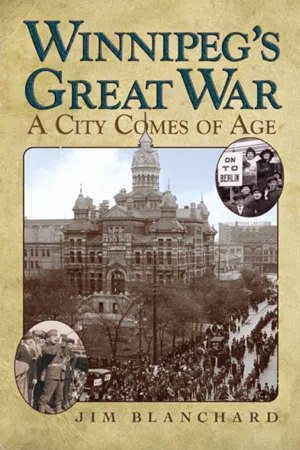
- 272 pages
- English
- ePUB (mobile friendly)
- Available on iOS & Android
eBook - ePub
About this book
Information
1914

In the summer of 1914 those middle-class families that could afford it left Winnipeg, boarding trains headed for “the lake.” Charles Gordon, the minister of St. Stephen’s Presbyterian Church and an internationally known novelist under his pen name of Ralph Connor, migrated with his family to their island Birkencraig at Lake of the Woods. In his autobiography, he recorded his memories of the fateful summer of 1914. About the time the Gordons left the city, the newspapers began reporting the assassination of the Austrian heir to the throne in Sarajevo. But the family, like most Canadians, did not pay much attention: “It was glorious weather. With our canoes and boats, with our swimming and tennis, our campfires and singsongs our life was full of rest and happy peace.”1
The governor general, the Duke of Connaught, and his daughter Princess Patricia, visited the Lake of the Woods in July on their way to a summer vacation in Banff. They stayed at the summer home of Robert Rogers, minister of the interior. At one point, the stern of the duke’s boat was damaged and he had to be rescued as it sank under him. The duke’s party proceeded to the mountains to enjoy the rest of their holiday on dry land.
Early in the summer the international news on the front pages of the Winnipeg papers was not from Europe but Ireland, where disagreements over the Home Rule Bill passing through Parliament seemed to be leading the country toward civil war. The struggle between Irish Catholics and Protestants was riveting for Canadians, many of whom had strong feelings about the issues.
Then, Gordon records, “on Thursday, July 30th, our boat returning with supplies brought back a newspaper with red headlines splashed across the page. Austria had declared war on Serbia.” Suddenly the peaceful lake community was talking of nothing but the situation in Europe. When the Gordons went to church on Sunday they stopped to chat with a group of fellow cottagers on the wharf in Kenora, Ontario, about how the war had spread to Germany and Russia. Then on August 4, the headlines shouted about the impending declaration of war by the British. “I remember taking the newspaper from my son King and going into the woods to look at the thing and to consider what it had to do with me,” he writes.
Gordon was a man in his sixties but he was also the chaplain of the 69th Cameron Highlanders, one of Winnipeg’s new militia regiments. He eventually did go to the trenches with the Camerons, but on that day in the woods his first worry was how safe his family would be. He and his son boated over to the wharf in Kenora to talk about the news with their lake neighbours. Gordon remembers speaking to James Ashdown, the owner of the J.H. Ashdown Hardware Company, who, as he rushed to catch the Winnipeg train, said, “everything has changed. We must accommodate ourselves to the change.” Over the next four years, Ashdown’s concise summary of the situation could have served as the city’s wartime motto as its people struggled to adapt to the many changes the war would bring.
Irene Evans, the wife of former Winnipeg mayor Sanford Evans, was also at the lake, with their two children, Gurney and Katherine, and her maid, Molly Barbone, at the family’s summer camp, Idyllcrag, on Lake of the Woods at Keewatin. Sanford Evans was working in Ottawa at the time, and his wife’s letters, written to him as war broke out, give us another picture of those last sunny days of summer.
Irene and her children had all the tranquil moments normally provided by holidays at the lake. They went with their neighbour Mr. “W” by ferry to the dam on the Winnipeg River and had a “perfect picnic.” They caught some pickerel and they cooked and ate the fish with bacon and gathered a “marvelous bunch of flowers.”
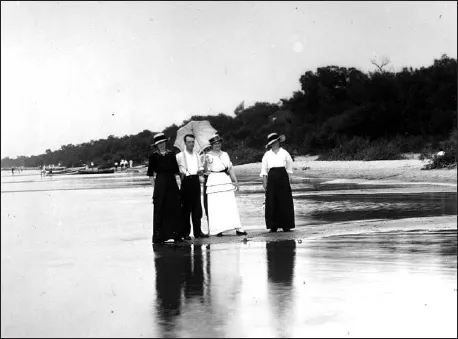
On the eve of the war, many Winnipeggers were still enjoying time on the shores of Winnipeg Beach.
But there was no ignoring the war news that crept in to poison the calm and beauty of the lake. “It is a somber awesome air we breathe— Fanny writes that two Morton Morse boys, John Galt Jr., three Dennistouns went this week and even our little Reverend Diamond of Keewatin has gone as Strathcona Horse Chaplain.”2 Young men like these, from the middle-class families that, with the Evanses, composed the Anglo-Canadian establishment of Winnipeg, were joining the army in large numbers and boarding trains for the east. Douglas Waugh, the son of Richard Waugh, then mayor of Winnipeg, spent part of July at Minaki and visiting friends at Lake of the Woods. Mere weeks later, he passed Minaki on a troop train taking him and other newly recruited members of the Lord Strathcona’s Horse to war. He would return a little over a year later, permanently disabled by wounds received at the Battle of Festubert.
Irene Evans wrote to her husband at the end of August that it was “sickeningly lonely and depressing without you just now, and I dread the return to the city…. The moon almost full—such heavenly peace—the world beyond in a nightmare.” She nevertheless wanted the latest information and at the end of the month she asked him to get a couple of copies of the Blue Book issued by the federal government, Documents Relative to the European War. It contained all the cables, Orders-in-Council, and speeches connected to the declaration of war, and she wanted him to send one to her father in Toronto. One of their neighbours at the lake had lent her a copy.
She reported to her husband that the economic effects of the war were already disrupting their lives. Many people had had their wages cut, as employers tried to reduce costs. She had decided to cut her own washerwoman’s wages from twenty to fifteen dollars. She was also about to lose her maid, who had decided to quit so she could marry her “sojer boy” and thus keep him from enlisting. In the early months of the war, volunteers whose wives objected to their going were rejected by the army. The policy was soon abandoned as the need for troops was too great.
The author Nellie McClung also spent August at the family cottage at Matlock on Lake Winnipeg. The news that war had actually broken out seemed unreal to her: “When the news of war came, we did not really believe it! War! That was over! There had been war of course, but that had been long ago, in the dark ages, before the days of free schools and peace conferences and missionary conventions and labor unions!”3
McClung described how war news gradually invaded the calm of life at the beach. The men coming out from the city “brought back stories of the great crowds that surged through the streets blocking traffic in front of the newspaper offices reading the bulletins, while the bands played patriotic airs.” War quickly made its way into the games of the children: “Now they made forts of sand, and bored holes in the ends of stove-wood to represent gaping cannon’s mouths, and played that half the company were Germans; but before many days that game languished, for there were none who would take the German part.”
As the family drove away from the boarded-up cottage at the end of their vacation, she wrote that “instinctively we felt that we had come to the end of a very pleasant chapter in our life as a family; something had disturbed the peaceful quiet of our lives; somewhere a drum was beating and a fife was calling! Not a word was spoken but Jack put it all into words, for he turned to me and asked quickly, ‘Mother, when will I be eighteen?’”4
Not all Winnipeggers were on holiday that summer. Hugh Sutherland, a Winnipeg pioneer and businessman, by this time a vice-president of the Canadian Northern Railway, was on business in Vienna when war broke out. With all the trains in Europe being commandeered by the military as part of the mobilization, it took Sutherland three days to make his way to England. He had to walk four miles at one point to catch a train bound for Belgium. As he was climbing aboard, a German officer grabbed him by the arm and tried to pull him off the steps. In what may have been the first act of war by a Canadian, the Winnipeg Telegram reported that Sutherland hit him hard in the face and “felled him.” Near the Austrian border, Sutherland witnessed the execution of four Serbians who had not reported when called up by the Austro-Hungarian Army.5
For Canada, the war began at midnight, London time, Tuesday, August 4, 1914. At that moment, the ultimatum the British had given Germany, demanding that it withdraw from Belgian territory, expired and a state of war existed between the British and German empires. As a dominion with no independent foreign policy, Canada was then automatically at war.
This momentous news arrived in Winnipeg, 3900 miles away, two hours later at around 8 p.m. local time. People had been milling in front of the city’s newspaper offices for days, and since late afternoon the crowds had been growing larger, anxiously awaiting information from the centres of the crisis in Europe. Everyone was trying to calculate what time it would be in Winnipeg when it was midnight in London. Bulletins were rushed outside and posted on boards on the wall of the Telegram newspaper office at Albert and McDermot. Later in the war the Telegram would mount an electric tickertape to get the latest news out more quickly. At the Winnipeg Free Press building on Carlton Street a man armed with a megaphone stood on a wooden platform in front of the building and shouted the news to the crowd as it came in over the telegraph wires.
When he announced that war had been declared, the crowds of people filling the street broke into patriotic song. “Rule, Britannia!,” “God Save the King,” “The Old Red, White and Blue,” “The Maple Leaf Forever,” and “La Marseillaise” were heard. The Free Press reported that “strong voices took up the strain with a will and a volume of glorious sound roared forth and set the blood of the British crowd racing at top speed.”6
There was another outbreak of enthusiasm when the megaphone man announced that the British fleet had been ordered to “capture or destroy the enemy.” “The effect was electric,” the Free Press reported. “The roar that followed resembled what takes place when a match is touched to a powder magazine. Then, stirred to white heat by patriotic sentiment, the great throng burst forth spontaneously into the National Anthem. The vigor of the outburst was thrilling beyond description.” After reading for many years about the race between the European powers to build ever larger and more sophisticated battle ships, the public naturally expected the war to be won or lost at sea. In the end, as usual, it was the long-suffering infantrymen who decided the issue four bitter years later.
The police had blocked traffic on Carlton between Portage and Ellice avenues because of the dense crowd in front of the Free Press building. A frustrated motorist, driving a large seven-passenger touring car, forced his way through and injured several people, one of whom was taken away in the police ambulance. The crowd stormed down the street to the corner of Portage Avenue where another car had stopped. Mistaking the driver for the man who had just driven through the crowd, they charged his car shouting “kill him, mob him.” He was able to convince them he was not the guilty party before any damage was done. It was as if the coming of the war had released deep-seated aggressive feelings in the citizens of Winnipeg.
Both the Conservative Telegram and the Liberal Free Press, rivals in politics and in business, claimed that they were the best source for war news. In reality, they received their news from the same sources, telegraphed from Europe over one of several transatlantic cables. Because of the high cost of sending these messages, agencies like the Associated Press handled the transmission and then distributed the information to subscribers like the Winnipeg papers.
It was no easy matter to obtain news in the early hours of the war. The Free Press complained that the cables were being commandeered for government and military use. Very soon the British would cut the German transatlantic cable and North America thenceforth received little or no news with a German point of view.
The Telegram informed its readers that they would also be printing dispatches from their special correspondent, “Windemere,” in London, and all the papers published letters from troops and others who were overseas to give some background for anxious readers at home. Beginning in 1915 readers could count on the Canadian “Eye Witness,” Lord Beaverbrook, whose staff produced a steady stream of positive stories about the exploits of the Canadian Army.
The first of many military parades took to the Winnipeg streets at 8 p.m. With the conflict only two hours old, the members of the 90th Winnipeg Rifles regiment had been summoned to the drill hall at the corner of Broadway and Osborne. They crossed to the university grounds on the north side of Broadway, formed ranks, and marched up Kennedy Street to Portage Avenue. Their band played the regimental march, “Old Solomon Levi” and “Soldiers of the King,” and the crowds cheered all along the way, many rushing into the street to march beside the militiamen. Street parades were an important propaganda tool for reaching large numbers of people at a time before radio and when a good portion of the population could not read. They were used extensively to educate the populace about war aims, to show that all elements of society supported the war effort, and to impress the public with the quality of the troops Canada was sending to fight.
It was natural that the 90th Regiment should parade first. It was the oldest militia unit in Winnipeg, formed in 1885 at the time of the Métis resistance in Saskatchewan. Named the “Little Black Devils” by a Métis fighter, referring to their black uniforms, the regiment was a favourite with the people of the city. Many members had volunteered to fight in South Africa, and during World War I the unit, in the form of the 8th Battalion, would be recognized for the bravery and toughness of its men.
At Portage and Main the regiment turned north and marched to city hall, and then headed back toward the drill hall again. When they passed McDermot Avenue a man in the crowd grabbed a flag and shouted for people to follow him. The crowd swept along McDermot and turned right at Albert, running north to Market Square, cheering and singing, replacing the orderly marching of the troops with the unrestrained enthusiasm of the crowd.
In front of the Free Press building a young man, William Farmer, described by the newspaper as a “raw-boned six foot specimen of Canadian manhood,” jumped onto the platform and shouted to the crowd to follow him. He and John Blair—they both lived in Aberdeen Court at 230 Carlton—led another spontaneous parade down Portage and up Main to the city hall. The newspaper described a crowd of 6000 people, men and women, surging along five and six abreast in the street: “In the van walked half a dozen young men carrying a great union jack, which for want of a pole, was carried spread out over their shoulders.”7
Another part of the crowd headed for Government House, carrying a Union Jack and a French tricolour, both nailed to clothesline posts taken from someone’s backyard. They poured onto the front lawn of the house, cheering when the lieutenant governor, Douglas Cameron, emerged onto the balcony over the front door. Re-enacting, in a modest fashion, the appearance of the king on a balcony at Buckingham Palace only a short time before, he told the crowd that “Britain will never stop while one drop of blood or one coin of money remains unexpended,” adding that France was equally determined to win. The crowd was in a mood to cheer and Cameron’s grim words were greeted with wild applause.
A Free Press reporter visited the city’s two largest hotels, hoping to get some reactions to the war news. He found the corridors full of guests discussing events. At the Fort Garry Hotel, which was crowded with attendees at the Knights of Pythias convention, many of the American delegates said they sympathized with the French and British cause. At the Royal Alexandra, the reporter talked to one of the hotel’s chefs who was from Alsace Lorraine. He had five brothers, three of whom were fighting in the kaiser’s army and two in the army of France. A guest of Austrian birth, “now a loyal British subject,” he said Canada “had been good to me” and he had married a Canadian woman. “Naturally I wish the Empire well,” he said, but he could not h...
Table of contents
- Cover
- Half Title Page
- Title Page
- Copyright Page
- Dedication
- Table of Contents
- List of Illustrations
- Introduction
- Chapter 1 1914
- Chapter 2 1915
- Chapter 3 1916
- Chapter 4 1917
- Chapter 5 1918
- Epilogue
- Notes
- Index
Trusted by 375,005 students
Access to over 1.5 million titles for a fair monthly price.
Study more efficiently using our study tools.
Frequently asked questions
Yes, you can cancel anytime from the Subscription tab in your account settings on the Perlego website. Your subscription will stay active until the end of your current billing period. Learn how to cancel your subscription
No, books cannot be downloaded as external files, such as PDFs, for use outside of Perlego. However, you can download books within the Perlego app for offline reading on mobile or tablet. Learn how to download books offline
Perlego offers two plans: Essential and Complete
- Essential is ideal for learners and professionals who enjoy exploring a wide range of subjects. Access the Essential Library with 800,000+ trusted titles and best-sellers across business, personal growth, and the humanities. Includes unlimited reading time and Standard Read Aloud voice.
- Complete: Perfect for advanced learners and researchers needing full, unrestricted access. Unlock 1.5M+ books across hundreds of subjects, including academic and specialized titles. The Complete Plan also includes advanced features like Premium Read Aloud and Research Assistant.
We are an online textbook subscription service, where you can get access to an entire online library for less than the price of a single book per month. With over 1.5 million books across 990+ topics, we’ve got you covered! Learn about our mission
Look out for the read-aloud symbol on your next book to see if you can listen to it. The read-aloud tool reads text aloud for you, highlighting the text as it is being read. You can pause it, speed it up and slow it down. Learn more about Read Aloud
Yes! You can use the Perlego app on both iOS and Android devices to read anytime, anywhere — even offline. Perfect for commutes or when you’re on the go.
Please note we cannot support devices running on iOS 13 and Android 7 or earlier. Learn more about using the app
Please note we cannot support devices running on iOS 13 and Android 7 or earlier. Learn more about using the app
Yes, you can access Winnipeg's Great War by Jim Blanchard in PDF and/or ePUB format, as well as other popular books in Storia & Storia militare e marittima. We have over 1.5 million books available in our catalogue for you to explore.