Sharon Bown's remarkable 16-year career with the Royal Australian Air Force saw her deployed to East Timor, Bali and Afghanistan. She also served for a year as Aide-de-Camp to the Minister for Defence. From barely surviving a helicopter crash to commanding a combat surgical team, Sharon's journey is a confronting, but ultimately inspirational, account of what our men and women in the military experience, and the price they pay for their service.
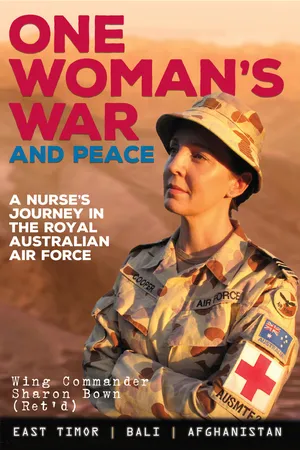
eBook - ePub
One Woman’s War and Peace
A Nurse's Journey in the Royal Australian Air Force
- 221 pages
- English
- ePUB (mobile friendly)
- Available on iOS & Android
eBook - ePub
One Woman’s War and Peace
A Nurse's Journey in the Royal Australian Air Force
About this book
Information
Topic
HistoireSubtopic
Biographies militairesCHAPTER 1
OFFICER TRAINING SCHOOL
January 1999
OFFICER TRAINING SCHOOL
January 1999
Australian military service had always interested me. Possessing a fairly conservative nature, though, I never thought I would be suited to the nomadic and potentially dangerous lifestyle of the Australian military. At high school I listened eagerly to the recruiters as they explained the financial benefits of having the Australian Defence Force, the ADF, fund your university degree. I daydreamed about serving my country in the long-revered tradition of the ANZACs but, alas, at seventeen years of age I did not yet have the spirit of adventure, or the courage that had spurred those fine young Australians into action some 75 years earlier.
I was the third of four daughters born to happily married parents. My father was a police officer and my mother stayed at home to care for us until my later primary school years, when she returned to work as a nursing aide caring for the elderly and infirm. We had a humble and happy childhood and my parents worked hard to give us every opportunity they could afford.

RAAF Bases mentioned
Unlike many female students of my generation I loved science and math and the physicality of team sports, such as hockey and netball. So it might have seemed out of character for me to pursue nursing, a career in the female-dominated ‘helping’ profession. But I wanted to make a difference in the lives of others and I watched in awe as my mother showed how compassionately this could be done. In choosing nursing, I became the first person in my family to attend university. By the age of 23 I had completed my Bachelor of Nursing and was living a comfortable life in Tasmania with my boyfriend of five years.
Ironically, given my comfortable existence, my eventual decision to join the Royal Australian Air Force, the RAAF, arose from the very conservatism that had earlier held me back. I had been working as a Registered Nurse for three years and was enjoying the challenge of perioperative work in the operating theatre — providing nursing care to patients before, during and immediately after surgery. I loved the nursing specialty I had chosen yet began to feel that, even though I was still a very junior clinician, I already possessed the knowledge, skills and experience that could assist those less fortunate than myself. I also realized that I was working in the hospital where I had been born and might end up being groomed to take over from my baby boomer colleagues. So I started to look for adventure.
At work I listened to the plastic surgeons and some of the more senior nurses talk of their humanitarian work overseas and I felt that it would be many years before I would be ready to accompany such an elite team. At the same time, I sensed a growing urge within me to provide humanitarian assistance to those in need, to travel overseas and discover other cultures, and to find an existence so removed from my own that I would fully appreciate the world into which chance had delivered me. I had witnessed the great Ethiopian famine of 1984 from the comfort of my parent’s living room through the safety of a colour TV screen and, like so many other Australian children, my mother had frequently threatened to send my uneaten dinner to the starving children in China. Superficially, I knew that there was suffering in the world but I wanted to experience a greater depth of life and with an intensity that would not disappear with the switch of a channel or be diluted by another unwanted mouthful of cabbage.
It was the Air Force that would become my passage to this dramatically different world and bring me close to the immense suffering of others. It also taught me something else: the mostly unseen sacrifice of those who serve their country.
I was proud to have an opportunity to serve my country, to have the skills and experience to do so and a level of health and fitness such a position demanded. Asked why I chose the Air Force and not the Navy or Army, I would jokingly reply that my favourite colour was blue. Indeed, my favourite colour is blue, but that was certainly not why I sought to join the Air Force over the other services. I suffer from motion sickness at sea so I was not keen on spending extended periods of time working aboard a ship in the Navy and, as my family had enjoyed at least four weeks of each year camping, I was not attracted to the amount of time Army Nursing Officers spent under canvas in the field. I was, though, drawn to the aeromedical evacuation role of the Air Force Nursing Officer.
The Air Force not only offered me the opportunity for defence service but a unique and exciting opportunity to learn a type of nursing new to me; one that enabled the rapid delivery of healthcare to those in need. The prospect of flying into places to get patients out and nursing them in the back of an aircraft provided me a great adrenaline rush and sparked my interest in the role. With a quick phone call and a follow-up visit to the Defence Force Recruiting offices in Hobart, I was past the first hurdle, promptly recruited into the Air Force, and scheduled to undertake officer training.
My first memories of Officer Training School (OTS) were of a not-so-brave, young civilian nurse standing on the edge of an oval at RAAF Base Williams (Point Cook) in Victoria. Here I was within the boundary of the oldest continuous serving military airfield in the world and readying to join the great tradition of Air Force Officers who had already had the privilege to serve within its grounds. That was all very well, but right then I was hoping that no one would see the tears in my eyes or hear the quiver in my voice as I attempted to gulp back the emotional lump in my throat and reassure my parents and boyfriend that I had arrived safely and that I was okay.
I saw no need to tell them that I had fallen asleep in the taxi from the airport, blindly trusting a driver who, in broken English, had thrust a street directory at me and told me that I would have to show him where to go. The small-town, timid Tasmanian girl who had absolutely no idea of where she was going, in any sense, had set out on her adventure and was feeling a sense of fear. I felt so far outside my comfort zone and far from my family, my friends and my boyfriend. My life back in Tasmania had been so comfortable that I had an overwhelming desire to call another taxi and board a flight back home. I quickly reminded myself, though, that if my new sense of isolation, trepidation and doubt were part of the adventure I had sought, it was meant to be.
Officer training was challenging but it was not terrifying. It would turn out to be one of the most enjoyable times of my life, helping me evolve from a shy girl into a confident woman prepared for adventure and rewarding me with friends and colleagues to see out a career and maybe even a lifetime.
On my first day of training, as we gathered as a group outside the accommodation block, a male voice barked from out of nowhere, instructing us to ‘form up’. Everyone around me moved almost instantly to stand in neat rows on the edge of the roadway. I, not having any idea what form up meant, naively followed and stood among them. It was, of course, a very military thing to do but to me it seemed odd as we had not yet been issued uniforms and were still in an array of civilian clothes.
Despite our military formation, the individuality of our group was evident with its mix of gender, race and physical attributes; within 24 hours, that individuality would be less obvious when we would proudly adopt the uniform of the Royal Australian Air Force. While form up seemed easy enough, the authoritative voice then shouted even more commands that were foreign to me: ‘Attention’, ‘Left turn’, ‘By the right’, ‘Quick march’. All of this spurred the otherwise neatly formed group around me to change direction and begin walking, arms swinging and in perfect time with each other. They were marching; I, like some weak member of the herd, was flailing around in their midst, one out-of-step stride behind, doing my utmost to simply keep up. I suddenly realized that I had a great deal more to learn than I might ever have expected.
I continued to feel like a fish out of water for the first few weeks of training, but my colleagues were quick to assist. The Directing Staff (DS) were even quicker in their own way, presenting themselves as the common enemy, espousing the one-in-all-in philosophy that also translated as ‘one screws up, all will suffer’. I learned to do many things with precision: to march, to iron, to tie my hair in a bun. I soon understood that there was never any reason to have my hands in my pockets, and that showering quickly was not only a necessary part of what some might call the ‘bastardisation’ process, it also saved on making too much mess that I would later be obliged to clean up.
I could iron my bedclothes while they remained on the bed and clean my room so it appeared no one lived there. There were a few colleagues who at the end of the course had not once slept in their bed for fear of having to make it again. A chaplain on the course ahead of me described the moment when he knew officer training had changed him. Standing at attention at the end of his bed awaiting the critical assessment of his DS, he spotted a dead cockroach on the floor. The chaplain pounced on it, sweeping it up in an instant to secret it away in his uniform pocket before the DS inspection would reveal him to be a poor example of an Air Force Officer. As he stood at attention, cockroach securely hidden from sight, he asked himself, ‘Where else in the world would I shove a dead cockroach into my pocket?’
I was far from being considered for the Officer Qualities Award at the conclusion of training, but that was okay by me. I worked hard to be what was known as the ‘grey man’, the person who blended into the group, not at all drawing any attention to themself. More notable than these ‘military achievements’, it was during officer training that I gained my career-long nickname of ‘Coops’, from my maiden name Cooper; I made the most of my grey man status to become incredibly good at a murder party card game known as Mafia; and I became renowned for the head shake. Apparently when I disapprove of anything, I shake my head, something I learned about only from living and working with the same group of people for fifteen weeks.
I was pleased to have kept and, indeed, gained some personal traits, despite having worked so hard to adapt to the stringent standards of dress and bearing required of a military officer. For women, long hair was to be secured in a bun and short hair cut above the collar and secured neatly behind the ears. Hair was required to be of a natural colour and make-up neutral. Fingernails were to be short and not coloured. The only jewellery allowed was one small stud per ear, a plain wristwatch and no more than two rings per hand.
As the daughter of a police sergeant, the structured and certain way of life in the Air Force was not a surprise for me and I was good at following rules. Also, my nursing career had taught me a lot about dress standards, time management and working within a team. I could see some of the others were finding the transition a little harder, struggling to get out of bed on time and to dress themselves to the required standard. This was the time when we learned to care for each other. Those with previous military experience helped those of us with none and we quickly learned teamwork, appreciating that it was benefiting us all.
As the course progressed, I began to relax a little and enjoy myself more. I had begun to make friends, including fellow Tasmanian Lara Gunn. She was diminutive but driven and had entered the Air Force as a pharmacist. To look at her, one would not expect that she would choose the life of an ADF officer, but both of us were in it together: two Tasmanian girls on their big adventure as the Air Force tried to mould us into something they could use. Lara and I would become firm friends.
The training ranged from academic studies of subjects, such as air power, Defence Force discipline, security and Defence writing, to activities and field exercises designed to demonstrate and assess leadership, teamwork, problem-solving and military skills. I learned to ‘play the game’, realizing that while OTS was providing me with the knowledge, skills and experience required of an Air Force Officer, it was also a test of my hardiness and resilience, the essentials for my future career.
On my 24th birthday I got the clearest sign yet of what I had signed myself up for. We had by this time relocated or, as I would now say, ‘deployed’ to RAAF Base East Sale in Gippsland, eastern Victoria, to carry out a ground defence exercise. It can get very cold around East Sale and while inspecting the base’s Air Force Health Centre we were shown the hypothermia bed, there to treat trainee officers who succumbed to numbing cold while undertaking the very sort of ground force exercise awaiting us. Despite having grown up in chilly Tasmania this was not an encouraging sight.
As trainee defenders of the nation we were to set-up a defensive posture around a designated ‘key point’ or asset that was to be protected. Among many other things, this necessitated that at all times we carried the ADF standard issue service rifle, the F88 AUSteyr. If you left your rifle behind it was quickly replaced with a heavy steel fence post or stake that was very awkward to carry. Such punishment was humiliating and irritating enough to ensure you never forgot your rifle. Adding some realism to the situation, we were issued with blank ammunition and rigorously followed weapons handling techniques. Any mistake in weapon handling could result in an accidental discharge of the weapon, which would lead to the perpetrator being charged and prosecuted under the Defence Force Discipline Act.
While this type of ground defence responsibility would not normally fall to a Nursing Officer, it was vital that all Air Force Officers were cognizant of the process so they were able to carry out the basics in a conflict zone. I am still grateful for the time spent in training with the F88, as throughout my career, I would be armed on overseas operations for a combined total of twelve months — a laughable achievement for a soldier perhaps, but a contradiction in terms for a healthcare professional trained to preserve life, not take it.
Our training was now well and truly out in the field. We dug weapons pits — two-man trenches from which to fire our weapons — around the perimeter of a key point and from which we could adopt an ‘outward-looking defensive posture’. We slept immediately behind our weapon’s pit so that in the event of potential attack we could easily jump into them and defend our position from opposing forces — the ‘bad guys’.
As eager young officer trainees, our attempts to fulfil this responsibility were often more humourous than effective. At East Sale, we ‘stood-to’ to protect the key point from a suspicious-looking kangaroo advancing on our position, and at Puckapunyal, the Australian Army’s home to the School of Armour, where mud is mud in summer and frozen in winter, a fellow officer became spooked when he became aware of a Leopard tank in our vicinity, calling us all to stand-to and man our defensive positions. I’m sure that Army soldiers at Puckapunyal felt reassured knowing that their Air Force counterparts were keeping their base safe from Australia’s very own tanks! My favourite memory is of two officers who slept through a middle-of-the-night attack by the ‘enemy’ because one successfully convinced the other that he must be hearing things. Some might think that the firing of weapons is a convincing enough sound.
Had I been back in Tasmania in my former life on my 24th birthday I might have taken the day off and treated myself to a long and peaceful sleep in and later gone out to dinner and drinks with my friends. But on this birthday, I was awoken suddenly by the very convincing sound of simulated mortar fire. It was bitterly cold and we were sleeping out in the open, on the ground behind our weapons pit. In order to keep myself as warm as possible I had pulled the drawstring of my sleeping bag hood as tight as possible and then tied it securely. There was just enough room for my nose and mouth to draw in fresh air. Having tied the hood when I was awake the night before, I had not considered having to undo it when not quite so awake.
As the mortar fire ‘rained down’, simulated by the frightening and annoying explosives known as whizz-bangs (owing to their unique sound), I jumped up to take shelter in my weapons pit. Trapped in my sleeping bag and in blind panic, I could not undo the knot. I writhed and wriggled around on the ground like an epileptic caterpillar until I eventually broke free from my cocoon, not-so-much a beautiful butterfly but more a dishevelled and confused officer cadet, and dived into the hole in the ground in front of me. Thank goodness for the dim dawn light that protected me from utter embarrassment. There, in the subzero cold and peering out over the dirt edge, rifle poised and ready with small arms and mortar fire sounding around me, I shook my head and muttered to myself, ‘Happy Birthday, Sharon. What the hell are you doing?!’
The day brought no further incident but it was to end with a treat. Our Ground Defence Officer announced it was my birthday and I was allowed a single phone call. I just had to decide if my family or my boyfriend should be the recipient of this valued gift. The Directing Staff had hearts after all. I took the phone and was looking for somewhere quiet to phone my boyfriend as it would be nice to hear his voice and listen to some tales of the life I had left behind. But before I could disappear a gruff announcement burst forth: ‘Get used to it, Cooper, this will be the first of many birthdays away from home for you.’ What a cheery thought. But it was indeed an accurate one as a year later I was on a military operation working alongside Egyptians, Singaporeans and Portuguese. On my 25th birthday, I would awake to a plaintive Muslim call to prayer. We were soon to enter the new millennium and I would be in Dili, East Timor.
CHAPTER 2
DEPL...
DEPL...
Table of contents
- Cover
- Title Page
- Dedication
- Contents
- Foreword
- Preface
- Prologue
- 1 Officer Training School
- 2 Deployment to East Timor
- 3 Far From Home
- 4 Return to East Timor
- 5 ‘Mayday!’ ‘Mayday!’
- 6 Broken and Banged Up
- 7 Losing Mum, Losing Friends, Losing Hope
- 8 Working for the Minister For Defence
- 9 ‘How Does That Feel, Copper?’
- 10 Taking Command and Afghanistan
- 11 The Darkness
- 12 The Dawn
- Epilogue
- Abbreviations, Acronyms and Terminology
- Index
- Copyright
- Back Cover
Trusted by 375,005 students
Access to over 1.5 million titles for a fair monthly price.
Study more efficiently using our study tools.
Frequently asked questions
Yes, you can cancel anytime from the Subscription tab in your account settings on the Perlego website. Your subscription will stay active until the end of your current billing period. Learn how to cancel your subscription
No, books cannot be downloaded as external files, such as PDFs, for use outside of Perlego. However, you can download books within the Perlego app for offline reading on mobile or tablet. Learn how to download books offline
Perlego offers two plans: Essential and Complete
- Essential is ideal for learners and professionals who enjoy exploring a wide range of subjects. Access the Essential Library with 800,000+ trusted titles and best-sellers across business, personal growth, and the humanities. Includes unlimited reading time and Standard Read Aloud voice.
- Complete: Perfect for advanced learners and researchers needing full, unrestricted access. Unlock 1.5M+ books across hundreds of subjects, including academic and specialized titles. The Complete Plan also includes advanced features like Premium Read Aloud and Research Assistant.
We are an online textbook subscription service, where you can get access to an entire online library for less than the price of a single book per month. With over 1.5 million books across 990+ topics, we’ve got you covered! Learn about our mission
Look out for the read-aloud symbol on your next book to see if you can listen to it. The read-aloud tool reads text aloud for you, highlighting the text as it is being read. You can pause it, speed it up and slow it down. Learn more about Read Aloud
Yes! You can use the Perlego app on both iOS and Android devices to read anytime, anywhere — even offline. Perfect for commutes or when you’re on the go.
Please note we cannot support devices running on iOS 13 and Android 7 or earlier. Learn more about using the app
Please note we cannot support devices running on iOS 13 and Android 7 or earlier. Learn more about using the app
Yes, you can access One Woman’s War and Peace by Wing Commander Sharon Bown (Retd) in PDF and/or ePUB format, as well as other popular books in Histoire & Biographies militaires. We have over 1.5 million books available in our catalogue for you to explore.