eBook - ePub
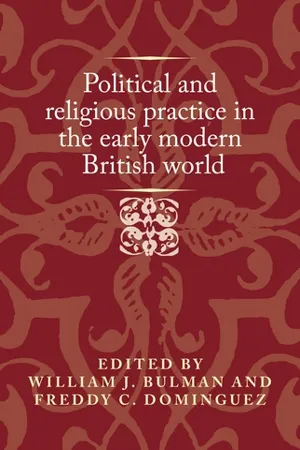
Political and religious practice in the early modern British world
- 267 pages
- English
- ePUB (mobile friendly)
- Available on iOS & Android
eBook - ePub
Political and religious practice in the early modern British world
About this book
This volume brings together cutting-edge research by some of the most innovative scholars of early modern Britain. Inspired in part by recent studies of the early modern 'public sphere', the twelve chapters collected here reveal an array of political and religious practices that can serve as a foundation for new narratives of the period. The practices considered range from deliberation and inscription to publication and profanity. The narratives under construction range from secularisation to the rise of majority rule. Many of the authors also examine ways British developments were affected by and in turn influenced the world outside of Britain. These chapter will be essential reading for students of early modern Britain, early modern Europe and the Atlantic World. They will also appeal to those interested in the religious and political history of other regions and periods.
Information
Part I
Political and religious practices
1
Stealing bibles in early modern London
Ethan H. Shagan
In 1561, about a quarter-century after the first English Bible was legally printed, the first English bible was stolen. In Hackney, John Doone ‘broke sacrilegiously into the church of the said parish, and stole therefrom a horsecloth worth two shillings and a bible worth thirteen shillings’.1 According to a 1531 statute, robbing a church was felony without benefit of clergy, hence John Doone was hanged for his sacrilege.2
This trivial crime signals the beginning of a remarkable, widespread, but almost totally overlooked phenomenon: stealing bibles. There are hundreds of extant cases of bible theft from the sixteenth to the eighteenth centuries. Yet stealing bibles has no history. It has been occasionally noticed in accounts of the print trade, a curious footnote to the broader topic of book theft.3 From the history of religion it is wholly absent. To my knowledge, of all the countless books and articles written about the English Bible – the physical object, its theology, its production and reception – none has ever studied the phenomenon of stealing bibles. I cannot recall even seeing it mentioned, presumably because theft is no more interesting to historians of religion than bibles are to historians of crime.
In this chapter, focused on London and its environs, I want to consider what might happen to our understanding of England’s long Reformation if we attend to bible theft as a new species of impiety. Stealing bibles relates two separate historical processes: first, commercialisation, the dense new matrix of buyers and sellers attempting to locate one another in the rapidly expanding metropolis, with the resulting commodification of experience; and, second, the intense scriptural piety peddled by the English Protestant regime, which insisted upon the importance of Bible reading and Bible ownership as signs of respectability and participation in the national religious project. The zone of intersection between these two phenomena produced, as we know, a novel commercial piety industry. But it also produced an equally novel commercial impiety industry, parasitic upon the godly throngs who wanted or needed to own bibles. By putting so much new emphasis on the Bible, Protestant authorities increased demand for stolen bibles, leading to more theft; and more theft led to more Bible reading, as poor Londoners gained access to cheap stolen bibles on the black market. In a new symbiosis between profanation and devotion, pious Londoners depended upon criminality for access to commoditised devotion, while thieves and fences depended upon the success of the Reformation to peddle their stolen goods. The Protestant regime’s commitment to scriptural piety thus not only discursively invented a new category of sacrilege against God’s Word, it also produced that very category as a lived experience.
This is not a history of ‘secularisation’. After all, far from producing spaces outside religion, stealing bibles for resale on the black market buoyed Christianity, contributing to its proliferation among the urban poor. Bible theft can be read as evidence of Christianity’s continued strength into the eighteenth century, now measured in the new idiom of market demand. But none the less, it must be acknowledged that something profoundly corrosive and unsettling to traditional religion was implicit in the pervasive new activity of bible theft, something for which we do not yet have a scholarly vocabulary. Call it profanation rather than secularisation. This was a practice without a theory: people who felt alienated from Reformation piety, but who did not yet imagine themselves to have a ‘secular’ existence, profaned Protestant symbols and assimilated them to novel cultural spaces. They hollowed out biblicist Protestantism by reducing scripture to a transactional object, rather than allowing themselves to be the transactional objects on which the bible operated spiritually. Stealing bibles was thus the cutting edge of a profound new experience of modernity.
To begin with background: bible theft was not unknown in the Middle Ages, as the chains attaching medieval books to their lecterns suggest.4 For instance, a bible was stolen from Reading Abbey in 1253. The bishop of Salisbury excommunicated the unknown culprit and a circular letter was sent to nearby monasteries in case they had unwittingly purchased the bible. A more spectacular example occurred in 1327, when a mob raided the Abbey of Bury St Edmunds and stole scores of books, including twelve bibles.5 Some medieval books, including bibles, also contain colourful curses against anyone who steals them, calling down God’s wrath in the form of leprosy, hanging, or the swords of demons. We cannot tell from these curiosities how common theft was, only that it occurred.6
But the emergence of bible theft as a substantial social phenomenon depended upon the proliferation of English bibles. The first legal bible in English was the so called ‘Matthew Bible’ printed in 1537 with the support of Henry VIII’s government. After 1538, an English bible was required in every church, and the printers who worked to fulfil that injunction soon discovered they had a best-seller on their hands: with English bibles legal, lots of people wanted them, so more editions followed. By 1640, some 280 editions of the complete Bible had been printed, and by 1729 a further 338 editions. Beginning in the 1580s this included smaller-format bibles in significant numbers, then with the Authorized Version in 1611 pocket-sized editions exploded into prominence. In the 1630s, one of these small bibles cost between 3 and 4 shillings, well within the budget of a conscientious London artisan if not a landless rural labourer.7 If we take 618 separate editions of the Bible and multiply by an average print run of one thousand, we get over six hundred thousand English bibles printed by 1730, plus nearly 250,000 more copies of the New Testament without the Old.8 That means close to a million English bibles or new testaments were printed by 1730, and the total population of England and Wales in the year 1700 was about 5.1 million. And those numbers, based on the research of Ian Green, do not include Irish or Scottish bibles, or the Douai–Rheims Bible created by and for English Catholics, or psalm books and other excerpts, or bibles in other languages spoken by England’s cosmopolitan population.
That is a lot of bibles. It suggests that bibles were the primal objects of consumer desire in one of the first consumer societies in history. This proliferation of bibles set the stage for the remarkable explosion of bible theft in early modern London.
There are a fair number of sixteenth-century examples. In 1573, William Burfield stole a wool cloak and ‘an English book called a bible’ from a man in Whitechapel.9 Burfield was sentenced to death, but pleaded benefit of clergy and so was delivered; many bible thieves escaped the gallows on a first offence. In 1583, Morgan Jones broke into the house of Nicholas Maddox near the Temple Bar and stole from him ‘a book called a bible, to the value of 30s’.10 In 1592, a gang of thieves, identified in the records as a yeoman, a cutler, and two bakers, stole a whole collection of books from the bookseller John Proctour; their haul included six new testaments and two psalm books.11 More examples followed in the first decade of the seventeenth century. In 1605, Edmund Morgan of Southwark, described as a porter, confessed to petty larceny for stealing a bible from John Shermandynes worth 10d. This was a rough-and-ready plea bargain, as the bible was undoubtedly worth more, but in English law any theft under the value of one shilling was petty larceny rather than grand larceny and would likely result in whipping rather than hanging.12 In the village of East Molesey, just outside London and a stone’s throw from Hampton Court, Richard Hunt burgled the house of Garrard Gore, gentleman, in 1607, stealing his doublet and breeches as well as a 4-shilling bible.13
This was a trickle and not yet a flood. But after the publication of the Authorized Version in 1611, the numbers rapidly increased. In 1614 at St Saviour parish in Southwark, the butcher Richard Canter stole cloth, pots, beakers, and a 6-shilling bible from Randal Wood.14 Just down the road in St George parish, Susan Sares, spinster, was indicted in 1620 for stealing a bible worth 6s 8d and a ‘ruff band’ from Barnard Fox; she was acquitted of this theft, and of another, but convicted of a third.15 In 1628, William Towler was taken by the night watch at Fleet Street ‘for pilfering a bible and some other things from his dame where he dwell’.16 In 1636, Thomas Owen was arrested for ‘pilfering two bibles out of the house of Edward Rice’; he denied stealing the bibles but admitted to stealing an iron pot worth 4 pence, another plea bargain to save his life.17
Our sources become richer and more discursive from the later seventeenth century onwards, when we can more often and more clearly reconstruct the nature of the crime. In 1687, for instance, someone stole a bible belonging to Hollan Crevat of St Giles in the Fields, and suspicion immediately fell on two lodgers in his house, Grace Johnson and Susan Johnson. There was, however, no clear evidence against the sisters, and since ‘they both took pains for a livelihood’ – that is, they had jobs and therefore social credit – the jury acquitted them.18 In 1690, Benjamin Harvy of Fulham was convicted of having burgled the house of William Skinner three years earlier and stolen a bible, a looking-glass, a pair of sheets, and other beddings. He entered the house by breaking a glass window and using his knife to prise up the bar that closed the shutters. How was this crime discovered after so much time? Harvey and his wife had ‘a falling out between them’ and she took the whole story to a justice of the peace.19 For another example, Mary Bearing had a shop stall in Holborn. On 14 April 1714, according to an eyewitness, Walter Cantwell took from the stall ‘a bible, value 1s, a parcel of tennis balls, glass necklaces, and other things’. The witness ‘took him’ with the stolen goods on his person, as well as ‘some picklock keys in his pocket’. Having nothing to offer in his defence, he was convicted, but the court showed mercy by finding him guilty of stealing only 10d.20 Three years later, Elizabeth Brown of St Ann’s, Westminster, was indicted ‘for picking the pocket of Thomas Appleby of a bible, value 3s’. Remarkably, Brown robbed Appleby inside their parish church.21
‘Stealing bibles’ was not an official or juridical term: theft of bibles was not statutorily differentiated from other kinds of theft. I would speculate that this was because the phenomenon ran roughshod over contemporary religious categories and could not easily be assimilated into the moral universe of early modern crime. If a bible was stolen in order to be part of orthodox worship, was that theft pious or sacrilegious? Did the special status of the Bible make the theft more worthy of punishment or less? I will discuss this more below, but for now it should be made clear that the term ‘stealing bibles’ is not meant to imply a single juridical or socio-cultural phenomenon; stealing bib...
Table of contents
- Cover
- Half Title
- Title Page
- Copyright
- Dedication
- Contents
- List of figures
- Notes on contributors
- Introduction: Post-revisionism and the history of practices in the early modern British world
- Part I: Political and religious practices
- Part II: British, European, and Atlantic dimensions
- Index
Trusted by 375,005 students
Access to over 1.5 million titles for a fair monthly price.
Study more efficiently using our study tools.
Frequently asked questions
Yes, you can cancel anytime from the Subscription tab in your account settings on the Perlego website. Your subscription will stay active until the end of your current billing period. Learn how to cancel your subscription
No, books cannot be downloaded as external files, such as PDFs, for use outside of Perlego. However, you can download books within the Perlego app for offline reading on mobile or tablet. Learn how to download books offline
Perlego offers two plans: Essential and Complete
- Essential is ideal for learners and professionals who enjoy exploring a wide range of subjects. Access the Essential Library with 800,000+ trusted titles and best-sellers across business, personal growth, and the humanities. Includes unlimited reading time and Standard Read Aloud voice.
- Complete: Perfect for advanced learners and researchers needing full, unrestricted access. Unlock 1.5M+ books across hundreds of subjects, including academic and specialized titles. The Complete Plan also includes advanced features like Premium Read Aloud and Research Assistant.
We are an online textbook subscription service, where you can get access to an entire online library for less than the price of a single book per month. With over 1.5 million books across 990+ topics, we’ve got you covered! Learn about our mission
Look out for the read-aloud symbol on your next book to see if you can listen to it. The read-aloud tool reads text aloud for you, highlighting the text as it is being read. You can pause it, speed it up and slow it down. Learn more about Read Aloud
Yes! You can use the Perlego app on both iOS and Android devices to read anytime, anywhere — even offline. Perfect for commutes or when you’re on the go.
Please note we cannot support devices running on iOS 13 and Android 7 or earlier. Learn more about using the app
Please note we cannot support devices running on iOS 13 and Android 7 or earlier. Learn more about using the app
Yes, you can access Political and religious practice in the early modern British world by William J. Bulman, Freddy Domínguez, William J. Bulman,Freddy C. Domínguez in PDF and/or ePUB format, as well as other popular books in History & British History. We have over 1.5 million books available in our catalogue for you to explore.