What motivates states to commit to international human rights treaties remains a contested question in political and legal science. Many tentative explanations for the observed variation in ratification patterns have been proposed. Some are based on the content of the treaties (the substance of the protected rights and the control mechanisms), others are tied to external factors (having originated either from pressure of the international community or within the domestic political system). In any case, empirical evidence supporting the proposed hypotheses remains rather scarce and overall knowledge about the reasons for signing and ratifying treaties is inconclusive. We aim to contribute to the scholarly discussion by providing a new and thorough examination of the commitment practices in two post-communist countries, the Czech Republic and Slovakia, and also in their common predecessors, the undemocratic illiberal Czechoslovakia and then the transitioning Czechoslovak Federation. While both new countries have experienced very similar international development that is propelled by the same international incentives and constraints, their internal political experience differs significantly. It is those differences which make these countries promising and productive 'laboratories' for investigation.
eBook - PDF
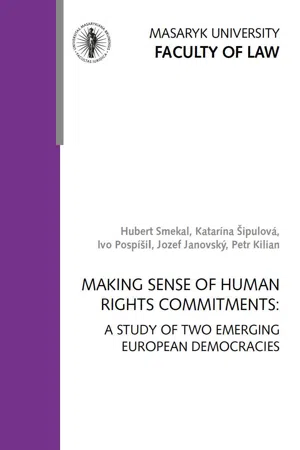
Making Sense of Human Rights Commitments: A Study of Two Emerging European Democracies
- 318 pages
- English
- PDF
- Available on iOS & Android
eBook - PDF
Making Sense of Human Rights Commitments: A Study of Two Emerging European Democracies
About this book
Information
Table of contents
- Table of Contents
- List of Abbreviations
- Acknowledgments
- 1 Introduction
- I. GENERAL TRENDS OF HUMAN RIGHTS COMMITMENTS
- 2 What We Know about Adopting International Human Rights Commitments
- 3 Political Regimes and Commitment Patterns
- II. CASE STUDY
- 4 Human Rights Commitments in Czechoslovakia, Czech Republic and Slovakia – Background Information
- 5 Treaty Control Mechanism, Legitimacy and Domestic Change
- 6 Commitment Decisions: Differences between Leftist and Rightist Governments
- 7 Moderating the Commitment Decision with Reservations: Explaining What Is Missing in Commitment Patterns
- 8 Who and What Impacts the Processof A dopting Human Rights Commitments? Veto Players and International Human Rights Commitments
- III. INDIRECT INFLUENCES (MICRO-LEVEL ANALYSIS)
- 9 Human Rights Treaties before Constitutional Courts: Identical Starting Points, Slightly Different Outcomes
- 10 International Human Rights Treaties in the Case Lawof Domestic Courts: Supreme Courtand Supreme Administrative Court
- 11 International Human Rights Lawin Legal Education
- 12 Conclusion
- About the Authors
- Bibliography
- List of Figures
- List of Tables
- Index
- ANNEX 1: List of Treaties
- ANNEX 2: Ranking of the United Nations Member States and Their Commitment Practice
- ANNEX 3: Ranking of the Council of Europe Member States and Their Commitment Practice
Trusted by 375,005 students
Access to over 1.5 million titles for a fair monthly price.
Study more efficiently using our study tools.
Frequently asked questions
Yes, you can cancel anytime from the Subscription tab in your account settings on the Perlego website. Your subscription will stay active until the end of your current billing period. Learn how to cancel your subscription
No, books cannot be downloaded as external files, such as PDFs, for use outside of Perlego. However, you can download books within the Perlego app for offline reading on mobile or tablet. Learn how to download books offline
Perlego offers two plans: Essential and Complete
- Essential is ideal for learners and professionals who enjoy exploring a wide range of subjects. Access the Essential Library with 800,000+ trusted titles and best-sellers across business, personal growth, and the humanities. Includes unlimited reading time and Standard Read Aloud voice.
- Complete: Perfect for advanced learners and researchers needing full, unrestricted access. Unlock 1.5M+ books across hundreds of subjects, including academic and specialized titles. The Complete Plan also includes advanced features like Premium Read Aloud and Research Assistant.
We are an online textbook subscription service, where you can get access to an entire online library for less than the price of a single book per month. With over 1.5 million books across 990+ topics, we’ve got you covered! Learn about our mission
Look out for the read-aloud symbol on your next book to see if you can listen to it. The read-aloud tool reads text aloud for you, highlighting the text as it is being read. You can pause it, speed it up and slow it down. Learn more about Read Aloud
Yes! You can use the Perlego app on both iOS and Android devices to read anytime, anywhere — even offline. Perfect for commutes or when you’re on the go.
Please note we cannot support devices running on iOS 13 and Android 7 or earlier. Learn more about using the app
Please note we cannot support devices running on iOS 13 and Android 7 or earlier. Learn more about using the app
Yes, you can access Making Sense of Human Rights Commitments: A Study of Two Emerging European Democracies by Hubert Smekal,Katarína Šipulová,Ivo Pospíšil,Jozef Janovský in PDF and/or ePUB format, as well as other popular books in Law & Public Law. We have over 1.5 million books available in our catalogue for you to explore.