Drawing on up-to-date literary and archaeological research, an in-depth study of the units based in the Eastern Provinces during the turbulent third century of the Roman Empire.
In this book, eminent Roman historian, Dr Raffaele D'Amato, looks at the notoriously under-represented history of the Roman armies during the middle 3rd Century whose records have been obscured by the chaotic civil wars of that period between usurpers to the Imperial authority of Rome.
Following on from the previous title, MAA 527, Roman Army Units in the Western Provinces (2): 3rd Century AD, this book considers the evidence for troops in the Eastern half of the Empire specifically around the Balkans, Mesopotamia, the Middle East and North Africa and looks at the weakness of Imperial central authority which inevitably led to local particularism and a wide range of appearance in regional commands.
Dr D'Amato uses literary, painted, sculptural and archaeological sources to reconstruct this little-understood period of Roman military history and, with the aid of meticulous coloured artwork, photos and detailed charts, reconstructs the appearance and campaigns of the Roman forces stationed in the East.
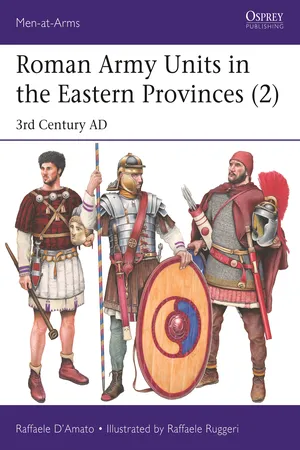
eBook - ePub
Roman Army Units in the Eastern Provinces (2)
3rd Century AD
- 48 pages
- English
- ePUB (mobile friendly)
- Available on iOS & Android
eBook - ePub
Roman Army Units in the Eastern Provinces (2)
3rd Century AD
About this book
Information
ARMS, EQUIPMENT & CLOTHING
MOESIA SUPERIOR
The funerary stele from Viminacium of the speculator (scout) L. Bassius Nigellio of Legio VII Claudia (CIL III, 1650) clearly shows a spear with the heart-shaped head identifying a beneficarius. His clothing is typical of the 3rd century: a long-sleeved tunic, long trousers and ankle-length boots. Similar gravestones show that the hooded paenula marching cloak was still in widespread use.
A beautifully decorated breast-fastening plate from a scale armour recovered at Rytopek (Tricornium) belonged to Aurelius Herculanus of Legio VII Claudia. It shows complex divine symbols, but also images of muscled armour worn over subarmales with pteryges, pseudo-Corinthian helmets, shields, and cohort standards. An unusual helmet from the excavation of Cuprja is probably a local variant of the Niederbieber type (Robinson’s so-called ‘Auxiliary Cavalry Type E’ – though recent scholarship suggests that Robinson was mistaken in identifying only as cavalry helmets several typologies with extended cheek-guards, including the Niederberber specimen).

Detail of an early 3rd-century marble stele from Viminiacum, Moesia Superior. Its interest lies in the fact that it commemorates a civilian magistrate, but depicts him in the military costume of a dux or legatus. The inscription reads, in part: ‘To the gods and spirits, [remember] Caius Cornelius Rufus, decurio and municipal augur of Aelia Viminiacum, [who] lived 70 years. [This monument was dedicated by] his widow Ulpia Rufina [and by] Caius Cornelius Pacata, decurio and flamen of the same municipality, together with his daughters and heirs Rufina and Bassa Corneliae…’. (National Museum of Pozarevac; author’s photo, courtesy the Museum)
A 3rd-century spatha from a large hoard excavated in Singidunum fortress, and preserved in Belgrade City Museum, has a straight blade bearing traces of pattern-welding. It is 92.2cm (36.2 ins) long with a 69cm (27 in) blade, and is of Lauriacum-Hromowka type. The same museum also has several chance-found late 2nd- and 3rd-century scabbard chapes characteristic of long spathae. They are of pelta shape in copper alloy, with side volutes; while generally undecorated, some show incised concentric rings or pelta-shaped piercings.
While belt buckles of the usual omega and round shapes are common, Viminacium has yielded more complex examples of Celtic-style openwork buckles, together with UTERE FELIX (‘Use it in good fortune’) lettering from belts, and a silver openwork belt mount with pendant. During the 3rd century both ‘crossbow’ and arched fibulae, for fastening military cloaks at the right shoulder, had appeared (the smallest examples were probably used to fasten the military neck-scarf or maphorion). Dated from 293 onward (Brzi Brod, Kostolac, Kosmaj), some fibulae have the incised inscription UTERE FELIX. They are associated with propeller-shaped military belt fittings and rectangular strap-ends; some burials reveal gilded silver examples, suggesting individuals of wealthy status.
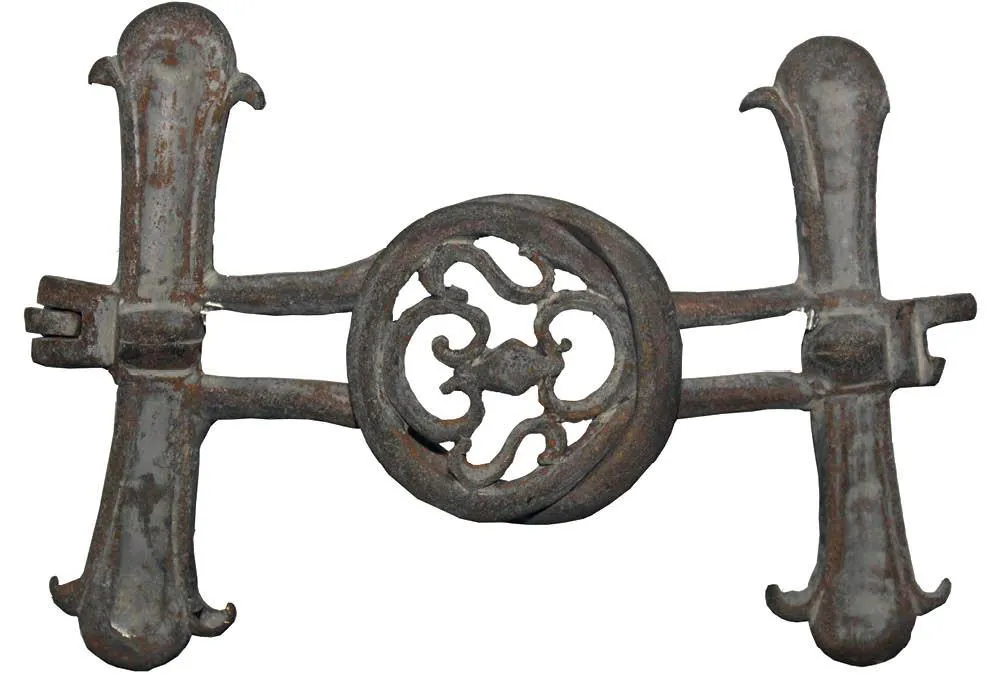
Central belt-fastener, 3rd century, from Kostolac (Viminiacum); this unusual item probably belonged to a soldier of Legio VII Claudia. It is made from copper alloy, lead and silver, by casting, forging and punching, and measures 19cm by 9.6cm (7.4 x 3.7 inches). (loc. Caves, G-3388, C-10000, inv. NMP 03/3584; National Museum of Pozarevac; author’s photo, courtesy the Museum)
The stele of Nigellio mentioned above also shows an interestng representation of military transport: a robust, open, four-wheeled, flat-bed cart (rheda), decorated with the emblem of a beneficiarius. Singidunum has also yielded splendid silver openwork Medusa-head chariot fittings.
MOESIA INFERIOR & SCYTHIA MINOR
The so-called Ludovisi sarcophagus shows Roman soldiers fighting against Gothic warriors. We do not know what troops are represented; some wear magnificent equipment which might suggest Praetorians or other elite units, but they might equally commemorate ordinary legionaries of the reigns of Decius, Herennius Etruscus, Trebonianus Gallus or Hostilianus – e.g., among others, Legio I Italica, Legio IIII Flavia or Legio VII Claudia.
The typology of most helmets represented on the sarcophagus seems to be pseudo-Attic or pseudo-Corinthian (of which there is archaeological evidence from Brigetio), or to resemble several decorated helmets formerly in the Axel Guttmann Collection. Most of them are decorated with images of divinities, lions or mythological beasts, and seem to have eagle protomes. While battlefield finds from the area include helmet fragments of the common Heddernheim-Buch typologies (e.g. Robinson’s so-called ‘Auxiliary Cavalry Types E, F & G’), other archaeology in this province has revealed more decorated types. One of the best examples is a helmet from Vetren (Tegulicium), of Worthing typology (see Robinson’s ‘Cavalry Sports Type H’), with a crest ending in an eagle protome and with embossed snakes on the skull. A mask helmet of possible ‘Mater Castrorum’ typology was excavated from Melta (modern Lovech). From Shumen we have another fragment, as well as plate armour fragments including a fastener-plate decorated with Minerva. Decorated greaves were found in the area of Razgrad, one of them splendidly ornamented with a Winged Victory, while a massive, smooth bronze cavalry greave came from the Abryttus battlefield, and there is also a single greave of Kunzing typology in the Romfeya Collection. Military belt finds in the province include openwork plates with blossom motifs.
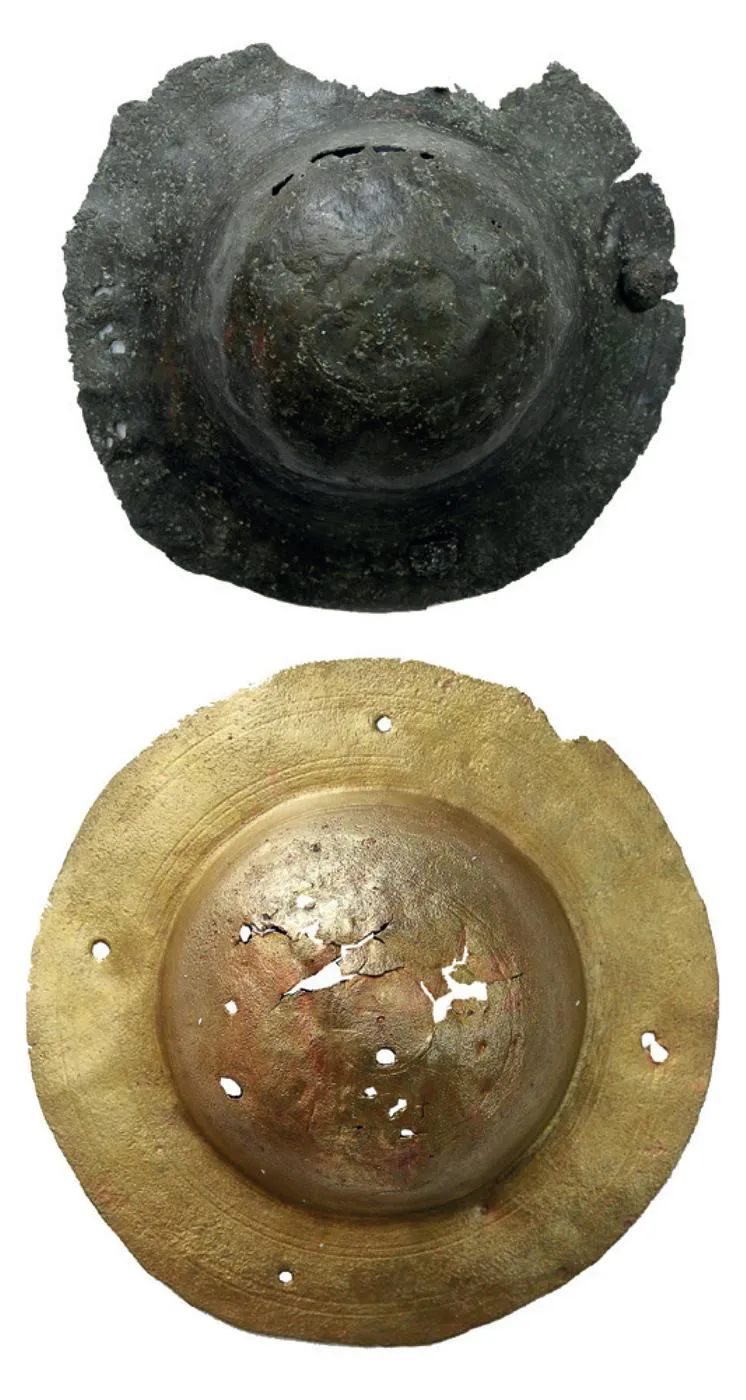
Examples of iron and copper-alloy shield bosses (umbones) from the battlefield of Abryttus, Moesia Inferior, AD 251. (Razgrad Archaeological Museum; photo courtesy Prof Valeri Yotov)
A number of impressive stelae of cavalrymen sometimes represent them figuratively, sometimes idealized as hunting Thracian horsemen, but in both cases depicting long-sleeved tunics, trousers, boots of endromides type, sagum cloaks, and ring-buckle belts. The stele of the speculator Vibius Severus from Tomis shows the same military transport vehicle as the example mentioned above from Moesia Superior.
DACIA (Malvensis & Superior)
Limestone funerary sculptures of Roman soldiers and officers in typical 3rd-century attire are attested from Apulum, the base of Legio XIII Gemina. These men are represented wearing heavy sleeved tunics either without purple stripes, or with stripes of small size – macrocherae), rough cloaks (clamides hirtae; SHA, Severus, XXXIII) pinned at the right shoulder; fitted trousers (anaxyridae); low campagi boots, and belts with central ring-buckles. These belts (Ringschnallencingulum-type, in modern German terminology) are mainly of the variant with side fixing rivets. ‘Belted’ burials around Apulum reveal the use of a specific broad and grooved ring-buckle, as visible on the figurative monuments.
Depictions of soldiers in battle equipment are very rare in Dacia, but one interesting monument from Apulum dating from the 3rd century represents quite clearly the equipment of a legionary cavalryman of Legio XIII Gemina. From the same locality we have an important fragment of a funerary monument to some heroes of that legion. This shows one of the rare 3rd- century representations of legionaries with rectangular shields, and also a p...
Table of contents
- Cover
- Title Page
- Table of Contents
- Introduction
- Select Chronology
- Military Organization
- Distribution of Units
- Arms, Equipment & Clothing
- Select Bibliography
- Plate Commentaries
- eCopyright
Trusted by 375,005 students
Access to over 1.5 million titles for a fair monthly price.
Study more efficiently using our study tools.
Frequently asked questions
Yes, you can cancel anytime from the Subscription tab in your account settings on the Perlego website. Your subscription will stay active until the end of your current billing period. Learn how to cancel your subscription
No, books cannot be downloaded as external files, such as PDFs, for use outside of Perlego. However, you can download books within the Perlego app for offline reading on mobile or tablet. Learn how to download books offline
Perlego offers two plans: Essential and Complete
- Essential is ideal for learners and professionals who enjoy exploring a wide range of subjects. Access the Essential Library with 800,000+ trusted titles and best-sellers across business, personal growth, and the humanities. Includes unlimited reading time and Standard Read Aloud voice.
- Complete: Perfect for advanced learners and researchers needing full, unrestricted access. Unlock 1.5M+ books across hundreds of subjects, including academic and specialized titles. The Complete Plan also includes advanced features like Premium Read Aloud and Research Assistant.
We are an online textbook subscription service, where you can get access to an entire online library for less than the price of a single book per month. With over 1.5 million books across 990+ topics, we’ve got you covered! Learn about our mission
Look out for the read-aloud symbol on your next book to see if you can listen to it. The read-aloud tool reads text aloud for you, highlighting the text as it is being read. You can pause it, speed it up and slow it down. Learn more about Read Aloud
Yes! You can use the Perlego app on both iOS and Android devices to read anytime, anywhere — even offline. Perfect for commutes or when you’re on the go.
Please note we cannot support devices running on iOS 13 and Android 7 or earlier. Learn more about using the app
Please note we cannot support devices running on iOS 13 and Android 7 or earlier. Learn more about using the app
Yes, you can access Roman Army Units in the Eastern Provinces (2) by Raffaele D’Amato,Raffaele Ruggeri,Raffaele D'Amato in PDF and/or ePUB format, as well as other popular books in History & Eastern European History. We have over 1.5 million books available in our catalogue for you to explore.