The book describes and covers the most common topics relating to charter parties, bill of lading, claims handling and much more that officers and captains should know about cargo and damage control. It should be a guideline for officers and master with regards to Commercial Admiralty Law and it's application
- 338 pages
- English
- ePUB (mobile friendly)
- Available on iOS & Android
eBook - ePub
Commercial Admiralty Law for Officers and Masters
About this book
Information
1.0 Charter Parties
1.1 The different Charter Parties
The term, Charter Party’’ means a contract between the Owner of a vessel and the Charterer. The Charterer is the one that takes over the vessel for a certain amount of time or for a voyage. The charter party is the traditional contract of carriage for the movement of materials. In some law books the term “contract of Affreightment” is also mentioned. The charter party will avoid confusion – it is a contract of carriage.
1.1.1 Time Charter
On a Time-Charter the vessel is hired by a charterer for a specific named period of time and for a specific amount of money per day, - payable at specific schedules.
The entire vessel, with all her cargo space and all her other capacities is at the Charterers disposal.
The Owner still manages the physical operation of the vessel, he employs the Master and the Crew, he is paying for the stores and provision as well as for the upkeep and repair of the vessel, but is doing so for the benefit of the Charterer.
Important:
Unless it is expressly stated otherwise, the Charterer is acting as Carrier The entire ships capacity is at Charterers disposal Charter hire depends upon the duration of charter, the type and size of the vessel.
For account of the Charterers
- Fuel
- Port/Pilot Charges
- Stevedores Charges
- Cleaning of Holds, unless other stated in C/P
- Commission and Brokerage on Cargo
- Claims (Dependent upon condition in C/P)
For Account of the Owners:
- Crews Wages, Crews Insurance
- Provision
- Maintenance & Repairs
- Stores & Supplies
- Equipment
- Lubrication Oil
- Water
- Insurance for the vessel
- Surveys (Statutory/Classification)
- Overhead Charges
- Brokerage Depreciation of the vessel.
Time Charter-Party represents a complex commercial bargain between the Ship-Owner and the Charterer of a vessel. See examples of charter parties below
BIMCO1 Uniform General Charter (to be used for trades for which no special approved from is in force) – Code Name: GENCON.
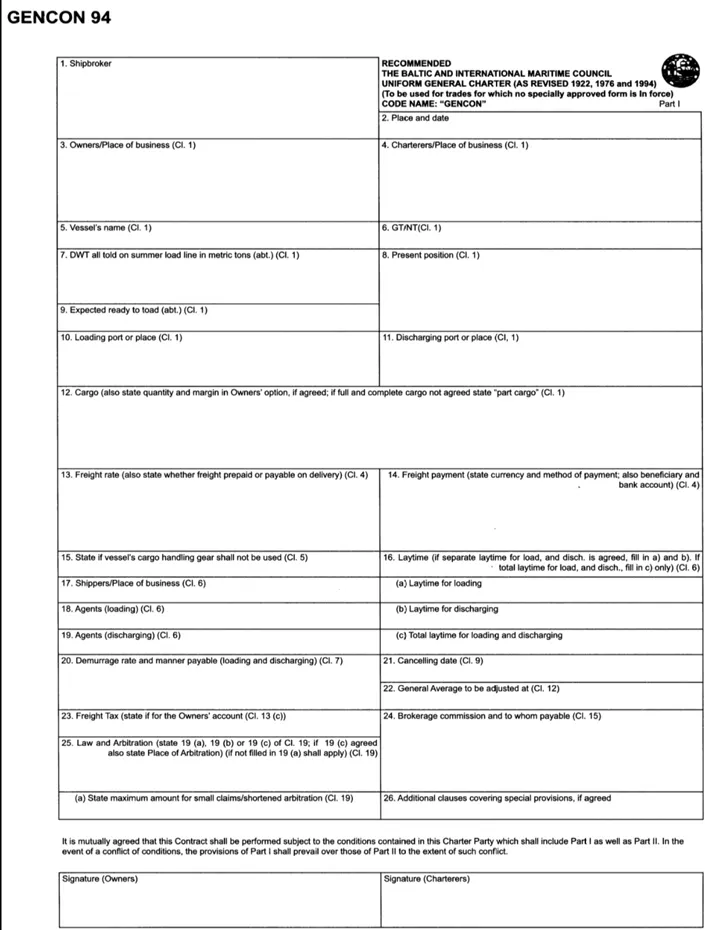
Illustration 1: Example of a Gencon Charter Party
Source: https://studylib.net/doc/8832478/gencon-94
BIMCO – General Time Charter Party – Code Name: GENTIME
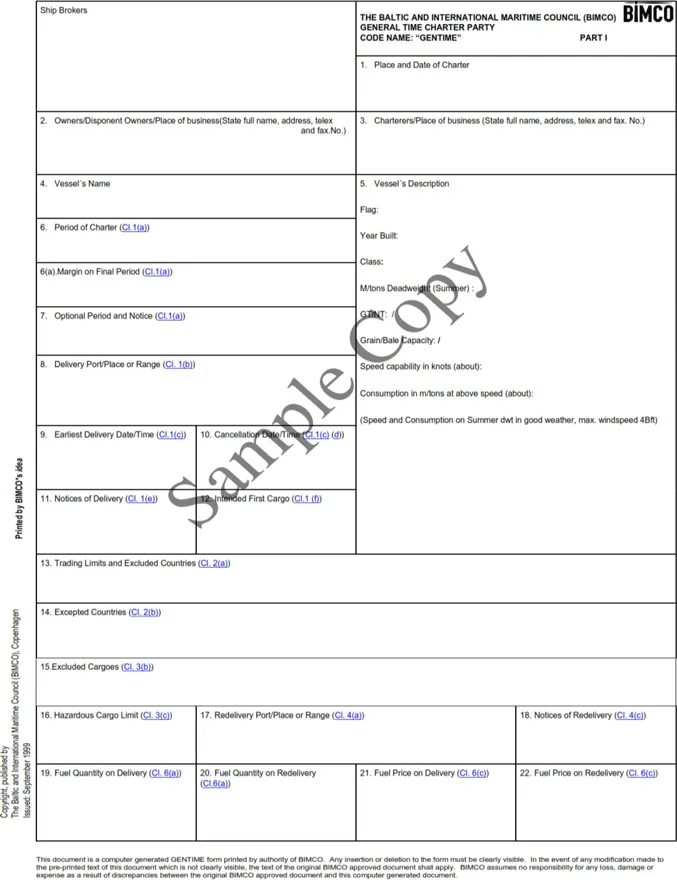
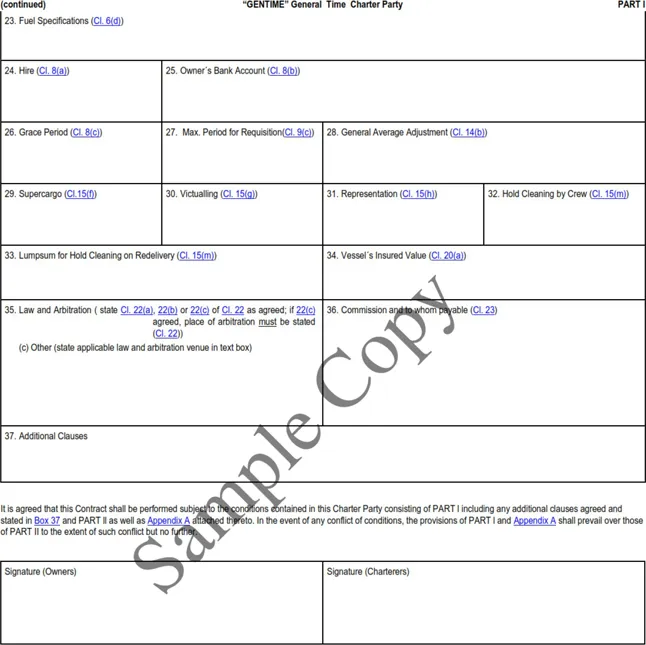
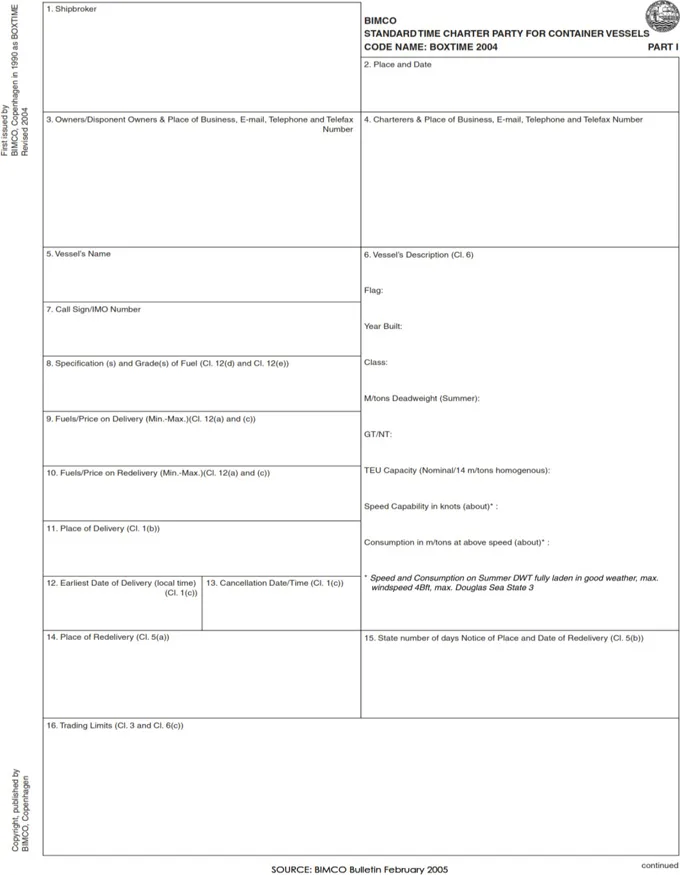
Illustration 2: Exapmle of Gentime Charter Party
Source: BIMCO Bulletin, February 2005
1.1.2 BIMCO Standard Time Charter Party for Container Vessels – Code Name: BOXTIME 2004
BOXTIME charter contract was a purpose made document for time chartering container ships. Container shipping is increasing in demand and it represents 13.5% of global fleet, yet industry widely used BALTIME, GENTIME and heavily amended NYPE forms for agreement. Therefore after 15 years of BOXTIME, a revision was made with the view of promoting BOXTIME as a document of choice for this particular business, thus BOXTIME 2004 contract came into existence in 2004. The main purpose of this contract is to avoid rider clauses to minimise confusion and litigation. The contract is divided into three parts. The first part is for stating the details, second for clauses of agreement pertaining to the contract and third one for providing description of the vessel. Analysis of certain important clauses is made in this report, along with comparisons with the original contract developed in 1990. (ref.: https://www.researchgate.net/publication/317080408_DESCRIPTION_AND_ANALYSIS_OF_BOXTIME_2004
Under a time charter, the vessel is at the disposal of a charterer for a time period, who runs it for his own purposes such as commodity trading or transportation and the ship owner is paid the hire for the agreed period, however, this placing of vessel at the charterer’s disposal would be under certain contractual limits, which is described in the contract and agreed upon; these clauses are very important as it defines the liabilities, responsibilities, duties and obligations of each party of the contract (Wilson, 2010).
There are three parts in a BOXTIME 2004 contract, the first part is for providing information important for the contract, it consists of boxes, the second part indicates the terms and conditions of the contract and finally the third part is for providing the Vessel’s description. The following sections compares the three parts of the original and amended BOXTIME charter parties.
PART I
Part one of both the BOXTIME contracts is for stating the relevant information pertaining to the charter, and most of them are referenced with the appropriate clauses which are given in part two of the contract. There are a few alterations in the new BOXTIME contract, there are only 34 boxes in this section of the new contract compared to 36 boxes in the old one, box 6 is a combination of data which were separately given from boxes 7 to 13 in the original BOXTIME and also includes “year built” in it, box 7 of the new contract is for providing IMO number which was not prevalent during the development of the old contract in 1990, “Maximum Bunker Capacity” given in box 15 is not present in the new contract, in the new contract box 17 permits to state excluded cargoes other than those mentioned in clause 4, box 22 is an addition to the new contract to state owner’s bank account details, a box for representation expenses as monthly lump sum is given in box 25 of the new contract, boxes 28 and 29 stating daily rates for supercargo and victualing of the old contract is combined in box 24 of the new one but as monthly lump sum, boxes 29 and 30 are also addition in the new contract for stating replacement cost for vessel’s lost or damaged lashings and payment per man hours for reefer repair undertaken by crew respectively
(BIMCO, Brinkmann, 2008).
Furthermore, part one of BOXTIME 2004 also specifies details such as trading limits, period of charter, delivery and redelivery place and time, hire, fuel specifications, quantity of hazardous goods, insured value of vessel, P&I club of both owner and charterer, general average adjustment, place of arbitration, provision for additional clauses etc.
PART II
Part two of the charter-party lays out the clauses governing the contract. There are twenty eight clauses in BOXTIME 2004, with notable amendments of the old clauses as well as some supplements such as, Redelivery (cl.5), Master (cl.13), Bills of Lading, Waybills, and other Contracts of Carriage (cl.17), Refrigerated Goods (cl.20), Exceptions (cl.21), Navigation (cl.22) and BIMCO Ice Clause for Time Charter Parties (cl.24). Charter party agreements follow the principle of freedom of contract based on the supply and demand condition existing in the market, therefore any clause, which either party is unwilling to agree can be cancelled or amended (Wilson, 2010), this poses an ambiguity on the functionality of the interest of any standard charter party forms.
There are some important changes done in the BIMCO Container Charter party - Boxtime Charter.
Here are the most important one:
Clause 5: Redelivery
The importance of this event in a charter party led to the formation of a separate clause, which was otherwise spread out as subclauses 6(m) and 7(f) in the old contract, the clause specifies that the vessel should be redelivered clean and fit to load containers and goods with fair wear and tear at the agreed place at the end of charter period and it also stipulates that the charterer should give out notice of redelivery in the agreed schedule which by default would be within 45, 30, 10, 5 and 2 days prior redelivery.
Most importantly the sub-clause for ‘final voyage’ gives consideration to the charterer’s effort to redeliver the vessel even if it is delayed by unforeseen reasons beyond charterer’s control
At first look this seems to be a balanced clause, which can be put forward by either parties, the owners expect to take back the vessel in the said conditions, and the charterers are protected against any claim due to any unplanned disruptions in the final voyage to redelivery; however, the extent of fair wear and tear is unspecified and the charterers are expected to pay hire for the extended period which was unplanned.
Clause 13: Master
This is a new clause added in the new contract, adopted from GENTIME, and can be considered relevant in a time charter party, as the owner places the vessel in the hands of the
charterer, the Master and the crew is appointed by the owner, thus the Master could be seen as a servant of the owner carrying out charterer’s instructions. This clause states the Master’s obligations and requirements.
Clause 17: Bills of lading, waybills, and other contracts of carriage
This clause is inspired from GENTIME and stated so because of its relevance, which was otherwise a sub clause (14. (b)) under ‘Owner’s Requirement’ in the old contract. Unlike the old contract this clause automatically authorizes the charterers to sign the bills of lading on owner’s behalf, however, the charterer can request the Master to sign contracts of carriage; if a multimodal transport bill of lading is issued, the charterers should indemnify the owner against cargo claims or loss resulted beyond the period in which the cargo is on-board.
This clause gives a relief to the owner by stating that, unless it is a compulsory application, the charterers or their agents shall not incorporate Hamburg Rules in the contract of carriage, however, the owners are bound by The Hague or Hague-Visby Rules.
The owners are also protected by a ‘Payment and Indemnity’ clause against any loss, damage or expense arising out of the breach of this clause. It also states that the charterer shall warrant to include ‘clause paramount’ applying Hague or Hague Visby rules, ‘New Jason’ clause, ‘General Average’ clause according to York-Antwerp Rules 1994, ‘Himalaya’ clause, and ‘Both to Blame Collision’ clause.
Clause 20: Refrigerated goods
This is not an entirely new clause, but it is based on the sub clause 17(b) of the old contract. The creation of a new specific clause might point out to the increasing usage or importance of containers with atmospheric control systems. The only difference from the old contract is that, ...
Table of contents
- About the book
- Table of Contents
- 1.0 Charter Parties
- 2.0 Voyage Charter Party
- 3.0 Bareboat Charter
- 4.0 Mate’s Receipt & Cargo Manifest
- 5.0 The Bill of Lading
- 6.0 The Hague Rule
- 7.0 The Hague - Visby Rule
- 8.0 The COSGA 1971
- 9.0 The Hamburg Rules
- 11.0 The Incoterms
- 12.0 Claims and Claim Handling
- 13.0 General Average
- 14.0 Chartering Terms and Abbreviation
- Bibliography
- Table of Illustration
- Copyright
Trusted by 375,005 students
Access to over 1.5 million titles for a fair monthly price.
Study more efficiently using our study tools.
Frequently asked questions
Yes, you can cancel anytime from the Subscription tab in your account settings on the Perlego website. Your subscription will stay active until the end of your current billing period. Learn how to cancel your subscription
No, books cannot be downloaded as external files, such as PDFs, for use outside of Perlego. However, you can download books within the Perlego app for offline reading on mobile or tablet. Learn how to download books offline
Perlego offers two plans: Essential and Complete
- Essential is ideal for learners and professionals who enjoy exploring a wide range of subjects. Access the Essential Library with 800,000+ trusted titles and best-sellers across business, personal growth, and the humanities. Includes unlimited reading time and Standard Read Aloud voice.
- Complete: Perfect for advanced learners and researchers needing full, unrestricted access. Unlock 1.5M+ books across hundreds of subjects, including academic and specialized titles. The Complete Plan also includes advanced features like Premium Read Aloud and Research Assistant.
We are an online textbook subscription service, where you can get access to an entire online library for less than the price of a single book per month. With over 1.5 million books across 990+ topics, we’ve got you covered! Learn about our mission
Look out for the read-aloud symbol on your next book to see if you can listen to it. The read-aloud tool reads text aloud for you, highlighting the text as it is being read. You can pause it, speed it up and slow it down. Learn more about Read Aloud
Yes! You can use the Perlego app on both iOS and Android devices to read anytime, anywhere — even offline. Perfect for commutes or when you’re on the go.
Please note we cannot support devices running on iOS 13 and Android 7 or earlier. Learn more about using the app
Please note we cannot support devices running on iOS 13 and Android 7 or earlier. Learn more about using the app
Yes, you can access Commercial Admiralty Law for Officers and Masters by Peter Grunau in PDF and/or ePUB format, as well as other popular books in Law & Law Theory & Practice. We have over 1.5 million books available in our catalogue for you to explore.