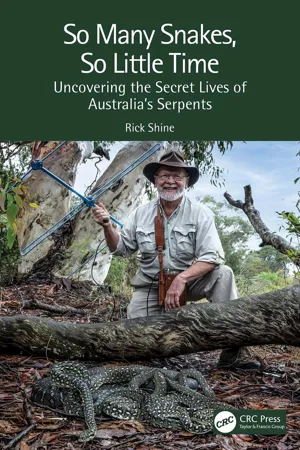
Snakes are creatures of mystery, arousing fear in many people but fascination in a few. Recent research has transformed our understanding of the behaviour and ecology of these animals, revealed their important roles in diverse ecosystems, and discovered new and effective ways to conserve their populations and to promote coexistence between snakes and people. One of the leading contributors to that scientific revolution has been Prof Rick Shine. Based in Australia, whose snake fauna is diverse and often dangerous, his experiences and anecdotes will inspire a new generation of serpent scientists. Spellbinding stories highlight the challenges, frustrations, and joys of discovery, and give the reader a greater appreciation of these often-slandered slithering reptiles.
Key Features
Documents the important role played by a preeminent herpetologist.
Focuses on research conducted in Australia, especially on snakes.
Three months after my 15th birthday, I almost died. Death tapped my nose, but didn’t manage to sink his fangs in.
The scene is etched into my brain. Sheep pastures running down to the Molonglo River, near the city of Canberra. Willow trees along the edge of the river, and steep banks where floods had eroded the sandy soils. Between the banks and the water, a narrow sandy beach. And on that beach, as I walked along the banks above, lay the biggest Brownsnake I had ever seen.
The Eastern Brownsnake is the great success story of snakedom in southern Australia. As its name suggests, an adult Brownsnake is drab brown above, beautifully camouflaged against the gray-brown Australian bush—just another dead branch amid the thousands littering the paddocks, juvenile Brownsnakes feed mostly on frogs and lizards, but when they reach a meter (3 feet) in length, these slender-bodied lightning-fast speedsters switch across to eat house-mice. And that’s a good tactic, because there’s a lot of mice out there to eat. Clearing the eucalypt forests to create pastures for sheep and cattle has provided a smorgasbord for rodents. As a result, Brownsnakes thrived. Their numbers boomed.
Eastern Brownsnakes possess one of the deadliest venoms of any snake species, worldwide. Combine that toxicity with high abundance, especially around farms, and you have a recipe for disaster. And there are other factors as well. These elongate Australian mambas are some of the fastest-moving snakes I’ve ever dealt with; and they are among a small minority of snake species that, if harassed, will opt for vigorous retaliation. Sometimes, they even chase their tormentor rather than trying to escape. As a result, Brownsnakes kill more people than do any other snake species in Australia.
Even a tiny Brownsnake—as thick as a pencil—has enough venom to kill an adult human. And the snake that lay below me on the banks of the Molonglo was at least 2 meters (6 feet) long, and thicker than my scrawny forearms. And I was miles from anywhere. Mobile phones had yet to be invented, nobody knew where I was, and there was no way to send a distress call if anything went wrong. If I Were bitten, it would take hours for me to walk out to the nearest road and flag down a passing car. And I wouldn’t have hours to spare. A bite would be fatal.
Only an idiot would have tackled that snake. But I was 15 years old, and this was the biggest snake I'd ever seen. Without pausing to look around for a stick with which to pin the snake’s head down, I took a flying leap off the bank, landed beside the snake, seized it by the tail, and lifted that tail into the air.
Very quickly, several things became apparent. First, the snake was huge. Even when I stood on tip-toes and held its tail as high as I could, its head still reached theground. Second, the snake wasn’t happy. It exploded into action, hinging at me with an athleticism that belied its bulk. Third, I realized—belatedly—that I had no way out. The bank was too steep to scramble back up: I was trapped on a tiny beach with an enraged snake. It was too heavy to fling away—if I tried, it was likely to come straight back for revenge. And fourth, not grabbing a stout stick beforehand was a serious error—because as far as I could see (in between ducking and weaving as the snake’s head shot past my shoulder), there were no suitable sticks on the beach.
It’s amazing what adrenalin can do. That snake was bouncing around, mouth open, hurling itself in every direction. It was an important lesson about the power of a large venomous snake. And a lesson also in my own fallibility—I discovered that it was very tiring to stand on tip-toes holding a monster snake by the tail. My muscles were quivering and cramping, and something had to happen very soon. I frantically looked around for a stick to pin down the reptilian whirling dervish so that I could grab it behind the head—and saw an old branch, a foot long, by the water’s edge. Looking around for a stick meant I wasn’t focused on the snake—but I felt its weight shift as it threw itself upward. I looked up to see an open mouth inches from my face and coming down fast. As I drew back, the snake’s snout tapped my nose, but he didn’t get his fangs into me.
It was now or never. Unless I got my hands around that snake’s neck very soon, I would lose the contest. So I dropped to my knees, grabbed that short stick, and pushed it down across the snake’s neck when it next hit the ground. The stick broke immediately, but this was my only chance. I slammed my hand down on the gyrating head, pressing the business end of the massive reptile into the sandy beach. And by good fortune, it worked.
Panting, trembling, I lay on top of the writhing snake until my body was able to obey the signals from my brain. Somehow-or-other, I managed to stuff the snake into a bag and take it home. But even with my 15-year-old’s enthusiasm, I could understand my parent’s reluctance to have this giant snake added to my backyard menagerie.
I’ve caught a lot of snakes since then, but none have frightened me as much as that first huge Brownsnake. That magnificent animal taught me to think about what I’m doing before the battle is joined, not afterward. It was an important education for someone destined to spend the next 50 years working with snakes. By scaring the hell out of me, that huge Brownsnake helped me survive a thousand similar situations in the decades to come.
At some stage, every child worries his or her parents by exhibiting peculiar behavior. But some behaviors are more peculiar than others, and a fetish for snakes must rank highly among “Behaviors That Induce Parental Anxiety”. All over the world, a small minority of young boys and girls manifest a passion for snakes. Most of those children later shift their interest to dinosaurs or video games, but a few stubbornly retain their scaly obsession. We pester our parents to take us to the Reptile House at the zoo, and we spend hours poring over books and websites that feature snake stories. And eventually, we decide that life isn’t complete without a pet snake.
In most parts of the world, that’s not a major problem. The snake that young Jack or Amelia encounters in the backyard is harmless, so catching it won’t entail more than a few scratches. And if the backyard lacks snakes, you can buy a python at the pet store. But those options weren’t available for people growing up where I did (in Australia) when I did (in the 1950s and 1960s). Uniquely among the world’s continents, Australia has more venomous than non-venomous snake species. That’s especially true in the southern part of the continent, where I lived as a boy. And the commercial trade in snakes as pets didn’t begin until much later. When I was a youngster, the only way to obtain a pet snake was to catch one yourself. It was legal—regulations about wildlife protection didn’t include reptiles until the 1970s— but catching your own snake was a daunting challenge.
With snakes in the “too hard” basket, my childhood activities centered on pet lizards instead of pet snakes. Serpents were deadly and elusive, whereas lizards were harmless and common. And I had plenty of opportunities to look for lizards in this halcyon era, before fear of strangers convinced parents to drive their kids to school. I walked from my home to the train station every morning to catch the train to school, and back again in the afternoon. The walk took 20 minutes if I took the straightest path, but instead I embarked on circuitous routes to look for Bluetongue Skinks. Up to 60 cm (24 inches) long, these reptilian rouseabouts handle urbanization better than most other reptiles. They are common in suburban gardens, but fiendishly difficult to catch. Blueys plan their escape routes in advance, and they don’t stray far from a safe haven. I rarely caught a lizard the first time I saw it, but I was persistent. After I located the home of a local lizard, I would creep up to the appropriate garden every day. If the lizard was slower or sleepier than usual, I could leap onto it before it reached the safety of an impregnable drainage pipe. My success rates were low, but once in a while I came home triumphant, with a large lizard to be added to the outdoor pen in our backyard. I was better at catching lizards than at building secure cages, so the rate of escapees exceeded the rate of new arrivals. I never ran out of room.
Snakes fascinated me but they scared me as well, because everyone I talked to regarded snakes as malevolent monsters. The common catch-cry was “the only good snake is a dead snake”. In today’s world, the internet makes information easily accessible—but facts about snakes were hard to come by when I was a youngster. Even the basic issues—what snakes occur where, and how can you tell the difference between one species and another?—were shrouded in mystery. The only books on Australian snakes were dry academic tomes. Even if a schoolkid was prepared to fight his or her way through technical terms (and I was), the information was limited and often wrong. So, my ignorance about snakes was matched by my fear of them.
There’s nothing like unadulterated terror to make a meeting memorable. The first snakes I saw in the bush were Red-Bellied Blacksnakes, a species that later became a focus of my research. Blacksnakes are magnificent. Awe-inspiring. Big, heavybodied, glossy black above, scarlet along the sides, pink on the belly . . . rippling muscles . . . and an amiable personality and relatively mild venom to boot. But in the days of my childhood, the sight of a jet-black body glistening in the sunlight filled me with terror rather than reverence. I fled in fear, expecting these demons to hurl themselves at me with venom dripping from their fangs. In retrospect, that’s like expecting Mother Teresa to whip out a switchblade and eviscerate me. But snakes were an unknown entity, and everything I heard about them was negative.
FIGURE 1.1 The Eastern Brownsnake combines agility and attitude with highly toxic venom. Photo by Rob Valentic.
Early high school years in the northern suburbs of Sydney liberated me to wander further from home, and I discovered a tract of bushland with sandstone cliffs that might house reptiles. And sure enough, it wasn’t long before I turned over a large rock and saw a slender olive-green snake beneath. Fortunately for me, it was a harmless species—a Green Tree Snake. I managed to capture the snake, albeit clumsily. And I brought it home in triumph.
My fascination with reptiles surprised my parents. They expected me to develop other interests as I grew up, but in the meantime they were willing to let me indulge my passion. My parents’ generation had a far harder life than my own. Mum was brilliant but never finished high school; in the society she grew up in, “education is wasted on girls”. Dad completed high school and started a university course, but he couldn’t afford the fees. He dropped out and sold encyclopedias door-to-door during the Great Depression. My mother and father were married during the Second World War, just days before he left for Canada for his military training—and from there he was sent off to an English airstrip. As navigator in a Lancaster Bomber, his job was to bomb the Germans. It was incredibly dangerous; only a quarter of the Lancaster airmen survived the war. In 1944, Mum received a telegram from the War Office informing her that Dad’s plane had been shot down over enemy territory, and he was believed dead. Months later, his name appeared on a list of prisoners-of-war, and Molly Shine knew that she wasn’t yet a widow. Compared to that, my life has been a bed of roses.
FIGURE 1.2 Resilient to the challenges of suburban living, large Bluetongue Lizards can survive even in densely populated cities like Sydney. For reptile-obsessed youngsters growing up in eastern Australia, Blueys were the “big game” we all tried to catch. Photograph by Jules Farquar.
FIGURE 1.3 The first snake I ever caught in the wild was a Green Tree Snake, a harmless species that remains common even on the outskirts of suburban Sydney. Photograph by Stephen Mahony.
In hindsight, my parents’ forbearance was perilously close to deserving sainthood. With no special interest in animals themselves, they were bemused by their youngest son’s obsession with scaly creatures. But they supported me, and Dad made running repairs to my rickety backyard lizard pen so that it offered at least a temporary home to my pet reptiles. Snakes, though? Surely that was going too far? I’m sure that there were some long and difficult parental conversations (out of my hearing) about young Ricky’s peculiar passions. Bless their hearts, they let me keep that first snake I caught, I proudly housed it in an aquarium in my bedroom.
That snake was soon followed by others of the same species. And fossicking around the same area a few weeks later, I discovered rock crevices that housed Brown Tree Snakes, a mildly venomous and delightfully pugnacious species. They joined the collection. I even had a Yellow-Faced Whipsnake briefly—a small slender olive-green venomous species with a bite like a bee-sting. My parents’ tolerance was testimony to their unwavering support for their children. My older brother John’s passion was chemistry, and the result of one unanticipated chemical reaction was a lung-full of chlorine gas that sent John gasping and wheezing from the garage. My sister Judith never manifested a passion for venomous snakes or dangerous explosions, but any teenage girl gives her parents plenty to worry about. So, snakes may have seemed like a low-risk option.
I have very few photographs of myself as a youngster, with or without a snake in hand. Film was expensive, and the Shine family wasn’t rolling in cash. A twist of fate, however, has given me several photographs from a snake-catching trip that took
FIGURE 1.4 The author as a teenage reptile enthusiast, sharing a bed with a Land Mullet. Photograph by Michael J. Strachan.
place soon after I began high school. With the idea of producing a small children’s book on the topic, an aspiring author offered to drive me and two of my schoolfriends to somewhere that we could find snakes. Transport to a snake-hunting site was too good an opportunity to refuse, so we leapt at the opportunity to visit the fabled golf course at La Perouse. I caught two Whipsnakes that day and my picture adorns the cover of a slim volume entitled The Snake Catchers. Photographic evidence of my youthful obsession!
The next Great Leap Forward occurred a couple of years later. As soon as my brother John (the garage-chemist, four years older than me) obtained his driving license, I had a way to travel further afield. And one of those trips took me to a patch of bushland where I had my first encounter with the rockstar of snake life in southern Australia. As its name suggests, the Diamond Python is a living jewel. This is no shoelace-thin tiny serpent in olive-drab colors. It’s a huge snake—up to 3 meters (9 feet) long, chunky and muscular, and splendidly adorned with fluorescent yellow spots against a jet-black background. It makes most other snakes look like earthworms.
Pythons were the stuff of dreams for any young snake enthusiast, but I never expected to see one in the flesh. When a 2-meter vision of beauty slithered across the bush track in front of me, I was shocked. I was already keeping a held notebook when I was 14 years old, so I can nominate the exact date of this great adventure. My friend Tim and I were wandering along on the 22nd of August 1964, when the giant python materialized in front of us. Neither of us believed it was real, and the snake had almost slithered away into the bush before I came to my senses and grabbed its tail. The python was by far the largest snake I had ever touched, so I expected fireworks—and possibly, near-lethal wounds—but the snake just quietly hissed its displeasure. I’d read somewhere that Diamond Pythons are mellow snakes, reluctant to bite. Foolishly, I believed it. On the car ride back to my house, I cradled that snake in my lap.
The next challenge was to convince my parents to let me keep this monster. Dad wasn’t home, and Mum was horrified. I was in the front yard, with my armful of giant snake, when she came out of the house to block my way. Irresistible force meeting immovable object. I had no intention of giving up the snake of my dreams, and Mum was irrevocably opposed to housing this huge reptile in the backyard. The high rates of escape of my captive Bluetongues and Green Tree Snakes may have reinforced her opinion. But I was equally fervent. Believing in the Diamond Python’s mellow nature, I supported a few coils in my arms, letting the head move about freely . . . and as I was pointing out the angelic attitude of Diamond Pythons to my skeptical mother, the snake finally ran out of patience. It struck out hard and fast, fortunately at my leg rather than my face. Pythons have big heads, with dental equipment that evolved to handle formidable prey like Brushtail Possums. That snake hit my leg like a battering ram.
When the snake hammered into m...
Table of contents
Cover
Half Title
Title
Copyright
Contents
Preface
About the Author
Chapter 1 Boyhood and Adolescence
Chapter 2 Serpents in the Sheep Paddock
Chapter 3 Peering into the Love Lives of Blacksnakes
Chapter 4 Long-Dead Snakes at the Museum
Chapter 5 A Plethora of Pythons
Chapter 6 Between a Rock and a Hard Place
Chapter 7 Snakes in Need of a Defamation Lawyer
Chapter 8 Rough Characters in the Billabong
Chapter 9 Snakes, Rats, and Rainfall
Chapter 10 Science on the Floodplain
Chapter 11 Our Evolving Relationship with Serpents
Acknowledgments
Bibliography
Index
Trusted by 375,005 students
Access to over 1.5 million titles for a fair monthly price.
Study more efficiently using our study tools.
Frequently asked questions
Yes, you can cancel anytime from the Subscription tab in your account settings on the Perlego website. Your subscription will stay active until the end of your current billing period. Learn how to cancel your subscription
No, books cannot be downloaded as external files, such as PDFs, for use outside of Perlego. However, you can download books within the Perlego app for offline reading on mobile or tablet. Learn how to download books offline
We are an online textbook subscription service, where you can get access to an entire online library for less than the price of a single book per month. With over 1.5 million books across 990+ topics, we’ve got you covered! Learn about our mission
Look out for the read-aloud symbol on your next book to see if you can listen to it. The read-aloud tool reads text aloud for you, highlighting the text as it is being read. You can pause it, speed it up and slow it down. Learn more about Read Aloud
Yes! You can use the Perlego app on both iOS and Android devices to read anytime, anywhere — even offline. Perfect for commutes or when you’re on the go. Please note we cannot support devices running on iOS 13 and Android 7 or earlier. Learn more about using the app
Yes, you can access So Many Snakes, So Little Time by Rick Shine in PDF and/or ePUB format, as well as other popular books in Biological Sciences & Veterinary Medicine. We have over 1.5 million books available in our catalogue for you to explore.