In light of the tumultuous global changes which have dramatically affected the hospitality business, the third edition of Developing Hospitality Properties and Facilities provides insight into the reality of developing hospitality properties in challenging international contexts.
Since its successful first publication in 2000 and subsequent second edition in 2004, Developing Hospitality Properties and Facilities has sought to model and demystify the process of designing, planning, constructing and sustaining hospitality properties. The third edition boasts an impressive array of academic and professional contributors from Europe, North America, South America, Asia, Africa and the Middle East and 12 case studies and issues concerning individual hotels and international regions and addressing issues of technology, revenue management and fee structures. This edition recognizes that in order for the hospitality sector to overcome periodic problems such as global pandemics, it is important to inform academic and professional readers so that they can ensure that future developments are sustainable, environmentally friendly and resilient in the longer term.
Written for hospitality owners, developers, investors and managers and suitable for students, this book aims to bridge the gap between generic and applied texts using a model-based approach to clarify the process in an informed, non-technical way.
Any development process usually starts with a concept, normally conceived by an individual or resultant of a collective group’s analysis of a challenge or recognition of an opportunity. So, what constitutes a concept? The Concise Oxford Dictionary of Current English (1996: 274) defines the word ‘concept’ as:
General notion
An abstract idea
The origins come from the Latin, and, more particularly the French word ‘concevoir’, meaning to formulate in the mind or imagine a plan or scheme.
While dictionary definitions are always a good starting point and, in the context of this chapter subject, the Latinate origins are interesting, but for these purposes a hospitality concept could be defined as:
An idea with definition and identity that defines a hospitality product
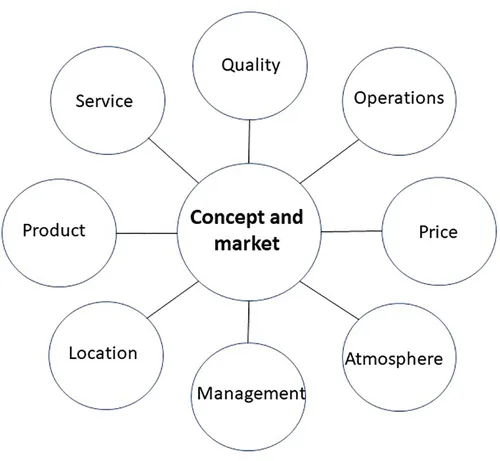
Such a concept must have attributes of a commercial nature as illustrated in Figure 1.1.
Figure1.1 The hospitality concept
As illustrated in Figure 1.1, in hospitality a ‘concept’ normally consists of a service delivered in a purposely designed property, whose quality, atmosphere, service style and content, supported by a specified operation and management in a specific location determine price and define the product.
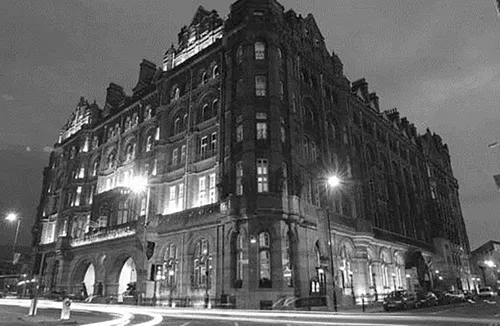
Illustration1.1 Midland Hotel, Manchester: a railway hotel (courtesy of The Paramount Hotel Group)
Historical perspective
From the days of travel by coach and horses, followed by the age of steam trains, to the advent of the car, the aeroplane and now, perhaps, the spacecraft, the hospitality industry has historically been driven by evolution in modes of travel. Coach travel was synonymous with the coaching inn; trains gave rise to the great railway hotels in Europe, the Americas and elsewhere in the world where the great cities were joined by steel rails. Travel then was still a luxury, but Henry Ford changed that forever, with the mass-produced car. Volume production at affordable prices led to volume accommodation at comparative pricing in hotels. Market segmentation focused on differentiation in terms of quality and pricing. By the 1950s, Holiday Inn had opened their first motel, and in the UK, the Automobile Association (AA) introduced its quality star rating system.
Travel by most people, however, was primarily still undertaken within national boundaries. In the 1960s, the growth of the airline industry led to the development of the package holiday with its consequential boom in resort developments in the sunny beach destinations worldwide. Similarly, the post-WWII economic recovery led to an increase in international business travel. The airlines became active in hotel ownership and operations, developing their own international chains in competition with expanding US chains such as Holiday Inns, Hilton and Sheraton. Lufthansa owned Penta Hotels, KLM funded Golden Tulip (now part of NH Hotels) and US carriers expanded Intercontinental Hotels, each country having local national chains, such as Trusthouse Forte and Grand Metropolitan Hotels in the UK, Accor in France, and Scandic in Scandinavia.
At that time, it was to the USA that the world looked for the development of new concepts and operational management systems, not least because of their economic prosperity and widespread internal travel. The 1970s saw development of hotels being increasingly funded by local investors with the recognized hotel companies providing their ‘flag’ and operational management and product standards of their product and access to their distribution systems. Owners then used to sign a management contract and effectively handover their asset for periods up to 25 years for a return from the property’s projected turnover. To increase their expansion in the mid-scale sector, Holiday Inn developed their Franchise agreement, a type of agreement now used by many hotel companies. Essentially it provided the local owner/operator with the right to use their flag (now brand), product standards and operating systems for a royalty fee and a percentage of gross room revenue, there being additional ongoing fees for brand marketing programmes, technology and certain other items.
These hotel products became very standardized to facilitate ease of expansion and operations internationally but essentially were similar in facilities provided to the product content of the hotels built at the turn of the 20th century. These included a range of bedrooms with ensuite bathrooms, reception, conference and banqueting rooms, bars, restaurants and the ubiquitous coffee shop. Designed to be self-sufficient, the back of house facilities included a bakery, butchery, laundry, extensive storage areas and a range of kitchens with their associated preparation and chilled storage areas. With computerization in its infancy, administration processes, while standardized, lacked the centralization of today and, consequently, administration management staff and their facilities were much more extensive than today.
Although the format of standardization was primarily a management tool to control and ease the process of development and operational management, it also offered great reassurance to the guest because it ensured a recognized and consistent standard of service and facilities. These were designed to be similar, or of an aspirational standard, to those experienced at the guest’s home. These standards evolved into the early benefits, of what we now recognize as brand value, identified by the immortal quote from an unnamed hotel guest:
I’m not sure whether I’m in Paris or Berlin, but I’m staying in a Holiday Inn!
Unarguably, for travellers from North America, such product standardization in the 1970s provided added value, as the local alternative products were shrouded in myth. The same standardization approach was applied to the development of package holiday resort hotels and, while many of these properties were developed and managed by local investors, the product content and systems used were cloned from US chains. Many such properties still trade in the older resort destinations with upgraded interior décor but little alteration to their building fabric or range of facilities.
With the increase in wealth in the developed countries and the expansion in internationally based regional offices and manufacturing plants, the hospitality industry enjoyed a boom in development throughout the 1980s. This resulted in an increase in the number of operating companies both on a national and international basis. With increased competition, greater brand name recognition and more effective distribution systems, the industry began to move away from the established quality star rating system and began to explore the potential of market segmentation. Crowne Plaza by Holiday inn and Courtyard by Marriot were early examples of this phenomenon. Simultaneously, product types were developed including airport, all-suite, conferences, health spas, marina, golf and ski hotels. Similarly, resort developments were moving into timeshare multi-ownership and this time saw the creation of destination venues such as theme parks and the other family-based activity parks. Driven by greater consumer wealth and fiercer competition, the demand for continuing growth and return on investment provided the ideal laboratory for commercial innovation. The budget or limited-service product was a classic example. Adapted to suit local conditions internationally, primarily in size, area and number bedrooms per unit, the budget sector witnessed rapid growth and separately provided a new entry level for people for people who had previously only used hotels for vacations rather than short stays.
The Gulf War at the start of the 1990s resulted in a dramatic decline of travel worldwide and, combined with an economic recession for much of the world, the hospitality industry suffered dramatically with low financial performance. Many companies were left unable to service debt and ownership of many hotels fell into the hands of banks and other financial institutions.
Emerging from this challenging period, the industry witnessed a move to consolidation, and the value of brands became a recognized benefit. At the same time some lenders and investors demanded greater transparency and involvement in the supervision of the businesses. Asset and yield management became disciplines through which the owner could manage the manager and, as methods of maximizing the value of individual or groups of hotels. The prevalent attitude of brands, however, was that they required increasing and wider international coverage to be significant players. Improved technology assisted more centralized control and increased the focus on standardization and the depersonalization of the service in the industry. This in turn reduced the demand on staff numbers and skill lev...
Table of contents
Cover
Half Title Page
Title Page
Copyright Page
Table of Contents
List of figures
List of illustrations
List of tables
List of contributors
Foreword
Introduction
Part 1 Concept
Part 2 Planning
Part 3 Construction
Part 4 Operations
Part 5 Asset management
Part 6 Sustainability
Glossary of terms, acronyms and abbreviations
Index
Trusted by 375,005 students
Access to over 1.5 million titles for a fair monthly price.
Study more efficiently using our study tools.
Frequently asked questions
Yes, you can cancel anytime from the Subscription tab in your account settings on the Perlego website. Your subscription will stay active until the end of your current billing period. Learn how to cancel your subscription
No, books cannot be downloaded as external files, such as PDFs, for use outside of Perlego. However, you can download books within the Perlego app for offline reading on mobile or tablet. Learn how to download books offline
Perlego offers two plans: Essential and Complete
Essential is ideal for learners and professionals who enjoy exploring a wide range of subjects. Access the Essential Library with 800,000+ trusted titles and best-sellers across business, personal growth, and the humanities. Includes unlimited reading time and Standard Read Aloud voice.
Complete: Perfect for advanced learners and researchers needing full, unrestricted access. Unlock 1.5M+ books across hundreds of subjects, including academic and specialized titles. The Complete Plan also includes advanced features like Premium Read Aloud and Research Assistant.
Both plans are available with monthly, semester, or annual billing cycles.
We are an online textbook subscription service, where you can get access to an entire online library for less than the price of a single book per month. With over 1.5 million books across 990+ topics, we’ve got you covered! Learn about our mission
Look out for the read-aloud symbol on your next book to see if you can listen to it. The read-aloud tool reads text aloud for you, highlighting the text as it is being read. You can pause it, speed it up and slow it down. Learn more about Read Aloud
Yes! You can use the Perlego app on both iOS and Android devices to read anytime, anywhere — even offline. Perfect for commutes or when you’re on the go. Please note we cannot support devices running on iOS 13 and Android 7 or earlier. Learn more about using the app
Yes, you can access Developing Hospitality Properties and Facilities by Josef Ransley, Hadyn Ingram, Debra Adams, Josef Ransley,Hadyn Ingram,Debra Adams in PDF and/or ePUB format, as well as other popular books in Business & Hospitality, Travel & Tourism Industry. We have over 1.5 million books available in our catalogue for you to explore.